Daoism Foundations · · 11 min read
Who Was Lao Tzu? The Father of Taoism, Wisdom of the Tao Te Ching, and Sacred Altar Traditions
Explore the life, Tao Te Ching wisdom, and sacred altar traditions of Lao Tzu (Laozi). An authoritative guide to Taoist philosophy and cultivation.
By Daoismart Editorial
On this page
- Executive Summary & Key Takeaways
- 1. The Life and Legacy of Lao Tzu: From Royal Archivist to Western Immortal
- The Archivist of the Zhou Dynasty
- The Crossing at Hangu Pass and the Inscription of the Tao Te Ching
- 2. Core Metaphysics of the Tao Te Ching: Cosmic Rhythm and Wu Wei
- The Primordial Dao and the Cosmological Origin
- Wu Wei (无为) and Ziran (自然)
- The Three Cardinal Treasures (San Bao 三宝)
- 3. Philosophical Laozi vs. Liturgical Taishang Laojun: A Lineage Taxonomy
- 4. Consecrated Artifacts and Altar Placement: Honoring Lao Tzu at Home
- Sacred Material Standards for Lao Tzu Statues
- The Consecration Protocol (Kai Guang 开光)
- Essential Altar Feng Shui Guidelines
- 5. Step-by-Step Daily Offering & Meditation Ritual Dedicated to Lao Tzu
- 6. Frequently Asked Questions (FAQ)
- Q1: Did Lao Tzu historically exist, or is he a legendary composite figure?
- Q2: What is the primary difference between philosophical Laozi and religious Taishang Laojun?
- Q3: Can I keep a statue of Lao Tzu on a home altar without formal Taoist ordination?
- Q4: How can one distinguish authentic Taoist sacred artifacts from commercial replicas?
Executive Summary & Key Takeaways
Core Principle: Lao Tzu (historically romanized as Laozi 老子, literally "Old Master") is the venerable progenitor of Taoism (Daoism) and the attributed author of the immortal Tao Te Ching (Daodejing 道德经). Active during China's 6th century BCE Spring and Autumn period, Lao Tzu articulated the metaphysical reality of the Dao (道 - The Way) and the practice of Wu Wei (无为 - Effortless Action). In orthodox religious Taoism (Daojiao 道教), Lao Tzu is revered as Taishang Laojun (太上老君 - The Grand Supreme Elder Lord), one of the supreme Three Pure Ones (Sanqing 三清). Connecting with Lao Tzu blends deep philosophical study with sacred altar cultivation, daily meditation (Zuowang 坐忘), and consecrated ritual artifacts.
1. The Life and Legacy of Lao Tzu: From Royal Archivist to Western Immortal
Few figures in human history bridge the realms of earthly wisdom and mystical transcendence as profoundly as Lao Tzu. Classical chronicles, notably Sima Qian's Records of the Grand Historian (Shiji 史记), record his historical name as Li Er (李耳), with the courtesy name Boyang (伯阳) and posthumous title Dan (聃).
The Archivist of the Zhou Dynasty
Lao Tzu served as the Keeper of the Royal Archives (Shoushi Shi 守藏室史) at the imperial court of the Eastern Zhou dynasty in Luoyang. Immersed in centuries of astronomical charts, divination records, and ritual classics, Lao Tzu observed the relentless rise and fall of political dynasties. He recognized that human suffering stems from compulsive contrivance, prideful intellectualism, and estrangement from cosmic harmony.
When the revered sage Confucius (Kongzi 孔子) visited Luoyang to inquire about ancient ancestral rites, he was deeply overwhelmed by Lao Tzu's boundless perception, famously confessing to his disciples:
"Birds can fly, fish can swim, and beasts can run... but the dragon ascends into Heaven upon the clouds and winds. Today, I have seen Lao Tzu; is he not like the dragon?"
The Crossing at Hangu Pass and the Inscription of the Tao Te Ching
Foreseeing the decline of the Zhou state, Lao Tzu renounced his official robes and departed toward the western frontier riding a gentle water buffalo, as Lao Tzu sought the quiet wilderness. Upon reaching Hangu Pass (函谷关), the border warden Yin Xi (尹喜)—an accomplished astrologer—witnessed a radiant purple vapor billowing from the east (Zi Qi Dong Lai 紫气东来), signaling the arrival of a divine immortal.
Yin Xi knelt by the mountain gate and pleaded with Lao Tzu to transmit his timeless realization before departing into the mountains. In response, Lao Tzu paused to write a compact manuscript of approximately 5,000 Chinese characters divided into two sections: the Book of Dao (Dao Jing 道经) and the Book of Virtue (De Jing 德经). This sacred scroll became universally celebrated as the Tao Te Ching (道德经).
2. Core Metaphysics of the Tao Te Ching: Cosmic Rhythm and Wu Wei
The timeless philosophical system bequeathed by Lao Tzu is neither detached dogmatism nor pessimistic withdrawal. It is a living, functional blueprint for harmonizing human consciousness with the cosmic pulse.
The Primordial Dao and the Cosmological Origin
Chapter 1 of the Tao Te Ching opens with the famous paradox: "The Dao that can be spoken of is not the eternal Dao; the name that can be named is not the eternal name" (道可道非常道,名可名非常名). For Lao Tzu, the Dao is the formless, unconditioned mother of the cosmos. In Chapter 42, Lao Tzu reveals Lao Tzu's cosmic progression that underpins all Taoist energetic medicine, Feng Shui, and altar liturgies:
$\text{Dao (道)} \longrightarrow \text{One (Yi 一)} \longrightarrow \text{Two (Er 二)} \longrightarrow \text{Three (San 三)} \longrightarrow \text{Ten Thousand Things (Wan Wu 万物)}$
- The One (一) represents the primordial undifferentiated Qi (Wuji 无极).
- The Two (二) designates the complementary polarities of Yin and Yang (阴阳).
- The Three (三) embodies the vital interaction of Heaven, Earth, and Humanity (San Cai 三才).
- The Ten Thousand Things (万物) encompass all manifested life and matter in the cosmos.
Wu Wei (无为) and Ziran (自然)
In the sacred teachings of Lao Tzu, central to his philosophy is Wu Wei (无为)—often mistranslated as "doing nothing." In authentic lineage understanding, Wu Wei signifies action without artificial friction, egoic contrivance, or aggressive imposition. Just as water effortlessly navigates rocks and carves massive canyons over time (Shang Shan Ruo Shui 上善若水 - Chapter 8), the cultivator aligns with Ziran (自然 - Spontaneous Self-Nature), achieving profound accomplishment without exhausting their vital breath (Qi 气).
The Three Cardinal Treasures (San Bao 三宝)
In Chapter 67 of the Tao Te Ching, Lao Tzu highlights three indispensable virtues for Lao Tzu disciples for both rulers and spiritual seekers:
- Compassion (*Ci* 慈): Loving-kindness and deep reverence for all living beings, forming an invincible shield of spiritual protection.
- Frugality (*Jian* 俭): Energetic conservation, avoiding wasteful consumption and preserving one's inner spiritual radiance (De 德).
- Humility (*Bu Gan Wei Tian Xia Xian* 不敢为天下先): Refraining from thrusting oneself ahead of others, leading quietly through modest service.
3. Philosophical Laozi vs. Liturgical Taishang Laojun: A Lineage Taxonomy
To comprehend Lao Tzu and the teachings of Lao Tzu fully, one must understand how his presence functions across both the scholarly philosophy of Daojia (道家) and the sacred temple liturgy of Daojiao (道教). Rather than conflicting, these two traditions form an unbroken continuum of wisdom and ritual devotion.
- *Title & Sacred Identity — Philosophical Perspective (Daojia 道家): Laozi (老子), Li Er, The Great Philosopher · Liturgical & Ritual Perspective (Daojiao 道教): Taishang Laojun (太上老君), Daode Tianzun (道德天尊) · Lineage Standard & Artifact Benchmark: Third of the Three Pure Ones (Sanqing* 三清)
- *Canonical Authority — Philosophical Perspective (Daojia 道家): Tao Te Ching (Daodejing 道德经), Zhuangzi · Liturgical & Ritual Perspective (Daojiao 道教): Daozang (道藏), Taishang Laojun Kaitian Lijing · Lineage Standard & Artifact Benchmark*: Orthodox scriptures transmitted across dynasties
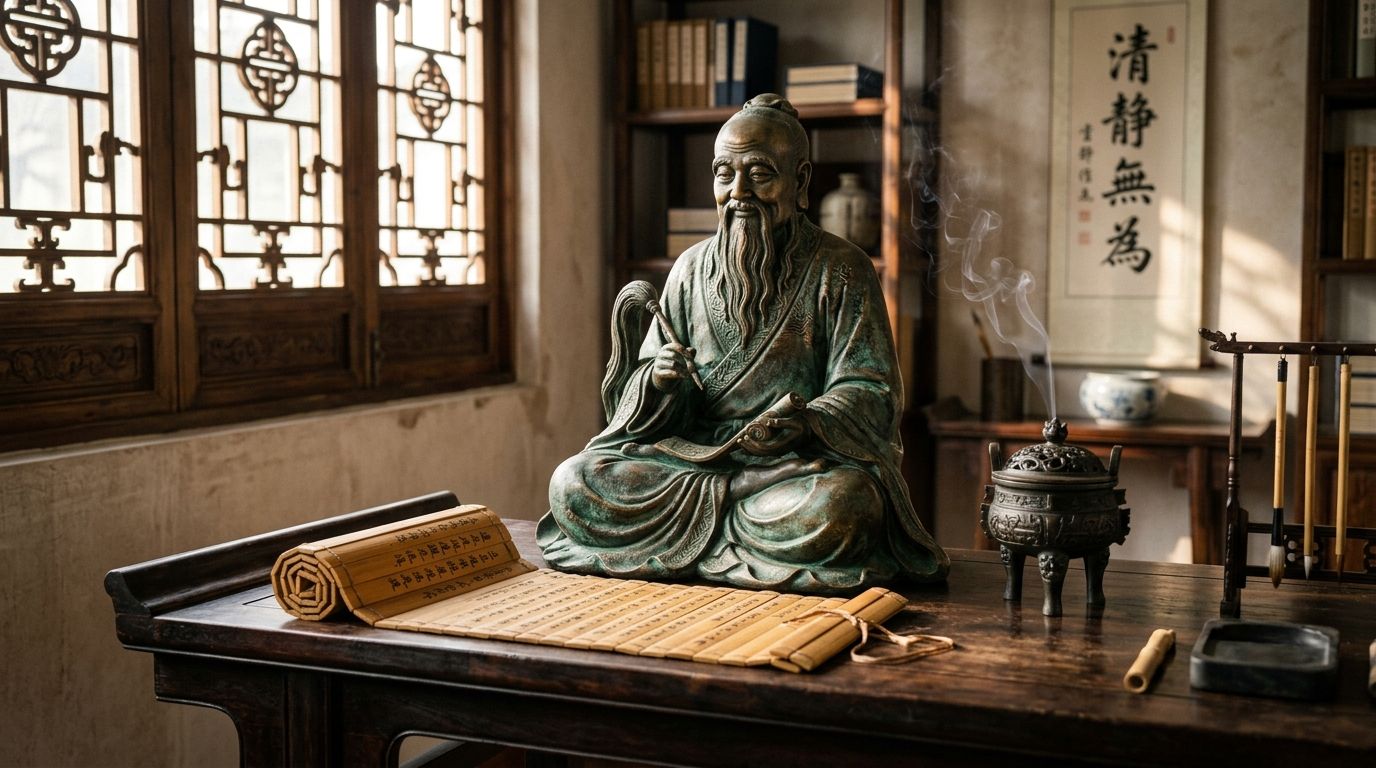
- *Iconographic Representation — Philosophical Perspective (Daojia 道家): Venerable sage seated on water buffalo or reading bamboo slips · Liturgical & Ritual Perspective (Daojiao 道教): Divine sovereign holding the Yin-Yang Taiji fan or fly-whisk · Lineage Standard & Artifact Benchmark*: Hand-cast patinated bronze, solid brass, or lacquered wood
- *Altar Implementation — Philosophical Perspective (Daojia 道家): Scholar desk study, brush stand, incense censer · Liturgical & Ritual Perspective (Daojiao 道教): Consecrated altar (Tan 坛), three water cups, ritual talismans · Lineage Standard & Artifact Benchmark: Consecration (Kai Guang* 开光) with pure mineral cinnabar
- *Core Method of Practice — Philosophical Perspective (Daojia 道家): Intellectual inquiry, ethical simplicity, natural living · Liturgical & Ritual Perspective (Daojiao 道教): Daily morning liturgy, Zuowang meditation, talismanic blessing · Lineage Standard & Artifact Benchmark: Harmonization of Essence, Breath, and Spirit (Jing, Qi, Shen*)
- *Material Integrity Standard — Philosophical Perspective (Daojia 道家): Natural bamboo scrolls, unglazed ceramics · Liturgical & Ritual Perspective (Daojiao 道教): Hand-cast bronze, aged zitan/elm wood, wild sandalwood · Lineage Standard & Artifact Benchmark*: Rejection of synthetic plastics and chemical fragrances
4. Consecrated Artifacts and Altar Placement: Honoring Lao Tzu at Home
In living Taoist practice, enshrining a consecrated statue of Lao Tzu or reciting the verses of Lao Tzu transforms an ordinary living area into a sanctuary of tranquility, anchoring stable Yang Qi throughout the household.
Sacred Material Standards for Lao Tzu Statues
When selecting a sacred altar statue of Lao Tzu (revered as Taishang Laojun by Lao Tzu followers), material integrity is paramount. Authentic sacred arts curators emphasize three noble materials:
- Lost-Wax Cast Bronze (*Tong Xiang* 铜像): Revered since antiquity for its enduring density and capacity to hold spiritual resonance. Authentic bronze statues exhibit subtle artisanal patina, gentle hand-chiseled facial features, and balanced weight. Toxic hollow resin and painted plastics should be strictly avoided.
- Aged Sacred Woods: Sculptures carved from aged camphorwood (Zhang Mu 樟木), ancient cypress, or lightning-struck jujube wood (Lei Ji Zao Mu 雷击枣木) carry natural terrestrial vitality and insect-repelling aromas.
- Cinnabar Inscribed Scrolls (*Zhusha* 朱砂): Displaying an authentic calligraphy scroll of the Tao Te Ching or the Taiji diagram written in pure mineral cinnabar wards off discordant vibrations (Xie Qi 邪气) and inspires daily mindfulness.
The Consecration Protocol (Kai Guang 开光)
In orthodox Zhengyi (正一) and Quanzhen (全真) lineages, an authentic statue of Lao Tzu is transformed from an aesthetic decorative sculpture into a sacred vessel through Kai Guang (开光 - Opening of Light). Performed by lineage Daoist masters, this sacred ceremony entails:
- Purification of the Vessel: Banishing latent impurities using peach wood and water blessed with sacred mantras.
- Internal Sanctification (*Zhuang Zang* 装脏): Placing the Five Sacred Metals (gold, silver, copper, iron, tin), herbal medicines, grains, and miniature scripture scrolls inside the consecrated chamber of the statue.
- Reflecting Celestial Light: Utilizing an antique bronze mirror and cinnabar brush to spiritually awaken the eyes, ears, and heart of the statue, attuning it to the cosmic frequency of Taishang Laojun.
Essential Altar Feng Shui Guidelines
- Directional Orientation: Position the altar facing South (the seat of illuminating Yang energy) or East (the realm of renewal and sunrise).
- Architectural Backing: Ensure the altar table rests firmly against a solid, load-bearing wall (Kao Shan 靠山). Avoid backing against windows or glass walls.
- Environmental Purity: Never position the altar beneath overhead structural beams, directly facing restrooms, or inside noisy entertainment rooms.
5. Step-by-Step Daily Offering & Meditation Ritual Dedicated to Lao Tzu
Honoring Lao Tzu through daily practice requires neither ostentatious spectacle nor dogmatic anxiety. Sincerity (Cheng 诚) and consistency form the bedrock of genuine cultivation. Follow this five-step morning protocol:
- Purification of Hands and Mind: Wash your hands and rinse your mouth with clean water. Take three slow, deep diaphragmatic breaths to discharge external haste and emotional agitation.
- Offering Fresh Water or Tea: Place three small porcelain or brass cups directly before the sacred image of Lao Tzu on the Lao Tzu altar. Fill them with pure spring water or freshly brewed green tea, signifying an unclouded mind and pristine devotion.
- Presenting the Three Sticks of Sacred Incense (*San Zhu Xiang* 三炷香):
- Light three natural incense sticks (aged Laoshan sandalwood or wild agarwood). Never blow on the flame with your breath; extinguish gently with a wave of your hand.
- Hold the incense with both hands at eye level, bowing three times.
- Insert the central stick for the Dao (道 - Cosmic Source), the left stick for the Jing (经 - Sacred Scriptures), and the right stick for the Shi (师 - Master Lao Tzu and Lineage Ancestors).
- Contemplative Recitation of Chapter 16: Read aloud or softly chant Chapter 16 of the Tao Te Ching:
"Attain utmost emptiness; maintain steadfast stillness. While the ten thousand things flourish together, I observe their return." (致虚极,守静笃。万物并作,吾以观复。)
- Silent Seated Cultivation (*Zuowang* 坐忘 / *Jingzuo* 静坐): Sit quietly before the altar for 15 to 20 minutes with a straight spine and relaxed shoulders. Gently place your awareness on the lower Dantien (丹田) below the navel, allowing the aromatic sandalwood smoke to harmonize your breath and calm the mind.
6. Frequently Asked Questions (FAQ)
Q1: Did Lao Tzu historically exist, or is he a legendary composite figure?
Answer: Historical records from Sima Qian's Shiji (Records of the Grand Historian) identify Lao Tzu as Li Er (李耳, courtesy name Boyang 伯阳), a royal archivist of the Eastern Zhou dynasty during the 6th century BCE. While Western academic scholarship acknowledges that the Tao Te Ching in its current form coalesced over several generations of disciples, living Taoist lineage traditions firmly revere Lao Tzu as the singular historical master whose teachings inaugurated classical Taoism.
Q2: What is the primary difference between philosophical Laozi and religious Taishang Laojun?
Answer: Philosophical Taoism (Daojia 道家) approaches Laozi as a profound philosopher who articulated the cosmological principles of the Dao (Way), Ziran (Spontaneity), and Wu Wei (Effortless Action). In orthodox religious Taoism (Daojiao 道教), Lao Tzu is revered in his deified form as Taishang Laojun (太上老君 - The Grand Supreme Elder Lord) or Daode Tianzun (道德天尊), the personification of the cosmic Dao and the third member of the supreme Trinity, the Three Pure Ones (Sanqing 三清).
Q3: Can I keep a statue of Lao Tzu on a home altar without formal Taoist ordination?
Answer: Yes. In authentic Taoist tradition, sincere reverence (Cheng 诚) and moral rectitude (De 德) are the true prerequisites for honoring Lao Tzu. Lay practitioners may respectfully enshrine a consecrated bronze, wood, or ceramic statue of Lao Tzu in a quiet study, library, or meditation room. The primary requirements are maintaining cleanliness, burning pure natural sandalwood or agarwood incense, and approaching the altar with a quieted mind.
Q4: How can one distinguish authentic Taoist sacred artifacts from commercial replicas?
Answer: Authentic Taoist artifacts are crafted from natural, energetically resonant materials: hand-cast solid bronze or brass, seasoned peach wood (Tao Mu 桃木), lightning-struck jujube wood (Lei Ji Zao Mu 雷击枣木), pure mineral cinnabar (Zhusha 朱砂), and wild aged incense woods. Authentic liturgical artifacts undergo traditional consecration (Kai Guang 开光) by lineage masters, infusing them with protective Yang Qi. Commercial replicas are typically cast from synthetic resin, toxic plastics, or scented with artificial chemical oils, lacking energetic vitality.
Authored by the Daoist Cultural Heritage & Sacred Arts Curatorial Guild. All historical chronologies, philosophical passages, and liturgical protocols conform to orthodox Daozang standards.