Daoism Foundations · · 29 min read
What Is the Tao? Cosmic Source, Wu Wei, Living Lineage Wisdom, and Sacred Altar Implements
What is the Tao? Explore the primordial cosmic source, Wu Wei, Wade-Giles history, internal alchemy, and sacred consecrated altar implements.
By Daoismart Editorial
On this page
- What Is the Tao? Cosmic Source, Wu Wei, Living Lineage Wisdom, and Sacred Altar Implements
- 1. The Ineffable Mystery: Deconstructing What Is the Tao in Classical Metaphysics
- The Etymology of the Living Path
- Chang Tao (常道) vs. Ke Tao (可道)
- The Genesis of the Ten Thousand Things
- The Omnipresence in the Zhuangzi: The Tao in Everyday Reality
- 2. Tao vs. Dao: Transliteration History and Global Reception
- The Wade-Giles Legacy
- The Modern Pinyin Standardization
- Reconciling Philosophy (Daojia) and Religion (Daojiao)
- 3. The Three Treasures of the Tao: Cultivation and Cosmology
- Laozi's Ethical Three Treasures
- 4. The Functional Mechanics of the Tao: Wu Wei (无为) and Ziran (自然)
- Ziran (自然): Primordial Spontaneity
- Wu Wei (无为): Demystifying Effortless Action
- The Parable of Cook Ding: The Razor Edge of Harmony
- 5. Somatic Realization: Internal Alchemy (Neidan 内丹) and the Microcosmic Orbit
- The Three Dantians (San Dantian 三丹田)
- 6. The Tao in Tangible Form: Consecrated Sacred Implements (Fawu 法物)
- 1. Lightning-Struck Jujube Wood (Leiji Zaomu 雷击枣木)
- 2. Seven Stars Peachwood Sword (Taomu Jian 桃木剑)
- 3. Pure Natural Mineral Cinnabar (Zhusha 朱砂)
- 7. Lineage Connoisseurship: Authentic Sacred Fawu vs. Tourist Imitations
- 8. The Five-Stage Canonical Rite of Kai Guang (开光, Opening the Light)
- 9. Step-by-Step Daily Practice: A 5-Step Protocol to Embody the Tao
- Step 1: Sanctuary Alignment & Taboo Clearance (Anwei Dingxiang 安位定向)
- Step 2: Dawn Purification of Body and Breath (Jingshen Jingshou 净身净手)
- Step 3: Offering the Three Pure Waters & Sandalwood Incense (Sanxiang Sanquan 三香三泉)
- Step 4: Lower Dantian Tu Na Breathwork with the Ziwu Mudra (Ziwu Jue 子午诀)
- Step 5: Sitting in Oblivion (Zuowang 坐忘) & Scripture Contemplation
- 10. Frequently Asked Questions (FAQ)
- What is the fundamental difference between the spellings 'Tao' and 'Dao'?
- If the Tao is ineffable and cannot be named, how can a human being practically experience what is the Tao?
- Does living in accordance with the Tao require withdrawing from everyday modern society and worldly career?
- Why do Taoist lineage practitioners revere physical altar implements (Fawu) if the Tao is omnipresent?
What Is the Tao? Cosmic Source, Wu Wei, Living Lineage Wisdom, and Sacred Altar Implements
Key Takeaways & Core Principles - The Primordial Cosmic Wellspring: When inquiring what is the Tao (道, historically rendered as Tao and in modern Pinyin as Dao), authentic lineage tradition defines it as the unnamable, self-originating source and eternal underlying rhythm of all existence. Existing prior to Heaven and Earth, the Tao is the boundless cosmic womb from which the universe spontaneously emerges, circulates, and ultimately returns. - Transcendence and Manifestation: The Tao encompasses two inseparable dimensions: the formless, unnamable void (Wuji 无极 / Chang Tao 常道) and the cyclical reality of physical existence (Taiji 太极), orchestrated through the dynamic interaction of Yin and Yang (Yin-Yang 阴阳). - Linguistic Clarification (Tao vs. Dao): The spelling Tao originates from the 19th-century Wade-Giles romanization system that popularized Eastern philosophy in the Western world, whereas Dao is the modern Hanyu Pinyin standard. Both represent the identical Chinese character 道, signifying both the ultimate cosmic headspring and the living path of self-cultivation. - Effortless Action (Wu Wei 无为): Aligning with the Tao never implies passive inertia or fatalism; it demands non-coercive, frictionless action (Wu Wei 无为) that moves in rhythm with natural timing rather than ego-driven force. - Somatic Cultivation (Neidan 内丹): Living the Tao is an embodied, experiential practice. Through breathwork (Tu Na 吐纳) and circulating internal energy (Qi 炁) through the Three Dantians (San Dantian 三丹田), the cultivator refines coarse essence into spiritual illumination. - Sacred Consecrated Implements (Fawu 法物): In orthodox lineage metaphysics, vital breath condenses into physical matter (Qi Ning Wei Wu 炁凝为物). Canonical implements—including lightning-struck jujube wood seals (Leiji Zaomu Yin 雷击枣木印), wild peachwood Seven Stars swords (Taomu Jian 桃木剑), and crystalline mineral cinnabar (Zhusha 朱砂)—serve as consecrated physical anchors that harmonize domestic Qi and focus meditative consciousness.
1. The Ineffable Mystery: Deconstructing What Is the Tao in Classical Metaphysics
For thousands of years, seekers, philosophers, and contemplative practitioners have pondered the ultimate question: what is the Tao? In the very first line of the foundational Daodejing (道德经), the ancient master Laozi (老子) immediately dismantles human intellectual pride by asserting that the supreme reality of the cosmos defies rigid linguistic boundaries:
$\text{“The Tao that can be spoken is not the eternal Tao; The name that can be named is not the eternal name.”}$
$\text{(道可道,非常道;名可名,非常名。)}$
The Etymology of the Living Path
In classical Chinese calligraphy, the character Tao (道) is a composite ideological graph constructed from two ancient roots:
- Chuo (辶): Depicting a foot stepping forward, symbolizing walking, movement, progression, and the unfolding journey.
- Shou (首): Depicting a human head or crown, symbolizing the primary source, the supreme leader, consciousness, and origin.
Thus, the glyph itself reveals the unified nature of what is the Tao: it is simultaneously the primordial headspring of all being and the dynamic, ongoing path upon which life journeys. The Tao is never static; it is an eternal, living process of unfolding and returning.
Chang Tao (常道) vs. Ke Tao (可道)
Laozi draws a vital philosophical distinction between two expressions of reality:
- Chang Tao (常道, The Eternal, Unchanging Tao): The immutable, transcendent ground of all being that existed before the dawn of galaxies, stars, and planetary spheres. It cannot be heard by mortal ears, seen by human eyes, or measured by mechanical instruments.
- Ke Tao (可道, The Manifest, Perceptible Tao): The dynamic, experiential movements of the Tao throughout the perceptible universe—the seasonal transitions from autumn harvest to winter dormancy, the spiraling orbits of celestial constellations, the cyclical flow of water down high mountain valleys, and the rhythmic inhalation and exhalation of vital breath within living creatures.
In Chapter 25 of the Daodejing, Laozi paints an awe-inspiring portrait of this cosmic mystery:
"There is a thing nebulously formed, born before Heaven and Earth. Silent and void, standing alone and unchanging, revolving everywhere without exhaustion. It may be regarded as the Mother of all under Heaven. I do not know its name; I style it 'Tao.' If forced to give it a name, I call it 'Great' (Da 大)."
The Genesis of the Ten Thousand Things
In Chapter 42 of the Daodejing, the architecture of cosmic genesis is laid out with pristine mathematical elegance:
$\text{“The Tao gives birth to One; One gives birth to Two; Two gives birth to Three; Three gives birth to the ten thousand things.”}$
$\text{(道生一,一生二,二生三,三生万物。)}$
- The Tao (道) is the primordial Wuji (无极)—the absolute, undifferentiated potential.
- The One (一) is Taiji (太极) and the primordial cosmic breath (Yuanqi 元炁), the initial awakening of movement within stillness.
- The Two (二) represents the twin polar forces of Yin (阴) and Yang (阳)—expansion and contraction, light and shadow, heat and coolness.
- The Three (三) represents the harmonious interplay of Yin and Yang producing the interactive breath (Chongqi 冲气).
- The Ten Thousand Things (万物, Wanwu) represent all manifest life: the oceans, mountains, trees, insects, minerals, humans, and stars.
The Omnipresence in the Zhuangzi: The Tao in Everyday Reality
While Western theology historically viewed the divine as elevated in distant celestial realms separated from profane matter, Taoism emphasizes the radical immanence of the Tao.
In the Zhuangzi (庄子), in the classical chapter Knowledge Wanders North (Zhi Bei You 知北游), the scholar Dongguozi approaches Master Zhuangzi and asks:
"Where is this thing you call the Tao?" Zhuangzi replied calmly: "There is nowhere it does not reside." Dongguozi urged: "Specify a concrete place so I may understand." "It is in the ant," Zhuangzi stated. "Can it be lower than that?" "It is in the common weed in the field." "Can it go still lower?" "It is in the broken tile and the pottery shard." "Can it descend to the lowest place of all?" "It is in the animal dung and urine."
Dongguozi fell silent in astonishment. Zhuangzi explained that the Tao is not an exclusive spiritual privilege reserved for elite temples. It is the inescapable substrate of all physical reality. Every atom, blade of grass, and breath of mountain air vibrates with the living pulse of the Tao.
2. Tao vs. Dao: Transliteration History and Global Reception
A frequent source of confusion for international readers seeking to understand what is the Tao is the dual spelling: Tao versus Dao. To resolve this apparent divergence, one must examine the history of Chinese phonetics and sinological translation:
The Wade-Giles Legacy
In the mid-19th century, British diplomat Sir Thomas Wade formulated a romanization system for Mandarin Chinese, later modified by Cambridge professor Herbert Giles in 1892. In Wade-Giles romanization:
- The unaspirated voiceless alveolar plosive [t] was transcribed as "t".
- The aspirated plosive [tʰ] was transcribed with an apostrophe as "t'".
Thus, the Chinese character 道 was written as "Tao", while an aspirated character like 套 was written as "T'ao".
Because early landmark English translations by James Legge, Arthur Waley, and Lin Yutang utilized Wade-Giles, the word "Tao" became deeply rooted in Western literature and popular culture. Landmark 20th-century books—such as Fritjof Capra’s The Tao of Physics (1975) and Benjamin Hoff’s The Tao of Pooh (1982)—cemented the spelling into the global consciousness.
The Modern Pinyin Standardization
In 1958, the Chinese government promulgated the Hanyu Pinyin (汉语拼音) system, which was subsequently adopted by the International Organization for Standardization (ISO) in 1982 and the United Nations. Under Pinyin:
- The unaspirated sound is represented by the letter "d" (as in Dao).
- The aspirated sound is represented by the letter "t" (as in Tao).
While contemporary academic discourse and sinological publications predominantly employ "Dao" and "Daoism," millions of spiritual practitioners, martial artists, and readers worldwide continue to search for and resonate with "Tao" and "Taoism."
Reconciling Philosophy (Daojia) and Religion (Daojiao)
In the 20th century, a common Western misconception arose suggesting that there are two disconnected Taoisms: a pristine, intellectual "philosophical Taoism" (Daojia 道家) and a superstitious, ritualized "religious Taoism" (Daojiao 道教).
Authentic lineage masters reject this artificial division. In Chinese cultural history, Daojia and Daojiao represent the roots and branches of a single living organism:
- Daojia (道家) provides the metaphysical and philosophical framework (the cosmology of Laozi, Zhuangzi, and the canonical scriptures).
- Daojiao (道教) provides the practical technologies and liturgical vehicles (internal alchemy, consecrated implements, breathwork, rituals, and seasonal ceremonies) through which that lofty philosophy is embodied, experienced, and grounded in physical human life.
3. The Three Treasures of the Tao: Cultivation and Cosmology
To understand what is the Tao in active practice, one must study the Three Treasures (Sanbao 三宝), which function across three distinct cosmological and practical dimensions:
Laozi's Ethical Three Treasures
In Chapter 67 of the Daodejing, Laozi reveals the three protective virtues that preserve human life amidst worldly chaos:
"I have three treasures that I hold and prize: The first is Compassion (Ci 慈); The second is Frugality (Jian 俭); The third is Daring not to stand before all under Heaven (Bugan Wei Tianxia Xian 不敢为天下先). From compassion comes courage; From frugality comes generosity; From refusing to stand before all comes enduring leadership."
- Ci (慈, Compassion): Not sentimental pity, but an unconditional, maternal tenderness toward all living forms. In classical Taoism, compassion is the ultimate protective shield; a warrior armed with compassion is invincible because their actions align with Heaven’s nourishing intent.
- Jian (俭, Frugality / Moderation): The deliberate conservation of one’s vital energies, words, desires, and material acquisitions. By refusing to waste physiological and mental energy on frivolous pursuits, the cultivator stores up vital reserves.
- Bugan Wei Tianxia Xian (不敢为天下先, Sacred Humility): Yielding the spotlight, avoiding vanity, and leading by supporting others from behind. Just as the great ocean lies below all mountain streams and thereby becomes the king of all waters, the Taoist sage stays low, centered, and peaceful.
4. The Functional Mechanics of the Tao: Wu Wei (无为) and Ziran (自然)
Living the Tao is governed by two master principles that bridge cosmic reality with human action: Ziran (自然) and Wu Wei (无为).
Ziran (自然): Primordial Spontaneity
In modern Chinese, Ziran translates as "nature." In classical metaphysics, however, it carries a vastly more profound meaning:
- Zi (自): Self, spontaneous, intrinsic.
- Ran (然): So, as it is, in this manner.
Thus, Ziran (自然) signifies “that which is of itself so”—pure, unforced, self-generating existence.
When Laozi declares in Chapter 25 that “Dao Fa Ziran” (道法自然), he is articulating the ultimate cosmic hierarchy:
- Humanity models Earth (Ren Fa Di 人法地).
- Earth models Heaven (Di Fa Tian 地法天).
- Heaven models the Tao (Tian Fa Dao 天法道).
- The Tao models Spontaneity (Dao Fa Ziran 道法自然).
The Tao has no external commander, legal manual, or bureaucratic supervisor. It acts purely out of its own organic, spontaneous nature. When a practitioner embodies Ziran, they drop artificial social posturing, pretentious vanity, and calculated neuroses, returning to their authentic, uncarved spiritual integrity (Pu 朴).
Wu Wei (无为): Demystifying Effortless Action
No term in Eastern thought has been more consistently misunderstood by Western audiences than Wu Wei (无为). Popular culture frequently equates it with lethargy, apathy, fatalism, or lazy non-action.
In authentic Taoist lineages, Wu Wei does not mean doing nothing. The character Wei (为) denotes contrived, artificial, aggressive forcing against the natural grain. The character Wu (无) signifies the absence of such contrivance.
Therefore, Wu Wei represents “non-coercive action”, “effortless mastery”, or “action in accordance with natural timing.”
Consider the master timber artisan: an amateur hacks aggressively across the grain of a seasoned log with brute force, dulling their chisel and splintering the wood. The master artisan inspects the lumber, reads the invisible pathways of the grain, and slides the blade effortlessly along the natural contours of the wood. The master accomplishes ten times the work with one-tenth the physical exertion. That is Wu Wei.
The Parable of Cook Ding: The Razor Edge of Harmony
In Chapter 3 of the Zhuangzi, Master Zhuangzi illustrates Wu Wei through the legendary story of Cook Ding (庖丁解牛) butchering an ox for Lord Wenhui:
Cook Ding's hands moved with such grace, his shoulders yielded with such rhythm, and his feet stepped with such cadence that his work resembled a sacred ceremonial dance. The meat fell away from bone with a whisper. Lord Wenhui exclaimed in awe: "Splendid! Can skill really reach such heights?" Cook Ding set down his knife and replied: "What I love is the Tao, which goes beyond mere skill. When I first began cutting up oxen, all I could see was the whole ox. After three years, I no longer saw the whole ox. And now, I encounter it with spirit rather than my physical eyes. Perception and understanding cease, and the spirit moves where it wills. I follow the natural structural openings, sliding through the great hollows, guiding the blade through the vast cavities. I never touch a ligament or tendon, let alone a major bone. A mediocre cook changes their knife every month because they hack; a skilled cook changes their knife every year because they cut. But I have used this knife for nineteen years, butchering thousands of oxen, yet the blade remains as sharp as if it had just come from the whetstone. Between the joints there are spaces, and the edge of the knife has no thickness. When you insert that which has no thickness into that which has space, there is ample room for the blade to play!"
5. Somatic Realization: Internal Alchemy (Neidan 内丹) and the Microcosmic Orbit
True understanding of what is the Tao cannot remain an intellectual abstraction. In orthodox Taoism, the human body is recognized as a living temple and an exact energetic mirror of the universe (Tian Ren He Yi 天人合一, The Unity of Heaven and Humanity).
The Three Dantians (San Dantian 三丹田)
Within internal alchemy (Neidan 内丹), the cultivator refines the coarse dimensions of life into refined spiritual awareness:
- Lower Dantian (下丹田, Xia Dantian): The root battery situated in the lower abdomen. It stores reproductive essence, somatic vitality, and foundational Jing (精).
- Middle Dantian (中丹田, Zhong Dantian): Located at the solar plexus and heart region. It governs emotional coherence, circulating refined Qi (炁) through the twelve primary meridians.
- Upper Dantian (上丹田, Shang Dantian): Located in the center of the brain behind the brow point. It governs spiritual illumination, clear discernment, and divine consciousness (Shen 神).
The transformative formula of internal alchemy is summarized in the ancient four-phrase dictum:
- Refine Essence into Vital Breath (Lian Jing Hua Qi 炼精化炁)
- Refine Vital Breath into Spirit (Lian Qi Hua Shen 炼炁化神)
- Refine Spirit into Emptiness (Lian Shen Huan Xu 炼神还虚)
- Refine Emptiness to Unite with the Tao (Lian Xu He Dao 炼虚合道)
6. The Tao in Tangible Form: Consecrated Sacred Implements (Fawu 法物)
A widespread misunderstanding among modern Western readers is the assumption that because the Tao is formless and silent, physical material objects are irrelevant to Taoist spirituality.
In orthodox lineage cosmology, however, physical matter is recognized as condensed vital energy:
$\text{“When vital breath condenses, it forms physical matter; when it disperses, it returns to the formless void.”}$
$\text{(炁聚为物,炁散为虚。)}$
Physical matter and spiritual energy are two ends of a single vibrational spectrum. Consecrated sacred implements (Fawu 法物) are specialized energetic instruments crafted from organic materials that naturally absorb, concentrate, and radiate celestial Yang Qi into human living spaces:
1. Lightning-Struck Jujube Wood (Leiji Zaomu 雷击枣木)
In Taoist sacred lore, no botanical substance carries greater cosmic potency than high-mountain jujube timber struck by natural cloud-to-ground lightning. In a single microsecond, tens of thousands of volts of celestial atmospheric electricity strike the dense, slow-growing grain of the wild jujube tree.
Known as Leiji Zaomu (雷击枣木), this timber embodies the instantaneous marriage of Heaven's pure Yang Fire and Earth’s nourishing Yin Wood. When hand-carved into lineage master seals—such as the Yangping Zhidugong Seal (阳平治都功印) of the Celestial Masters—the implement acts as a permanent energetic battery that dispels low-vibrational domestic discord.
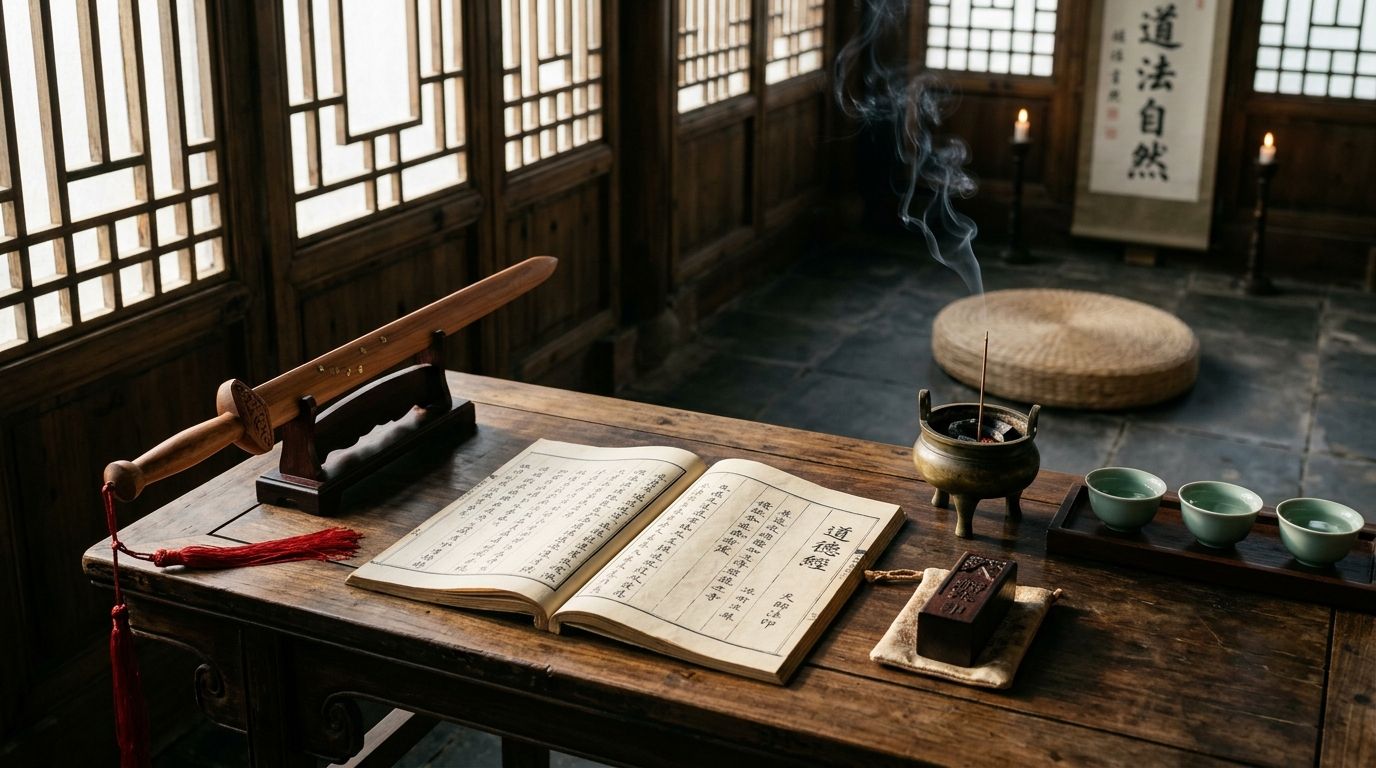
2. Seven Stars Peachwood Sword (Taomu Jian 桃木剑)
Carved from seasoned mountain peach heartwood, the Taomu Jian (桃木剑) is inlaid with polished brass representations of the seven stars of the Big Dipper (Beidou Qixing 北斗七星).
In Chinese traditional metaphysics, peachwood is classified as solar timber that naturally dissolves stagnant, heavy Yin energy. Unlike metallic weapons designed for physical combat, the Taoist wooden sword is an energetic instrument. Displayed with dignity on an altar or scholar’s desk, it creates a coherent geometric vortex of protective Qi, dispelling emotional turbulence and nightmares.
3. Pure Natural Mineral Cinnabar (Zhusha 朱砂)
For over three millennia, Taoist priests have used natural crystalline mineral cinnabar (Zhusha 朱砂)—natural mercuric sulfide formed under intense geothermal heat and pressure deep within tectonic faults. Possessing extraordinary physical density and a brilliant vermilion hue, genuine cinnabar is recognized as the supreme mineral conductor of Yang Fire energy on the planet.
When writing sacred paper talismans (Fu Lu 符箓) or conducting consecration rituals, pure mineral cinnabar powder is blended with consecrated well water. It serves as an indelible energetic ink that charges the calligraphy with enduring spiritual frequency.
7. Lineage Connoisseurship: Authentic Sacred Fawu vs. Tourist Imitations
A sincere student of the Tao approaches physical implements with uncompromising discernment. An object molded from synthetic plastic or chemically dyed scrap wood carries chaotic, dead frequencies that pollute an altar space.
To assist international practitioners, the structured comparative matrix below details the empirical and energetic differences between genuine canonical Fawu and cheap commercial souvenirs:
- Lightning-Struck Jujube Wood (Leiji Zaomu 雷击枣木) — Authentic Lineage Fawu (正统法物): Harvested from wild mountain ridge trees struck by atmospheric lightning; natural burn fissures; dense, heavy grain; sinks in water; emits a warm, toasted amber scent when rubbed. · Commercial Tourist Imitation (工业仿品): Common low-grade plantation pine or chemically compressed fiberboard; artificially charred with blowtorches; floats easily on water; emits an acrid chemical solvent odor. · Energetic & Material Signature: High Yang Density: Creates an immediate calming, grounded sensation in the solar plexus during meditation.
- Mountain Peachwood Sword (Taomu Jian 桃木剑) — Authentic Lineage Fawu (正统法物): Wild mountain timber seasoned naturally across 3+ dry winters; warm honey-amber tone; hand-inlaid brass Big Dipper stars; smooth tactile warmth with natural grain variation. · Commercial Tourist Imitation (工业仿品): Rapid-growth orchard softwood; dipped in thick red polyurethane industrial paint; brittle, prone to warping; glued-on plastic or printed foil dots. · Energetic & Material Signature: Spatial Coherence: Purifies room acoustics, cuts through mental fog, and dissolves lingering emotional stagnation.
- Pure Mineral Cinnabar (Zhusha 朱砂) — Authentic Lineage Fawu (正统法物): Mined crystalline mercuric sulfide mineral; remarkably heavy in the hand; cool to the initial touch; displays an authentic sparkling crystalline micro-structure. · Commercial Tourist Imitation (工业仿品): Synthetic red lead-oxide paint or red acrylic pigment mixed with common talcum powder; lightweight; greasy chalk residue that rubs off on paper; fades rapidly. · Energetic & Material Signature: Solar Yang Fire: Radiates intense grounding heat; acts as an energetic conductor for talismanic scripts.
- Sacred Temple Incense (Tanxiang & Jiangzhen) — Authentic Lineage Fawu (正统法物): Wild aged sandalwood (Laoshan Tanxiang) and natural Jiangzhen resin with pure natural sticky-bark plant binder; silky, semi-translucent smoke; sweet, deeply relaxing natural aroma. · Commercial Tourist Imitation (工业仿品): Industrial sawdust scented with cheap synthetic fragrance oils and petroleum burn accelerators; thick, acrid black or grey smoke that irritates eyes, nose, and throat. · Energetic & Material Signature: Atmospheric Bridge: Calms beta brainwaves into meditative alpha states; clears spatial stale Qi.
- Altar Bronze Censer (Tong Xianglu 铜香炉) — Authentic Lineage Fawu (正统法物): Heavy, solid cast bronze; hand-burnished with a natural warm patina; produces a clear, resonant bell-like acoustic tone when tapped; distributes heat evenly and safely. · Commercial Tourist Imitation (工业仿品): Lightweight stamped sheet metal or zinc alloy sprayed with brass metallic paint; dull, flat hollow thud when tapped; paint blisters and emits toxic fumes when charcoal burns hot. · Energetic & Material Signature: Earth-Metal Resonance: Anchors domestic altar Qi; acts as the sacred cauldron for prayers and offerings.
8. The Five-Stage Canonical Rite of Kai Guang (开光, Opening the Light)
Even an implement carved from the finest lightning-struck timber remains merely an inert piece of wood until it undergoes the orthodox lineage ceremony of Kai Guang (开光, Opening the Light) performed by an ordained Taoist priest (Daoshi 道士):
Without authentic Kai Guang, an implement is merely an artistic curiosity; with canonical Kai Guang, it becomes an empowered, living spiritual vessel connected directly to the lineage stream of the Tao.
9. Step-by-Step Daily Practice: A 5-Step Protocol to Embody the Tao
To transition from contemplating what is the Tao to living it directly, sincere cultivators maintain a structured morning routine. Follow this authentic five-step lineage protocol to anchor cosmic balance into your home:
Step 1: Sanctuary Alignment & Taboo Clearance (Anwei Dingxiang 安位定向)
- Solid Support (Kaoshan 靠山): Position your sacred altar table or meditation space against a solid interior wall of brick, stone, or hardwood. Never position an altar floating in the center of a room or backed by a fragile glass window.
- Directional Orientation: Whenever possible, face your altar toward the East to receive the rising purple dawn energy (Ziqi Donglai 紫气东来), or toward the primary entrance of the room.
- Spatial Taboos: Ensure the altar is not located inside a master bedroom where couples sleep, never shares a wall with a bathroom plumbing pipe, is never positioned under exposed overhead structural beams, and is never used as a casual table for meat or alcoholic beverages.
Step 2: Dawn Purification of Body and Breath (Jingshen Jingshou 净身净手)
- Practice during the Mao Hour (卯时, 5:00 AM – 7:00 AM), the sacred daily window when the Earth's Yang Qi awakens and begins its ascent.
- Wash your hands and face thoroughly with cool spring or filtered water.
- Rinse your mouth to purify speech before approaching the sacred space.
- Dress in loose, comfortable clothing made of natural fibers (unbleached cotton or linen) and take three deep, slow abdominal breaths to clear residual lethargy.
Step 3: Offering the Three Pure Waters & Sandalwood Incense (Sanxiang Sanquan 三香三泉)
- Place three celadon porcelain offering cups in a straight line on your altar:
- Center Cup: Represents the Tao (道宝) and Yuanshi Tianzun.
- Left Cup (Observer's Left): Represents the Scriptures (经宝) and Lingbao Tianzun.
- Right Cup (Observer's Right): Represents the Lineage Masters (师宝) and Daode Tianzun (Laozi).
- Fill each cup with pure fresh water.
- Light three sticks of natural aged sandalwood (Laoshan Tanxiang) or Jiangzhen incense.
- Never blow out the flame with your mouth; human breath is regarded as turbid and disrespectful. Gently wave your hand through the air to extinguish the flame.
- Raise the incense to forehead level, bow respectfully, and insert the sticks into your bronze censer:
- Insert the center stick first, dedicating yourself to the Tao.
- Insert the left stick second, honoring the sacred scriptures.
- Insert the right stick third, showing gratitude to the lineage masters.
Step 4: Lower Dantian Tu Na Breathwork with the Ziwu Mudra (Ziwu Jue 子午诀)
- Sit comfortably on a round woven rush cushion (Putuan) with an upright, relaxed spine.
- Form the ancient Ziwu Hand Mudra (子午诀):
- Place your right thumb inside the right palm and wrap your right fingers around it.
- Enfold the right hand within the left palm, resting your left thumb on the base of the left ring finger (the Zi 子 position, midnight water Yin) and the right thumb on the middle fingertip (the Wu 午 position, midday fire Yang).
- Rest the mudra gently at your lower abdomen, sealing your internal bio-electrical circuit.
- Inhale slowly and silently through the nose, feeling the lower abdomen expand outward like a balloon, drawing the breath down into the Lower Dantian (下丹田).
- Exhale gently and completely, feeling the abdomen contract toward the spine. Perform this circular breathing for 12 complete breath cycles.
Step 5: Sitting in Oblivion (Zuowang 坐忘) & Scripture Contemplation
- Release all mental calculations, professional worries, and emotional clingings.
- Practice Zuowang (坐忘, Sitting in Oblivion): Allow your thoughts to arise and dissipate like clouds passing across an open blue sky, without clinging or resisting.
- Conclude by reading aloud or contemplating a single passage from Chapter 1 or Chapter 25 of the Daodejing, letting the silent wisdom of the Tao saturate your consciousness before stepping forth into your daily activities.
10. Frequently Asked Questions (FAQ)
What is the fundamental difference between the spellings 'Tao' and 'Dao'?
Linguistically and philosophically, 'Tao' and 'Dao' refer to the exact same Chinese character: 道. The variation exists solely because of differing Western romanization systems. 'Tao' stems from the 19th-century Wade-Giles system developed by British sinologists Sir Thomas Wade and Herbert Giles, which entered the global lexicon through classic 20th-century translations of the Tao Te Ching and popular philosophical literature. 'Dao' is the official modern Hanyu Pinyin system adopted by mainland China and international academic bodies in the late 20th century. While Pinyin represents Mandarin phonetics more accurately to linguists, both terms designate the identical primordial, unnamable cosmic mother and living spiritual path.
If the Tao is ineffable and cannot be named, how can a human being practically experience what is the Tao?
While Chapter 1 of the Daodejing declares that the primordial Tao (常道, Chang Tao) transcends intellectual and linguistic definitions, it is not distant or abstract. In authentic Taoist tradition, the Tao is experienced directly through experiential embodiment rather than dogmatic speculation. Cultivators experience the Tao by aligning with Ziran (自然, natural spontaneity), cultivating Wu Wei (无为, effortless, non-forcing action), practicing Tu Na (吐纳) diaphragmatic breathwork, and refining vital energy (炁, Qi) across the Three Dantians. By quieting mental chatter in seated stillness (坐忘, Zuowang), one directly observes and participates in the living flow of the Tao.
Does living in accordance with the Tao require withdrawing from everyday modern society and worldly career?
No. While hermit recluses exist in Taoist history, classical and orthodox lineages emphasize that true spiritual cultivation occurs directly within ordinary daily life. This is encapsulated in the ancient Taoist maxim: "Minor hermits conceal themselves in wild mountains; major hermits harmonize within bustling marketplaces" (小隐隐于野,大隐隐于市). Living the Tao does not demand abandoning one's family, profession, or ambitions; rather, it transforms how one engages with them. By operating from centered clarity, conserving energetic reserves through simplicity, and responding to workplace or personal challenges with the yielding resilience of water, one embodies the Tao amidst modern complexities.
Why do Taoist lineage practitioners revere physical altar implements (Fawu) if the Tao is omnipresent?
In orthodox Taoist cosmology, the visible universe is condensed primordial energy (炁凝为物, Qi Ning Wei Wu). Physical sacred implements (法物, Fawu)—such as lightning-struck jujube wood seals, mountain peachwood Seven Stars swords, and natural mineral cinnabar—are crafted from organic materials that naturally store concentrated celestial and solar Yang Qi. When consecrated through canonical Kai Guang (开光) rituals, these implements act as energetic anchors and geometric focal points. They clear domestic energetic turbulence, protect the practitioner's field during meditation, and bridge mortal consciousness with the subtle frequency of the Tao.