Daoism Foundations · · 27 min read
What Is the Dao? The Cosmic Source, Wu Wei, Confucian Contrasts, and Sacred Implements in Living Taoism
What is the Dao? Discover the primordial cosmic source, Wu Wei, philosophical contrasts with Confucianism, and sacred altar implements in Taoism.
By Daoismart Editorial
On this page
- What Is the Dao? The Cosmic Source, Wu Wei, Confucian Contrasts, and Sacred Implements in Living Taoism
- 1. The Ineffable Origin: Deconstructing What Is the Dao in Classical Taoism
- Chang Dao (常道) vs. Ke Dao (可道)
- The Cosmic Genesis: From the Dao to the Ten Thousand Things
- Omnipresence in the Zhuangzi: The Dao in the Ant and the Clay Shard
- 2. The Great Philosophical Dialogue: Daoism vs. Confucianism
- The Legendary Meeting: Confucius Inquires of Laozi Regarding the Rites
- The Confucian Dao: The Cultivated Way of Moral Humanity (Ren Dao 人道)
- The Daoist Critique: Cosmic Spontaneity over Artificial Virtue
- The Historical Synthesis: Confucian on the Outside, Daoist on the Inside
- 3. Systematic Comparison Matrix: The Dao in Daoism vs. Confucianism
- 4. The Functional Mechanics of the Dao: Wu Wei (无为) and Ziran (自然)
- Ziran (自然): The Primordial Principle of Spontaneity
- Wu Wei (无为): Demystifying Effortless Action
- The Supreme Metaphor: The Living Wisdom of Water (Shui 水)
- 5. The Dao in Tangible Form: Consecrated Sacred Implements (Fawu 法物)
- 1. Lightning-Struck Jujube Wood (Leiji Zaomu 雷击枣木)
- 2. Seven Stars Peachwood Sword (Taomu Jian 桃木剑)
- 3. Natural Crystalline Cinnabar (Zhusha 朱砂)
- 6. Connoisseurship: Genuine Lineage Fawu vs. Industrial Souvenirs
- 7. The Five-Stage Canonical Rite of Kai Guang (开光, Opening the Light)
- 8. Step-by-Step Daily Practice: A 5-Step Protocol to Attune to the Dao
- Step 1: Sanctuary Alignment & Taboo Clearance (Anwei Dingxiang 安位定向)
- Step 2: Dawn Purification of Body and Breath (Jingshen Jingshou 净身净手)
- Step 3: Offering the Three Pure Waters & Sandalwood Incense (Sanxiang Sanquan 三香三泉)
- Step 4: Lower Dantian Tu Na Breathwork with the Ziwu Mudra (Ziwu Jue 子午诀)
- Step 5: Sitting in Oblivion (Zuowang 坐忘) & Scripture Contemplation
- 9. Frequently Asked Questions (FAQ)
- If the Dao cannot be named or defined, how can a human being understand what is the Dao?
- What is the primary difference between the Dao in Daoism and the Dao in Confucianism?
- Does living in accordance with the Dao mean one should be completely passive or give up ambition?
- How do physical sacred implements (Fawu) assist a practitioner in connecting with the formless Dao?
What Is the Dao? The Cosmic Source, Wu Wei, Confucian Contrasts, and Sacred Implements in Living Taoism
Key Takeaways & Core Principles - The Primordial Source: When exploring what is the Dao (道, often spelled Tao), orthodox Taoist lineage tradition defines it as the ineffable, unnamable cosmic source and underlying rhythm of all existence. Existing prior to Heaven and Earth, the Dao is the boundless womb from which the universe spontaneously emerges, circulates, and ultimately returns. - The Ineffable and the Manifest: The Dao possesses two inseparable dimensions: the formless, unnamable transcendent ground (Wuji 无极 / Chang Dao 常道) and the vibrant, cyclical manifestation of life (Taiji 太极) orchestrated through the dynamic dance of Yin and Yang (Yin-Yang 阴阳). - Daoism vs. Confucianism: While both traditions venerate the Dao, Confucianism interprets the Dao as the moral and social order of humanity (Ren Dao 人道), grounded in ritual propriety (Li 礼) and benevolence (Ren 仁). In contrast, Taoism approaches the Dao as the primordial cosmic law (Tian Dao 天道 / Da Dao 大道), asserting that artificial human moralizing pales before organic cosmic spontaneity (Dao Fa Ziran 道法自然). - The Art of Effortless Action (Wu Wei 无为): Aligning with the Dao does not require passive detachment; it demands non-coercive, frictionless action (Wu Wei 无为) that moves organically with natural timing rather than egoic force. - Tangible Anchors of the Dao (Fawu 法物): The formless Dao condenses into sacred physical matter. Lineage implements—such as lightning-struck jujube wood seals (Leiji Zaomu Yin 雷击枣木印), wild mountain peachwood swords (Taomu Jian 桃木剑), and natural mineral cinnabar (Zhusha 朱砂)—serve as consecrated physical anchors that harmonize spatial Qi and focus meditative consciousness. - Canonical Consecration (Kai Guang 开光): Genuine sacred implements are empowered through orthodox five-stage lineage consecration rites, infusing physical objects with celestial resonance and internal breath (Zhu Qi 注炁).
1. The Ineffable Origin: Deconstructing What Is the Dao in Classical Taoism
For over two and a half millennia, seekers, scholars, and spiritual cultivators have asked the fundamental question: what is the Dao? In the opening verse of the canonical Daodejing (道德经), the ancient sage Laozi (老子) immediately warns against reducing this ultimate cosmic reality to intellectual concepts or rigid definitions:
$\text{“The Dao that can be spoken is not the eternal Dao; The name that can be named is not the eternal name.”}$
$\text{(道可道,非常道;名可名,非常名。)}$
Chang Dao (常道) vs. Ke Dao (可道)
In classical Chinese, the character Dao (道) consists of two radicals: Chuo (辶), signifying movement, walking, or a path; and Shou (首), signifying the head, origin, or primary leader. Thus, the Dao represents both the ultimate cosmic headspring and the dynamic walking path through which life unfolds.
Laozi draws a vital distinction between:
- Chang Dao (常道, The Constant / Eternal Dao): The immutable, unnamable, and boundless cosmic ground that exists prior to space, time, and matter. It cannot be seen, heard, or grasped by intellectual calculation.
- Ke Dao (可道, The Speakable / Manifest Dao): The localized, perceptible manifestations of the Dao in the empirical universe—the rising and setting sun, the changing seasons, the flow of rivers, the sprouting of seeds, and the physiological breath circulating within the human body.
In Chapter 25 of the Daodejing, Laozi provides an awe-inspiring description of this cosmic reality:
"There is a thing nebulously formed, born before Heaven and Earth. Silent and void, standing alone and unchanging, revolving everywhere without exhaustion. It may be regarded as the Mother of all under Heaven. I do not know its name; I style it 'Dao.' If forced to name it, I call it 'Great' (Da 大)."
The Cosmic Genesis: From the Dao to the Ten Thousand Things
In Chapter 42, the canonical mechanism of cosmic genesis is laid bare:
$\text{“The Dao gives birth to One; One gives birth to Two; Two gives birth to Three; Three gives birth to the ten thousand things.”}$
$\text{(道生一,一生二,二生三,三生万物。)}$
- The Dao (道) is the undivided, unmanifest Wuji.
- The One (一) is the primordial cosmic breath (Yuanqi 元炁) or Taiji, the initial stirring of potential.
- The Two (二) represents the polar energetic opposites of Yin and Yang.
- The Three (三) represents the harmonious blending of Yin and Yang through the interactive breath (Chongqi 冲气).
- The Ten Thousand Things (万物, Wanwu) represent all living entities, plants, minerals, humans, and celestial bodies that populate the manifest universe.
Omnipresence in the Zhuangzi: The Dao in the Ant and the Clay Shard
While Western metaphysical traditions frequently position divinity high above in distant celestial realms, classical Taoism emphasizes the radical immanence of the Dao. In the Zhuangzi (庄子), in the famous chapter Knowledge Wanders North (Zhi Bei You 知北游), a seeker named Dongguozi asks Master Zhuangzi:
"Where is this thing you call the Dao?" Zhuangzi replied: "It is everywhere." Dongguozi insisted: "Give me a specific instance." "It is in the ant," said Zhuangzi. "Can it be lower down?" "It is in the panic-grass." "Can it be still lower?" "It is in the broken tile and the pottery shard." "Can it be even lower than that?" "It is in the animal excrement and urine."
Dongguozi fell silent in shock. Zhuangzi explained that the Dao is not an elite philosophical trophy; it is the universal substrate of all physical reality. Nothing is excluded from the Dao. From the grandest galaxy to the humblest pebble, every particle vibrates with the cosmic pulse.
2. The Great Philosophical Dialogue: Daoism vs. Confucianism
To truly grasp what is the Dao within Chinese intellectual history, one must examine the profound, multi-century dialogue between Daoism (道家 / 道教) and Confucianism (儒家). Both schools revere the Dao as their supreme guiding star, yet they define its purpose, scope, and application through fundamentally distinct paradigms.
The Legendary Meeting: Confucius Inquires of Laozi Regarding the Rites
The historic meeting between the two great patriarchs is immortalized in Sima Qian’s Records of the Grand Historian (Shiji 史记). When Confucius traveled to the imperial capital of Luoyang to study the ancestral archives, he sought out Laozi, who served as the Keeper of the Archives:
Confucius spoke passionately about reviving ancient Zhou Dynasty ceremonial etiquette (Li 礼), restoring moral righteousness, and rectifying social roles. Laozi listened quietly, then delivered this piercing lineage counsel:
"The bones of the men you speak of have long since rotted into dust, and only their words remain. When a noble person finds their time, they ride in a carriage; when the time is against them, they drift with the wind like tumbled weeds. I have heard that a capable merchant conceals his treasures so deeply that he appears empty, and a gentleman of abundant inner virtue maintains an appearance of foolish simplicity. Rid yourself of your haughty airs, your numerous desires, your manicured posturing, and your exaggerated ambitions. None of these offer any benefit to your personal soul. This is all I have to tell you."
Following this encounter, Confucius returned to his disciples in profound awe, confessing:
"I know that birds can fly, fish can swim, and beasts can run. For what runs, we can make snares; for what swims, we can cast nets; for what flies, we can release arrows. But as for the Dragon, I cannot know how it rides upon the wind and clouds to ascend into Heaven. Today, I have seen Laozi—and he is just like the Dragon!"
The Confucian Dao: The Cultivated Way of Moral Humanity (Ren Dao 人道)
In the Confucian worldview, the Dao is primarily an anthropocentric, ethical, and sociopolitical highway. Confucius was deeply concerned with curing the violent social chaos, civil strife, and moral decay of the Spring and Autumn period. For Confucius, the Dao manifests through:
- Ren (仁, Benevolence / Human-Heartedness): The supreme moral virtue of empathy, loving-kindness, and mutual respect among human beings.
- Yi (义, Righteousness): The ethical commitment to do what is just and proper, independent of personal profit.
- Li (礼, Ritual Propriety & Etiquette): The structured social ceremonies, ancestral veneration rites, and polite codes of conduct that harmonize interpersonal relationships between parent and child, ruler and minister, husband and wife.
- Xiao (孝, Filial Piety): Devotion and honor toward parents and ancestors, forming the structural pillar of a stable civilization.
In the Analects (Lunyu 论语 15:29), Confucius makes his famous declaration: "It is the human being who broadens the Dao, not the Dao that broadens the human being" (人能弘道,非道弘人). In Confucianism, the Dao remains inert and abstract unless noble human scholars (Junzi 君子) actively study, institutionalize, and embody it through diligent moral discipline and good governance.
The Daoist Critique: Cosmic Spontaneity over Artificial Virtue
Laozi and Zhuangzi viewed the Confucian approach with critical skepticism. From the Taoist perspective, the frantic human desire to codify moral rules, write penal codes, and enforce rigid etiquette was not the beginning of civilization, but a clear symptom of spiritual decay.
In Chapter 18 of the Daodejing, Laozi observes with devastating clarity:
$\text{“When the Great Dao falls into disuse, benevolence and righteousness arise;} \\ \text{When cleverness and knowledge appear, great hypocrisy emerges;} \\ \text{When family relations fall out of harmony, filial piety and maternal love are proclaimed;} \\ \text{When the state is disordered and chaotic, loyal ministers appear.”}$
$\text{(大道废,有仁义;智慧出,有大伪;六亲不和,有孝慈;国家昏乱,有忠臣。)}$
To a Taoist, when humanity remains in organic unity with the Dao, benevolence is as natural and unconscious as breathing; no one needs to lecture a mother bird to feed her chicks or force a river to flow toward the ocean. It is only when human society severs its connection to cosmic nature (Ziran 自然) that artificial moral dogmas must be invented to police human behavior.
The Historical Synthesis: Confucian on the Outside, Daoist on the Inside
Rather than destroying one another, Daoism and Confucianism formed the complementary Yin-Yang dynamic of Chinese civilization for two thousand years—summarized in the classical cultural idiom "Wai Ru Nei Dao" (外儒内道, Confucian on the outside, Daoist on the inside):
- In their professional civic duties, social obligations, and community ethics, scholars practiced Confucian diligence, kindness, and public service.
- In their private contemplation, artistic creation, physical health preservation, and spiritual longing, they retreated into the liberating embrace of the Daoist Way—drinking tea, practicing calligraphy, admiring mist-veiled mountains, and seeking peace in the timeless Dao.
3. Systematic Comparison Matrix: The Dao in Daoism vs. Confucianism
To provide comprehensive clarity on how both traditions conceptualize the ultimate path, examine the structured comparative matrix below:
- Metaphysical Scope — The Taoist Way (Daoism / 道家·道教): Universal, cosmic, infinite; exists before Heaven and Earth · The Confucian Way (Confucianism / 儒家): Anthropocentric, terrestrial; focused on human relationships
- Primary Classification — The Taoist Way (Daoism / 道家·道教): Tian Dao (天道, Way of Heaven) & Da Dao (大道) · The Confucian Way (Confucianism / 儒家): Ren Dao (人道, Way of Humanity) & Moral Order
- Core Epistemology — The Taoist Way (Daoism / 道家·道教): Ineffable, intuitive, non-verbal; grasped through stillness · The Confucian Way (Confucianism / 儒家): Codified, scholastic, pedagogical; learned through classical study
- Guiding Behavioral Principle — The Taoist Way (Daoism / 道家·道教): Wu Wei (无为, Non-coercive, spontaneous action) · The Confucian Way (Confucianism / 儒家): You Wei (有为, Purposeful, deliberate moral action)
- Ultimate Ideal State — The Taoist Way (Daoism / 道家·道教): Return to the Uncarved Block (Pu 朴) and cosmic harmony · The Confucian Way (Confucianism / 儒家): The Noble Scholar (Junzi 君子) and Harmonious Society
- Attitude Toward Ritual (Li) — The Taoist Way (Daoism / 道家·道教): Views formal rigid ritual as a decline of natural virtue · The Confucian Way (Confucianism / 儒家): Views ritual as the indispensable anchor of civilization
- Relationship to Nature — The Taoist Way (Daoism / 道家·道教): Humanity must model Earth, Heaven, and Spontaneity · The Confucian Way (Confucianism / 儒家): Nature is a backdrop for human ethical stewardship
- Primary Cultivation Engine — The Taoist Way (Daoism / 道家·道教): Internal Alchemy (Neidan), breathwork, meditation, Fawu · The Confucian Way (Confucianism / 儒家): Ethical reflection, ritual practice, reading the Classics
- Foundational Canonical Texts — The Taoist Way (Daoism / 道家·道教): Daodejing (道德经), Zhuangzi (庄子), Daozang (道藏) · The Confucian Way (Confucianism / 儒家): The Analects (论语), Mencius (孟子), Book of Rites (礼记)
- Spiritual Goal — The Taoist Way (Daoism / 道家·道教): Transcendent Sage (Zhenren 真人), Spiritual Immortality · The Confucian Way (Confucianism / 儒家): Moral Sage (Shengren 圣人), Cultural Legacy
4. The Functional Mechanics of the Dao: Wu Wei (无为) and Ziran (自然)
Understanding what is the Dao requires analyzing the two primary engines through which the Dao functions within the manifest universe: Ziran (自然) and Wu Wei (无为).
Ziran (自然): The Primordial Principle of Spontaneity
In modern Chinese, Ziran translates as "nature" or "the environment." However, in ancient Taoist philosophy, the characters carry a far deeper ontological meaning:
- Zi (自): Self, from oneself, spontaneously.
- Ran (然): So, as it is, in this manner.
Thus, Ziran (自然) literally means "that which is of itself so"—organic self-so-ness. The Dao does not operate by following an external master, manual, or cosmic decree. It does what it does because that is its own spontaneous nature. When Laozi writes in Chapter 25 that "Dao Fa Ziran" (道法自然), he is not stating that the Dao follows trees and clouds; he is revealing that the ultimate law of the Dao is spontaneous self-unfolding. When human beings cultivate Ziran, they drop artificial pretense, social anxiety, and ego-driven masks, returning to their authentic, uncarved spiritual core (Pu 朴).
Wu Wei (无为): Demystifying Effortless Action
No concept in Taoist philosophy has suffered more distortion in the West than Wu Wei (无为). Popular translations frequently label it as "passivity," "laziness," or "non-action."
In orthodox Taoist lineages, Wu Wei does not mean sitting on a couch and refusing to act. The character Wei (为) signifies deliberate, contrived, artificial forcing. The prefix Wu (无) signifies absence. Therefore, Wu Wei translates accurately as "non-coercive action" or "frictionless effort."
It means engaging with reality without psychological friction, personal pride, or violent resistance to natural timing. A master martial artist dodging an opponent's punch with minimal movement embodies Wu Wei; a skilled surgeon whose hands move like water across human tissue embodies Wu Wei; a woodworker who follows the natural grain of seasoned lumber embodies Wu Wei.
The Supreme Metaphor: The Living Wisdom of Water (Shui 水)
In Chapter 8 of the Daodejing, Laozi reveals the supreme physical emblem of the Dao on Earth:
"The highest good is like water. Water benefits all things and does not contend. It dwells in the lowly places that all humans disdain. Therefore, it is near to the Dao." (上善若水。水善利万物而不争,处众人之所恶,故几于道。)
Consider the properties of water:
- Adaptive Yielding: Water has no fixed shape of its own. In a cup, it becomes the cup; in a riverbed, it becomes the river. Yet, across geological time, soft yielding water carves through the hardest granite canyon.
- Effortless Nourishment: Water nourishes crops, animals, and cities without demanding applause or billing for its services.
- Humility: Water naturally gravitates to the lowest, most discarded ravines. While human egos struggle to climb upward toward fame and dominance, water flows downward, resting in peace at the foundation of all things.
5. The Dao in Tangible Form: Consecrated Sacred Implements (Fawu 法物)
A common intellectual error is to imagine that because the Dao is formless, physical material objects are irrelevant to Taoist practice. In orthodox Taoism, however, the visible universe is recognized as condensed vital breath:
$\text{“When vital breath gathers, it forms physical matter; when it disperses, it returns to the formless void.”}$
$\text{(炁聚为物,炁散为虚。)}$
Physical matter and spiritual energy are two ends of a single vibrational continuum. Sacred implements (Fawu 法物) are deliberate, canonical vehicles designed to anchor, concentrate, and radiate the harmonious Yang Qi of the Dao within our physical living environments.
1. Lightning-Struck Jujube Wood (Leiji Zaomu 雷击枣木)
In Taoist sacred cosmology, nothing surpasses genuine mountain timber that has absorbed a direct atmospheric thunderbolt. High on mountain ridges, thunderstorms unleash tens of thousands of volts of pure celestial electricity into the dense grain of an ancient jujube tree.
Known as Leiji Zaomu (雷击枣木), this timber represents the instantaneous union of Heaven's Yang Fire and Earth's Yin Wood. When carved by lineage artisans into the sacred administrative seals of the Celestial Masters—such as the Yangping Zhidugong Seal (阳平治都功印)—the implement acts as a permanent battery of protective Yang energy, dispersing negative residential frequencies and anchoring domestic harmony.
2. Seven Stars Peachwood Sword (Taomu Jian 桃木剑)
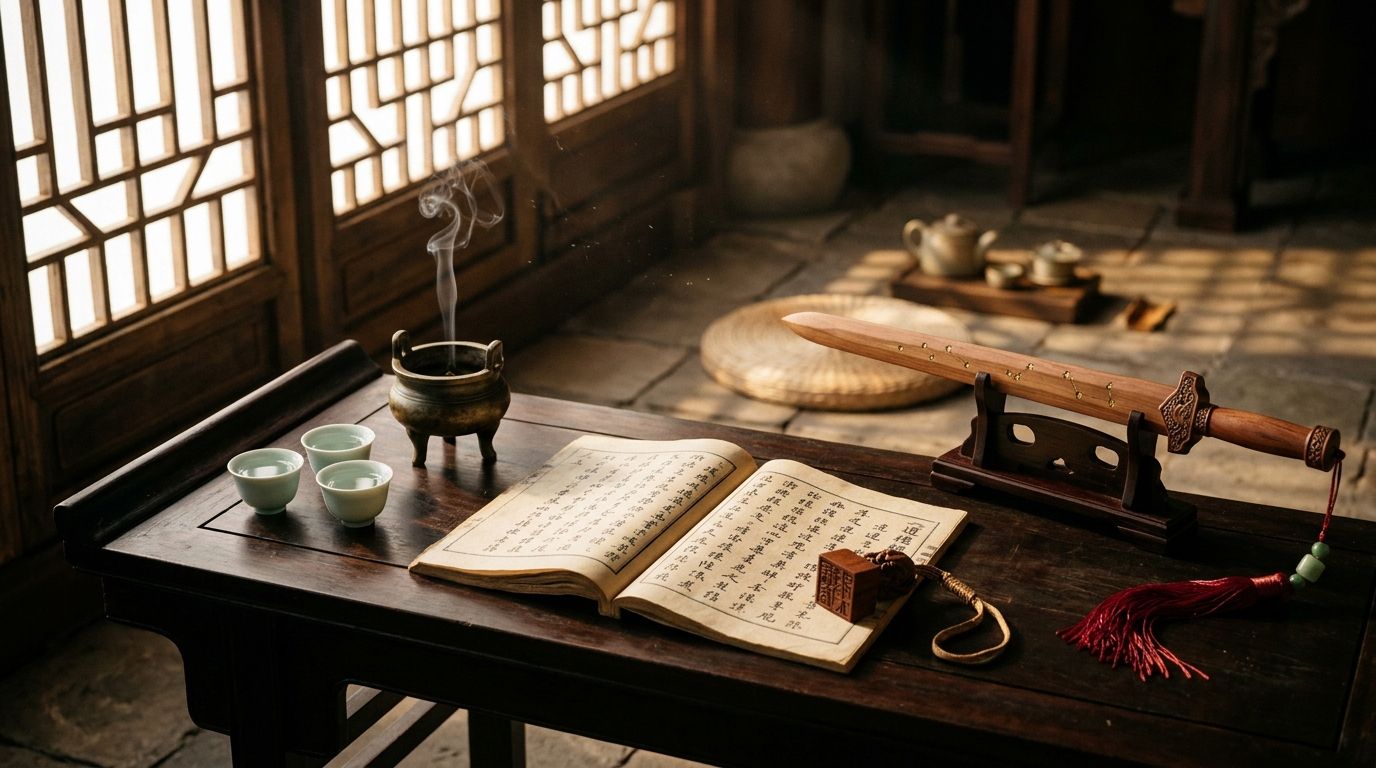
Hand-carved from seasoned heartwood of wild mountain peach trees, the Taomu Jian (桃木剑) is inlaid with polished brass representations of the seven stars of the Big Dipper (Beidou Qixing 北斗七星).
In Chinese energetic medicine, peachwood is classified as solar timber that naturally expels pathogenic Yin energies. Unlike metallic combat weapons designed to shed blood, the Taoist wooden sword is a surgical energetic implement. Mounted respectfully on an altar, it creates a clean, calm vortex of balanced Qi, dispelling nightmares, anxiety, and household discord.
3. Natural Crystalline Cinnabar (Zhusha 朱砂)
For over three millennia, Taoist priests have used natural crystalline mineral cinnabar (Zhusha 朱砂)—natural mercuric sulfide formed under intense geothermal heat and pressure deep within the earth. Possessing a dense physical weight and a brilliant vermilion crimson color, authentic cinnabar is considered the supreme geological anchor of Fire-element Yang energy on the planet.
When writing sacred talismans (Fu Lu 符箓) or consecrating holy implements, pure cinnabar powder is mixed with consecrated water. It serves as an indelible spiritual conductive ink that charges the talisman with lasting energetic potency.
6. Connoisseurship: Genuine Lineage Fawu vs. Industrial Souvenirs
A genuine practitioner of the Dao approaches physical implements with uncompromising discernment. An artifact made from synthetic plastic or chemically stained lumber carries fragmented, distorted energy. To protect practitioners, the authoritative comparative table below details the physical and energetic distinctions between genuine canonical Fawu and cheap commercial souvenirs:
- Lightning-Struck Jujube Wood (Leiji Zaomu) — Authentic Lineage Fawu (正统法物): Harvested from high mountains; natural lightning scar; dense, tight grain; sinks in water; emits a toasted amber aroma when rubbed. · Commercial Tourist Imitation (工业仿品): Ordinary low-grade pine or compressed sawdust; artificially blackened with chemical dyes; floats in water; emits an acrid solvent odor.
- Mountain Peachwood Sword (Taomu Jian) — Authentic Lineage Fawu (正统法物): Wild mountain timber seasoned over 3+ dry winters; natural peach-honey hue; hand-carved Big Dipper brass inlays; tactile warmth. · Commercial Tourist Imitation (工业仿品): Rapid-growth plantation soft timber; dipped in thick industrial red lacquer; brittle grain prone to warping; painted silver or yellow foil dots.
- Pure Mineral Cinnabar (Zhusha) — Authentic Lineage Fawu (正统法物): Earth-mined crystalline mercuric sulfide; exceptionally heavy; naturally cool to the touch; luminous, shimmering crystalline sheen. · Commercial Tourist Imitation (工业仿品): Synthetic lead-oxide paint or common red acrylic mixed with talcum powder; lightweight, chalky; greasy smear that fades rapidly in sunlight.
- Sacred Temple Incense (Tanxiang & Jiangzhen) — Authentic Lineage Fawu (正统法物): Wild aged sandalwood (Laoshan) and Jiangzhen resin with natural sticky-powder tree binder; silky translucent white smoke; sweet, calming aroma. · Commercial Tourist Imitation (工业仿品): Industrial sawdust soaked in petroleum-based fragrance oils and chemical burn accelerators; harsh eye-stinging smoke; leaves oily chemical residue.
- Altar Bronze Censer (Tong Xianglu) — Authentic Lineage Fawu (正统法物): Heavy cast bronze; hand-finished with natural patina; resonant bell-like acoustic tone when tapped; steady thermal heat distribution. · Commercial Tourist Imitation (工业仿品): Lightweight sheet-iron or zinc alloy; sprayed with brass-colored spray paint; dull, hollow thud when tapped; emits toxic paint fumes when hot.
7. The Five-Stage Canonical Rite of Kai Guang (开光, Opening the Light)
Even an implement carved from the finest thunder-struck timber remains merely an inert piece of wood until it undergoes the orthodox lineage ritual of Kai Guang (开光, Opening the Light) conducted by an ordained Taoist priest (Daoshi 道士):
Without authentic Kai Guang, an implement is merely an artistic curiosity; with canonical Kai Guang, it becomes an empowered, living spiritual vessel connected directly to the lineage stream of the Dao.
8. Step-by-Step Daily Practice: A 5-Step Protocol to Attune to the Dao
To bridge the philosophical answer of what is the Dao into your direct daily life, sincere practitioners maintain an intentional morning cultivation routine. Follow this authentic five-step protocol to anchor cosmic balance into your home:
Step 1: Sanctuary Alignment & Taboo Clearance (Anwei Dingxiang 安位定向)
- Solid Support (Kaoshan 靠山): Position your sacred altar table or meditation space against a solid interior wall of brick, stone, or hardwood. Never position an altar floating in the center of a room or backed by a fragile glass window.
- Directional Orientation: Whenever possible, face your altar toward the East to receive the rising purple dawn energy (Ziqi Donglai 紫气东来), or toward the primary entrance of the room.
- Spatial Taboos: Ensure the altar is not located inside a master bedroom where couples sleep, never shares a wall with a bathroom plumbing pipe, is never positioned under exposed overhead structural beams, and is never used as a casual table for meat or alcoholic beverages.
Step 2: Dawn Purification of Body and Breath (Jingshen Jingshou 净身净手)
- Practice during the Mao Hour (卯时, 5:00 AM – 7:00 AM), the sacred daily window when the Earth's Yang Qi awakens and begins its ascent.
- Wash your hands and face thoroughly with cool spring or filtered water.
- Rinse your mouth to purify speech before approaching the sacred space.
- Dress in loose, comfortable clothing made of natural fibers (unbleached cotton or linen) and take three deep, slow abdominal breaths to clear residual lethargy.
Step 3: Offering the Three Pure Waters & Sandalwood Incense (Sanxiang Sanquan 三香三泉)
- Place three celadon porcelain offering cups in a straight line on your altar:
- Center Cup: Represents the Dao (道宝) and Yuanshi Tianzun.
- Left Cup (Observer's Left): Represents the Scriptures (经宝) and Lingbao Tianzun.
- Right Cup (Observer's Right): Represents the Lineage Masters (师宝) and Daode Tianzun (Laozi).
- Fill each cup with pure fresh water.
- Light three sticks of natural aged sandalwood (Laoshan Tanxiang) or Jiangzhen incense.
- Never blow out the flame with your mouth; human breath is regarded as turbid and disrespectful. Gently wave your hand through the air to extinguish the flame.
- Raise the incense to forehead level, bow respectfully, and insert the sticks into your bronze censer:
- Insert the center stick first, dedicating yourself to the Dao.
- Insert the left stick second, honoring the sacred scriptures.
- Insert the right stick third, showing gratitude to the lineage masters.
Step 4: Lower Dantian Tu Na Breathwork with the Ziwu Mudra (Ziwu Jue 子午诀)
- Sit comfortably on a round woven rush cushion (Putuan) with an upright, relaxed spine.
- Form the ancient Ziwu Hand Mudra (子午诀):
- Place your right thumb inside the right palm and wrap your right fingers around it.
- Enfold the right hand within the left palm, resting your left thumb on the base of the left ring finger (the Zi 子 position, midnight water Yin) and the right thumb on the middle fingertip (the Wu 午 position, midday fire Yang).
- Rest the mudra gently at your lower abdomen, sealing your internal bio-electrical circuit.
- Inhale slowly and silently through the nose, feeling the lower abdomen expand outward like a balloon, drawing the breath down into the Lower Dantian (下丹田).
- Exhale gently and completely, feeling the abdomen contract toward the spine. Perform this circular breathing for 12 complete breath cycles.
Step 5: Sitting in Oblivion (Zuowang 坐忘) & Scripture Contemplation
- Release all mental calculations, professional worries, and emotional clingings.
- Practice Zuowang (坐忘, Sitting in Oblivion): Allow your thoughts to arise and dissipate like clouds passing across an open blue sky, without clinging or resisting.
- Conclude by reading aloud or contemplating a single passage from Chapter 1 or Chapter 25 of the Daodejing, letting the silent wisdom of the Dao saturate your consciousness before stepping forth into your daily activities.
9. Frequently Asked Questions (FAQ)
If the Dao cannot be named or defined, how can a human being understand what is the Dao?
While classical Taoism affirms that the primordial Dao (常道, Chang Dao) transcends linguistic definitions, it is not distant or unreachable. The Dao is understood not through abstract intellectual theorizing, but through direct intuitive embodiment. Laozi teaches that the Dao reveals itself through its operational virtues (德, De) and natural patterns (自然, Ziran). By observing the flow of water, practicing internal breathwork (吐纳, Tu Na), quieting the analytical ego in seated stillness (坐忘, Zuowang), and harmonizing with cosmic rhythms rather than forcing outcomes (无为, Wu Wei), the practitioner directly tastes the living reality of the Dao.
What is the primary difference between the Dao in Daoism and the Dao in Confucianism?
The central distinction lies in their metaphysical scope. For Confucianism, the Dao is primarily the 'Way of Humanity' (人道, Ren Dao)—an ethical, sociological roadmap centered on moral cultivation, benevolence (仁, Ren), righteousness (义, Yi), and ritual propriety (礼, Li) within family and state. As Confucius stated in the Analects, 'It is the human being who broadens the Way, not the Way that broadens the human being.' For Taoism, however, the Dao is the boundless 'Cosmic Way' (天道, Tian Dao / 大道, Da Dao) that precedes human existence and natural laws alike. Taoism regards human moral codes as secondary constructs, urging humanity instead to model itself after Heaven, Earth, and spontaneous natural order (道法自然, Dao Fa Ziran).
Does living in accordance with the Dao mean one should be completely passive or give up ambition?
No. This is one of the most widespread Western misconceptions regarding the Dao and Wu Wei (无为). Wu Wei does not mean lethargy, fatalism, or doing nothing. Rather, it signifies non-coercive, uncontrived, and frictionless action. It means acting with such refined sensitivity to natural circumstances that one achieves maximum result with minimal energetic expenditure—much like a master navigator reading the prevailing winds rather than exhausting themselves rowing against the tide. Historical Taoist masters were active astronomers, herbal physicians, architects, and martial artists who achieved extraordinary accomplishments through effortless cosmic alignment.
How do physical sacred implements (Fawu) assist a practitioner in connecting with the formless Dao?
In orthodox Taoist theology, the physical universe is condensed vital energy (炁凝为物, Qi Ning Wei Wu). Sacred implements (法物, Fawu)—such as lightning-struck jujube wood seals, peachwood Seven Stars swords, and pure mineral cinnabar—are crafted from organic materials that naturally absorb concentrated solar and celestial Yang Qi. When canonically consecrated through authentic Kai Guang (开光) rites, these implements serve as physical energetic resonators. They clear chaotic domestic frequencies, protect the meditator's energetic field, and anchor the mind in the timeless, centered stillness of the Dao during daily altar devotion.