Daoism Foundations · · 21 min read
What Is Taoism? Essential Beliefs, Sacred History, Lineage Traditions, and Living Ritual Practices
What is Taoism? Discover Daoist history, philosophies of Wu Wei, Three Treasures, orthodox lineages, consecrated artifacts, and daily altar rites.
By Daoismart Editorial
On this page
- What Is Taoism? Essential Beliefs, Sacred History, Lineage Traditions, and Living Ritual Practices
- 1. What Is Taoism? Unveiling the Primordial Way
- 2. The Twin Streams: Deconstructing the Western Divide Between Daojia and Daojiao
- 3. Historical Genesis: From Shamanic Roots to Institutional Lineages
- The Archaic Era and the Hermit Tradition (Pre-Qin Period, c. 6th–3rd Century BCE)
- The Revelation of Mount Heming: The Formal Birth of Daojiao (142 CE)
- The Medieval Golden Age and the Great Lineage Streams
- 4. Core Metaphysical Principles: The Cosmic Mechanics of the Dao
- The Dao (道): The Ineffable Source and Way
- De (德): Sacred Virtue and Inherent Potency
- Wu Wei (无为): Effortless Action and Sacred Non-Contrivance
- Ziran (自然): Spontaneous Self-So-Ness
- Yin-Yang (阴阳) and Wuxing (五行): Dynamic Polarity and the Five Phases
- 5. The Sacred Taoist Pantheon: Celestial Realms and Immortal Guardians
- The Three Pure Ones (Sanqing 三清)
- Universal Sovereign and Stellar Protectors
- 6. Structural Comparison: Navigating the Dimensions of Daoism
- 7. Sacred Implements, Authentic Materials, and the Rite of Kai Guang (开光)
- The Imperative of Authentic Natural Materials
- The Solemn Rite of Kai Guang (开光, Consecration)
- 8. Step-by-Step Practical Guide: The Orthodox Morning Altar Offering Ritual (Chenzhao Fenggong 晨朝奉供)
- Preparation & Spatial Hygiene
- Step-by-Step Liturgy:
- 9. Frequently Asked Questions (FAQ)
- Q1: What is the primary difference between Taoism as a philosophy and Taoism as a religion?
- Q2: Can someone outside of Chinese heritage genuinely practice authentic Taoism and maintain a home altar?
- Q3: What makes authentic lightning-struck wood and mineral cinnabar essential in Taoist sacred implements?
- Q4: How does the Taoist concept of "Wu Wei" apply to modern high-stress careers and personal ambitions?
- 10. Conclusion: Walking the Harmonious Path in a Modern World
What Is Taoism? Essential Beliefs, Sacred History, Lineage Traditions, and Living Ritual Practices
Key Takeaways (Executive Summary) - Core Definition: What is Taoism? Taoism (Daoism) is an indigenous Chinese religious and philosophical tradition spanning over 2,500 years, dedicated to living in spontaneous harmony with the Dao (道)—the ineffable, primordial Source and universal rhythmic order of all existence. - Two Inseparable Streams: Taoism encompasses both profound philosophical metaphysics (Daojia 道家, pioneered by Laozi and Zhuangzi) and institutional, liturgically grounded religious traditions (Daojiao 道教, founded by Celestial Master Zhang Daoling). - Guiding Metaphysics: Practical realization revolves around Wu Wei (无为) (effortless, non-contrived action), Ziran (自然) (organic spontaneity), and the dynamic equilibrium of Yin-Yang (阴阳) and the Five Phases (Wuxing 五行). - Sacred Living Practice: Beyond abstract contemplation, orthodox Taoism utilizes internal alchemy (Neidan 内丹), consecrated ritual implements (Fa Qi 法器), sacred talismans (Fu Lu 符箓), and daily altar offerings (Fenggong 奉供) to align human consciousness with celestial energy.
1. What Is Taoism? Unveiling the Primordial Way
What is Taoism? To ask this foundational question is to embark on an exploration of one of humanity's most ancient, sophisticated, and deeply ecological spiritual paths. Originating in the misty river valleys and sacred mountains of China more than two and a half millennia ago, Taoism (formally romanized as Daoism) is not merely a philosophical theory or a system of institutional dogma. It is an experiential science of cosmic alignment—a way of perceiving, honoring, and directly embodying the mysterious, living matrix that sustains the universe.
In the contemporary West, seekers often encounter Taoism through poetic translations of the Daodejing (道德经, The Classic of the Way and Its Virtue) or through holistic wellness practices such as Tai Chi (Taijiquan 太极拳) and Qigong (气功). Yet beneath these popular entry points lies a vast, multi-layered spiritual architecture comprising sacred canons, celestial registries, consecrated altars, ancestral lineages, and precise ritual practices designed to refine the mortal human body into an immortal vessel of celestial light.
At its core, Taoism answers the fundamental human dilemmas of anxiety, alienation, and mortality by inviting us to surrender egoic resistance and harmonize our personal rhythms with the Dao (道)—the unnamable womb and eternal principle from which the "ten thousand things" (Wanwu 万物) arise, flourish, and ultimately return.
2. The Twin Streams: Deconstructing the Western Divide Between Daojia and Daojiao
For nearly two centuries, Western academic discourse and popular literature imposed a rigid dichotomy upon the tradition, categorizing it into two supposedly contradictory realms:
- Daojia (道家): "Philosophical Daoism," viewed as pure, naturalist, intellectual, and poetic metaphysics attributed to Laozi and Zhuangzi.
- Daojiao (道教): "Religious Daoism," often dismissively characterized by 19th-century colonial commentators as a "degenerate, superstitious" accumulation of temple rituals, exorcisms, deity pantheons, and alchemical elixirs.
To authentic Taoist lineage masters and ordained practitioners, this divide is entirely artificial. In orthodox Chinese understanding, Daojia and Daojiao represent the living root and the flowering branches of a single, indivisible tree.
The profound philosophical principles articulated in the Daodejing—such as humility, emptiness (Xu 虚), stillness (Jing 静), and effortless action (Wu Wei 无为)—do not exist merely as theoretical debate topics. They are the exact operational mechanics embedded within every sacred liturgical rite (Keyi 科仪), every stroke of a consecrated talisman (Fu Lu 符箓), and every breath of internal meditation (Zuowang 坐忘). Without the profound cosmology of Daojia, temple rituals would degenerate into empty superstition; without the living sacramental technologies of Daojiao, philosophical metaphysics would remain barren intellectual concepts devoid of transformative spiritual power.
3. Historical Genesis: From Shamanic Roots to Institutional Lineages
The historical evolution of Taoism spans thousands of years, progressing from ancient primordial shamanism into one of the world's great organized religions.
The Archaic Era and the Hermit Tradition (Pre-Qin Period, c. 6th–3rd Century BCE)
Long before formal temples existed, the foundations of Taoism were nurtured by the Fangshi (方士, "masters of esoteric methods"), astronomers, herbalists, and solitary mountain hermits who closely observed celestial mechanics and bodily energies.
- Laozi (老子): Revered as the foundational philosopher of Taoism. Serving as the keeper of archives at the royal court of Zhou, Laozi recognized the corruption of societal contrivance and chose to depart westward on a water buffalo. At the Hangu Pass (函谷关), the guardian Yinxi requested his guidance, inspiring Laozi to record the 81 succinct chapters of the Daodejing (道德经).
- Zhuangzi (庄子): The master storyteller who expanded Laozi's vision through dazzling allegories, paradoxes, and radical psychological liberation. Zhuangzi introduced core cultivation concepts such as Zuowang (坐忘, "sitting and forgetting") and Xinzhai (心斋, "fasting of the heart"), demonstrating that true freedom is found when one sheds social conditioning and merges completely with the cosmic flow.
The Revelation of Mount Heming: The Formal Birth of Daojiao (142 CE)
The transition from decentralized philosophical wisdom to a structured, institutionalized religious lineage occurred in 142 CE during the Eastern Han Dynasty.
- Upon Mount Heming (鹤鸣山) in modern Sichuan Province, the hermit scholar Zhang Daoling (张道陵) received a direct celestial vision from Laozi, who manifested in his exalted celestial form as Taishang Laojun (太上老君, The Grand Supreme Elderly Lord).
- Taishang Laojun conferred upon Zhang Daoling the title of First Celestial Master (Tian Shi 天师), along with sacred liturgical scriptures, talismanic registries, and authority over unseen celestial armies.
- Zhang Daoling established the Way of the Celestial Masters (Tianshi Dao 天师道), also known as the Way of the Five Pecks of Rice (Wudoumi Dao 五斗米道). This movement organized local communities into self-governing spiritual parishes, built communal healing halls, abolished bloody animal sacrifices in favor of pure vegetable offerings and incense, and established the unbroken lineage of ritual priesthood that continues to this day.
The Medieval Golden Age and the Great Lineage Streams
Throughout the Tang Dynasty (618–907 CE)—whose imperial rulers claimed direct biological descent from Laozi—and the Song Dynasty (960–1279 CE), Taoism reached extraordinary heights of institutional influence, state sponsorship, and literary sophistication. The vast Daozang (道藏, The Daoist Canon) was compiled, eventually encompassing over 1,400 sacred texts.
Today, orthodox Taoism is primarily anchored by two venerable lineage pillars:
- The Zhengyi Lineage (正一道, Orthodox Unity Tradition):
- Ancestral Seat: Mount Longhu (龙虎山) in Jiangxi Province, presided over by the hereditary descendants of Celestial Master Zhang Daoling.
- Core Focus: Talismanic calligraphy (Fu Lu 符箓), public liturgies (Jiao 醮), energetic home purification, exorcism of malevolent forces, and blessing rituals for families and communities.
- Priesthood: Priests (Daoshi 道士) may marry, maintain domestic households, and live within normal civil society while functioning as ordained intermediaries between humanity and the celestial realms.
- The Quanzhen Lineage (全真道, Complete Reality Tradition):
- Ancestral Seat: Founded in the 12th century by Patriarch Wang Chongyang (王重阳); its central monastic headquarters is the White Cloud Temple (Baiyunguan 白云观) in Beijing.
- Core Focus: Monastic celibacy, strict vegetarianism, mental discipline, and the systematic cultivation of Internal Alchemy (Neidan 内丹).
- Syncretic Ethos: Quanzhen integrates the ethical rigor of Confucianism, the psychological mindfulness of Chan (Zen) Buddhism, and the deep metaphysical alchemy of Taoism into a single unified discipline aimed at achieving spiritual immortality (Xian 仙).
4. Core Metaphysical Principles: The Cosmic Mechanics of the Dao
To genuinely understand Taoism, one must move past superficial Western translations and examine its core philosophical concepts within their native metaphysical framework.
The Dao (道): The Ineffable Source and Way
The first line of the Daodejing warns: "The Dao that can be spoken of is not the eternal Dao" (道可道,非常道). The Dao is neither a personalized creator deity who sits outside the cosmos nor an anthropomorphic judge. It is the unoriginated, boundless ground of being—the silent, formless, ever-present reality that gives birth to existence and sustains the eternal cycle of creation, expansion, and dissolution.
De (德): Sacred Virtue and Inherent Potency
If the Dao is the universal river, De (德) is the specific current that animates an individual being. Often translated as "virtue" or "inner power," De is not moralistic self-righteousness; rather, it is the unfiltered, spontaneous manifestation of the Dao within a human soul, an animal, a tree, or a stone. A person who embodies De moves through the world with natural grace, commanding reverence without coercion.
Wu Wei (无为): Effortless Action and Sacred Non-Contrivance
Perhaps the most misunderstood concept in Eastern philosophy, Wu Wei (无为) is frequently misinterpreted in the West as laziness, passivity, or fatalistic resignation.
- In authentic Taoist practice, Wu (无) signifies the absence of egoic contrivance, selfish manipulation, and artificial forcing.
- Wei (为) signifies action and creation.
- Therefore, Wu Wei represents action in perfect alignment with nature—like water carving through a granite canyon without straining, or an experienced archer releasing an arrow when breath, bow, and target merge into a single seamless reality. In human affairs, Wu Wei means discerning the natural direction of cosmic momentum and acting with maximum efficacy and zero wasted energy.
Ziran (自然): Spontaneous Self-So-Ness
Ziran (自然), literally meaning "of itself so," is the ultimate standard of the cosmos. As Chapter 25 of the Daodejing famously proclaims: "Humanity models itself upon the Earth, Earth models itself upon Heaven, Heaven models itself upon the Dao, and the Dao models itself upon Ziran" (人法地,地法天,天法道,道法自然). To cultivate Ziran is to strip away societal pretensions, emotional posturing, and artificial anxieties, returning to the pristine, uncarved simplicity (Pu 朴) of original human nature.
Yin-Yang (阴阳) and Wuxing (五行): Dynamic Polarity and the Five Phases
In Taoist cosmology, the undifferentiated primordial oneness (Wuji 无极) polarizes into the dual dynamic interplay of Yin and Yang (Taiji 太极):
- Yin (阴): Receptive, dark, cooling, internal, quiet, earth-bound, and nurturing.
- Yang (阳): Active, luminous, warming, external, expressive, heaven-bound, and initiating.
From the continuous rhythmic dance of Yin and Yang emerge the Five Phases (Wuxing 五行)—Wood (Mu 木), Fire (Huo 火), Earth (Tu 土), Metal (Jin 金), and Water (Shui 水). These are not static physical elements, but five primary energetic frequencies that govern the cycles of the seasons, the internal organs of the human body, emotional states, and planetary movements. In internal cultivation, harmonizing these five energetic movements restores pristine physical health and spiritual vitality.
5. The Sacred Taoist Pantheon: Celestial Realms and Immortal Guardians
Contrary to the Western view of polytheism as arbitrary mythology, the Taoist pantheon functions as a sophisticated cosmic bureaucracy reflecting the energetic hierarchy of the universe. In Taoist temple liturgy, deities are revered as celestial focal points of refined primordial Qi (Xian Tian Qi 先天炁) that practitioners can invoke to harmonize their internal energies.
The Three Pure Ones (Sanqing 三清)
At the pinnacle of the Taoist celestial realm reside the Three Pure Ones (Sanqing 三清), representing the three fundamental stages of cosmic unfolding:
- Yuanshi Tianzun (元始天尊, Celestial Worthy of Primordial Beginning):
- Resides in the Realm of Jade Purity (Yuqing 玉清).
- Symbolizes the primordial void (Wuji 无极) before the birth of the cosmos; holds the pearl of creation.
- Lingbao Tianzun (灵宝天尊, Celestial Worthy of Numinous Treasure):
- Resides in the Realm of Supreme Purity (Shangqing 上清).
- Represents the emergence of order and cosmic law (Taiji 太极); holds the sacred Ruyi scepter symbolizing cosmic harmony.
- Daode Tianzun (道德天尊, Celestial Worthy of the Way and Its Virtue):
- Resides in the Realm of Grand Purity (Taiqing 太清).
- Also deified as Taishang Laojun (太上老君), the celestial manifestation of Laozi who descends across epochs to transmit sacred teachings and save mortal beings; holds the fan that commands celestial winds.
Universal Sovereign and Stellar Protectors
- The Jade Emperor (Yuhuang Dadi 玉皇大帝): The administrative ruler of the manifest cosmos, overseeing the celestial courts, seasonal shifts, and the records of human virtue and karma.
- Doumu Yuanjun (斗姆元君, Mother of the Big Dipper): The primordial cosmic mother who gave birth to the stars of the Northern Dipper (Beidou 北斗). Revered as the supreme protector who mitigates astrological afflictions and grants spiritual longevity.
- The Three Great Primordial Emperor-Officials (Sanguan Dadi 三官大帝): The Official of Heaven (Tianguan 天官, who grants blessings), the Official of Earth (Diguan 地官, who pardons sins), and the Official of Water (Shuiguan 水官, who dissolves calamities).
6. Structural Comparison: Navigating the Dimensions of Daoism
To provide clarity for contemporary scholars and spiritual seekers, the table below outlines the core distinctions and living connections across the major expressions of the tradition:
- Historical Inception — Philosophical Daoism (Daojia 道家): c. 6th–4th Century BCE (Pre-Qin Era) · Orthodox Religious Daoism (Daojiao 道教): 142 CE (Eastern Han Dynasty Revelation) · Syncretic Folk Traditions (Minjian Xinyang 民间信仰): Ongoing organic agrarian synthesis
- Primary Figures & Founders — Philosophical Daoism (Daojia 道家): Laozi (老子), Zhuangzi (庄子), Liezi (列子) · Orthodox Religious Daoism (Daojiao 道教): Zhang Daoling (张道陵), Wang Chongyang (王重阳), Ge Hong (葛洪) · Syncretic Folk Traditions (Minjian Xinyang 民间信仰): Local folk heroes, regional patron spirits, ancestral ghosts
- Canonical Foundation — Philosophical Daoism (Daojia 道家): Daodejing (道德经), Zhuangzi (南华真经) · Orthodox Religious Daoism (Daojiao 道教): The Daozang (道藏, 1,400+ volumes of liturgical & alchemical canons) · Syncretic Folk Traditions (Minjian Xinyang 民间信仰): Oral folklore, regional story cycles, divinatory almanacs
- Core Objective — Philosophical Daoism (Daojia 道家): Intellectual liberation, psychological peace, alignment with nature · Orthodox Religious Daoism (Daojiao 道教): Spiritual immortality (Xian 仙), transcendence of Samsara, universal harmony · Syncretic Folk Traditions (Minjian Xinyang 民间信仰): Immediate worldly blessings: wealth, health, fertility, safe travels
- Priestly Lineage — Philosophical Daoism (Daojia 道家): None (Solitary scholars, philosophers, poets) · Orthodox Religious Daoism (Daojiao 道教): Formally ordained priesthood (Daoshi 道士) with lineage genealogies · Syncretic Folk Traditions (Minjian Xinyang 民间信仰): Village mediums (Jitong 乩童), fortune tellers, informal shrine keepers
- Ritual Implements Used — Philosophical Daoism (Daojia 道家): Scholar's brush, tea ware, plain incense censer · Orthodox Religious Daoism (Daojiao 道教): Consecrated seals (Fayin 法印), peach wood swords (Taomu Jian 桃木剑), talismanic silk · Syncretic Folk Traditions (Minjian Xinyang 民间信仰): Paper ghost money, commercial joss sticks, generic fortune tallies
- Primary Cultivation Method — Philosophical Daoism (Daojia 道家): Metaphysical contemplation, intellectual detachment · Orthodox Religious Daoism (Daojiao 道教): Internal Alchemy (Neidan 内丹), liturgical invocation, altar devotion · Syncretic Folk Traditions (Minjian Xinyang 民间信仰): Temple petitioning, vows of repayment, spirit possession
7. Sacred Implements, Authentic Materials, and the Rite of Kai Guang (开光)
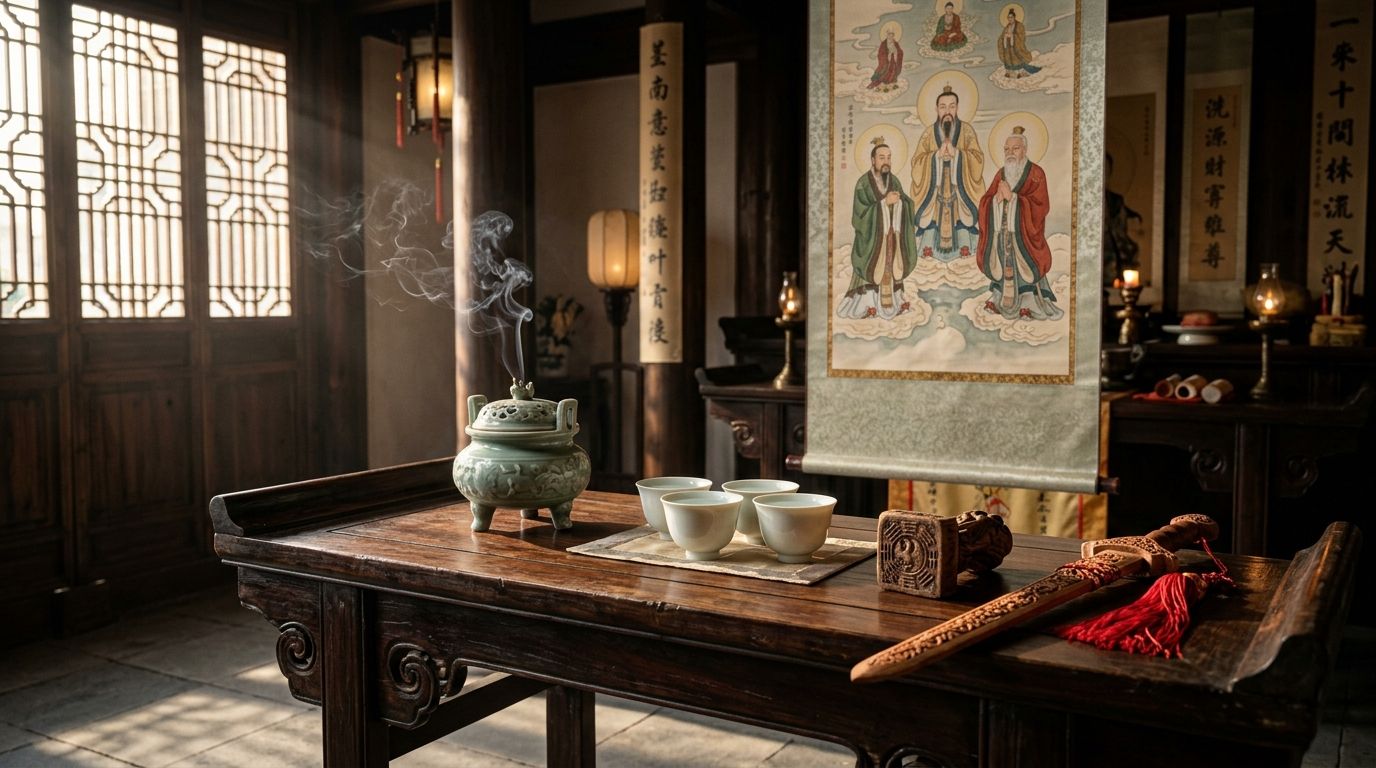
Within orthodox Taoism, sacred artifacts (Fa Qi 法器) and home altars are never regarded as superstitious idols or superficial decorative curios. Instead, they function as precision energetic instruments—physical antennas crafted from natural materials that gather, condense, and radiate pure celestial Yang energy (Yang Qi 阳气) while purifying stagnant, discordant Yin influences.
The Imperative of Authentic Natural Materials
Traditional Taoist ritual strictly prohibits the use of modern synthetic substitutes, such as injection-molded plastics, chemically dyed powders, or industrial composite woods. Synthetic materials possess chaotic, dead energetic signatures that disrupt the subtle Qi meridians of the home altar.
- Lightning-Struck Jujube Wood (Leiji Zaomu 雷击枣木):
- Known as the "Emperor of Sacred Woods," this rare material is created when a wild jujube tree growing on an auspicious mountain crest is struck by natural celestial lightning (Tianlei 天雷).
- The extreme electrostatic and atmospheric blast purges all residual Yin stagnation, permanently sealing the raw creative fire of Heaven into the wood.
- Master artisans carve this wood into lineage command seals (Fayin 法印) and protective Bagua talismans that provide impenetrable spiritual protection.
- Authentic Mineral Cinnabar (Zhusha 朱砂):
- Pure mercuric sulfide crystallized within deep subterranean veins over millions of years.
- Bearing a vibrant crimson hue, mineral cinnabar possesses the highest vibrational Yang frequency among earthly minerals.
- Ordained priests grind pure crystalline cinnabar with sacred spring water and herbal binders to write sacred talismans (Fu Lu 符箓) and perform the sensory consecration rites of deities.
- Seasoned Old Peach Wood (Taomu 桃木):
- In Chinese mythology, the peach tree is the "Wood of the Sun" (Yang Mu 阳木), blossoming first in early spring and harboring vibrant life force.
- Hand-carved peach wood ritual swords (Taomu Jian 桃木剑) hung in domestic sanctums dissolve malevolent energetic disturbances, settle domestic discord, and deflect harmful external Feng Shui sha (Fengshui Sha Qi 风水煞气).
- Natural Lineage Incense (Lao Shan Tan 老山檀 & Chenxiang 沉香):
- Burning wild agarwood (Chenxiang 沉香) or authentic aged Mysore sandalwood (Lao Shan Tan 老山檀) generates a vertical column of pure aromatic smoke.
- In Taoist liturgy, pure natural incense smoke is the literal "Vehicle of the Spirit" (Xiang Yan Chuan Xin 香烟传信), carrying the practitioner's sincere aspirations directly into the celestial halls of the Three Pure Ones.
The Solemn Rite of Kai Guang (开光, Consecration)
An unconsecrated statue or talisman remains an ordinary piece of carved wood or paper. To transform an object into a living vessel of divine resonance, an ordained Taoist master conducts the solemn rite of Kai Guang (开光, "Opening of the Spiritual Light"):
- Jinghua (净化, Cleansing & Exorcism): The implement is thoroughly purified with pure water, consecrated salt, and wild mugwort/sandalwood incense smoke to strip away all previous earthly impurities.
- Zhuang Zang (装脏, Relic Cavity Consecration): For statues, a sacred cavity is carved into the back. The priest places the Five Sacred Minerals (gold, silver, bronze, iron, tin), the Five Sacred Grains, medicinal herbs, five-colored silk threads representing the Five Phases, and an inscribed heart scripture (Xinjing 心经) into the core, giving the sacred vessel an internal energetic heartbeat.
- Shengguang & Dian Yan (点眼, Dotting the Sensory Organs): Using a consecrated calligraphic brush dipped in pure mineral cinnabar and consecrated chicken rooster comb Yang-blood (or pure herbal cinnabar elixir), the priest directs stellar Qi from the Big Dipper, systematically dotting the eyes, ears, nose, mouth, hands, and feet of the deity or implement while reciting the secret consecration incantation:
"Point to the eyes, so they shine like sun and moon; point to the ears, so they hear the cries of the ten directions; point to the heart, so it radiates eternal compassion."
8. Step-by-Step Practical Guide: The Orthodox Morning Altar Offering Ritual (Chenzhao Fenggong 晨朝奉供)
For sincere international practitioners who wish to cultivate genuine Taoist harmony in their daily lives, establishing and maintaining a traditional home altar offers a transformative spiritual anchor. Below is the step-by-step liturgical protocol practiced by orthodox Taoist householders every morning at dawn.
Preparation & Spatial Hygiene
- Timing: Ideally performed between 5:00 AM and 7:00 AM (the Mao Hour 卯时, when morning Yang Qi begins its ascent).
- Physical Cleanliness: Wash hands, rinse mouth, dress in clean, modest garments, and ensure the altar room is quiet, well-ventilated, and free from domestic clutter.
Step-by-Step Liturgy:
- Step 1: Mindful Cleansing of Heart and Speech (Jingxin Jingkou 净心净口)
Stand quietly before the altar table. Close your eyes, inhale deeply through the nose down into the Lower Dantian (Xia Dantian 下丹田, two inches below the navel), and exhale slowly through the mouth. Silently recite the ancient Spiritual Mantra for Purifying the Heart (Jingxin Shenzhou 净心神咒):
"My mind is clear and free of dust, my spirit tranquil in the void. Returning to the roots of nature, I merge into the eternal Dao."
- Step 2: Preparing and Offering the Three Waters (Sanqing Fengshui 三清奉水)
Approach the altar with quiet reverence. Remove the three celadon or porcelain offering cups from the altar table:
- Rinse them thoroughly with pure spring or filtered water.
- Fill all three cups with fresh, pure water, representing the uncorrupted clarity of body, speech, and mind.
- Place the first cup in the center (honoring Yuanshi Tianzun), the second cup to the left/observer's right (honoring Lingbao Tianzun), and the third cup to the right/observer's left (honoring Daode Tianzun).
- Step 3: Igniting the Three Stems of Pure Natural Incense (Fengxiang 奉香)
Take three sticks of natural aged sandalwood or agarwood incense. Hold them with both hands and ignite the tips with a clean flame:
- Never blow out the flame with human breath (which carries bodily impurities). Instead, gently wave the incense sticks downward or extinguish the flame with a smooth flick of the wrist.
- Raise the incense sticks to brow level using both hands, aligning the tips with your Third Eye center (Yintang 印堂).
- Step 4: The Sacred Hand Posture of Zi-Wu (Ziwu Jue 子午诀)
Hold the base of the incense sticks between your palms while forming the Ziwu Seal (子午诀):
- Wrap the left hand (representing the solar Yang energy of Heaven) around the right hand (representing the receptive Yin energy of Earth), with the left thumb touching the base of the left ring finger (the Zi 子 position) and the right thumb touching the tip of the right middle finger (the Wu 午 position).
- This posture seals your personal microcosmic orbit, preventing external energetic distraction.
- Step 5: Inserting the Incense into the Censer (Sanxiang Dingxiang 三香定向)
Step forward and insert the three incense sticks into the bronze or celadon censer one by one:
- First Stick (Center): Inserted strictly upright. Dedicate to the Heavenly Worthy of Primordial Beginning, honoring the truth of the Dao.
- Second Stick (Left / Yang side): Inserted about one finger-width to the left of the center. Dedicate to the Heavenly Worthy of Numinous Treasure, honoring the sacred scriptures.
- Third Stick (Right / Yin side): Inserted about one finger-width to the right of the center. Dedicate to the Heavenly Worthy of the Way and Its Virtue, honoring the living teachers and lineage masters.
- The three sticks must stand upright and parallel, symbolizing unwavering alignment between Heaven, Earth, and Humanity.
- Step 6: Three Receptive Prostrations and Recitation (Baili Ji Songjing 拜礼及诵经)
Step back one pace. With hands joined in the Ziwu seal at heart level, bow forward reverently three times (San Libai 三礼拜). Feel the warmth and clarity descending from your crown through the central channel down into the Dantian. If time permits, chant Chapter 1 or Chapter 8 of the Daodejing, letting the ancient cosmic cadence reverberate within your chest.
- Step 7: Seated Stillness (Zuowang 坐忘 / Jingzuo 静坐)
Conclude the morning offering by sitting comfortably on a meditation cushion before the altar for 15 to 20 minutes. Practice Zuowang (坐忘, "sitting in forgetfulness"): release all planning, let go of past memories and future anxieties, observe the fragrant ribbons of white smoke gently curling upward toward the ceiling, and abide in the timeless, tranquil presence of the Dao.
9. Frequently Asked Questions (FAQ)
Q1: What is the primary difference between Taoism as a philosophy and Taoism as a religion?
Answer: In the traditional Chinese understanding, philosophical Taoism (Daojia 道家) and religious Taoism (Daojiao 道教) are two dimensions of the same living tradition rather than opposing schools. Daojia provides the core metaphysical cosmology—focusing on the concepts of the Dao, Wu Wei (effortless action), Ziran (naturalness), and Yin-Yang balance as articulated by Laozi and Zhuangzi. Daojiao provides the institutional, ceremonial, and practical methods—such as temple liturgies, lineage transmissions, talismanic consecrations, and internal alchemy—that allow human beings to directly experience, worship, and embody those philosophical principles in daily life.
Q2: Can someone outside of Chinese heritage genuinely practice authentic Taoism and maintain a home altar?
Answer: Absolutely. The foundational doctrine of the Daodejing explicitly declares that the Dao is universal and omnipresent—belonging to no single nation, ethnicity, or geographical region. Anyone who respects the principles of harmony, simplicity, humility, and natural balance can walk the Taoist path. Maintaining a traditional home altar requires only genuine reverence, a clean and dignified space, authentic natural offering vessels (such as a ceramic censer and pure water cups), and adherence to mindful daily etiquette. Authenticity is determined by the sincerity of one's heart and the purity of one's intention, not by bloodline.
Q3: What makes authentic lightning-struck wood and mineral cinnabar essential in Taoist sacred implements?
Answer: In Taoist energetic science, sacred implements (Fa Qi 法器) are physical resonators designed to manipulate subtle Qi fields. Wild jujube wood struck by natural lightning (Leiji Zaomu 雷击枣木) absorbs the immense electro-magnetic and solar Yang fire of the heavens, permanently imbuing the wood with the power to dispel stagnant or malevolent Yin energies. Pure mineral cinnabar (Zhusha 朱砂) is the premier natural Yang mineral of the earth, holding exceptional energetic density. Synthetic plastic resin replicas possess lifeless, chaotic energetic frequencies that cannot hold a consecrated blessing or harmonize environmental Qi.
Q4: How does the Taoist concept of "Wu Wei" apply to modern high-stress careers and personal ambitions?
Answer: Wu Wei (无为) is not laziness, passivity, or giving up on one's goals; it is the art of effortless effectiveness through non-contrivance. In a modern professional setting, practicing Wu Wei means eliminating emotional friction, overcoming egoic stubbornness, and refusing to force outcomes against the natural current of circumstances. Just as a seasoned sailor adjusts the sails to work with the wind rather than rowing frantically against a gale, a practitioner of Wu Wei studies the underlying trends of a situation, acts decisively at the precise moment of maximum leverage, and achieves profound success with calm clarity and zero burnout.
10. Conclusion: Walking the Harmonious Path in a Modern World
In an era characterized by relentless cognitive overload, environmental degradation, and perpetual societal anxiety, the ancient question—What is Taoism?—acquires urgent relevance.
Taoism does not demand blind obedience to rigid dogmatic creeds, nor does it ask us to withdraw permanently from the responsibilities of daily society. Instead, it invites us to remember our primordial origin: to soften our rigid edges, quiet our clamoring intellects, and realign our daily actions with the patient, benevolent rhythms of Heaven and Earth.
Whether through the quiet contemplation of the Daodejing, the mindful offering of fresh morning water and fragrant incense before an ancestral altar, or the protective presence of an authentic hand-carved lightning-struck talisman, the Way remains forever open. By cultivating stillness within motion and honoring the eternal Dao in every breath, we discover that harmony is not a distant mountain peak to be conquered—it is the very ground upon which we stand.