Daoism Foundations · · 21 min read
What Is Tao Religion? Sacred History, Living Lineages, Temple Liturgies, and Consecrated Implements
Discover what is Tao religion: explore sacred Daoist history, Zhengyi and Quanzhen lineages, temple liturgies, and consecrated altar implements.
By Daoismart Editorial
On this page
- What Is Tao Religion? Sacred History, Living Lineages, Temple Liturgies, and Consecrated Implements
- 1. What Is Tao Religion? Deconstructing the Western Philosophical Dichotomy
- The Historical Genesis of Daojiao (142 CE)
- 2. The Two Living Lineages of the Tao Religion: Zhengyi and Quanzhen
- The Zhengyi Tradition: Priesthood in the Human World
- The Quanzhen Tradition: Monastic Renunciation and Inner Alchemy
- 3. Cosmological Theology: The Taoist Celestial Hierarchy
- The Three Pure Ones (Sanqing 三清): The Primordial Celestial Trinity
- 4. Sacred Implements (Fawu 法物) and the Consecration Mystery of Kai Guang
- The Four Sacred Stages of Kai Guang Consecration
- 5. Curatorial Connoisseurship: Authentic Lineage Artifacts vs. Commercial Counterfeits
- 6. Step-by-Step Practical Guide: Establishing an Authentic Home Altar & Daily Ritual
- Step 1: Space Selection and Environmental Alignment
- Step 2: Enshrining the Sacred Vessels
- Step 3: The Morning Offering Ritual (San Jing San Feng 三敬三奉)
- Step 4: Daily Inner Cultivation: Breathwork and Seated Forgetting
- Step 5: Evening Gratitude and Dedication of Merit
- 7. The Global Relevance of the Tao Religion in the Modern Era
- Frequently Asked Questions (FAQ)
- What is the primary difference between Daoist philosophy and the Tao religion?
- Is the Tao religion polytheistic or monotheistic?
- Do followers of the Tao religion worship physical statues as idols?
- How can a beginner practice the Tao religion without living near a temple?
What Is Tao Religion? Sacred History, Living Lineages, Temple Liturgies, and Consecrated Implements
Key Takeaways & Core Principles - Direct Definitive Insight: Seeking to understand what is Tao religion? The Tao religion (Daojiao 道教) is China's sole indigenous, two-thousand-year-old liturgical and spiritual tradition rooted in the primordial cosmological source known as the Dao (Dao 道, "The Way"). Rather than existing merely as an abstract philosophical treatise, the Tao religion is an unbroken, living sacred system uniting canonized scripture (Daozang 道藏), an ordained priesthood (Daoshi 道士), communal temple liturgies (Jiao 醮), internal alchemy (Neidan 内丹), and consecrated altar implements (Fawu 法物). - The Sacred Triad (Sanbao 三宝): The spiritual architecture of the Tao religion is anchored by the Three Treasures: the formless, omnipresent Dao (Dao 道), the canonical sacred texts (Jing 经), and the initiated lineage masters (Shi 师) who transmit sacred wisdom across generations. - Two Great Living Traditions: The contemporary Tao religion operates through two complementary schools: the monastic, celibate Quanzhen (全真道, Complete Perfection) lineage centered on silent internal alchemy and mountain abbeys, and the household, liturgical Zhengyi (正一道, Orthodox Unity) lineage centered on ritual ceremonies, talismanic craft (Fu Lu 符箓), and sacred consecration (Kai Guang 开光). - Sacred Material Conduits: In the cosmological view of the Tao religion, matter is condensed spiritual energy (Qi ju wei wu 炁聚为物). Consecrated implements—such as lightning-struck jujube wood seals, seven-star peachwood swords, natural sandalwood incense, and mineral cinnabar amulets—serve as active conduits harmonizing human life with celestial virtue.
1. What Is Tao Religion? Deconstructing the Western Philosophical Dichotomy
For more than a century, Western academic discourse and popular culture have maintained a misleading separation between what scholars termed "philosophical Daoism" (Daojia 道家) and "religious Daoism" (Daojiao 道教). Under this artificial division, the poetic paradoxes of Laozi’s Daodejing (《道德经》) and the parables of the Zhuangzi (《庄子》) were celebrated as enlightened philosophy, while the living Tao religion—with its temples, priestly vestments, celestial pantheon, and liturgical ceremonies—was often dismissed as later folk corruption.
Within the authentic, unbroken Chinese lineage tradition, this division is entirely recognized as false. Philosophical contemplation and religious liturgy are the root and branches of the exact same sacred organism:
The principles of non-coercive naturalness (Wu Wei 无为) and spontaneous balance (Ziran 自然) taught by Laozi do not exist in intellectual isolation; they find their highest somatic and communal realization through the liturgical rites, breathing disciplines, and consecrated altars of the Tao religion.
The Historical Genesis of Daojiao (142 CE)
While philosophical Daoist insights trace back to the 6th century BCE, the formal institutional emergence of the Tao religion took place in 142 CE during the Eastern Han Dynasty. High atop Mount Heming (鹤鸣山) in contemporary Sichuan Province, Celestial Master Zhang Daoling (张道陵) experienced a monumental celestial revelation. The deified sage Laozi appeared as Taishang Laojun (太上老君, The Grand Supreme Elderly Lord), transmitting the sacred Covenant of Orthodox Unity (Zhengyi Mengwei 正一盟威).
This historic covenant marked the founding of the Way of the Celestial Masters (Tianshi Dao 天师道). Far from an abstract academic academy, this early community established an organized, egalitarian social order featuring community parishes, cooperative granaries, free mountain travel stations, moral ledgers, and spiritual clinics where illness was treated through ethical confession and sacred talismans. For over 1,800 years, surviving dynastic transitions and societal upheavals, this sacred lineage has endured as China’s sole indigenous, continuously functioning world religion.
2. The Two Living Lineages of the Tao Religion: Zhengyi and Quanzhen
When examining what is Tao religion in the modern world, one encounters two primary orthodox streams recognized by official ancestral sanctuaries: the liturgical Zhengyi (正一道, Orthodox Unity) lineage and the monastic Quanzhen (全真道, Complete Perfection) lineage. While both lineages venerate the same celestial pantheon and read the same canonical scriptures, their methods of daily practice represent two harmonious expressions of cultivation.
The structured comparison table below illustrates the distinctive disciplines, lifestyles, and lineages that define the Tao religion, contrasted with common commercial misconceptions:
- Historical Inception — Zhengyi Tradition (正一道): Founded in 142 CE by Celestial Master Zhang Daoling at Mount Heming. · Quanzhen Tradition (全真道): Founded in 1170 CE by Grandmaster Wang Chongyang during the Jin Dynasty. · Commercial & Popular Misconceptions: Often portrayed merely as folk fortune-telling or stage martial arts.
- Priestly Lifestyle — Zhengyi Tradition (正一道): Household-dwelling (Huoju Daoshi 火居道士); priests marry, raise families, and serve community parishes. · Quanzhen Tradition (全真道): Monastic and celibate (Chujia Daoshi 出家道士); monastics reside permanently in mountain temples. · Commercial & Popular Misconceptions: Stereotyped as fictional hermits living entirely without rules or structure.
- Primary Spiritual Arts — Zhengyi Tradition (正一道): Liturgical ritual ceremonies (Jiao 醮), talismanic calligraphy (Fu Lu 符箓), and sacred consecration (Kai Guang 开光). · Quanzhen Tradition (全真道): Internal Alchemy (Neidan 内丹), seated stillness (Zuowang 坐忘), and breath circulation (Tu Na 吐纳). · Commercial & Popular Misconceptions: Mistaken for commercialized physical exercise or superstition.
- Dietary Discipline — Zhengyi Tradition (正一道): Vegetarian during ritual liturgies; omnivorous in daily life, strictly excluding the four sacred meats: beef, dog, turtle, and crane. · Quanzhen Tradition (全真道): Strict, permanent vegetarianism (Sushi 素食) to preserve internal Yang Qi and cultivate universal compassion. · Commercial & Popular Misconceptions: Assumed to have no dietary ethics or to practice extreme ascetic starvation.
- Ancestral Seat — Zhengyi Tradition (正一道): Mount Longhu (龙虎山, Dragon and Tiger Mountain) in Jiangxi Province. · Quanzhen Tradition (全真道): White Cloud Temple (白云观, Baiyun Guan) in Beijing and Mount Wudang (武当山). · Commercial & Popular Misconceptions: Viewed as localized folklore lacking institutional headquarters.
- Transmission Mechanism — Zhengyi Tradition (正一道): Sacred Register Transmission (Chuan Du 传度 and Shou Lu 授箓) conferred by lineage masters. · Quanzhen Tradition (全真道): Crown and Robe Investiture (Guanjin 冠巾) and Solemn Precept Transmission (Chuan Jie 传戒). · Commercial & Popular Misconceptions: Assumed that anyone can proclaim themselves a priest without lineage training.
The Zhengyi Tradition: Priesthood in the Human World
The Zhengyi school embodies the communal and liturgical heartbeat of the Tao religion. Zhengyi priests live directly within the community, serving as spiritual custodians and metaphysical counselors. When families experience illness, architectural disharmony, or the passing of loved ones, Zhengyi priests perform cosmic liturgies (Jiao 醮) to restore peace between the celestial realms, the human world, and subterranean spirits.
Central to Zhengyi practice is the transmission of sacred talismans (Fu Lu 符箓). Far from arbitrary scribbles, an authentic talisman is a legal decree written in celestial seal script. The priest enters deep meditation (Cunshen 存神), aligns their breath with the Northern Dipper (Beidou 北斗), and channels cosmic Yang energy through a wolf-hair brush into pure cinnabar ink on consecrated paper, anchoring protective cosmic frequencies within the physical world.
The Quanzhen Tradition: Monastic Renunciation and Inner Alchemy
Established during the 12th century by Grandmaster Wang Chongyang (王重阳), the Quanzhen tradition represents the monastic and contemplative pillar of the Tao religion. Synthesizing Daoist internal alchemy, Chan Buddhist meditation, and Confucian ethics, Quanzhen monastics take vows of celibacy, adopt plain blue robes, coil their hair in the traditional topknot (Ziji 髻), and devote their days to silent spiritual cultivation.
The hallmark of Quanzhen practice is Internal Alchemy (Neidan 内丹). Ancient practitioners once experimented with external mineral elixirs containing mercury and lead (Waidan 外丹), but this dangerous practice was entirely discarded centuries ago. Instead, the Quanzhen adept treats the human body as an alchemical furnace (Ding 鼎). Through seated stillness, the practitioner transforms physical Essence (Jing 精) into Vital Energy (Qi 气), refines Vital Energy into Pure Consciousness (Shen 神), and ultimately dissolves Consciousness into the infinite Emptiness of the Dao (Huan Xu 还虚).
3. Cosmological Theology: The Taoist Celestial Hierarchy
To comprehend what is Tao religion, one must examine its theological worldview. Unlike Western monotheistic faiths centered on an external creator who judges creation from beyond, the Tao religion teaches that divinity is immanent within the fabric of nature. The cosmos unfolds through organic differentiation from formless stillness into vibrant multiplicity:
The Three Pure Ones (Sanqing 三清): The Primordial Celestial Trinity
At the pinnacle of veneration in the Tao religion stand the Three Pure Ones (Sanqing 三清). They are not historical mortals elevated to divinity, but personified emanations of the Dao’s three primordial cosmological frequencies:
- Yuanshi Tianzun (元始天尊, Celestial Worthy of Primordial Beginning): Residing in the Heaven of Pure Jade (Qingwei Tian 清微天), he represents the initial emergence of light and order out of primordial chaos (Hundun 混沌).
- Lingbao Tianzun (灵宝天尊, Celestial Worthy of Numinous Treasure): Residing in the Heaven of Supreme Purity (Yuyu Tian 禹余天), he personifies the transmission of sacred scriptures, cosmic law, and talismanic registers.
- Daode Tianzun (道德天尊, Celestial Worthy of the Way and Its Virtue): Residing in the Heaven of Great Purity (Dachi Tian 大赤天), he is the deified incarnation of Laozi (Taishang Laojun), representing the compassionate descent of celestial wisdom into the mortal world to teach humanity.
Beneath the Three Pure Ones serves an intricate celestial administration. Deities such as the Jade Emperor (Yuhuang Dadi 玉皇大帝) govern cosmic law, stellar deities of the Northern Dipper (Beidou 北斗) govern human destiny and longevity, and ancestral immortal masters (Zhenren 真人) provide protection and inspiration to sincere practitioners.
4. Sacred Implements (Fawu 法物) and the Consecration Mystery of Kai Guang
A defining hallmark of the Tao religion is its understanding that spirit and matter are deeply intertwined. As recorded in ancient Daoist texts: Qi ju wei wu, Qi san wei kong (炁聚为物,炁散为空)—"When Qi condenses, it becomes physical matter; when Qi disperses, it returns to the void."
Consequently, natural materials sourced from living trees, precious metals, and crystalline minerals possess distinct energetic frequencies. When crafted with reverence and activated through the sacred ritual of Kai Guang (开光, Opening the Light), these implements (Fawu 法物) become active antennas for celestial virtue:
The Four Sacred Stages of Kai Guang Consecration
In the Tao religion, an unconsecrated statue or sword is merely a decorative craft. To transform an object into a living vessel of celestial resonance, an ordained priest performs the solemn liturgy of Kai Guang:
- Purification with Peachwood Water (Jinghua 净化): The implement is washed in mountain spring water infused with seven wild peach twigs, cleansing away all profane residue and handling dust.
- Sacred Cavity Enshrinement (Zhuangzang 装脏): For deity statues, consecrated chambers inside the sculpture are filled with hand-written scriptures, Five Elements colored silk threads, precious minerals (gold, silver, jade, pearl), and rare medicinal herbs.
- Gathering Solar Fire (Yinzhao 引照): Using a polished concave bronze mirror under the morning sun, the master gathers pure solar Yang rays onto the crown of the implement.
- Cinnabar Dotting (Dianyan 点眼): Holding a pure wolf-hair brush saturated with ground natural cinnabar, the master holds their breath in deep concentration and dots the sensory centers: the eyes (to perceive cosmic truth), ears (to hear prayers), mouth (to preach virtue), and heart (to radiate compassion).
5. Curatorial Connoisseurship: Authentic Lineage Artifacts vs. Commercial Counterfeits
As global curiosity about what is Tao religion expands, commercial markets have become inundated with cheap synthetic imitations. In genuine Daoist practice, the spiritual potency of an implement is indivisible from the physical and energetic purity of its materials. A chemically treated imitation disrupts personal harmony, while an authentic heritage artifact provides enduring stability.
The comparative matrix below details the rigorous material criteria used by experienced Daoist curators to differentiate authentic lineage implements from industrial imitations:
- Lightning Jujube Wood Seals (Leiji Zaomu Yin 雷击枣木印) — Authentic Lineage Artifact (正统道门法物): Sourced exclusively from wild mountain jujube trees naturally struck by sky thunder; displays organic lightning fissures and internal carbonized core; exceptionally dense, sinking in water; emits a toasted, nutty fragrance when rubbed. · Commercial Industrial Imitation (市面廉价仿制品): Fast-growing plantation timber or common basswood artificially scorched with industrial lasers or propane torches; lightweight, porous, floats on water; emits an acrid chemical odor of synthetic lacquer. · Diagnostic Verification & Energetic Impact: Energetic Charge: Natural thunder wood stores atmospheric high-voltage electromagnetic Yang charge, dispelling energetic stagnation. Laser-charred wood is energetically dead and emits toxic carbon dust.
- Seven-Star Peachwood Swords (Taomu Jian 桃木剑) — Authentic Lineage Artifact (正统道门法物): Hand-carved from seasoned heartwood of wild mountain peach trees aged over 30 years; deep amber-honey grain with dense annual rings; inlaid with solid brass Big Dipper constellation markers; substantial, grounding tactile weight. · Commercial Industrial Imitation (市面廉价仿制品): Cheap composite medium-density fiberboard (MDF) or fast-growing pine; stamped with thin yellow foil stickers or spray paint; featherweight, brittle, and coated in polyurethane varnish. · Diagnostic Verification & Energetic Impact: Spatial Yang Resonance: Genuine aged peachwood is rich in natural resin that absorbs environmental static and repels pests. Glued composite MDF off-gasses toxic formaldehyde, agitating household Qi.
- Ritual Talismans (Zhusha Fu Lu 符箓) — Authentic Lineage Artifact (正统道门法物): Hand-brushed by an initiated priest in deep meditative focus; ink prepared from finely ground natural crystalline cinnabar (Zhusha 朱砂) suspended in purified botanical binder; glistens with subtle mineral brilliance. · Commercial Industrial Imitation (市面廉价仿制品): Mass-printed on industrial offset presses using synthetic petrochemical red ink on chemically bleached paper; completely uniform and printed by thousands. · Diagnostic Verification & Energetic Impact: Vibrational Stability: Cinnabar is a dense, high-frequency mineral compound that maintains an exceptionally stable electromagnetic charge. Commercial red printing ink contains synthetic solvents devoid of energetic vitality.
- Temple & Altar Incense (Xiangdao 香道) — Authentic Lineage Artifact (正统道门法物): 100% pure wild-harvested Hainan Jiangzhen incense (降真香) and aged Laoshan Sandalwood (老山檀香); contains zero chemical binders or burning accelerants; burns with a silky white smoke column and comforting aroma. · Commercial Industrial Imitation (市面廉价仿制品): Sawdust and scrap wood powder blended with industrial potassium nitrate (combustion accelerator) and synthetic chemical perfumes; burns with harsh, choking black smoke. · Diagnostic Verification & Energetic Impact: Respiratory & Meditative Health: Pure botanical resins soothe the autonomic nervous system and deepen diaphragmatic breathing. Synthetic chemical incense produces toxic benzene compounds that trigger headaches.
6. Step-by-Step Practical Guide: Establishing an Authentic Home Altar & Daily Ritual
One of the most inspiring answers to what is Tao religion is that it is fundamentally accessible in daily domestic life. You do not need to abandon modern responsibilities or reside on a remote mountain peak to practice Daoist spirituality. By establishing a respectful altar sanctuary at home, seekers can cultivate cosmic balance each day.
Follow this classical five-step protocol to set up and maintain a traditional home sanctuary:
Step 1: Space Selection and Environmental Alignment
Select a quiet, clean, and well-ventilated corner of your home, such as a study or dedicated meditation space. In accordance with traditional Feng Shui geomancy, the altar should ideally face East (the direction of dawn and rising Yang) or South (the direction of supreme illumination). Ensure the altar table is never placed directly opposite bathrooms, beneath exposed structural ceiling beams, or against walls shared with noisy appliances.
Step 2: Enshrining the Sacred Vessels
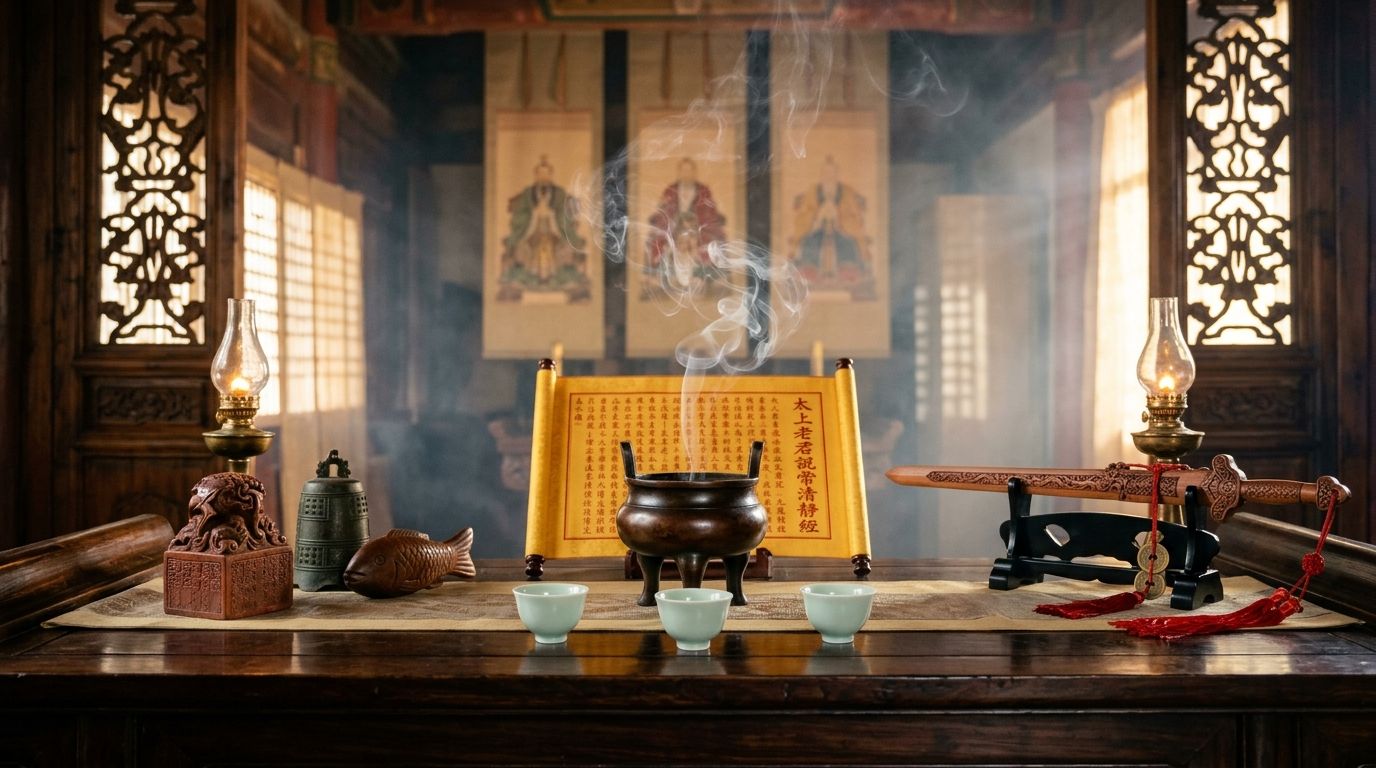
Arrange the surface of a clean, sturdy wooden table (such as elm, walnut, or oak):
- The Central Focus: Enshrine a consecrated statue of Taishang Laojun (Laozi), or hang an authentic hand-brushed Chinese calligraphy scroll inscribed with the sacred character DAO (道).
- The Bronze Incense Censer: Place a solid bronze tripod censer in the center, filled with clean, sifted plant ash.
- The Pure Water Offering: Position three clean white porcelain or celadon cups before the censer, filled daily with fresh spring water. In Taoist philosophy, water is the supreme physical mirror of virtue (Shang Shan Ruo Shui 上善若水—"The highest excellence is like water").
- Protective Implements: Enshrine an authentic seven-star peachwood sword on a wooden stand behind or beside the censer, accompanied by a consecrated lightning-struck jujube wood master seal.
Step 3: The Morning Offering Ritual (San Jing San Feng 三敬三奉)
Each morning upon waking, wash your face and hands, dress tidily, and approach the altar with a calm and reverent mind:
- Refresh the three cups with fresh, clean water using both hands.
- Light one stick of pure sandalwood incense (representing cosmic unity with the Dao) or three sticks (honoring the Three Pure Ones).
- Gently waft the flame out with your hand; never blow directly on altar incense with your mouth, as breath contains mortal impurities.
- Raise the incense with both hands to the level of your eyebrows (the Upper Dantian), bow three times respectfully, and insert the sticks vertically into the censer.
Step 4: Daily Inner Cultivation: Breathwork and Seated Forgetting
Sit comfortably before your altar on a meditation cushion with an upright, relaxed spine. Dedicate 15 to 20 minutes to daily inner cultivation:
- Diaphragmatic Breath (Tu Na 吐纳): Soften your belly. Inhale smoothly through your nose, guiding your breath down into the Lower Dantian (Xia Dantian 下丹田) located two inches below the navel. Exhale gently, releasing physical tension and emotional agitation.
- Seated Forgetting (Zuowang 坐忘): As articulated by Master Zhuangzi, let go of social labels, career anxieties, and intellectual calculations. Allow thoughts to dissolve like clouds across an expansive morning sky, resting in the luminous stillness of the Dao.
Step 5: Evening Gratitude and Dedication of Merit
Before retiring in the evening, pause briefly before your altar. Offer heartfelt gratitude for the guidance and protection received throughout the day. Dedicate any inner calm and clarity generated through your practice to the well-being of your family, your community, and all living beings.
7. The Global Relevance of the Tao Religion in the Modern Era
In our contemporary 21st-century civilization, characterized by hyper-speed technology, continuous sensory overstimulation, and ecological crisis, understanding what is Tao religion offers an urgent and healing perspective. The Tao religion does not advocate retreating from the world or denying human experience; rather, it teaches harmonious participation within the cosmic dance.
By revering the natural world through environmental balance, cultivating physical vitality through internal alchemy, and anchoring sacred space with consecrated heritage artifacts, the Tao religion preserves an unbroken sanctuary of clarity and peace. It gently reminds humanity that when we surrender artificial control, return to natural simplicity, and align with the cosmic rhythms of the universe, we effortlessly come home to the eternal Way.
Frequently Asked Questions (FAQ)
What is the primary difference between Daoist philosophy and the Tao religion?
In Western scholarship, a distinction is frequently made between Daojia (道家, philosophical Daoism) and Daojiao (道教, the Tao religion). While Daojia refers to the classical philosophical writings of Laozi and Zhuangzi on Wu Wei and metaphysics, Daojiao is the living, organized religious manifestation established in 142 CE under Celestial Master Zhang Daoling. The Tao religion adopts these classical philosophical texts as its sacred canonical scriptures, expanding them into a structured ecclesiastical tradition of ordained clergy (Daoshi 道士), sacred temple liturgies (Jiao 醮), internal alchemy (Neidan 内丹), moral precepts, and consecrated implements (Fawu 法物) designed for spiritual realization and cosmic harmony.
Is the Tao religion polytheistic or monotheistic?
The Tao religion is neither strictly monotheistic nor polytheistic in the Western theological sense; it is best understood as a pantheistic or panentheistic tradition. At its root is the Dao—the uncreated, formless, and boundless source of all that exists. The multitude of deities within the Taoist pantheon, led by the Three Pure Ones (Sanqing 三清), are not separate creators who rule from outside the cosmos, but direct personifications of primordial cosmic energies, celestial laws, and stellar forces emerging from the Dao. Devotees revere these beings as cosmic guides and energetic anchors rather than arbitrary judges.
Do followers of the Tao religion worship physical statues as idols?
No. In orthodox Daoist practice, statues and hanging scrolls are not worshipped as idols, but revered as consecrated energetic antennas (Xiang 象). Before a sacred image is enshrined, it undergoes the traditional rites of Kai Guang (开光, Opening the Light) and Zhuangzang (装脏, sacred cavity enshrinement with scriptures and precious minerals). This ceremony purifies the physical vessel and attunes it to the specific celestial frequency of the deity, enabling the practitioner to harmonize their own physical and spiritual Qi with the cosmic virtue represented by that celestial being.
How can a beginner practice the Tao religion without living near a temple?
A beginner can easily integrate the living essence of the Tao religion into daily life from home. The tradition emphasizes that the human body and domestic living space are sacred sanctuaries. You can begin by setting up a simple, clean altar with an incense burner, three cups of fresh spring water, and an image or calligraphy of the Dao. Practicing daily diaphragmatic breathing (Tu Na 吐纳), reading classical scriptures such as the Daodejing and Qingjing Jing, cultivating non-contention (Bu Zheng 不争) and natural action (Wu Wei 无为) in everyday relationships, and enshrining authentic consecrated implements (such as a peachwood sword or lightning jujube seal) allows any sincere seeker to connect directly with the living tradition.