Daoism Foundations · · 19 min read
What Is Tao? Unveiling the Cosmic Way, Sacred Philosophy, Lineage Traditions, and Consecrated Artifacts
What is Tao? Discover the meaning of Tao (道): from Laozi's Daodejing and cosmic Yin-Yang balance to Wu Wei, living altar rituals, and consecrated artifacts.
By Daoismart Editorial
On this page
- What Is Tao? Unveiling the Cosmic Way, Sacred Philosophy, Lineage Traditions, and Consecrated Artifacts
- 1. The Primordial Mystery: What Is Tao?
- The Etymology of the Character 道 (Dào)
- Canonical Revelation: Daodejing Chapter 1 & Chapter 25
- 2. The Three Dimensions of the Tao: Cosmic, Ontological, and Practical
- 1. The Cosmic Tao (Tiandao 天道): Nature’s Immutable Rhythm
- 2. The Ontological Tao (Benti Dao 本体道): The Unmanifest Mother of Being
- 3. The Ethical and Living Tao (Rendao 人道 & De 德): Walking the Path
- 3. Comprehensive Comparison Table: Authentic Taoist Doctrine vs. Western Misconceptions
- 4. The Supreme Sages of the Way: Laozi, Zhuangzi, and the Daozang Canon
- Laozi and the Water Philosophy (Shang Shan Ruo Shui)
- Zhuangzi: Transcendence, Freedom, and the Skillful Life
- The Sacred Canon: The Daozang (道藏)
- 5. Sacred Material Culture: Consecrated Implements (Fa Qi) as Vessels of the Tao
- Connoisseurship & Material Authenticity: Natural Heritage vs. Commercial Fakes
- The Sacred Liturgical Rite of Kai Guang (开光, Opening the Light)
- 6. Step-by-Step Practical Guide: Aligning with the Tao Through Daily Altar Practice
- Step 1: Mindful Purification of Body and Mind (Jing Shen Jing Shou 净身净手)
- Step 2: Offering the Three Pristine Waters (Sanqing Fengshui 三清奉水)
- Step 3: Presenting the Three Sandalwood Incense Sticks (Sanxiang Guige 三香规格)
- Step 4: Forming the Sacred Ziwu Hand Mudra (Ziwu Jue 子午诀)
- Step 5: Seated Breathing and Lower Dantian Stillness (Jingzuo Zuowang 静坐坐忘)
- 7. Frequently Asked Questions (FAQ)
- Q1: What is Tao in simple terms?
- Q2: Is the Tao considered a god or deity in Taoism?
- Q3: What is the relationship between the Tao and Wu Wei (无为)?
- Q4: How can one experience and cultivate harmony with the Tao today?
What Is Tao? Unveiling the Cosmic Way, Sacred Philosophy, Lineage Traditions, and Consecrated Artifacts
Key Takeaways (Executive Summary) - Direct Definition: When asking what is Tao (spelled Dào in Pinyin and written as 道), it denotes the ineffable, primordial origin, infinite cosmic law, and natural rhythm of the entire universe. - The Ineffable Source: As proclaimed in Chapter 1 of the Daodejing (道德经), "The Tao that can be spoken of is not the eternal Tao." It is the formless mother of Heaven and Earth, sustaining the Ten Thousand Things (Wanwu 万物) without possessing them. - Complementary Pillars: The inquiry into what is Tao spans both contemplative philosophy (Daojia 道家)—championing effortless action (Wu Wei 无为) and spontaneous authenticity (Ziran 自然)—and liturgical religion (Daojiao 道教), preserving orthodox altar rituals and spiritual cultivation. - Dynamic Cosmology: The Tao unfolds through a precise cosmological progression: from primordial formlessness (Wuji 无极) emerges supreme polarity (Taiji 太极), which balances into Yin and Yang (阴阳) to animate all physical creation. - Living Sacred Material Culture: Understanding what is Tao requires moving beyond abstract theory into embodied cultivation. Through authentic consecrated implements (Fa Qi 法器)—crafted from lightning-struck jujube wood (雷击枣木), seasoned peach wood (桃木), and pure mineral cinnabar (朱砂)—practitioners harmonize physical space through the lineage rite of Kai Guang (开光, Opening the Light).
1. The Primordial Mystery: What Is Tao?
Few questions have captivated humanity’s philosophical imagination as profoundly as: what is Tao? Across millennia, emperors, hermits, poets, and modern seekers have looked into the stillness of the cosmos, seeking to decipher this enigmatic single syllable.
When we ask what is Tao, we are not inquiring about a rigid dogma, an anthropomorphic creator, or a distant celestial judge. In orthodox Chinese metaphysics, Tao (道, Dào) is simultaneously the transcendent wellspring of all reality, the underlying mechanical rhythm of nature, and the practical path of human enlightenment.
The Etymology of the Character 道 (Dào)
To comprehend what is Tao, one must examine the ancient ideogram itself. In classical Chinese orthography, the character 道 is composed of two distinct radical elements:
- 首 (Shǒu): Meaning "head," "mind," "source," or "leader." It signifies conscious awareness, primary origin, and the guiding intelligence of the universe.
- 辶 / 辵 (Chuò): Meaning "to walk," "to journey," "motion," or "a pathway." It depicts movement through time and space.
Synthesized together, 道 (Dào) visually and conceptually reveals its true meaning: to walk with awareness along the primordial path of the cosmos. The Tao is not static dogma; it is active walking. It is not an abstract concept to be memorized, but an organic river of reality in which we are already swimming.
Canonical Revelation: Daodejing Chapter 1 & Chapter 25
In answering what is Tao, the foundational text of Taoism, the Daodejing (道德经), composed by the supreme sage Laozi (老子) around the 6th century BCE, opens with an immortal paradox:
"The Tao that can be spoken of is not the eternal Tao; The name that can be named is not the eternal name. The Nameless is the origin of Heaven and Earth; The Named is the mother of all things." — Daodejing, Chapter 1 (道可道,非常道;名可名,非常名。无名天地之始,有名万物之母。)
Laozi explains that language is finite, whereas the Tao is infinite. Any intellectual box we build to define what is Tao immediately limits its boundless nature. Yet, in Chapter 25, Laozi provides our most intimate metaphysical glimpse into this cosmic reality:
"There is a thing indistinct yet complete, born before Heaven and Earth. Silent and solitary, standing alone and unchanging, revolving endlessly without exhaustion. It may be regarded as the Mother of the world. I do not know its name; I designate it as Tao, and forced to give it a name, I call it Great." — Daodejing, Chapter 25 (有物混成,先天地生。寂兮寥兮,独立而不改,周行而不殆,可以为天下母。吾不知其名,字之曰道,强为之名曰大。)
2. The Three Dimensions of the Tao: Cosmic, Ontological, and Practical
To unravel what is Tao with academic precision and spiritual clarity, classical Taoist scholarship analyzes the concept across three interdependent dimensions:
1. The Cosmic Tao (Tiandao 天道): Nature’s Immutable Rhythm
The Cosmic Tao manifests as the grand cycles of the macrocosm. It is observed in the inexorable succession of day and night, the four seasons, the orbital mechanics of the celestial stars, and the balance of the Five Elements (Wuxing 五行: Wood, Fire, Earth, Metal, Water).
The Cosmic Tao does not demand worship, nor does it operate with emotional preference. As Laozi observed in Chapter 5: "Heaven and Earth are not benevolent; they treat the ten thousand things as straw dogs (天地不仁,以万物为刍狗)." This does not mean the cosmos is cruel; rather, it is completely impartial, nurturing all life with perfect equanimity.
2. The Ontological Tao (Benti Dao 本体道): The Unmanifest Mother of Being
Ontologically, what is Tao points to the paradox of Non-Being (Wu 无) and Being (You 有). The Tao is empty, yet infinitely inexhaustible. Chapter 42 of the Daodejing charts this divine generation of reality:
"The Tao produced One; One produced Two; Two produced Three; Three produced the Ten Thousand Things. The Ten Thousand Things carry Yin on their backs and embrace Yang in their arms, harmonizing these two energetic currents into pristine balance." — Daodejing, Chapter 42 (道生一,一生二,二生三,三生万物。万物负阴而抱阳,冲气以为和。)
- From Tao to One: The Tao condenses into the unified, primordial field of cosmic breath (Yuanqi 元气).
- From One to Two: Yuanqi polarizes into Yin (阴, Receptive, Dark, Cooling) and Yang (阳, Active, Light, Warming).
- From Two to Three: The dynamic interplay of Yin and Yang produces the dynamic middle harmonic (Chongqi 冲气).
- From Three to All Things: From this harmonic resonance crystallize all minerals, plants, animals, and human beings.
3. The Ethical and Living Tao (Rendao 人道 & De 德): Walking the Path
When the Tao is embodied within human consciousness and daily action, it is called De (德), often translated as "Virtue," "Inner Power," or "Spiritual Potency." If the Tao is the cosmic blueprint, De is the manifestation of that blueprint in human life. To live in De is to act without self-aggrandizement, greed, or violent contrivance, allowing nature to complete its work through us.
3. Comprehensive Comparison Table: Authentic Taoist Doctrine vs. Western Misconceptions
For centuries, Western popular culture has flattened or misunderstood the profound metaphysical reality of what is Tao. The comparative table below dispels superficial myths and articulates authentic lineage doctrine:
- Ontological Nature — Authentic Taoist Lineage Doctrine: The nameless, uncreated, impersonal principle and matrix of all reality (Wuji & Taiji). · Western Pop-Culture Misconception: Often confused with a personified Western "God" or an emotional cosmic superhero. · Canonical Source & Altar Application: Daodejing Ch. 1; visualized on the altar as the unpainted wooden tablet of the Three Pure Ones (Sanqing).
- Concept of Action (Wu Wei 无为) — Authentic Taoist Lineage Doctrine: Effortless, unforced alignment with natural law; highly skilled non-interference. · Western Pop-Culture Misconception: Mistaken as passive fatalism, sheer laziness, or complete inaction. · Canonical Source & Altar Application: Zhuangzi (Cook Ding story); cultivated through meditative stillness (Jingzuo) and focused craft.
- Spiritual Moral Order — Authentic Taoist Lineage Doctrine: Spontaneous equilibrium (Ziran 自然); harmony through self-correction and balance. · Western Pop-Culture Misconception: Assumed to be rigid authoritarian commandments and dogmatic guilt. · Canonical Source & Altar Application: Taishang Ganying Pian (太上感应篇); living gently with all creatures and honoring ancestors.
- Matter and Physical Existence — Authentic Taoist Lineage Doctrine: Physical matter is condensed Qi (Qi Ju wei Xing 气聚为形); the physical body is a sacred temple. · Western Pop-Culture Misconception: Misinterpreted as an illusion to escape (escapism) or corrupt sinful flesh. · Canonical Source & Altar Application: Daozang alchemical scrolls; revered through dietary purity, tea arts, and physical Longevity arts (Yangsheng).
- Ritual & Sacred Implements (Fa Qi 法器) — Authentic Taoist Lineage Doctrine: Consecrated objects act as tangible acoustic resonators linking human Qi with the Celestial Tao. · Western Pop-Culture Misconception: Dismissed as "primitive idol worship" or empty commercial superstition. · Canonical Source & Altar Application: Orthodox Kai Guang (开光) rites; utilizing authentic lightning-struck jujube wood and natural cinnabar.
- The Ultimate Goal — Authentic Taoist Lineage Doctrine: Harmony with nature (Tianren Heyi 天人合一); return to primordial simplicity (Pu 朴). · Western Pop-Culture Misconception: Western conquest of nature, relentless material accumulation, and ego triumph. · Canonical Source & Altar Application: Daodejing Ch. 16; sitting in quietude to observe the return of all things to their roots.
4. The Supreme Sages of the Way: Laozi, Zhuangzi, and the Daozang Canon
One cannot explore what is Tao without consulting the two luminous minds whose writings form the bedrock of classical Chinese wisdom: Laozi (老子) and Zhuangzi (庄子), alongside the vast ecclesiastical treasury of the Daoist Canon (Daozang 道藏).
Laozi and the Water Philosophy (Shang Shan Ruo Shui)
Laozi’s primary teaching on what is Tao centers upon the supreme metaphor of Water (水, Shuǐ). In Chapter 8 of the Daodejing, he writes:
"The highest good is like water. Water nourishes all things without competing with them. It settles in places that men disdain, and therefore it comes closest to the Tao." — Daodejing, Chapter 8 (上善若水。水善利万物而不争,处众人之所恶,故几于道。)
Water embodies every attribute of the Tao:
- It is supremely soft, yet it carves stone and breaks mountains.
- It flows downward to the humblest valleys, seeking the low position rather than the peak.
- It takes the shape of whatever vessel holds it, possessing infinite adaptability without losing its core essence.
Zhuangzi: Transcendence, Freedom, and the Skillful Life
Two centuries after Laozi, the brilliant literary genius Zhuangzi (庄子) expanded our understanding of what is Tao through irony, humor, and cosmic liberation in the Nanhuajing (南华经).
In his celebrated chapter "The Secret of Caring for Life" (Yang Sheng Zhu 养生主), Zhuangzi recounts the parable of Cook Ding (Paoding 庖丁) carving an ox for King Wenhui. Cook Ding’s knife slipped effortlessly between the joints without hacking or dulling the blade, because he perceived the invisible spaces between bones rather than the dense carcass. When asked about his secret, Ding smiled:
"What I love is the Tao, which goes beyond mere skill. When I cut up an ox, I do not see with my eyes; I perceive with my spirit. I follow the natural grain of things."
To discover what is Tao in daily life is to develop Cook Ding’s awareness: finding the spacious, effortless path through the thickest entanglements of human society.
The Sacred Canon: The Daozang (道藏)
Beyond philosophy, Taoism was preserved across two millennia by dedicated monastic and liturgical lineages: the Quanzhen (全真, Complete Reality) tradition founded by Wang Chongyang, and the Zhengyi (正一, Orthodox Unity) tradition founded by Zhang Daoling.
Their comprehensive library, the Daozang (道藏)—canonized in 1445 CE during the Ming Dynasty—contains 5,485 scrolls spanning meditation manuals, herbal pharmacopeias, talismanic codices, liturgical hymns, and cosmology. It proves that the Tao has always been a complete living civilization, uniting physical health, metaphysical contemplation, and liturgical worship.
5. Sacred Material Culture: Consecrated Implements (Fa Qi) as Vessels of the Tao
In orthodox Taoist philosophy, there is no ontological division between the spiritual and the physical. Spirit (Shen 神) and matter (Xing 形) are both expressions of cosmic breath (Qi 气). Therefore, sacred implements (Fa Qi 法器) are not decorative trinkets; they are precision acoustic instruments designed to anchor the formless Tao within physical sanctuaries.
Connoisseurship & Material Authenticity: Natural Heritage vs. Commercial Fakes
For modern collectors and spiritual practitioners, identifying authentic sacred materials is vital to cultivating genuine resonance with the Tao:
- Lightning-Struck Jujube Wood (雷击枣木) — Orthodox Botanical / Mineral Standard: Naturally split by celestial mountain thunderbolts; extremely dense; roasted caramel undertone; dark grain. · Commercial Fake Warning: Industrially electrocuted timber or regular wood scorched with blowtorches. · Spiritual Energetic Resonance: Bears Tianhuo (天火, Celestial Fire); supreme for carving Taiji Bagua Lineage Seals (法印) to command turbulent energies.
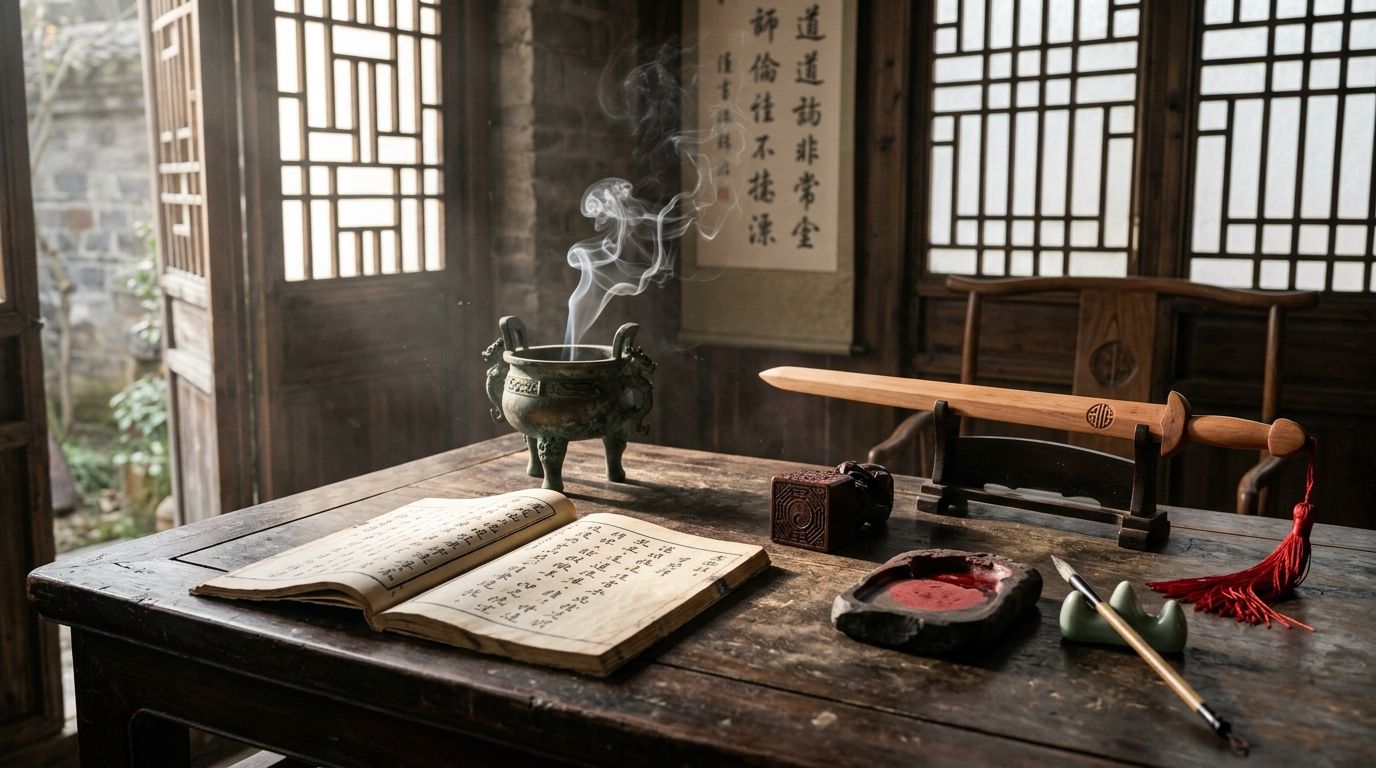
- Aged Mountain Peach Wood (Taomu 桃木) — Orthodox Botanical / Mineral Standard: Old mountain peach tree wood dried over 3+ years; pale reddish-tan hue; silky hand-feel. · Commercial Fake Warning: Chemically bleached pine or molded toxic polyresin mass-stamped in factories. · Spiritual Energetic Resonance: Resonates with Spring Solar Yang; crafted into Peach Wood Swords (桃木剑) to dissolve disharmonious Sha Qi.
- Natural Mineral Cinnabar (Zhusha 朱砂) — Orthodox Botanical / Mineral Standard: Natural mercuric sulfide mined from deep crystalline geothermal veins; heavy weight; sub-metallic luster. · Commercial Fake Warning: Toxic dyed plastic powder mixed with red chemical dyes and heavy glues. · Spiritual Energetic Resonance: Pure Earth-Core Yang energy; utilized to inscribe sacred talismans (Fu Lu 符箓) and dot apertures during consecration.
- Aged Laoshan Sandalwood (老山檀香) — Orthodox Botanical / Mineral Standard: Naturally aged heartwood from mature trees; buttery, creamy, lingering balsamic aroma. · Commercial Fake Warning: Sawdust compressed with synthetic petroleum perfumes, producing pungent acrid smoke. · Spiritual Energetic Resonance: Transmutes chaotic mental chatter; purifies indoor Qi; lifts human prayer to the celestial registers.
- Wild Jiangzhen Incense (降真香) — Orthodox Botanical / Mineral Standard: Resinous ancient liana wood documented in the Daozang for invoking divine immortals. · Commercial Fake Warning: Ordinary scrap wood dyed brown and sprayed with cheap chemical musk. · Spiritual Energetic Resonance: Supreme incense for grand altar invocations, pacifying the Five Spirits and aligning the body's internal meridians.
The Sacred Liturgical Rite of Kai Guang (开光, Opening the Light)
An uninitiated wooden carving or bronze vessel remains inert until awakened through the liturgical mystery of Kai Guang (开光). Administered strictly by an ordained Taoist priest (Daoshi 道士) who has undergone ritual fasting and water purification, this sacred procedure includes:
- Sanctuary Cleansing (Jing Tan 净坛): Chanting the Jingtiandi Shenzhou (净天地神咒) while sprinkling pure spring water with fresh peach leaves to clear lingering stale Qi.
- Celestial Invocations (Qingshen 请神): Burning authentic sandalwood to call upon the presence of the Three Pure Ones (Sanqing 三清) and the ancestral masters.
- Internal Breath Transmutation (Zhu Qi 注炁): The Daoshi focuses mind and breath at the Lower Dantian (下丹田), gathering cosmic Yang Qi and projecting it through sacred hand mudras into the artifact.
- Consecration of Apertures (Dian Yan 点眼): Using a virgin wolf-hair brush dipped in purified mineral cinnabar ink, the master dots the symbolic eyes, ears, mouth, and heart of the implement, awakening its spiritual resonance.
- Internal Organ Loading (Zhuangzang 装脏): For consecrated statues and vessels, five-color silk threads, medicinal roots, precious mineral stones, and miniature scripture scrolls are sealed inside the relic cavity, breathing living cosmic life into the form.
6. Step-by-Step Practical Guide: Aligning with the Tao Through Daily Altar Practice
How does a modern practitioner step beyond intellectual curiosity about what is Tao into daily embodied peace? The most effective lineage method is establishing a dedicated domestic altar (Tan 坛) and engaging in the classical morning offering protocol (Chenzhao Fenggong 晨朝奉供).
Follow this five-step daily cultivation protocol:
Step 1: Mindful Purification of Body and Mind (Jing Shen Jing Shou 净身净手)
Perform this practice during the dawn hours, ideally during the Mao Hour (卯时, 5:00 AM – 7:00 AM), when the day’s primordial Yang Qi begins its gentle ascent.
- Cleanse hands and face thoroughly with cool water; rinse the mouth to purify physical speech.
- Approach your altar space with quiet reverence; gently wipe the rosewood or cedar altar surface with a dedicated silk cloth.
- Take three slow, expansive abdominal breaths through the nostrils, allowing all mental anxiety and daily rushing to evaporate.
Step 2: Offering the Three Pristine Waters (Sanqing Fengshui 三清奉水)
Take three small white porcelain or celadon offering cups filled with fresh natural spring water or light mountain green tea. Place them horizontally across the center of the altar table:
- Center Cup: Dedicated to Yuanshi Tianzun (元始天尊), the Heavenly Worthy of Primordial Beginning, embodying the unmanifest Tao and Universal Source.
- Left Cup (Observer's Left): Dedicated to Lingbao Tianzun (灵宝天尊), the Heavenly Worthy of Numinous Treasure, representing the sacred scriptures and cosmic law.
- Right Cup (Observer's Right): Dedicated to Daode Tianzun (道德天尊), the Heavenly Worthy of Way and Virtue (Laozi), representing the living lineage teachers.
The water represents pristine stillness, uncorrupted purity, and the motherly nourishment of the Tao.
Step 3: Presenting the Three Sandalwood Incense Sticks (Sanxiang Guige 三香规格)
Ignite three slender sticks of pure aged Laoshan sandalwood or natural agarwood. Extinguish the flame with a gentle wave of the hand—never blow upon sacred incense with human breath:
- Hold the three lit sticks between both palms at brow level, bowing from the waist in deep gratitude.
- Insert the three sticks vertically into the bronze or celadon censer from left to right:
- Center Stick First: Honoring the Dao (Dao Xiang 道香).
- Left Stick Second: Honoring the Sacred Teachings (Jing Xiang 经香).
- Right Stick Third: Honoring the Sages and Lineage Masters (Shi Xiang 师香).
- Keep the sticks aligned and upright, embodying an unswerving upright heart (Zheng Xin 正心).
Step 4: Forming the Sacred Ziwu Hand Mudra (Ziwu Jue 子午诀)
Stand or sit with spine naturally upright, bringing both hands together at the solar plexus to form the orthodox Ziwu Mudra (子午诀):
- Fold your left hand fingers gently around your right thumb.
- Place the tip of your left thumb at the base of your left ring finger (the Zi 子 coordinate, symbolizing North, Midnight, and Primordial Water).
- Touch the tip of your right thumb to the tip of your right middle finger (the Wu 午 coordinate, symbolizing South, Midday, and Celestial Fire).
- This ancient hand mudra seals the energetic meridians of the upper and lower body, blending Fire and Water in alchemical harmony (Kan-Li Jiao-Gou 坎离交媾).
Step 5: Seated Breathing and Lower Dantian Stillness (Jingzuo Zuowang 静坐坐忘)
Sit quietly upon a round meditation cushion before the altar for 15 to 20 minutes:
- Rest the tip of your tongue gently against the upper palate of your mouth.
- Settle your awareness into the Lower Dantian (下丹田), two inches beneath the navel.
- Breathe naturally without forcing, feeling the abdomen expand softly on inhalation and release on exhalation.
- Practice Zuowang (坐忘, Sitting in Forgetfulness): observe all thoughts arise like passing clouds and dissolve back into the silence of the Tao.
7. Frequently Asked Questions (FAQ)
Q1: What is Tao in simple terms?
Answer: In simple terms, Tao (道, Dào) is the primordial origin, cosmic order, and effortless flow of the universe. Literally translated as "The Way" or "The Path," Tao is both the transcendent source from which all existence springs and the immanent, natural rhythm governing how life unfolds. Rather than a personal creator God, the Tao is the unforced, self-sustaining harmony behind nature, daylight, seasons, and human consciousness.
Q2: Is the Tao considered a god or deity in Taoism?
Answer: No, the Tao itself is not an anthropomorphic deity, personified creator, or judgmental god. In Taoist metaphysics, the Tao is the nameless, formless, boundless cosmic principle (Wuji 无极) preceding all physical and celestial forms. However, in liturgical religious Taoism (Daojiao 道教), the profound virtues and manifestations of the Tao are personified as supreme celestial deities, foremost among them the Three Pure Ones (Sanqing 三清), and historical sages like Laozi deified as Taishang Laojun (太上老君), serving as celestial bridges for human reverence and liturgy.
Q3: What is the relationship between the Tao and Wu Wei (无为)?
Answer: Wu Wei (无为) is the practical human embodiment of the Tao. Often translated as "non-action" or "effortless action," Wu Wei does not mean idleness or apathy. Instead, it denotes action free from contrivance, ego-driven grasping, or artificial force—moving in pure alignment with the natural grain of the Tao, just as water effortlessly carves canyons and flows around boulders without strain. Living Wu Wei allows one's internal Qi to harmonize seamlessly with the cosmic flow of the Tao.
Q4: How can one experience and cultivate harmony with the Tao today?
Answer: One cultivates the Tao through both internal contemplation and tangible lineage practices. Internally, practices such as Neidan (内丹, internal alchemy), diaphragmatic Lower Dantian breathing, and Zuowang (坐忘, sitting in forgetfulness) quiet mental noise and restore primordial Qi. Externally, maintaining a clean home sanctuary altar (Tan 坛), burning pure aged sandalwood or Jiangzhen incense, and interacting with authentic consecrated implements (Fa Qi 法器)—such as lightning-struck jujube wood seals or peach wood swords activated through orthodox Kai Guang (开光)—anchors tranquil cosmic harmony amidst daily modern life.
Authored by the Daoist Cultural Heritage & Sacred Arts Curatorial Guild. All rituals, canonical citations, and connoisseurship guidelines conform to orthodox Daozang liturgical standards.