Daoism Foundations · · 25 min read
What Is Daoism? Core Beliefs, Ancient History, Sacred Texts, and Living Altar Practices
Discover what is Daoism through its core philosophy, history, sacred texts, and living altar rites. Explore Wu Wei, Yin-Yang, and consecrated arts.
By Daoismart Editorial
On this page
- What Is Daoism? Core Beliefs, Ancient History, Sacred Texts, and Living Altar Practices
- 1. Demystifying the Great Way: Defining What Is Daoism Beyond Modern Misconceptions
- Deconstructing Pop-Culture Misconceptions
- 2. The Historical Tapestry: From Sage-Hermits to Canonical Lineages
- 1. The Classical Sage Era: Laozi and the Daodejing
- 2. The Mystical Flourishing: Zhuangzi
- 3. The Liturgical Foundation: Celestial Masters (Zhengyi Dao)
- 4. The Monastic Synthesis: Complete Reality (Quanzhen Dao)
- 3. Foundational Metaphysics: The Core Pillars of Daoist Wisdom
- 1. The Primordial Sequence: Wuji, Taiji, and Wanwu
- 2. Wu Wei (无为): The Art of Effortless Action
- 3. Ziran (自然): Spontaneous Authenticity
- 4. Yin-Yang and Wuxing: The Dynamic Rhythm of Change
- 4. Comprehensive Comparative Matrix: Philosophical Daoism (Daojia) vs. Liturgical Daoism (Daojiao)
- 5. Sacred Implements & Liturgical Arts: Embodying the Formless into Form
- 1. Sacred Natural Materials vs. Industrial Counterfeits
- 2. The Sacred Rite of Kai Guang (开光, Opening the Light)
- 6. Step-by-Step Practical Guide: Establishing an Authentic Daoist Morning Sanctuary Protocol
- Environmental Guidelines and Altar Taboos:
- Step-by-Step Liturgical Sequence:
- 7. Internal Alchemy (Neidan 内丹) and Daily Living: Walking the Way in Modern Society
- The Three Treasures (Sanbao 三宝) of Human Life:
- Living as Water in the Modern World
- 8. Frequently Asked Questions (FAQ)
- Q1: What is Daoism in simple terms?
- Q2: What is the difference between Daoism, Confucianism, and Buddhism?
- Q3: What is the difference between Daojia (philosophical Daoism) and Daojiao (religious Daoism)?
- Q4: How can a modern beginner begin practicing Daoism at home?
- 9. Conclusion: Walking the Way in the Modern Era
What Is Daoism? Core Beliefs, Ancient History, Sacred Texts, and Living Altar Practices
Key Takeaways (Executive Summary) - Direct Definition: To answer what is daoism at its metaphysical core: Daoism (also spelled Taoism) is an ancient Chinese indigenous philosophical, spiritual, and liturgical tradition dedicated to living in conscious alignment with the Dao (道, The Way)—the primordial, unnamable cosmic source and generative rhythm of all manifest reality. - The Dual Facets (Daojia & Daojiao): Authentic Daoism comprises two interdependent dimensions: Daojia (道家), the foundational philosophical tradition articulated by sages Laozi (老子) and Zhuangzi (庄子); and Daojiao (道教), the organized liturgical and religious lineages established by Celestial Master Zhang Daoling (张道陵) and later monastic masters. - Core Metaphysical Pillars: Daoist thought rests upon four central cosmic principles: Wu Wei (无为, effortless natural action), Ziran (自然, primordial spontaneity), the dynamic polarity of Yin and Yang (阴阳), and the perpetual transformation of the Five Elements (Wuxing 五行). - Sacred Literature: The canonical foundation of the tradition spans Laozi's 5,000-character Daodejing (道德经), the mystical allegories of the Zhuangzi (庄子), and the monumental 5,485-volume Daozang (道藏, Daoist Canon). - Living Altar Traditions & Consecrated Implements: In orthodox practice, the formless Dao is bridged into physical reality through consecrated ritual implements (Fa Qi 法器)—carved from sacred materials such as lightning-struck jujube wood (雷击枣木), seasoned peach wood (桃木), and pure mineral cinnabar (朱砂)—activated through the sacred lineage rite of Kai Guang (开光, Opening the Light).
1. Demystifying the Great Way: Defining What Is Daoism Beyond Modern Misconceptions
Across the modern landscape of global spirituality and cross-cultural philosophy, few traditions are as profoundly admired yet frequently misunderstood as Daoism. For many in the Western world, the term conjures fragmented impressions: graceful slow-motion movements of Tai Chi in public parks, stylized Yin-Yang symbols adorning martial arts studios, or charming folk proverbs regarding 'going with the flow.'
Yet, when we ask sincerely from the perspective of classical sinology and living monastic lineage: what is daoism?
At its most essential, Daoism is an unbroken, 2,500-year-old tradition that serves as both a comprehensive cosmological philosophy and a sophisticated liturgical religion. The word itself derives from Dao (道), literally translating to "way," "path," or "course," but conceptually signifying the eternal, undefinable, self-generating wellspring from which the entire cosmos arises, expands, and into which it ultimately returns. To this is joined Jiao (教), meaning "teaching," "transmission," or "sacred lineage."
Deconstructing Pop-Culture Misconceptions
To grasp what is daoism in its genuine integrity, one must first strip away several pervasive modern misinterpretations:
- Misconception: Daoism is mere passive fatalism or laziness.
The Orthodox Truth: The central Daoist doctrine of Wu Wei (无为) is frequently mistranslated as "doing nothing" or "non-action." In authentic Daoist metaphysics, Wu Wei means uncontrived action—acting in supreme effortless harmony with natural laws, without forced ego, artificial friction, or aggressive self-assertion. Like water carving its course effortlessly through stone, Wu Wei is supremely potent and radically effective.
- Misconception: Daoism is merely an abstract philosophy, not a practical religion.
The Orthodox Truth: While academic Western textbooks historically separated philosophical Daoism (Daojia 道家) from religious ritual Daoism (Daojiao 道教), living Chinese tradition views them as the root and branches of a single sacred tree. Without deep philosophical insight, ritual degenerates into empty superstition; without ritual embodiment and internal cultivation (Neidan 内丹), philosophy remains impotent intellectual theory.
- Misconception: Daoism promotes superstition or fortune-telling fear.
The Orthodox Truth: Orthodox Daoism, whether practiced in the towering temples of Mount Longhu or the misty hermitages of Mount Wudang, is grounded in objective cosmic naturalism. It teaches Tian Ren He Yi (天人合一)—the seamless unity of Heaven, Earth, and humanity. Sacred rituals, consecrated talismans, and altar offerings do not seek to bribe capricious deities, but rather to harmonize human energetic frequencies (Qi 炁) with the macrocosmic order of the universe.
2. The Historical Tapestry: From Sage-Hermits to Canonical Lineages
The historical evolution of Daoism reflects an organic journey of deepening revelation, transitioning from pre-axial shamanic nature worship to sophisticated classical philosophy, and ultimately blossoming into structured ecclesiastical lineages.
1. The Classical Sage Era: Laozi and the Daodejing
In the 6th century BCE, during the tumultuous Spring and Autumn period, an archivist of the imperial Zhou court named Li Er (李耳), reverently known as Laozi (老子, The Old Master), observed the moral decay and political violence of his era. Choosing seclusion, he rode a water buffalo westward toward the Hangu Pass.
At the frontier, the gatekeeper Yin Xi (尹喜) recognized his spiritual stature and implored him to leave behind his wisdom before vanishing into the western mountains. Laozi paused to brush five thousand sacred Chinese characters, creating the immortal Daodejing (道德经, The Classic of the Way and Its Virtue). In eighty-one succinct chapters of profound poetic cadence, the text unveiled the paradoxes of nature, the virtue of softness, the perils of hubris, and the supreme mystery of the unnamable Dao.
2. The Mystical Flourishing: Zhuangzi
In the 4th century BCE, the philosopher Zhuang Zhou (庄周, Zhuangzi) expanded Laozi's insights through radiant allegories, razor-sharp wit, and mystical paradoxes. In masterpieces such as Xiaoyaoyou (逍遥游, Free and Easy Wandering) and the celebrated parable of the Butterfly Dream (Zhuang Zhou Meng Die 庄周梦蝶), Zhuangzi invited seekers to dissolve the rigid boundaries of human ego, question conventional societal categories, and wander unbound in the infinite vastness of the cosmos.
3. The Liturgical Foundation: Celestial Masters (Zhengyi Dao)
By 142 CE, during the Eastern Han Dynasty, Daoism transitioned from decentralized philosophical hermitages into an organized religious tradition. On Mount Heming (鹤鸣山) in Sichuan, Zhang Daoling (张道陵) received a direct celestial revelation from the deified Laozi (Taishang Laojun 太上老君).
Designated as the first Tian Shi (天师, Celestial Master), Zhang Daoling established Tianshi Dao (天师道), today known as the Zhengyi (正一, Orthodox Unity) lineage. This tradition introduced structured liturgical registers, protective talismanic arts (Fu Lu 符箓), community altars, and ritual covenants designed to cure illness, harmonize spirits, and protect villages from ecological and social disaster. Zhengyi priests marry, live within communities, and pass sacred liturgical registers down through generational family lineages.
4. The Monastic Synthesis: Complete Reality (Quanzhen Dao)
In the 12th century, during the Jin and Yuan dynasties, Master Wang Chongyang (王重阳) founded Quanzhen Dao (全真道, The Way of Complete Reality) in northern China. Quanzhen synthesized the profound internal meditation of Daoism with the ethical discipline of Confucianism and the monastic mindfulness of Chan Buddhism.
Its disciples, led by the renowned Seven Immortals of the North (Beiqi Zhen 北七真), took strict monastic vows of celibacy, vegetarianism, and communal austerity. Center staging Neidan (内丹, Internal Alchemy) over external laboratory alchemy (Waidan 外丹), Quanzhen established major monastic epicenters such as the White Cloud Temple (Baiyun Guan 白云观) in Beijing and Mount Wudang in Hubei, preserving sacred meditative practices that continue uninterrupted to this day.
3. Foundational Metaphysics: The Core Pillars of Daoist Wisdom
To comprehend what is daoism at its cosmological foundation, one must understand how ancient Daoist masters mapped the architecture of reality. Far from proposing a universe created by a whimsical anthropomorphic ruler, Daoism articulates an organic, self-organizing fractal cosmos.
1. The Primordial Sequence: Wuji, Taiji, and Wanwu
As canonized in Chapter 42 of the Daodejing:
道生一,一生二,二生三,三生万物。万物负阴而抱阳,冲气以为和。 "The Dao generates the One; the One generates the Two; the Two generate the Three; the Three generate the ten thousand things. All things carry Yin on their backs and embrace Yang in their arms, harmonizing these breaths to achieve oneness."
- Wuji (无极, The Boundless): The state of primordial, unmanifest stillness before time, space, and form emerge. It is represented traditionally as an empty, pristine circle.
- Taiji (太极, The Supreme Ultimate): The primordial stirring of vital breath (Yuanqi 元炁). Taiji is the dynamic threshold where polarity emerges from the void.
- Liangyi (两仪, The Two Polarities): The division into Yin (阴) and Yang (阳).
- Wanwu (万物, The Ten Thousand Things): The infinite, shimmering tapestry of all living beings, physical materials, and celestial phenomena.
2. Wu Wei (无为): The Art of Effortless Action
Wu Wei is perhaps the most transformative ethical and spiritual concept in Daoism. It does not mean indolence or paralysis. Rather, it denotes action that is completely devoid of egotistical striving, contrivance, and counter-productive force.
Water is the consummate physical teacher of Wu Wei:
"Nothing in the world is as soft and yielding as water, yet for dissolving the hard and inflexible, nothing can surpass it." (Daodejing, Chapter 78).
Water never battles against the contours of the earth; it flows effortlessly into every hollow, nourishes all vegetation without demanding praise, and yet possesses the unstoppable capacity to carve profound canyons through solid granite. To practice Wu Wei is to align so deeply with circumstance that one achieves maximal impact with zero wasted energetic friction.
3. Ziran (自然): Spontaneous Authenticity
In classical Chinese, Ziran literally signifies "of itself so" or "self-so-ness." It represents the inherent, unforced naturalness of all things when left uncorrupted by artificial manipulation.
In Daoist ecology, trees do not force themselves to blossom, stars do not labor to illuminate the night sky, and seasonal rains do not require central committees. Everything fulfills its authentic inner virtue (De 德) spontaneously. For humans, returning to Ziran means stripping away societal pretension, social masks, and consumer greed to rediscover the pure, uncarved block (Pu 朴) of original consciousness.
4. Yin-Yang and Wuxing: The Dynamic Rhythm of Change
Daoism views physical reality not as static matter, but as pulsating energetic fields in continuous transformation:
- Yin (阴): Associated with the earth, the moon, darkness, receptivity, winter, interiority, and cooling stillness.
- Yang (阳): Associated with the heavens, the sun, radiance, creativity, summer, exteriority, and warming movement.
Neither Yin nor Yang is considered morally superior; both are indispensable polarities of the same single cosmic breath (Qi 炁). When Yang reaches its peak, Yin is inevitably born; when Yin reaches its absolute depth, Yang rekindles.
This rhythmic progression manifests through the Five Phases (Wuxing 五行):
- Wood (木): Upward expansion, spring dawn, generative growth.
- Fire (火): Upward radiant heat, summer midday, illumination.
- Earth (土): Central stability, late summer, grounding nourishment.
- Metal (金): Inward condensation, autumn dusk, refined clarity.
- Water (水): Downward fluidity, winter midnight, deep restorative storage.
4. Comprehensive Comparative Matrix: Philosophical Daoism (Daojia) vs. Liturgical Daoism (Daojiao)
To systematically clarify the relationship between the philosophical tradition and the living religious priesthood, examine the detailed comparison matrix below:
- Historical Emergence — Philosophical Daoism (Daojia 道家): Pre-Qin Period (~6th–4th c. BCE); sage-scholars and recluse hermits · Liturgical / Religious Daoism (Daojiao 道教): Eastern Han Dynasty (142 CE) onward; formal ecclesiastical orders · Integrated Living Practice: Unbroken 2,500-year continuous lineage tradition
- Primary Canonical Canons — Philosophical Daoism (Daojia 道家): Daodejing (道德经), Zhuangzi (庄子), Liezi (列子) · Liturgical / Religious Daoism (Daojiao 道教): Daozang (道藏, 5,485 volumes), liturgical registers, talismanic manuals · Integrated Living Practice: Scripture chanting, philosophical study, and contemplation
- Central Perspective on the Dao — Philosophical Daoism (Daojia 道家): The formless cosmic Source, natural law, and metaphysical principle · Liturgical / Religious Daoism (Daojiao 道教): Both cosmic principle and celestial deities (e.g., Sanqing 三清, Three Pure Ones) · Integrated Living Practice: Source of divine virtue and living spiritual presence
- Ultimate Goal of Cultivation — Philosophical Daoism (Daojia 道家): Mental peace, freedom from social illusion, effortless Wu Wei · Liturgical / Religious Daoism (Daojiao 道教): Longevity, transcendence, immortality (Xian 仙), and spiritual liberation · Integrated Living Practice: Holistic physical health, emotional calm, and spiritual awakening
- Sacred Space & Environment — Philosophical Daoism (Daojia 道家): Mountain wilderness, quiet natural retreats, domestic scholar studies · Liturgical / Religious Daoism (Daojiao 道教): Consecrated temple complexes, lineage halls, structured home altars · Integrated Living Practice: Clean, consecrated home sanctuary with pure incense and altar
- Priesthood & Organization — Philosophical Daoism (Daojia 道家): Informal community of philosophers, poets, and internal cultivators · Liturgical / Religious Daoism (Daojiao 道教): Ordained priests: Zhengyi (married householders) and Quanzhen (celibate monastics) · Integrated Living Practice: Sincere international practitioners guided by authentic lineage wisdom
- Primary Practices & Technologies — Philosophical Daoism (Daojia 道家): Contemplative reading, quiet observation of nature, "Sitting in Forgetfulness" (Zuowang 坐忘) · Liturgical / Religious Daoism (Daojiao 道教): Golden Elixir alchemy (Neidan 内丹), Talisman writing (Fu Lu 符箓), Liturgy (Jiao 醮) · Integrated Living Practice: Daily seated breathwork (Jingzuo), water offerings, and morning rites
- Role of Consecrated Implements — Philosophical Daoism (Daojia 道家): Metaphorical emblems and aesthetic reminders of natural order · Liturgical / Religious Daoism (Daojiao 道教): Consecrated spiritual conduits (Fa Qi 法器) holding celestial Yang Qi · Integrated Living Practice: Hand-carved natural woods, cinnabar seals, and pure botanical incense
5. Sacred Implements & Liturgical Arts: Embodying the Formless into Form
A frequent query among international seekers is: If the Dao is formless, why does Daoism utilize elaborate altars, bronze swords, wooden seals, and incense burners?
In orthodox Daoist theology, formless consciousness and tangible physical matter are not dualistic enemies. Physical matter is simply condensed Qi, while spirit is rarefied Qi. Consecrated liturgical implements (Fa Qi 法器) serve as sacred antennas—concentrating and anchoring celestial frequencies into terrestrial living spaces.
1. Sacred Natural Materials vs. Industrial Counterfeits
The texts of the Daozang emphasize that the vibrational memory of an implement depends entirely on the authenticity and purity of its material:
- Lightning-Struck Jujube Wood (Leiji Zaomu 雷击枣木):
The Emperor of Sacred Woods. When an ancient jujube tree growing on a sacred mountain is struck naturally by lightning during a summer storm, it absorbs astronomical electrostatic fire. Lineage masters carve this wood into talismanic seals (Fayin 法印) and protective amulets.
Material Connoisseurship: Authentic lightning-struck wood features natural carbonization veins, high density that sinks or hovers in water, and a subtle caramel-toasted woody aroma. It must never be confused with chemically scorched fake wood mass-produced with electrical torches.
- Seasoned Peach Wood (Taomu 桃木):
The Wood of the Solar Dragon. Peach trees blossom earliest in spring, symbolizing the victorious resurgence of pure Yang over winter Yin. Carved by artisans into ritual swords (Taomu Jian 桃木剑) and Bagua plaques, peach wood carries a warm golden grain and natural aromatic resins that disperse discordant spatial tension (Sha Qi 煞气).
- Pure Mineral Cinnabar (Zhusha 朱砂):
The Blood of the Earth. Natural crystalline mercuric sulfide harvested from deep geothermal mineral veins. Possessing an unmistakable metallic heft and deep lustrous vermilion-crimson crystal facets, pure cinnabar has been ground with pine soot ink for millennia to brush sacred talismans and awaken ritual implements. It radiates stable earth-element Yang resonance, distinct from cheap chemical industrial red dyes.
- Aged Old Mountain Sandalwood (Laoshan Tan 老山檀) & Jiangzhen Incense (降真香):
The Botanical Vehicle of Spirit. Pure, wild aged sandalwood heartwood burns with sweet, creamy balsamic smoke that calms the central nervous system and clears chaotic mental debris. Historically revered Jiangzhen Xiang (降真香)—literally "the incense that summons genuine celestial spirits"—is prized in Daoist liturgy for its resinous purplish-black heartwood that creates a sacred bridge between human prayer and the celestial realm.
2. The Sacred Rite of Kai Guang (开光, Opening the Light)
A common misunderstanding in modern commercial trade is that a Daoist artifact is merely an artistic ornament that can be bought off an assembly line. In orthodox tradition, an implement remains dormant until it undergoes the sacred rite of Kai Guang (开光, Opening the Light).
Performed by an ordained priest who has cultivated internal purity through fasting and meditation, the Kai Guang ritual involves:
- Purification (Jinghua 净化): Banishing residual mundane Qi using consecrated salt, pure spring water, and sacred peach wood spray.
- Invoking Stellar Deities (Qingshen 请神): Chanting esoteric incantations to invoke celestial luminaries, such as the Northern Dipper (Beidou 七星) and the Three Pure Ones (Sanqing 三清).
- Internal Projection of Qi (Zhu Qi 注炁): The master circulates internal Yang fire from the Lower Dantian through the palms, infusing the implement with vibrant spiritual intention.
- Dotting the Sacred Apertures (Dian Yan 点眼): Using a calligraphy brush dipped in pure mineral cinnabar and consecrated dew, the master dots the symbolic eyes, ears, heart, and boundaries of the implement, awakening its protective consciousness.
- Organ-Filling (Zhuangzang 装脏): For statues and hollow implements, sacred miniature scrolls, five-element grains, precious medicinal herbs, and raw mineral gems are sealed inside the cavity, providing a living energetic heartbeat.
6. Step-by-Step Practical Guide: Establishing an Authentic Daoist Morning Sanctuary Protocol
For international seekers and practitioners desiring to embody what is daoism within their daily lives, establishing a personal morning sanctuary protocol (Chenzhao Fenggong 晨朝奉供) creates an unshakeable anchor of serenity.
Below is an authentic seven-step liturgical and meditative sequence derived from classical temple traditions, adapted for the home altar or quiet meditation study:
Environmental Guidelines and Altar Taboos:
- Elevation: The altar table must be raised to chest or eye level; never place sacred implements directly on the floor.
- Orientation: Facing South (the celestial throne of Yang) or East (the rising sun of Spring) is ideal.
- Prohibited Rooms: Never place a consecrated altar inside a bedroom facing the bed, inside a bathroom, or underneath an overhead ceiling beam.
Step-by-Step Liturgical Sequence:
- Step 1: Spatial Cleansing with Natural Incense (Jing Tan 净坛)
Begin during early morning dawn hours (ideally between 5:00 AM and 7:00 AM, the Mao Hour 卯时). Gently dust the altar surface with a clean cloth reserved exclusively for sacred vessels. Ignite a sliver of natural sandalwood or agarwood. Wave the smoke clockwise three times across the altar perimeter to disperse stagnant nocturnal Qi.
- Step 2: Mindful Cleansing of Hands and Mouth (Jingxin Jingkou 净心净口)
Wash your hands and rinse your mouth with cool water. Stand upright before the altar, gently aligning your spine. Inhale deeply down to your abdomen, releasing any residual stress or mental chatter from dreams. Silently declare your sincere intention to align with the pure Dao.
- Step 3: Presenting the Three Pure Waters (Sanqing Fengshui 三清奉水)
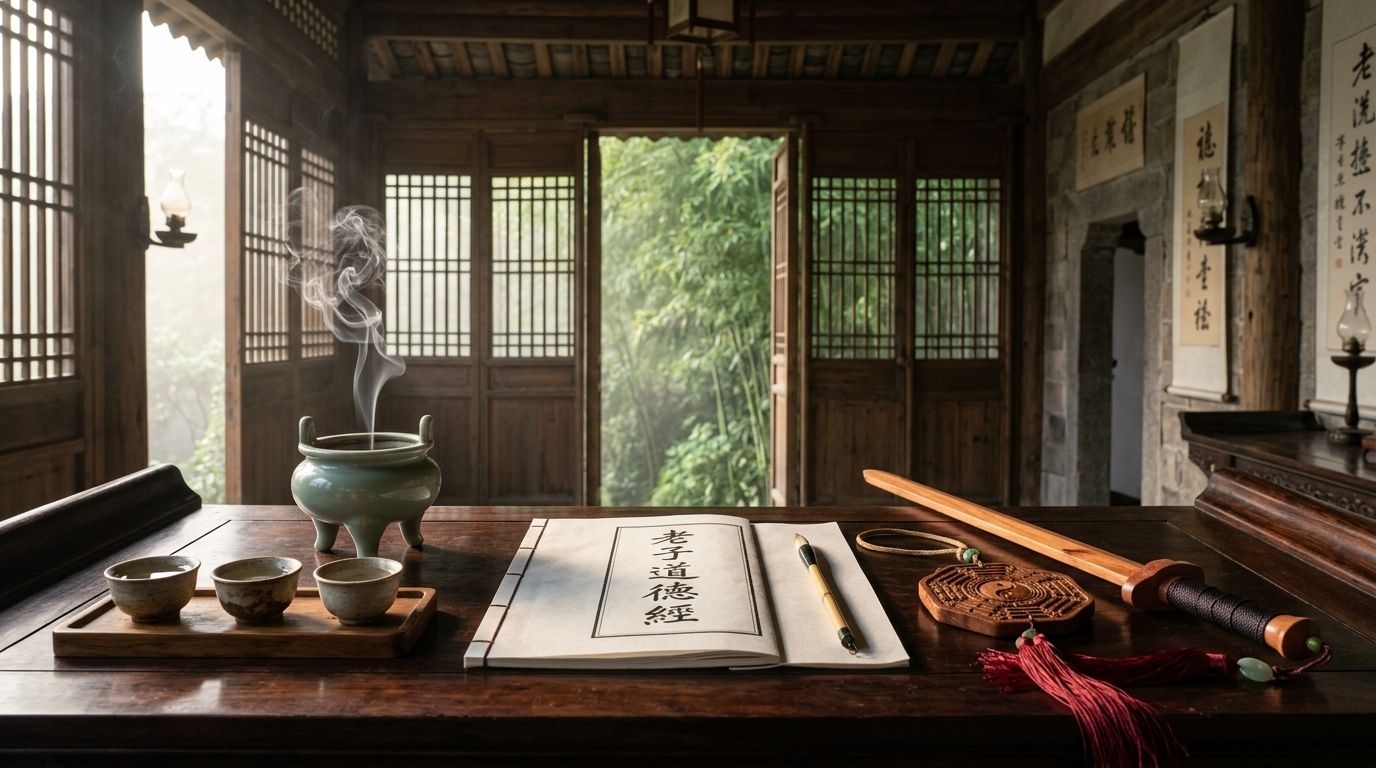
Fill three pristine celadon or white porcelain cups with clean, filtered spring water. Place them in a balanced horizontal line before the incense burner:
- Center Cup: Dedicated to the primordial Dao and Yuanshi Tianzun (元始天尊, Heavenly Worthy of the Primordial Beginning).
- Left Cup: Dedicated to the sacred scriptures and Lingbao Tianzun (灵宝天尊, Heavenly Worthy of the Numinous Treasure).
- Right Cup: Dedicated to the lineage masters and Daode Tianzun (Laozi 道德天尊, Heavenly Worthy of the Way and Its Virtue).
- Step 4: Offering the Three Incense Sticks (Sanxiang Dingxiang 三香定向)
Light three sticks of natural aged sandalwood or high-resin herbal incense. Extinguish the flame with a gentle wave of your hand—never blow on consecrated incense with your breath. Hold the three sticks between your palms at forehead height, bow from the waist, and insert them straight and upright into the censer from left to right:
- First Stick (Center): Dedicated to the Tao (Dao Xiang 道香).
- Second Stick (Left): Dedicated to the sacred teachings (Jing Xiang 经香).
- Third Stick (Right): Dedicated to the lineage ancestors (Shi Xiang 师香).
The three vertical trails of fragrant white smoke symbolize the harmonious connection uniting Heaven, Earth, and humanity.
- Step 5: Forming the Sacred Ziwu Hand Seal (Ziwu Jue 子午诀)
Bring your hands together at the solar plexus to form the traditional Ziwu Mudra (子午诀):
- Enclose your right thumb within the fingers of your left hand.
- Rest your left thumb at the base of your left ring finger (the Zi 子 coordinate, representing North, Water, and midnight stillness).
- Rest your right thumb at the tip of your right middle finger (the Wu 午 coordinate, representing South, Fire, and noon radiance).
This physical hand mudra locks the cosmic Taiji Yin-Yang circuit within your body, allowing water and fire energies to harmonize internally.
- Step 6: Seated Stillness & Microcosmic Breathing (Jingzuo Zuowang 静坐坐忘)
Sit comfortably upon a firm meditation cushion with your spine naturally upright. Rest your tongue lightly against the upper palate (the "Magpie Bridge"). Inhale slowly through your nose into the Lower Dantian (下丹田), feeling warmth gather two inches below the navel. As you exhale, release all bodily tension, practicing Zuowang (坐忘, Sitting in Forgetfulness) for 15 to 20 minutes. Observe thoughts arise and dissolve like passing clouds across an expansive sky.
- Step 7: Canonical Contemplation & Closing Reverence (Songjing Huixiang 诵经回向)
Conclude by reading a short chapter of the Daodejing or reciting the sacred Qingjing Jing (清静经, Classic of Purity and Stillness). Step back one pace, hold your hands respectfully in the Ziwu seal, and bow deeply three times. Carry the stillness of the altar into your workday activities, resolving to act with gentleness, clarity, and Wu Wei.
7. Internal Alchemy (Neidan 内丹) and Daily Living: Walking the Way in Modern Society
Beyond rituals and temple halls, the ultimate crucible of Daoism is the human body and mind. The esoteric monastic traditions of Mount Wudang maintain that every human being is an intricate microcosm (Xiaotiandi 小天地) reflecting the macrocosm (Datiandi 大天地).
The Three Treasures (Sanbao 三宝) of Human Life:
- Jing (精, Essence / Vital Stamina): The foundational physical vitality stored within the kidneys and reproductive system. In modern life, Jing is depleted through chronic sleep deprivation, overwork, excessive emotional drama, and poor diet. Daoism preserves Jing through restorative rest, seasonal nutrition, and mindful conservation.
- Qi (炁, Vital Breath / Energy): The dynamic pulsating life force circulating through the meridian pathways. Refined through conscious diaphragmatic breathing, Qigong, and gentle Tai Chi movements.
- Shen (神, Spirit / Consciousness): The clear, radiant light of awareness residing in the heart center and Upper Dantian. When Jing is abundant and Qi is balanced, Shen shines with intuitive wisdom, free from anxiety and fear.
Living as Water in the Modern World
To walk the Daoist path in contemporary 21st-century society does not require abandoning one's family or retreating to a mountain cave. It means applying the wisdom of the Uncarved Block (Pu 朴) to our everyday challenges:
- When Facing Conflict: Do not meet aggression with rigid resistance. Yield like water, absorb the momentum, and redirect the energy gracefully without generating karmic friction.
- When Facing Career Overwhelm: Recognize natural cycles. Constant non-stop expansion (Extreme Yang) leads inevitably to exhaustion and collapse. Honor your need for restorative rest and quiet reflection (Yin).
- When Facing Material Satiety: Practice Chapter 44 of the Daodejing: "He who knows contentment will suffer no disgrace; he who knows when to stop will face no danger."
8. Frequently Asked Questions (FAQ)
Q1: What is Daoism in simple terms?
Answer: In simple terms, Daoism (traditionally spelled Taoism) is an indigenous Chinese spiritual, philosophical, and liturgical tradition centered on living in conscious harmony with the Dao (道)—the nameless, eternal, and self-sustaining cosmic Source that generates and nourishes all manifest existence. Originating over 2,500 years ago through the foundational teachings of Laozi (老子) in the Daodejing (道德经), Daoism teaches that true health, spiritual clarity, and wisdom arise from practicing Wu Wei (无为, effortless natural action), honoring Ziran (自然, spontaneous authenticity), and balancing the rhythmic interplay of Yin and Yang (阴阳). Rather than demanding submission to an anthropomorphic deity or adhering to rigid dogma, Daoism provides holistic practical arts—including meditation, breathwork, herbal medicine, spatial alignment, and consecrated ritual offerings—to harmonize human life with the living pulse of the cosmos.
Q2: What is the difference between Daoism, Confucianism, and Buddhism?
Answer: Daoism, Confucianism, and Buddhism form the "Three Teachings" (Sanjiao 三教) that have collectively shaped East Asian civilization. While Confucianism focuses outward on moral ethics, social order, filial piety (Xiao 孝), and civic duty, Daoism directs awareness inward and upward toward nature, cosmic spontaneity, mystical transcendence, and non-coercive flow. Buddhism, introduced from India during the Han Dynasty, centers on transcending suffering (Dukkha) and cyclical rebirth through mindfulness, karma, and the realization of emptiness (Sunyata). Throughout Chinese history, rather than warring with one another, these three traditions synthesized organically. This cultural harmony is celebrated in the classic Chinese proverb: "Every Chinese person is a Confucian in public office, a Daoist when retreating to the mountains, and a Buddhist when preparing for the afterlife."
Q3: What is the difference between Daojia (philosophical Daoism) and Daojiao (religious Daoism)?
Answer: The historical distinction between Daojia (道家, philosophical Daoism) and Daojiao (道教, religious/liturgical Daoism) was largely popularized by Han Dynasty bibliographers and Western sinologists, but in authentic living tradition, they represent two halves of a single sacred whole. Daojia articulates the profound metaphysical architecture—explicated by ancient sages Laozi and Zhuangzi—revealing how the universe functions through the Dao, Yin-Yang, and Wu Wei. Daojiao provides the practical, liturgical, and ritual technology—developed by Celestial Master Zhang Daoling and monastic lineages like Quanzhen—to tangibly apply and embody that philosophy in physical reality through consecrated altars, talismans (Fu Lu 符箓), scripture chanting, and internal alchemy (Neidan 内丹). Philosophical Daoism provides the inner theoretical wisdom, while liturgical Daoism provides the living experiential vessel.
Q4: How can a modern beginner begin practicing Daoism at home?
Answer: Beginning a personal Daoist practice at home does not require renouncing modern life or taking monastic vows. It begins by cultivating quietude and simplicity (Pu 朴). First, study the foundational canonical texts—primarily the Daodejing (道德经) and the inner chapters of Zhuangzi (庄子)—contemplating their principles without intellectual overthinking. Second, establish a clean, dedicated meditation space or modest home altar: place a natural celadon or brass censer, offer three small cups of clear spring water each morning, and burn pure aged sandalwood (Laoshan Tan 老山檀) or agarwood. Third, practice daily seated quietude (Jingzuo 静坐) and diaphragmatic breathing into the Lower Dantian (下丹田) for 15–20 minutes to settle chaotic thoughts. Finally, cultivate Wu Wei (无为) in daily life: let go of unnecessary conflict, observe natural rhythms, eat seasonal whole foods, and live with humble kindness.
9. Conclusion: Walking the Way in the Modern Era
When we earnestly contemplate what is daoism, we discover that it is neither an obsolete relic of antiquity nor an elusive, unreachable mysticism. It is a living, breathing blueprint for sanity, vitality, and peace in an often discordant world.
In an era consumed by relentless hustle culture, artificial deadlines, and polarizing noise, Daoism extends an eternal invitation:
- You do not need to dominate the river; you only need to learn how to swim gracefully with its natural current.
- Your quiet moments of winter rest (Yin) are not failures of ambition, but the sacred womb from which your next spring creative flourishing (Yang) will be born.
- By returning to simplicity (Pu 朴) and releasing contrived control (Wu Wei 无为), you align with the silent, invincible power that sustains the stars.
Whether anchored through an authentic hand-carved lightning-struck jujube wood seal upon your home altar, experienced through the gentle rise and fall of the breath during morning meditation, or simply embodied by choosing patience over anger during a difficult conversation, the Dao remains ever-present. Step onto the path, breathe in the fragrance of natural sandalwood, and allow the eternal current of the Way to carry you home.