Daoism Foundations · · 26 min read
What Is a Taoist? Lineage Priests, Lay Cultivators, Sacred Implements, and the Living Path of the Tao
What is a Taoist? Explore ordained Daoshi lineages, lay cultivators, sacred altar implements, and living internal alchemy in orthodox Taoism.
By Daoismart Editorial
On this page
- What Is a Taoist? Lineage Priests, Lay Cultivators, Sacred Implements, and the Living Path of the Tao
- 1. The Foundational Definition: What Is a Taoist in Classical Tradition?
- Daoshi (道士): The Scholar and Priest of the Way
- Daojiao Jushi (道教居士): The Devoted Householder
- Deconstructing Western Misconceptions of What Is a Taoist
- 2. The Two Great Living Lineages: Quanzhen Monasticism vs. Zhengyi Liturgy
- Quanzhen: The Monastic Alchemy of Complete Perfection
- Zhengyi: The Liturgical Sovereignty of Orthodox Unity
- 3. Authoritative Comparison Matrix: Roles within the Taoist Tradition
- 4. The Sacred Wardrobe and Regalia of a Taoist
- The Daopao (道袍): Cloaking the Body in Cosmic Order
- The Topknot and the Ziwu Hairpin (Ziwu Zan 子午簪)
- 5. Sacred Lineage Implements (Fawu 法物): Physical Anchors of Cosmic Power
- 1. The Horsetail Flywhisk (Fuchen 拂尘)
- 2. The Seven Stars Peachwood Sword (Taomu Jian 桃木剑)
- 3. The Lightning-Struck Jujube Wood Seal (Leiji Zaomu Yin 雷击枣木印)
- 4. The Three Pure Ritual Bell (Sanqing Ling 三清铃)
- 5. Pure Mineral Cinnabar (Zhusha 朱砂)
- 6. Connoisseurship: Authentic Lineage Artifacts vs. Commercial Imitations
- The Five-Stage Canonical Rite of Kai Guang (开光, Opening the Light)
- 7. Step-by-Step Daily Morning Cultivation Protocol for a Taoist
- Step 1: Spatial Sanctuary Alignment & Taboo Observation (Anwei Dingxiang 安位定向)
- Step 2: Dawn Body, Speech, and Breath Purification (Jingshen Jingshou 净身净手)
- Step 3: Offering the Three Pure Waters & Sandalwood Incense (Sanxiang Sanquan 三香三泉)
- Step 4: Microcosmic Qi Locking with the Ziwu Hand Mudra (Ziwu Jue 子午诀)
- Step 5: Lower Dantian Meditation & Daodejing Contemplation (Dantian Jingzuo 丹田静坐)
- 8. Frequently Asked Questions (FAQ)
- Q1: Can a Westerner or non-Chinese person become an authentic Taoist?
- Q2: What is the primary difference between a Buddhist monk and a Taoist priest?
- Q3: Do all Taoists have to be celibate, vegetarian, and live in mountain temples?
- Q4: How can an ordinary beginner begin practicing Taoism at home without a nearby temple?
What Is a Taoist? Lineage Priests, Lay Cultivators, Sacred Implements, and the Living Path of the Tao
Key Takeaways (Executive Summary) - Core Definition: When asking what is a Taoist, orthodox tradition defines a Taoist as an individual whose mind, vital breath, and daily actions are harmonized with the Tao (道)—the unnamable cosmic source of all existence. Guided by effortless action (Wu Wei 无为), organic spontaneity (Ziran 自然), and the cultivation of the Three Treasures (Jing-Qi-Shen 精气神), a Taoist walks a path of grounded balance rather than passive fatalism. - Priests vs. Lay Disciples: In living heritage, a Taoist may be an ordained liturgical priest (Daoshi 道士), a devoted temple monastic, or a householder lay practitioner (Jushi 居士). While ordained priests preserve lineage rites, scripture transmission, and temple sanctuaries, lay practitioners apply Taoist philosophical and meditative disciplines to modern family, business, and community life. - The Two Major Lineages: The Taoist world is anchored by two living traditions: monastic Quanzhen (全真派, Complete Perfection), which prioritizes celibacy, vegetarianism, and internal alchemy (Neidan 内丹) within cloistered mountain temples; and communal Zhengyi (正一派, Orthodox Unity), whose priests are householders who marry, live within communities, and master sacred talismanic arts (Fu Lu 符箓) and classical liturgy (Zhaijiao 斋醮). - Simultaneous Cultivation of Nature and Vitality: Unlike systems that separate spirit from flesh, a Taoist practices the dual cultivation of spiritual consciousness and physical life-energy (Xing Ming Shuang Xiu 性命双修), viewing the human body as an organic microcosm of the cosmos (Tian Ren He Yi 天人合一). - Sacred Consecrated Implements (Fawu 法物): Tangible artifacts—such as the horsetail flywhisk (Fuchen 拂尘), double-edged peachwood sword (Taomu Jian 桃木剑), lightning-struck jujube wood seal (Leiji Zaomu Yin 雷击枣木印), and pure mineral cinnabar (Zhusha 朱砂)—serve as consecrated energetic anchors during meditation and space-harmonization. - Lineage Authenticity & Consecration: Authentic Taoist artifacts require wild, properly harvested natural materials empowered through canonical Kai Guang (开光, Opening the Light) rituals, distinguishing authentic sacred tools from mass-produced tourist trinkets.
1. The Foundational Definition: What Is a Taoist in Classical Tradition?
In Western popular culture, the question "What is a Taoist?" is frequently answered through romanticized caricatures: an eccentric hermit floating on a mist-covered mountain peak, a passive observer lounging in detachment, or a martial arts master displaying impossible acrobatics. While elements of aesthetic wonder and martial self-defense certainly intertwine with Taoist history, classical lineage records reveal a much richer, disciplined, and multidimensional spiritual identity.
Daoshi (道士): The Scholar and Priest of the Way
Etymologically, the term Daoshi (道士) translates literally as "Scholar of the Way" or "Gentleman of the Tao." Historically documented as early as the Han and Tang dynasties, a Daoshi is a formally initiated, ordained practitioner who has committed their life to embodying, preserving, and transmitting the sacred heritage of Taoism. A Daoshi is neither a dogmatic preacher nor an infallible guru; rather, they are technical specialists in celestial resonance, sacred cosmology, internal energy transformation, and liturgical diplomacy between human society and the spiritual realm.
Daojiao Jushi (道教居士): The Devoted Householder
Beyond the monastic walls and priestly lineages, millions of practitioners throughout history have answered the question of what is a Taoist by walking the path of the Jushi (居士, Householder Cultivator). A Jushi is a lay disciple who formally takes the Three Refuges (Sanbao Guiyi 三宝归依):
- Refuge in the Tao (Guiyi Dao 归依道): Trusting in the primordial, self-sustaining flow of the cosmos and dedicating oneself to virtue.
- Refuge in the Scriptures (Guiyi Jing 归依经): Committing to regular study and contemplation of classical texts, including the Daodejing (道德经), the Zhuangzi (庄子), and the liturgical classics collected within the 5,485 volumes of the Daozang (道藏).
- Refuge in the Masters (Guiyi Shi 归依师): Respecting the ancestral transmission line of historical sages and seeking ethical guidance from living ordained preceptors.
A lay Taoist does not withdraw from modern society. Instead, they transform their daily workplace, family home, and personal creative pursuits into a living laboratory for the practice of Wu Wei (无为, effortless alignment) and De (德, virtuous spiritual power).
Deconstructing Western Misconceptions of What Is a Taoist
To understand what is a Taoist from an authentic Lineage Standard lineage perspective, several pervasive contemporary myths must be dismantled:
- Myth 1: "A Taoist is completely passive and does nothing."
Lineage Reality: The concept of Wu Wei (无为) is often erroneously translated as "doing nothing" or passive inertia. To an authentic Taoist, Wu Wei signifies non-coercive, uncontrived action. It means moving without ego-driven forcing, acting in flawless timing with natural rhythms, much like a master sailor adjusting sails to the wind rather than trying to push the ocean. Historical Taoists were master astronomers, medical herbalists, civil engineers, and philosophical revolutionaries.
- Myth 2: "Taoism is merely a casual philosophy with no spiritual practices or altars."
Lineage Reality: The popular Western distinction between "philosophical Daoism" (Daojia 道家) and "religious Daoism" (Daojiao 道教) is largely an analytical categorization created by later historians. For a practicing Taoist, philosophy and liturgical practice are two sides of a single coin. Internal meditation (Zuowang 坐忘), breathwork (Tu Na 吐纳), altar offerings, and ritual consecration (Kai Guang 开光) are the practical, embodied engines through which the profound philosophy of Laozi is directly experienced.
- Myth 3: "Being a Taoist requires renouncing all human emotion and family life."
Lineage Reality: Unlike certain world ascetisms that condemn physical reality as fallen or dirty, a Taoist regards the human body and natural earthly existence as a wondrous manifestation of cosmic Qi. Physical vitality, emotional balance, family harmony, and longevity are deeply cherished and systematically nurtured.
2. The Two Great Living Lineages: Quanzhen Monasticism vs. Zhengyi Liturgy
When exploring what is a Taoist in contemporary living practice, one immediately encounters the two authorized branches that have preserved orthodox Taoist tradition across the centuries: the Quanzhen (全真派) and Zhengyi (正一派) traditions.
Quanzhen: The Monastic Alchemy of Complete Perfection
Founded during the Jin Dynasty (1115–1234 CE) by Patriarch Wang Chongyang (王重阳) in northern China, the Quanzhen (全真, Complete Perfection) tradition synthesized the highest insights of Taoist internal cultivation, Chan Buddhist meditative mindfulness, and Confucian moral duty. Patriarch Wang taught that an authentic Taoist must cultivate the "Three Completenesses": the complete preservation of vital essence (Jing 精), breath (Qi 炁), and spiritual consciousness (Shen 神).
Quanzhen monastics leave their biological families (Chujia 出家), take vows of lifelong celibacy, adopt a strictly vegetarian diet, and reside in communal monasteries such as the White Cloud Temple (Baiyun Guan 白云观) in Beijing or the high peaks of the Zhongnan Mountains (终南山). Their daily rhythm revolves around Neidan (内丹, Internal Alchemy)—a sophisticated psycho-spiritual practice wherein the practitioner transforms internal biological energy into spiritual radiance through meditation, breath control, and moral purity.
Among the seven famous disciples of Wang Chongyang (known as the Seven Immortals of the North / Beiqizhen 北七真), Qiu Chuji (丘处机, Changchun) founded the Longmen (Dragon Gate 龙门派) branch, which remains the largest and most influential monastic lineage in China today.
Zhengyi: The Liturgical Sovereignty of Orthodox Unity
Tracing its direct lineage back to Celestial Master Zhang Daoling (祖天师张道陵) in 142 CE on Mount Heming, the Zhengyi (正一, Orthodox Unity) tradition represents the institutional and liturgical bedrock of southern and overseas Taoism. Centered historically at the magnificent Mount Longhu (Dragon Tiger Mountain 龙虎山) in Jiangxi Province, Zhengyi has been led through continuous hereditary succession across more than sixty-five generations of Heavenly Masters.
Unlike their Quanzhen brothers and sisters, Zhengyi priests are primarily hearth-dwelling Taoists (Huoju Daoshi 火居道士). They marry, raise families, own homes, and engage in daily secular professions while maintaining their sacred lineage responsibilities. A Zhengyi Taoist is a master of liturgical ceremonies (Zhaijiao 斋醮), cosmic petitions (Biaowen 表文), and talismanic ink arts (Fu Lu 符箓). When local communities face illness, misfortune, ancestral transitions, or spatial imbalances, the Zhengyi priest is summoned to construct sacred altar arenas, invoke celestial guardians, and restore cosmic harmony between human society and the unseen spiritual order.
3. Authoritative Comparison Matrix: Roles within the Taoist Tradition
To provide comprehensive clarity on what is a Taoist across varying stages of dedication, the following structured matrix details the responsibilities, lifestyle codes, and spiritual tools of each role:
- Initiation & Status — Quanzhen Monastic Priest (出家道士): Full Monastic Ordination (Guanjin & Chuanjie) · Zhengyi Household Priest (火居道士): Lineage Register Ordination (Shoulu / Chulu) · Lay Taoist Practitioner (道教居士): Refuge in Three Treasures (Sanbao Guiyi)
- Living Environment — Quanzhen Monastic Priest (出家道士): Mountain monasteries (Gongguan) or hermitage caves · Zhengyi Household Priest (火居道士): Secular households, local towns, family shrines · Lay Taoist Practitioner (道教居士): Modern apartments, suburban homes, secular life
- Marital Status — Quanzhen Monastic Priest (出家道士): Strict lifelong celibacy (Banshen) · Zhengyi Household Priest (火居道士): Married; hereditary lineage transmission common · Lay Taoist Practitioner (道教居士): Married or single; normal secular family life
- Dietary Discipline — Quanzhen Monastic Priest (出家道士): Strict 100% vegetarian; alcohol strictly prohibited · Zhengyi Household Priest (火居道士): Vegetarian during rites; abstains from 4 meats · Lay Taoist Practitioner (道教居士): Balanced, mindful diet; periodic vegetarian fasting
- Core Spiritual Work — Quanzhen Monastic Priest (出家道士): Internal Alchemy (Neidan), sitting in oblivion (Zuowang) · Zhengyi Household Priest (火居道士): Liturgical rites (Zhaijiao), Talismans (Fu Lu) · Lay Taoist Practitioner (道教居士): Daily meditation, ethical living, study of classics
- Primary Canonical Regalia — Quanzhen Monastic Priest (出家道士): Cloud robe (Yunpao), wooden hairpin, rush cushion · Zhengyi Household Priest (火居道士): Embroidered vestments (Jiangyi), Five-Thunder crown · Lay Taoist Practitioner (道教居士): Clean linen clothing, meditation mat, jade pendant
- Typical Sacred Implements — Quanzhen Monastic Priest (出家道士): Horsetail flywhisk (Fuchen), Seven Stars peachwood sword · Zhengyi Household Priest (火居道士): Celestial Master seal (Zhidugong Yin), Three Pure bell · Lay Taoist Practitioner (道教居士): Bronze incense censer, celadon water cups, Daodejing
- Daily Liturgy — Quanzhen Monastic Priest (出家道士): Morning & Evening Scripture Chanting (Zao Wan Gongke) · Zhengyi Household Priest (火居道士): Communal blessing, memorial services, household wards · Lay Taoist Practitioner (道教居士): Dawn water offering, three sticks of incense, breathwork
Note on Dietary Ethics: Even hearth-dwelling Zhengyi Taoists adhere strictly to the ancient prohibition against consuming the "Four Noble Meats" (Si Bu Shi 四不食): Beef (representing tireless agricultural service), Dog (representing loyal devotion), Turtle-Dove/Wild Goose (representing spousal fidelity), and Eel/Snakehead Fish (representing filial sacrifice).
4. The Sacred Wardrobe and Regalia of a Taoist
To genuinely perceive what is a Taoist, one must understand that every garment worn by an ordained practitioner is not decorative costuming, but an external manifestation of cosmic geometry and internal energetic preservation.
The Daopao (道袍): Cloaking the Body in Cosmic Order
The traditional robe worn by a Taoist is known as the Daopao (道袍). Its structural architecture embodies the ancient Chinese cosmological principle of "Heaven is Round, Earth is Square" (Tian Yuan Di Fang 天圆地方). The collar forms a right-over-left diagonal cross (Jiaoling Youren 交领右衽), representing the harmonious meeting of Yin and Yang energies. The sweeping sleeves are intentionally cut large and cylindrical, allowing fresh air and vital breath to circulate freely around the body's meridian pathways without restrictive modern seams.
The Topknot and the Ziwu Hairpin (Ziwu Zan 子午簪)
Unlike Buddhist monks who shave their heads to symbolize severing ties with worldly illusion, a Taoist priest historically keeps their hair long. The hair is carefully brushed upward and bound at the Baihui (百会) acupoint at the very vertex of the skull into a tight, dignified topknot (Daoji 道髻). The hair is then secured using a horizontal hairpin carved from aged boxwood, peachwood, or white jade, known as the Ziwu Hairpin (子午簪).
In Taoist medical philosophy, the hair is regarded as the "surplus of blood and vital Qi" (Fa wei xue zhi yu 发为血之余). By binding the hair at the skull's highest portal, a Taoist seals and concentrates ascending Yang energy within the brain, preventing the leakage of precious spiritual essence during prolonged seated meditation.
5. Sacred Lineage Implements (Fawu 法物): Physical Anchors of Cosmic Power
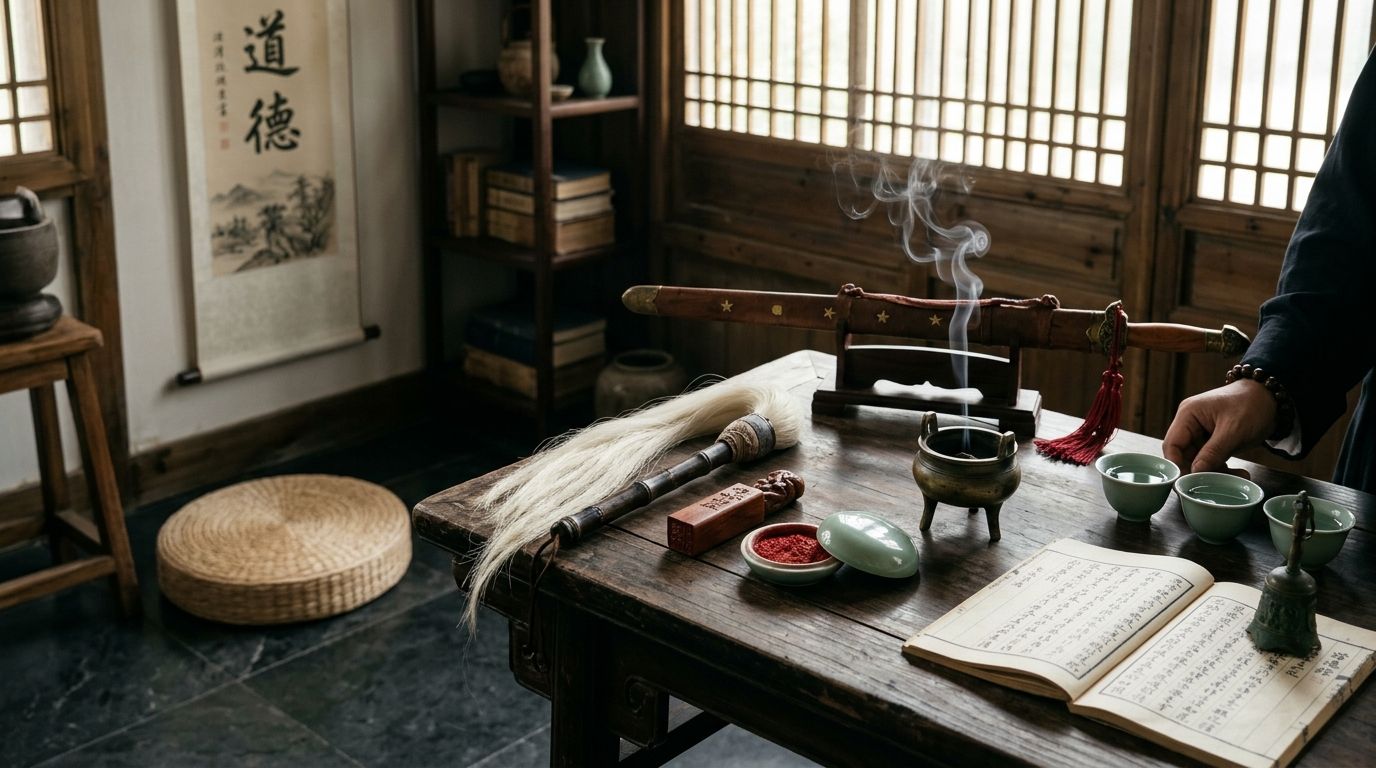
When exploring what is a Taoist in practical liturgical reality, consecrated physical implements (Fawu 法物) are indispensable. In orthodox Taoism, sacred artifacts are never viewed as superstitious idols or magical shortcuts. Rather, they function as bio-spiritual resonators—physical tools carefully crafted from specific natural materials that channel pure celestial Yang Qi, harmonize ambient magnetic disturbances, and focus the human mind.
1. The Horsetail Flywhisk (Fuchen 拂尘)
The Fuchen (拂尘) is universally recognized as the quintessential handheld emblem of a Taoist immortal. Constructed with a finely turned handle of seasoned bamboo or dark hardwood and fitted with flowing locks of natural horsehair, the flywhisk carries deep metaphysical symbolism. The Chinese character Chen (尘) signifies "dust," which in Taoist philosophy refers to the "red dust of the mortal world" (Hongchen 红尘)—the turbulent sea of greed, anxiety, egoic vanity, and chaotic mental noise.
When a Taoist master holds or gently waves the Fuchen, the physical gesture represents the active sweeping away of worldly illusions, restoring the practitioner's consciousness to its pristine, uncarved natural state (Pu 朴). Historically, Taoist wandering hermits carried the Fuchen across mountain trails to brush away insects without causing them harm, demonstrating reverent compassion toward all living beings.
2. The Seven Stars Peachwood Sword (Taomu Jian 桃木剑)
In Chinese esoteric tradition, wild mountain peachwood (Taomu 桃木) is venerated as the "Immortal Wood of the Sun" (Xianmu 仙木). Grown on sun-drenched rocky ridges, the peach tree absorbs concentrated solar Yang energy throughout its multi-decade lifespan. A Taoist sacred sword is hand-carved from seasoned heartwood, inlaid with the seven stars of the Big Dipper (Beidou Qixing 北斗七星) in polished brass, and adorned with a vibrant red silk tassel.
A Taoist sword is never forged for physical combat or bloodshed. Instead, it serves as a surgical instrument of spiritual physics. When wielded during ritual or mounted horizontally above an altar, its focused Yang resonance dispels stagnant domestic shadows, dissolves lingering grief, and provides impenetrable energetic shielding for the practitioner's home.
3. The Lightning-Struck Jujube Wood Seal (Leiji Zaomu Yin 雷击枣木印)
Among all organic materials revered by a Taoist priest, none holds greater authority than lightning-struck jujube wood (Leiji Zaomu 雷击枣木). When a violent thunderstorm strikes a living jujube tree on a high mountain summit, the immense electrical and atmospheric voltage of Heaven penetrates the dense organic core of the tree. In Taoist theology, this natural event is recognized as the ultimate marriage of Heavenly Fire and Earthly Wood—embodying pure, undiluted celestial Yang energy (Tianlei Yangqi 天雷阳炁).
Skilled artisans carve this sacred timber into administrative lineage seals—such as the Yangping Zhidugong Seal (阳平治都功印) of the Celestial Masters. Inscribed in ancient Seal Script (Zhuanshu), the seal is stamped in vermilion cinnabar upon sacred talismans and liturgical memorials to validate them before the celestial ministries.
4. The Three Pure Ritual Bell (Sanqing Ling 三清铃)
Also known as the Fa Ling (法铃) or Master Bell, this sacred bronze bell is crowned with a three-pronged brass handle representing the Three Pure Ones (Sanqing 三清). When rung in deliberate, measured cadences during dawn or dusk devotion, the bell produces a pure, crystalline acoustic overtone that shatters energetic stagnation, settles chaotic brainwave frequencies into deep meditative calm, and signals to benevolent ancestral spirits that sacred communion has begun.
5. Pure Mineral Cinnabar (Zhusha 朱砂)
For thousands of years, a Taoist priest writing protective talismans (Fu Lu 符箓) or consecrating a sacred implement has relied exclusively upon natural crystalline mineral cinnabar (Zhusha 朱砂). Composed of natural mercuric sulfide formed deep within geothermal earth veins, authentic cinnabar possesses a remarkable density and a luminous, natural crimson hue. In energetic alchemy, cinnabar is considered the most concentrated mineral anchor of pure Fire-element Yang energy on the planet, naturally dispelling parasitic low-vibrational energies.
6. Connoisseurship: Authentic Lineage Artifacts vs. Commercial Imitations
For anyone striving to understand what is a Taoist in relation to sacred implements, rigorous material connoisseurship is paramount. A plastic, chemically adulterated trinket purchased from an industrial souvenir market possesses zero energetic coherence and can introduce toxic vibrations into a sacred space. An authentic practitioner respects the living integrity of materials:
The Five-Stage Canonical Rite of Kai Guang (开光, Opening the Light)
Even the most exquisite implement crafted from five-hundred-year-old thunder-struck timber remains merely an inert piece of wood until it undergoes the orthodox ordination rite of Kai Guang (开光, Opening the Light) conducted by a qualified, ordained Taoist priest:
Without genuine Kai Guang, an artifact remains a cultural curiosity; with canonical Kai Guang, it becomes an empowered, living spiritual vessel connected directly to the lineage of the masters.
7. Step-by-Step Daily Morning Cultivation Protocol for a Taoist
To translate the answer of what is a Taoist into living, personal experience, sincere practitioners maintain an intentional morning cultivation routine. Follow this authentic five-step protocol designed to anchor cosmic harmony into contemporary life:
Step 1: Spatial Sanctuary Alignment & Taboo Observation (Anwei Dingxiang 安位定向)
- Solid Support (Kaoshan 靠山): Position your sacred altar table against a solid interior wall of brick, stone, or wood. Never place an altar against a hollow temporary plaster partition, directly under an open window, or against a floating glass pane.
- Elevation: The altar surface must be elevated to at least waist-height (approximately 38 to 42 inches above the ground), honoring the celestial plane.
- Directional Orientation: Whenever possible, face the altar toward the East (to welcome the morning purple dawn Yang Qi, Ziqi Donglai 紫气东来) or toward the room's primary entrance.
- Critical Taboos: Never locate an altar inside a bedroom where couples sleep, immediately adjacent to or sharing a plumbing wall with a bathroom, directly beneath an overhead exposed structural ceiling beam, or on a dining table where meat and alcohol are served.
Step 2: Dawn Body, Speech, and Breath Purification (Jingshen Jingshou 净身净手)
- Practice during the Mao Hour (卯时, 5:00 AM – 7:00 AM), the sacred transitional window when the sun's Yang Qi begins its daily ascent across the earth.
- Wash your hands and face thoroughly with cool, natural spring or filtered water.
- Rinse your mouth cleanly to purify daily speech before addressing the sacred masters.
- Silence all electronic devices, put on clean, loose natural clothing (cotton or linen), and take three slow, conscious breaths to release all residual nighttime lethargy.
Step 3: Offering the Three Pure Waters & Sandalwood Incense (Sanxiang Sanquan 三香三泉)
- Arrange three pristine celadon offering cups in a straight horizontal line across the altar:
- Center Cup: Represents the Tao (道宝) and Yuanshi Tianzun (Primordial Beginning).
- Left Cup (Observer's Left): Represents the Scriptures (经宝) and Lingbao Tianzun (Numinous Treasure).
- Right Cup (Observer's Right): Represents the Lineage Masters (师宝), honoring Laozi and the ancestral teachers.
- Fill each cup with pure, fresh drinking water.
- Ignite three sticks of natural, chemical-free aged sandalwood (Laoshan Tanxiang) or Jiangzhen incense:
- Never blow upon the flame with your mouth; human breath is considered turbid and disrespectful. Gently wave your right hand through the air to extinguish any flame.
- Raise the three incense sticks to brow level with both hands, bow reverently, and insert them into your bronze censer in sequential order:
- Insert the center stick first, affirming devotion to the Tao.
- Insert the left stick second, affirming devotion to the sacred scriptures.
- Insert the right stick third, affirming devotion to the lineage masters.
Step 4: Microcosmic Qi Locking with the Ziwu Hand Mudra (Ziwu Jue 子午诀)
- Sit comfortably on a round woven rush meditation cushion (Putuan) with an upright, supple spine.
- Form the ancient Ziwu Hand Mudra (子午诀) at your lower abdomen:
- Place your right thumb into the palm of your right hand and lightly close the right fingers around it.
- Enfold the right hand within the left palm, resting the left thumb upon the base of the left ring finger (the Zi 子 position, representing midnight water Yin) and the right thumb upon the middle finger tip (the Wu 午 position, representing midday fire Yang).
- This sacred bio-energetic lock seals the circuit between the Conception Vessel (Ren Mai) and Governing Vessel (Du Mai), preserving your vital life-force (Jing-Qi-Shen) from dispersing into the external environment.
Step 5: Lower Dantian Meditation & Daodejing Contemplation (Dantian Jingzuo 丹田静坐)
- Rest your tongue gently against the roof of the mouth, connecting the upper energy bridge (Queqiao 鹊桥).
- Inhale slowly through the nose, drawing the breath down past the chest into the Lower Dantian (下丹田) located two inches beneath the navel. Feel the lower abdomen softly expand on inhalation and naturally contract on exhalation.
- Settle into 15 to 20 minutes of serene stillness, silencing inner internal chatter and allowing the natural clarity of the mind to emerge.
- Silently reflect upon Chapter 16 of the Daodejing:
"Attain the utmost emptiness; embrace unwavering stillness. While all things are flourishing together, I observe their return. Each entity returns to its root; returning to the root is stillness, which is called returning to destiny."
- Conclude your morning attunement by bowing three times before the altar, carrying the centered tranquility and effortless grace of a Taoist into your everyday actions.
8. Frequently Asked Questions (FAQ)
Q1: Can a Westerner or non-Chinese person become an authentic Taoist?
Answer: Yes, absolutely. The Tao (道) is universal and non-sectarian, transcending national boundaries, ethnicity, and language. Historically, anyone who takes sincere refuge in the Three Treasures (Sanbao 三宝: the Tao, the sacred Scriptures, and the Lineage Masters) and lives in accordance with cosmic natural law (Ziran 自然) and non-contrived action (Wu Wei 无为) is recognized as a Taoist lay disciple (Jushi 居士). Sincere overseas practitioners can study classical texts like the Daodejing, establish a respectful home altar, practice internal alchemy (Neidan) and Qigong, and even undergo formal disciple initiation (Baisi 拜师) or ordination (Guanjin 冠巾 / Chulu 初箓) under recognized Quanzhen or Zhengyi lineage masters.
Q2: What is the primary difference between a Buddhist monk and a Taoist priest?
Answer: While both paths emphasize compassion, mental clarity, and spiritual liberation, their philosophical orientation and physical cultivation differ significantly. Traditional Buddhist monasticism focuses primarily on the cessation of suffering (Dukkha), transcending the cycle of reincarnation (Samsara), and realizing the emptiness (Sunyata) of all phenomena. In contrast, an authentic Taoist does not view the physical cosmos as an illusion to escape, but as the living, sacred manifestation of the Tao. A Taoist actively cultivates both spiritual nature and physical vitality simultaneously (Xing Ming Shuang Xiu 性命双修), harmonizing the subtle energies of Jing, Qi, and Shen to achieve radiant health, longevity, and spiritual immortality (Xian 仙) in harmonious unity with Heaven and Earth (Tian Ren He Yi 天人合一).
Q3: Do all Taoists have to be celibate, vegetarian, and live in mountain temples?
Answer: No. The lifestyle of a Taoist depends directly upon their lineage affiliation. Monastic priests of the Quanzhen (Complete Perfection 全真) tradition take strict monastic vows of celibacy, follow a pure vegetarian diet, wear traditional vestments, and reside in communal mountain monasteries (Gongguan 宫观). In contrast, priests of the Zhengyi (Orthodox Unity 正一) tradition are typically hearth-dwelling practitioners (Huoju Daoshi 火居道士) who marry, raise families, maintain secular professions, and serve their local communities as liturgical specialists. Furthermore, lay practitioners (Daojiao Jushi 道教居士) across all lineages live ordinary secular lives while upholding personal ethical precepts and daily meditation.
Q4: How can an ordinary beginner begin practicing Taoism at home without a nearby temple?
Answer: A beginner can authentically step onto the path of a Taoist through four grounded daily practices: first, immerse your mind in daily study of canonical root texts, particularly the Daodejing and Zhuangzi; second, establish a quiet, dedicated space or simple home altar equipped with a natural bronze censer, aged sandalwood incense, and three celadon offering cups; third, practice 15 to 20 minutes of daily morning Lower Dantian abdominal breathwork (Tu Na 吐纳) and sitting in stillness (Zuowang 坐忘); and fourth, integrate the virtues of simplicity (Pu 朴), non-coercive action (Wu Wei 无为), and environmental reverence into your daily work and human interactions.
Authored by the Daoist Cultural Heritage & Sacred Arts Curatorial Guild. All historical chronicles, lineage distinctions, and liturgical methodologies conform to orthodox Daozang canonical standards.