Daoism Foundations · · 16 min read
What Is a Taoist? Core Beliefs, Sacred Lineages, Consecrated Ritual Implements, and Daily Cultivation
Discover what defines an authentic Taoist: core beliefs, sacred lineages, consecrated ritual implements, and daily altar cultivation practices.
By Daoismart Editorial
On this page
- Key Takeaways: The Identity and Wisdom of an Authentic Taoist
- 1. The Foundations of Taoist Cosmology: The Way, Virtue, and the Microcosm
- The Dao and De: The Mystery Beyond Words
- Wu Wei and Ziran: The Art of Effortless Action
- The Three Internal Treasures: Jing, Qi, and Shen
- 2. Lineages of the Living Tradition: Quanzhen vs. Zhengyi Taoists
- The Quanzhen Lineage: Monastic Austerity and Internal Alchemy
- The Zhengyi Lineage: Liturgical Mastery and Household Priesthood
- Lineage and Practitioner Comparison Matrix
- 3. The Sacred Material Implements of a Taoist: Consecration, Metaphysics, and Authentication
- 1. The Five Thunder Command Block (Wu Lei Hao Ling 五雷号令)
- 2. The Taoist Horsetail Whisk (Fuchen 拂尘)
- 3. The Patinated Bronze Tripod Censer and Sacred Offerings
- 4. Pure Mineral Cinnabar (Zhusha 朱砂) and Talismans (Fu Lu 符箓)
- The Rite of Consecration: Kai Guang (开光)
- Material Benchmark: Authentic Implements vs. Commercial Counterfeits
- 4. Step-by-Step Living Taoist Cultivation: Daily Home Altar and Morning Practice Protocol
- Step 1: Mind-Body Cleansing (Jing Shen 净身 & Jing Kou 净口)
- Step 2: Altar Illumination & Orientation (Zhi Deng 致灯)
- Step 3: Presenting the Three Pure Water Offerings (San Bei Shui 三杯水)
- Step 4: Invoking the Three Treasures with Sacred Incense (San Zhu Xiang 三炷香)
- Step 5: Recitation of the Qingjing Jing (Scripture of Purity and Tranquility)
- Step 6: Zuowang Stillness & Microcosmic Breath Circulation (Xiao Zhou Tian 小周天)
- 5. Frequently Asked Questions (FAQ)
- Can anyone become a Taoist, and what is the difference between a lay cultivator and an ordained priest?
- What are the Three Treasures (San Bao) in Taoist tradition?
- How does a Taoist utilize the Five Thunder Command Block (Wu Lei Hao Ling) on a home altar?
- Why is lightning-struck jujube wood considered the premier material for Taoist protective artifacts?
Key Takeaways: The Identity and Wisdom of an Authentic Taoist
Core Definition: A Taoist (historically romanized as Daoist, encompassing both the philosophical adherent of Daojia 道家 and the ordained liturgical priest of Daojiao 道教) is a dedicated practitioner who aligns body, mind, and spirit with the Dao (道)—the primordial, self-generating cosmic order of the universe. Rather than imposing artificial force onto life, an authentic Taoist cultivates effortless action (Wu Wei 无为), radical simplicity, and spontaneous alignment with natural patterns (Ziran 自然). Grounded in canonical scriptures such as the Tao Te Ching (道德经) and Zhuangzi (庄子), living Taoist practice unites inner energetic alchemy (Neidan 内丹) with consecrated ritual implements (Kai Guang 开光法物) to restore balance within human existence.
1. The Foundations of Taoist Cosmology: The Way, Virtue, and the Microcosm
To understand what defines a Taoist is to enter a world where human consciousness is not separate from the cosmic canvas, but an intimate reflection of it. In the traditional Taoist worldview, the human being is a living microcosm (Xiao Qiankun 小乾坤) vibrating in resonance with the vast macrocosm of Heaven and Earth (Da Qiankun 大乾坤).
The Dao and De: The Mystery Beyond Words
The foundational bedrock of the Taoist path was articulated by the venerable sage Lao Tzu (Laozi 老子) during the Spring and Autumn period. In the opening verse of the Tao Te Ching, he cautions every seeker:
"The Dao that can be spoken of is not the eternal Dao; The name that can be named is not the eternal Name." (道可道,非常道;名可名,非常名。)
For a Taoist, the Dao is not a personalized deity residing in the clouds, nor is it a rigid philosophical dogma. It is the unnamable, formless, and inexhaustible wellspring from which all ten thousand things (Wan Wu 万物) emerge, flourish, and ultimately return. Complementing the Dao is De (德 - Virtue or Inherent Power)—the organic expression of the Dao operating through individual existence. When a Taoist cultivates De, one does not follow forced moralizing, but allows primordial goodness and clarity to flow naturally through daily action.
Wu Wei and Ziran: The Art of Effortless Action
At the spiritual core of the Taoist lifestyle lies the doctrine of Wu Wei (无为), commonly translated as "non-action," yet more accurately understood as non-contrived action or action without self-interested friction:
- Wu Wei is not indolence or passive resignation: It is the mastery of acting in absolute harmony with the prevailing currents of reality, just as water effortlessly shapes itself to the riverbed without struggle.
- Ziran (自然 - Self-So / Natural Spontaneity): Chapter 25 of the Tao Te Ching proclaims the supreme universal hierarchy:
"Man models Earth, Earth models Heaven, Heaven models the Dao, and the Dao models Ziran." (人法地,地法天,天法道,道法自然。)
An authentic Taoist cultivates an unburdened mind, stripping away societal artificiality, rigid posturing, and greed to return to the original simplicity of the uncarved block (Pu 朴).
The Three Internal Treasures: Jing, Qi, and Shen
In physiological and spiritual cultivation, a Taoist preserves and refines the Three Internal Treasures (San Bao 三宝):
- Jing (精 - Vital Essence): The foundational physical and reproductive vitality anchored within the kidneys and Lower Dantian.
- Qi (气 - Vital Breath and Life Energy): The dynamic energetic currents circulating through the meridians, animating physical movement and breath.
- Shen (神 - Transcendent Conscious Spirit): The luminous, non-dual awareness seated within the heart and Upper Dantian.
Through the classical discipline of Internal Alchemy (Neidan 内丹), a Taoist transmutes raw Jing into circulating Qi, refines Qi into pure Shen, and ultimately returns Shen back into the Great Emptiness of the Dao (Lian Jing Hua Qi, Lian Qi Hua Shen, Lian Shen Huan Xu 炼精化气,炼气化神,炼神还虚).
2. Lineages of the Living Tradition: Quanzhen vs. Zhengyi Taoists
Throughout Chinese spiritual history, the Taoist tradition crystallized into two primary orthodox lineages that continue to guide seekers today: the Quanzhen (全真 - Complete Perfection) school and the Zhengyi (正一 - Orthodox Unity) school. While both revere the Three Pure Ones (Sanqing 三清) and the Tao Te Ching, their structural paths and ritual methodologies offer distinct expressions of devotion.
The Quanzhen Lineage: Monastic Austerity and Internal Alchemy
Founded during the Jin Dynasty (12th century CE) by Master Wang Chongyang (王重阳) in the Zhongnan Mountains (终南山), the Quanzhen tradition represents the monastic and ascetic heart of Taoism:
- Monastic Discipline: Quanzhen Taoists reside in temple monasteries—such as the historic White Cloud Temple (Baiyunguan 白云观) in Beijing—take vows of celibacy, follow a strict vegetarian diet, and wear their hair bound in the traditional topknot (Zun Fa 髻发) crowned with the wooden jade hairpin.
- Core Focus: Quanzhen prioritizes rigorous internal alchemy (Neidan), sitting in deep stillness (Zuowang 坐忘), and the joint cultivation of Nature and Life (Xing Ming Shuang Xiu 性命双修). Physical austerity and mental purity are emphasized above external rituals.
The Zhengyi Lineage: Liturgical Mastery and Household Priesthood
Tracing its roots directly to the Han Dynasty (142 CE) when the First Celestial Master Zhang Daoling (张道陵) received divine revelation on Mount Heming, Zhengyi is the older, liturgical pillar of Taoism headquartered at Mount Longhu (龙虎山):
- Household Tradition: Zhengyi Taoist priests (Daoshi) generally do not take monastic vows. They marry, raise families, live among the populace, and pass sacred lineage knowledge down through generational lines.
- Liturgical and Talismanic Arts: Zhengyi specializes in liturgical ceremonies (Zhai Jiao 斋醮), talismanic writing (Fu Lu 符箓), thunder incantations (Lei Fa 雷法), and the consecration (Kai Guang 开光) of sacred artifacts. A Zhengyi master acts as an authorized intermediary connecting the human community with the celestial hierarchy.
Lineage and Practitioner Comparison Matrix
The following structured matrix clarifies the distinct orientations within living Taoist traditions:
- Primary Residence — Quanzhen Taoist (全真道士): Temple Monasteries (Mount Zhongnan, Baiyunguan) · Zhengyi Taoist (正一道士): Secular Community / Family Temple · Lay Taoist Cultivator (居士 / Jushi): Home Residence / Personal Sanctuary
- Vows & Lifestyle — Quanzhen Taoist (全真道士): Celibate, strict vegetarian, monastic discipline · Zhengyi Taoist (正一道士): Married allowed, secular diet with ritual fasting · Lay Taoist Cultivator (居士 / Jushi): Lay lifestyle guided by Taoist ethical precepts
- Core Practice — Quanzhen Taoist (全真道士): Internal Alchemy (Neidan), Stillness (Zuowang) · Zhengyi Taoist (正一道士): Liturgy (Zhai Jiao), Talismans (Fu Lu), Thunder Magic · Lay Taoist Cultivator (居士 / Jushi): Text study, daily meditation, home altar offerings
- Ordination Rite — Quanzhen Taoist (全真道士): Guan Ding (冠顶) & Three Precepts Transmission · Zhengyi Taoist (正一道士): Chuan Du (传度) & Lu Transmission (Jin Lu) · Lay Taoist Cultivator (居士 / Jushi): Discipleship refuge or self-cultivation commitment
- Signature Implement — Quanzhen Taoist (全真道士): Horsetail Whisk (Fuchen), Meditation Cushion · Zhengyi Taoist (正一道士): Five Thunder Command Block, Ritual Seals, Sword · Lay Taoist Cultivator (居士 / Jushi): Incense Censer, Water Offering Cups, Sacred Scripture
- Cosmic Focus — Quanzhen Taoist (全真道士): Transmuting internal Jing-Qi-Shen to attain Immortality · Zhengyi Taoist (正一道士): Balancing societal and cosmic Qi, communal blessings · Lay Taoist Cultivator (居士 / Jushi): Cultivating inner peace, domestic harmony, and longevity
3. The Sacred Material Implements of a Taoist: Consecration, Metaphysics, and Authentication
Far from dismissing the material realm, orthodox Taoism recognizes physical objects as sacred conduits for celestial frequencies. On a Taoist altar or in the hands of an experienced master, sacred implements (Fa Qi 法器) serve to focus intention, ground Pure Yang energy (Chun Yang 纯阳), and dispel stagnant vibrations (Xie Qi 邪气).
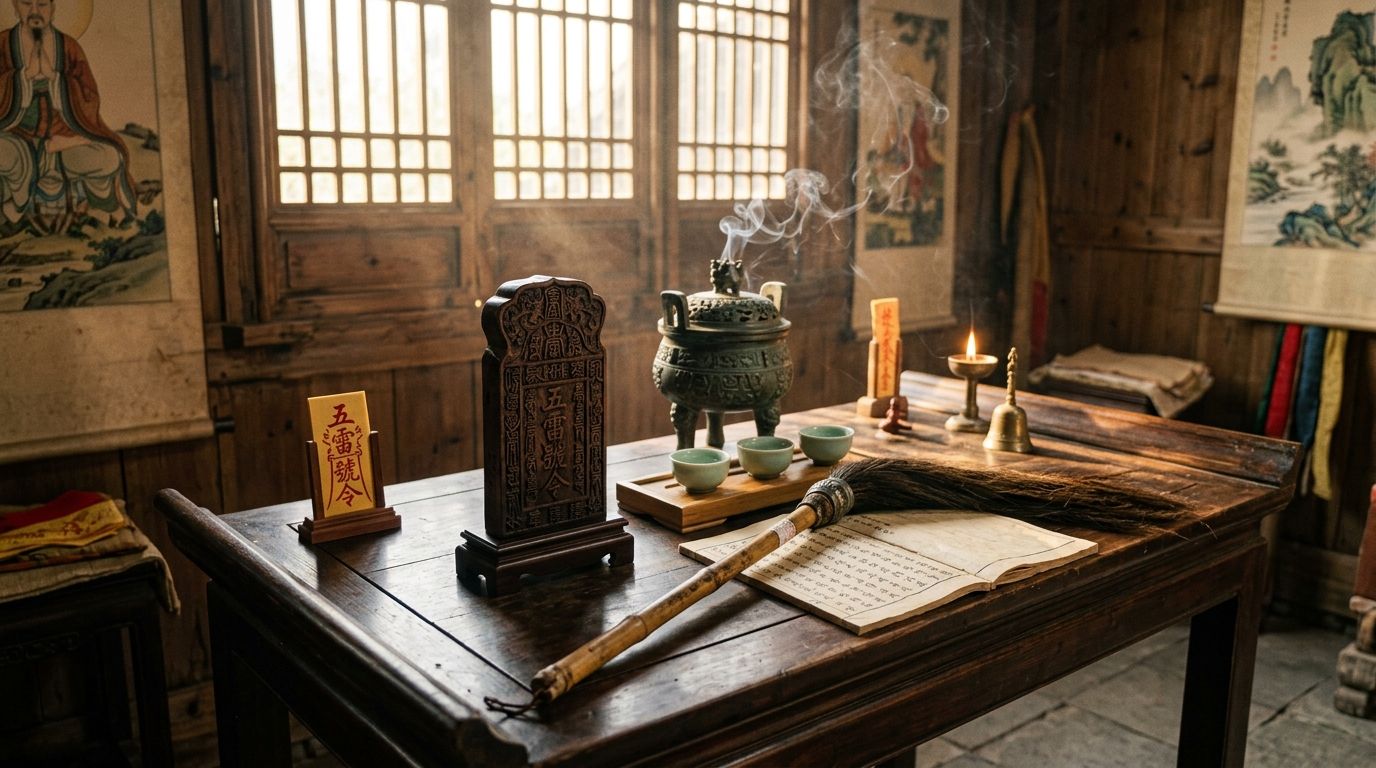
1. The Five Thunder Command Block (Wu Lei Hao Ling 五雷号令)
The Five Thunder Command Block—often termed the Thunder Board—stands as one of the most commanding ritual implements in Taoist liturgy:
- Metaphysical Architecture: In Taoist cosmology, thunder represents the cosmic authority of Heaven breaking through chaos. Carved with archaic celestial seal characters (Tian Shu 天书) representing the Five Thunder Marshals (Deng, Xin, Zhang, Tao, and Pang), this dense wooden block commands the unseen elemental forces during ritual liturgies.
- Canonical Material: Authentic command blocks are crafted exclusively from Lightning-Struck Jujube Wood (Lei Ji Zao Mu 雷击枣木). When raw heavenly lightning strikes an ancient wild jujube tree atop a sacred Taoist peak, the extreme electrical fire permanently transforms the wood's density and magnetic signature, imbuing it with unmatched solar vitality.
- Altar Function: Displayed upright upon a dedicated stand, the Five Thunder Command Block anchors domestic peace, dispels nightmares, and serves as an immovable shield against chaotic psychic fields.
2. The Taoist Horsetail Whisk (Fuchen 拂尘)
The horsetail whisk is an iconic personal implement of the Taoist cultivator, carried by sages such as Taishang Laojun and immortal Lü Dongbin:
- Symbolic Resonance: The Chinese character for whisk (Fu 拂) signifies to brush away. As a Taoist moves the flowing horsehair fibers, it symbolically sweeps away the dust of worldly delusion (Chen Xin 尘心), attachments, and anxious desires.
- Martial and Energetic Use: In traditional Wudang martial arts and Qigong, the whisk serves as a soft-yet-unyielding internal weapon, guiding Qi through fluid spiral dynamics and harmonizing the aura.
3. The Patinated Bronze Tripod Censer and Sacred Offerings
No Taoist sanctuary is complete without a consecrated incense censer (Xiang Lu 香炉):
- Incense as Celestial Telegraph: In Taoist liturgy, incense smoke is not merely an olfactory pleasantry; it is the sacred communication medium that bridges human prayers with the immortal realms (Xiang Yan Tong Shen 香烟通神). Burning pure woods—such as wild Jiangzhen Incense (降真香) and aged Laoshan Sandalwood (老山檀)—purifies the ritual atmosphere and clarifies the cultivator's meridians.
- The Three Water Offerings: Placed before the sacred image or tablet, three small porcelain or solid brass cups filled daily with clean mountain water reflect the unblemished clarity and yielding power of the Taoist mind (Shang Shan Ruo Shui 上善若水).
4. Pure Mineral Cinnabar (Zhusha 朱砂) and Talismans (Fu Lu 符箓)
An authentic Taoist talisman is a living energetic circuit:
- The Fire of the Earth: Talismans are inscribed using genuine crystalline mineral cinnabar powder blended with consecrated spring water. Because cinnabar absorbs deep geothermal Yang Qi over geological epochs, its vibrant crimson pigment carries an energetic resonance that synthetic chemical inks cannot replicate.
- Sacred Intention: Hand-inscribed onto yellow mulberry paper while the priest maintains a state of focused breath retention and silent incantation, the finished talisman acts as an enduring spiritual blessing.
The Rite of Consecration: Kai Guang (开光)
An implement purchased from a workshop remains merely an artistic curio until it undergoes the liturgical ceremony of Kai Guang (开光 - Opening of the Light):
- Jing Hua (净化 - Purification): Cleansing the vessel of all worldly contaminants using sacred spring water, peach twigs, and incense smoke.
- Zhuang Zang (装脏 - Internal Consecration): Depositing internal spiritual relics—the Five Sacred Metals (gold, silver, copper, iron, tin), the Five Healing Herbs, the Five Sacred Grains, and micro-inscribed scripture rolls—into the hollow interior of a sacred statue to establish its spiritual core.
- Dian Yan (点眼 - Illuminating the Senses): The officiating priest steps the sacred Pace of Yu (Yu Bu 禹步) to align with the Big Dipper, uses a polished round bronze mirror to focus morning sunlight onto the implement, and dots the crown and eyes with consecrated cinnabar. Through this ceremony, the implement is formally awakened into a living conduit of celestial grace.
Material Benchmark: Authentic Implements vs. Commercial Counterfeits
- Wood Material — Authentic Taoist Cultivation Implement: Certified natural lightning-struck jujube or old peach wood · Commercial / Mass-Market Counterfeit: Chemically scorched birch, laser-burnt composite plywood
- Mineral Medium — Authentic Taoist Cultivation Implement: Pure natural crystalline cinnabar (Zhusha 朱砂) powder · Commercial / Mass-Market Counterfeit: Toxic red chemical azo dyes or synthetic petroleum pigments
- Vessel Construction — Authentic Taoist Cultivation Implement: Solid lost-wax cast brass or hand-patinated bronze · Commercial / Mass-Market Counterfeit: Hollow cast zinc alloy with electroplated metallic spray
- Aromatic Incense — Authentic Taoist Cultivation Implement: Wild-harvested Jiangzhen incense, natural aged sandalwood · Commercial / Mass-Market Counterfeit: Artificially scented saw-dust sticks soaked in synthetic perfumes
- Spiritual Status — Authentic Taoist Cultivation Implement: Liturgically consecrated (Kai Guang) with lineage lineage prayers · Commercial / Mass-Market Counterfeit: Mass-produced decorative souvenir with unverified claims
- Energetic Effect — Authentic Taoist Cultivation Implement: Calming, grounding, harmonizes spatial Qi · Commercial / Mass-Market Counterfeit: Inert, odorless or headache-inducing chemical emissions
4. Step-by-Step Living Taoist Cultivation: Daily Home Altar and Morning Practice Protocol
Cultivating the Taoist path does not demand that you abandon modern life or move to a remote mountain cave. In the words of ancient masters, "The lesser hermit hides in the deep wilderness; the great hermit cultivates amidst the bustling marketplace" (小隐隐于野,大隐隐于市). By establishing a peaceful sanctuary and a dedicated morning routine, you can embody Taoist wisdom each day.
Follow this structured, sequential six-step protocol to align your mind, breath, and space:
Step 1: Mind-Body Cleansing (Jing Shen 净身 & Jing Kou 净口)
Before approaching your altar space, wash your hands and rinse your mouth with cool water. Wear loose, comfortable clothing made of natural fibers. Disconnect from digital screens and pause for three long, deep exhalations through the mouth, releasing residual fatigue, agitation, and mental chatter.
Step 2: Altar Illumination & Orientation (Zhi Deng 致灯)
Approach your clean, uncluttered altar facing south or east. Light the sacred altar oil lamp or pure beeswax candle with steady hands. The single steady flame symbolizes the Primordial Light of the Dao (Yuan Shen 元神) piercing the darkness of ignorance.
Step 3: Presenting the Three Pure Water Offerings (San Bei Shui 三杯水)
Place three pristine celadon or brass cups in a straight line before the sacred image, command block, or tablet. Fill them with fresh spring water or brewed white tea:
- The left cup represents the Dao (The Way).
- The middle cup represents the Jing (Sacred Wisdom and Scripture).
- The right cup represents the Shi (The Lineage Teachers).
Step 4: Invoking the Three Treasures with Sacred Incense (San Zhu Xiang 三炷香)
Take three sticks of natural aged sandalwood or Jiangzhen incense. Ignite them, extinguishing any open flame with a respectful wave of the hand (never blow on altar incense):
- Hold the sticks with both hands raised to forehead height, bowing deeply from the waist three times.
- Insert the central stick firmly into the censer, dedicating it to the Dao.
- Insert the left stick, dedicating it to the Jing.
- Insert the right stick, dedicating it to the Shi.
As the fragrant smoke ascends, visualize your thoughts dissolving into pure celestial clarity.
Step 5: Recitation of the Qingjing Jing (Scripture of Purity and Tranquility)
Take a seated posture and open the Taishang Laojun Shuo Chang Qingjing Jing (太上老君说常清静经). Read or chant the sacred verses slowly in a calm, resonant tone:
"The human mind loves purity, but desires disturb it; The human heart loves stillness, but worldly thoughts agitate it. If one can constantly banish desires, the heart naturally becomes still; Settle the mind, and the spirit naturally becomes pure." (人心好静,而欲牵之;常能遣其欲,而心自静,澄其心,而神自清。)
Allow the profound cadence of the words to wash away inner resistance.
Step 6: Zuowang Stillness & Microcosmic Breath Circulation (Xiao Zhou Tian 小周天)
Transition smoothly from scripture reading into deep, motionless meditation (Zuowang 坐忘):
- Posture: Sit with an erect spine, shoulders dropped, chin gently tucked, and hands resting in the Taiji Mudra (Taiji Yin 太极印) in your lap.
- Breath Regulation: Inhale smoothly through the nose, gently drawing subtle Qi down into the Lower Dantian (下丹田), located approximately two inches beneath your navel. Exhale without effort, releasing all tension into the earth.
- Microcosmic Orbit: As your stillness deepens, allow the circulating warmth of Qi to gently ascend the Governing Vessel (Du Mai 督脉) up the spine to the crown, and descend down the Conception Vessel (Ren Mai 任脉) along the chest back to the Dantian.
- Conclusion: After 20 to 30 minutes, rub your palms together until hot, gently massage your face and temples three times (Gan Mian 干面), bow toward the altar in the classic Taoist Gongshou (拱手) gesture, and step forward into your day rooted in calm equanimity.
5. Frequently Asked Questions (FAQ)
Can anyone become a Taoist, and what is the difference between a lay cultivator and an ordained priest?
Yes, anyone can cultivate as a Taoist by studying canonical teachings (such as the Tao Te Ching and Zhuangzi), practicing ethical harmony (De 德), and aligning daily life with Wu Wei (effortless action) and Ziran (natural spontaneity). In traditional Taoist practice, there is a clear distinction between a lay devotee (Jushi 居士) and an ordained priest (Daoshi 道士). A lay cultivator maintains a secular household, follows the basic precepts, and practices internal meditation and altar devotion at home. An ordained priest, belonging to lineages such as Quanzhen (全真) or Zhengyi (正一), undergoes formal discipleship, ritual transmission (Chuan Du 传度 or Guan Ding 冠顶), and is liturgically authorized to consecrate sacred implements (Kai Guang 开光), draft talismans (Fu Lu 符箓), and lead communal temple ceremonies (Zhai Jiao 斋醮).
What are the Three Treasures (San Bao) in Taoist tradition?
The concept of the Three Treasures (San Bao 三宝) exists on both philosophical and liturgical levels in Taoist doctrine. In Chapter 67 of the Tao Te Ching, Lao Tzu outlines the three ethical treasures: Compassion (Ci 慈), Frugality or Moderation (Jian 俭), and Not Daring to Put Oneself Ahead of Others (Bu Gan Wei Tian Xia Xian 不敢为天下先). In Taoist liturgical religion (Daojiao), the Three Treasures are the Dao (道 - The Primordial Source), the Jing (经 - The Sacred Scriptures), and the Shi (师 - The Lineage Masters and Ancestors). In internal alchemy (Neidan), the Three Treasures represent the internal energetic pillars: Jing (精 - Vital Regenerative Essence), Qi (气 - Breath and Vital Energy), and Shen (神 - Transcendent Conscious Spirit).
How does a Taoist utilize the Five Thunder Command Block (Wu Lei Hao Ling) on a home altar?
The Five Thunder Command Block (Wu Lei Hao Ling 五雷号令) is one of the most venerated ritual instruments in orthodox Taoist Thunder Magic (Lei Fa 雷法). Carved from authentic lightning-struck jujube wood, it bears esoteric talismanic seals invoking the celestial marshals of the Thunder Bureau. When placed on a home altar or private sanctuary, it functions as a spiritual pillar of Pure Yang energy (Chun Yang), anchoring cosmic authority, clearing stagnant or turbid Qi (Xie Qi 邪气), and stabilizing the spatial vibration of the dwelling. Practitioners and collectors position it reverently upright upon a dedicated wooden stand facing outward or toward the central altar.
Why is lightning-struck jujube wood considered the premier material for Taoist protective artifacts?
In Taoist energetic cosmology, lightning is the physical manifestation of Heaven's Pure Yang Fire (Tian Huo 天火), which shatters negative, Yin-turbid energetic configurations. Ancient jujube wood (Zao Mu 枣木) possesses extraordinary structural density, fine grain, and natural Yang resilience. When a wild jujube tree atop a sacred mountain is struck by natural cloud-to-ground lightning, celestial electrical fire fuses with centuries of terrestrial longevity. The resulting lightning-struck jujube wood (Lei Ji Zao Mu 雷击枣木) possesses an immense energetic frequency, making it the supreme canonical medium for carving sacred seals (Fa Yin 法印), command blocks, and protective amulets.