Daoism Foundations · · 14 min read
What Is a Daoist? Confucianism vs. Daoism, Sacred Ritual Arts, and Living Spiritual Cultivation
Explore what defines an authentic Daoist vs. Confucian ideals. Discover sacred ritual arts, consecrated artifacts, and daily living cultivation.
By Daoismart Editorial
On this page
- Key Takeaways & Core Principles
- 1. The Twin Pillars of Chinese Civilization: Daoist Spontaneity vs. Confucian Social Order
- The Cosmic Balance of Taiji (太极)
- The Historic Encounter at Luoyang: Confucius and Lao Tzu
- Outwardly Confucian, Inwardly Daoist (Wai Ru Nei Dao)
- The Metaphysical Divergence: Chapter 38 of the Tao Te Ching
- 2. Lineage Taxonomy: The Daoist Practitioner vs. The Confucian Scholar
- 3. The Sacred Material World of the Daoist: Altar Implements, Consecration, and Material Authenticity
- 1. Lightning-Struck Jujube Wood (Lei Ji Zao Mu 雷击枣木)
- 2. The Ancient Peach Wood Sword (Tao Mu Jian 桃木剑)
- 3. Pure Mineral Cinnabar (Zhusha 朱砂)
- 4. Holy Incense Woods: Laoshan Sandalwood and Jiangzhen Fragrance
- The Essential Rite of Consecration (Kai Guang 开光)
- 4. Step-by-Step Living Daoist Cultivation: Daily Altar Etiquette & Inner Quietude Protocol
- Step 1: Physical and Mental Purification (Jing Shen 净身)
- Step 2: Presenting the Sacred Water Offerings (Wu Gong 五供)
- Step 3: Offering the Three Pillars of Incense (San Zhu Xiang 三炷香)
- Step 4: Sitting in Forgetfulness (Zuowang 坐忘 / Jingzuo 静坐)
- Step 5: Closing Contemplation and Mindful Integration
- 5. Frequently Asked Questions (FAQ)
- What is the fundamental difference between an ordained Daoist priest (Daoshi) and a student of Daoist philosophy?
- How do Confucianism and Daoism coexist within traditional Chinese spiritual culture?
- Can a layperson wear or display Daoist sacred implements at home without formal ordination?
- How can one distinguish authentic Daoist ritual implements from commercial replicas?
Key Takeaways & Core Principles
Core Definition: A Daoist (traditionally romanized as Taoist, referring either to a philosophical practitioner of Daojia 道家 or an ordained priest of Daojiao 道教) is a spiritual seeker dedicated to living in spontaneous accord with the Dao (道 - The Way). While Confucianism organizes human society through moral hierarchy (Li 礼) and benevolence (Ren 仁), a Daoist transcends social contrivance to embrace cosmic rhythm, effortless action (Wu Wei 无为), and natural spontaneity (Ziran 自然). Grounded in the Tao Te Ching and centuries of lineage cultivation, authentic Daoist practice harmonizes inner spiritual alchemy (Neidan 内丹) with consecrated ritual implements (Kai Guang 开光法物).
1. The Twin Pillars of Chinese Civilization: Daoist Spontaneity vs. Confucian Social Order
For over two and a half millennia, the cultural consciousness of East Asia has been anchored by two complementary cosmic currents: the social architecture of Confucianism (Rujia 儒家) and the mystical, organic wisdom of the Daoist tradition (Daojia 道家). Understanding what it means to be a Daoist requires examining how these twin worldviews converse, collide, and ultimately harmonize.
The Cosmic Balance of Taiji (太极)
In traditional Chinese cosmology, Confucianism and Daoism represent the harmonious interplay of Yin and Yang:
- Confucianism (Rujia 儒家) — The Yang Current of Society: Focuses on structured order, civic duty, ritual decorum (Li 礼), human benevolence (Ren 仁), worldly governance, and familial ethics.
- Daoism (Daojia / Daojiao) — The Yin Current of the Cosmos: Focuses on natural spontaneity (Ziran 自然), effortless action (Wu Wei 无为), internal energetic cultivation (Neidan 内丹), and the sacred altar sanctuary.
The Historic Encounter at Luoyang: Confucius and Lao Tzu
The dynamic tension between the Confucian sage and the Daoist master is captured in the classical chronicle Records of the Grand Historian (Shiji 史记) by Sima Qian. During the turbulent Spring and Autumn period (circa 6th century BCE), the young sage Confucius (Kongzi 孔子) traveled to the imperial capital of Luoyang to study ritual etiquette (Li 礼) under Lao Tzu (Laozi 老子), who then served as the Keeper of the Royal Archives.
Lao Tzu observed Confucius’s intense earnestness and offered a penetrating Daoist admonition:
"Put away your haughty demeanor, your manifold ambitions, your elaborate posturing, and your unbridled will. None of these contribute anything to your real person. That is all I have to tell you." (去子之骄气与多欲,态色与淫志,是皆无益于子之身。吾所以告子者,若是而已。)
Upon returning to his disciples, Confucius remained silent for three days before uttering his renowned comparison:
"Birds fly through the skies; fish swim through the depths; beasts run across the plains. For those that run, a net can catch them; for those that swim, a line can hook them; for those that fly, an arrow can bring them down. But as for the dragon riding upon the clouds and wind into Heaven, I cannot know its boundless heights. Today, I have met Lao Tzu; is he not indeed like the dragon?"
Outwardly Confucian, Inwardly Daoist (Wai Ru Nei Dao)
This legendary dialogue revealed a profound truth: Confucianism constructs the necessary scaffolding for civic life, whereas the Daoist preserves the sovereign freedom of the primordial spirit.
Over the centuries, Chinese scholars, statesmen, and hermits resolved this duality through the cultural ethos of Wai Ru Nei Dao (外儒内道 - "Confucian on the outside, Daoist on the inside"). In public affairs, one exercised Confucian duty, civil responsibility, and familial piety; in private retreat, contemplation, and old age, one became a Daoist—releasing worldly ambition, savoring green tea beside mountain streams, practicing breath circulation, and communing with the Great Void (Taixu 太虚).
The Metaphysical Divergence: Chapter 38 of the Tao Te Ching
In Chapter 38 of the Tao Te Ching (Daodejing 道德经), Lao Tzu outlined the progressive degeneration of human awareness when society moves away from cosmic harmony:
"When the Dao is lost, there is De (Virtue); when De is lost, there is benevolence (Ren); when benevolence is lost, there is righteousness (Yi); when righteousness is lost, there is ritual decorum (Li). Now ritual decorum is the thin husk of loyalty and good faith, and the beginning of all chaos." (故失道而后德,失德而后仁,失仁而后义,失义而后礼。夫礼者,忠信之薄,而乱之首。)
Where the Confucian cultivates external rules (Li) to curb chaotic impulses, the authentic Daoist returns to the root of spontaneous virtue (De 德) prior to artificial regulation. For the Daoist practitioner, moral behavior does not arise from social policing, but flows spontaneously from an unclouded realization of the interconnected Dao.
2. Lineage Taxonomy: The Daoist Practitioner vs. The Confucian Scholar
To clarify the philosophical, ritual, and material distinctions between these two foundational paths, lineage scholars utilize the following comparative framework:
- Primary Spiritual Archetype — The Daoist Path (Daojiao / Daojia): Daoshi (Daoist Priest) / Daoist Hermit (Yinshi) · The Confucian Path (Rujia): Junzi (Exemplary Person) / Confucian Scholar (Rusheng) · Lineage Standard & Artifact Benchmark: Living lineage ordination vs. civil scholarly examination
- Cosmological Foundation — The Daoist Path (Daojiao / Daojia): The Dao, Yin-Yang, and Primordial Breath (Yuan Qi) · The Confucian Path (Rujia): Mandate of Heaven (Tianming), Human Nature (Xing) · Lineage Standard & Artifact Benchmark: Direct communion with cosmos vs. ethical mandate of Heaven
- Supreme Virtues — The Daoist Path (Daojiao / Daojia): Wu Wei (Effortless Action), Ziran, Compassion, Frugality · The Confucian Path (Rujia): Ren (Benevolence), Righteousness, Ritual Decorum, Filial Piety · Lineage Standard & Artifact Benchmark: Natural non-contriving presence vs. structured civic rectitude
- Primary Method of Practice — The Daoist Path (Daojiao / Daojia): Internal Alchemy (Neidan), Stillness (Zuowang), Liturgy · The Confucian Path (Rujia): Textual Exegesis, Self-Examination, Ancestral Rites · Lineage Standard & Artifact Benchmark: Energetic transformation of Jing-Qi-Shen vs. moral discipline
- Sacred Altar Implements — The Daoist Path (Daojiao / Daojia): Lightning-Struck Wood Seals, Peach Wood Swords, Cinnabar · The Confucian Path (Rujia): Scholar’s Four Treasures, Ancestral Spirit Tablets · Lineage Standard & Artifact Benchmark: Consecrated (Kai Guang) ritual vessels vs. ancestral tablets
- Relationship to Nature — The Daoist Path (Daojiao / Daojia): Dao Fa Ziran: Harmonizing life with cosmic patterns · The Confucian Path (Rujia): Regulating nature for human cultivation and harvest · Lineage Standard & Artifact Benchmark: Sacred ecological integration vs. societal stewardship
- Relationship to the Sacred — The Daoist Path (Daojiao / Daojia): Celestial Immortals, The Three Pure Ones, Stellar Deities · The Confucian Path (Rujia): Heaven, Earth, Imperial Ancestors, Sage Kings · Lineage Standard & Artifact Benchmark: Liturgical communion with divinities vs. memorialization
3. The Sacred Material World of the Daoist: Altar Implements, Consecration, and Material Authenticity
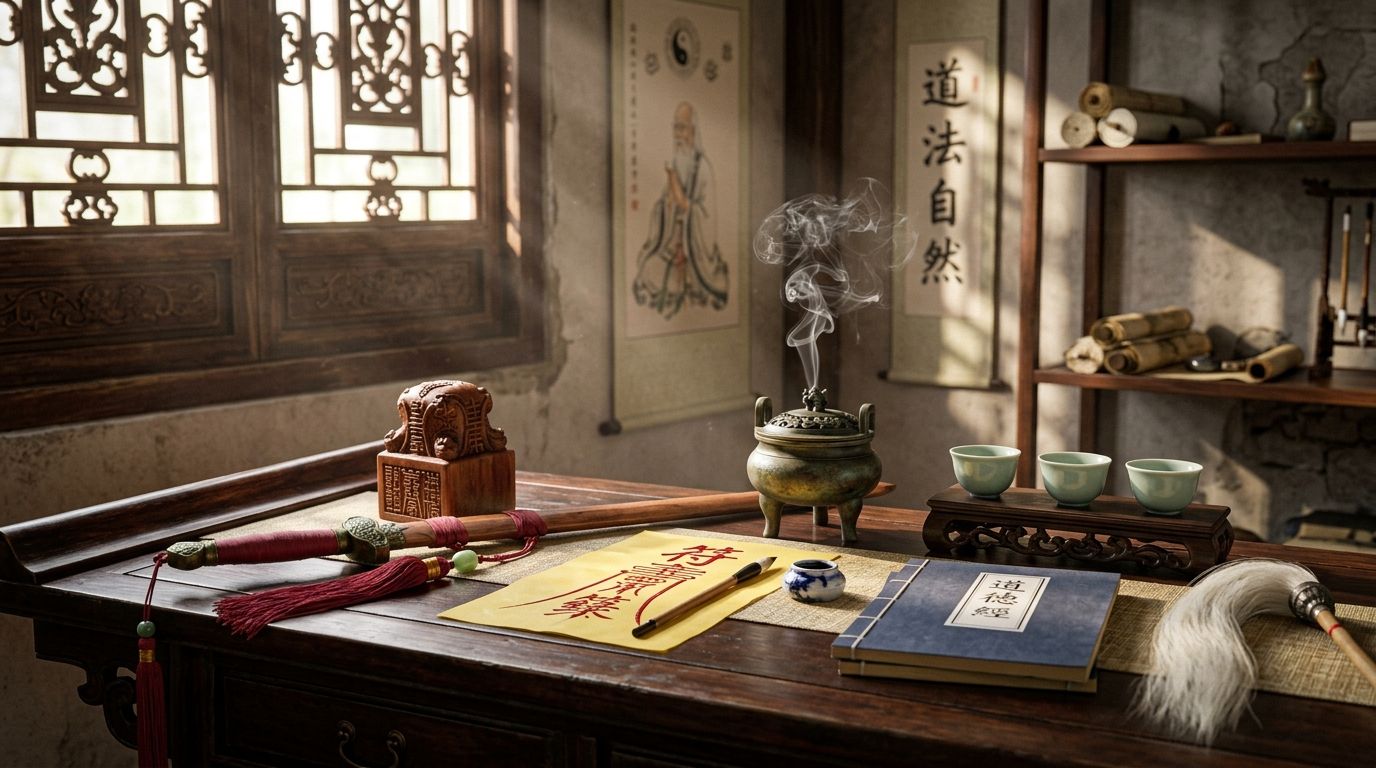
In popular culture, an ordained Daoist is sometimes stereotyped as either an esoteric recluse or an exotic magician. In orthodox Daoist lineages—such as Zhengyi (正一 - Orthodox Unity) and Quanzhen (全真 - Complete Perfection)—the material implements of the Daoist altar are revered as sacred Daoist conduits of celestial frequency and energetic anchors of pure Yang Qi (Chun Yang 纯阳).
1. Lightning-Struck Jujube Wood (Lei Ji Zao Mu 雷击枣木)
Among all sacred woods treasured by the Daoist priest, lightning-struck jujube wood occupies the supreme pinnacle of spiritual potency.
- Cosmological Origin: When natural cloud-to-ground lightning strikes an ancient jujube tree atop sacred Taoist mountains (such as Mount Longhu 龙虎山 or Mount Wudang 武当山), the cosmic fire of Heaven (Tian Huo 天火) pierces the dense, fine-grained terrestrial wood. This instant union of celestial electrical energy and earthly longevity creates a material vibrating with immense Yang Qi.
- Daoist Applications: Master carvers craft sacred talismanic seals (Fa Yin 法印), such as the Dao Jing Shi Bao (道经师宝 - Seal of the Three Treasures of Dao, Scripture, and Master) and the Tian Gang Yin (天罡印 - Northern Dipper Seal). A genuine lightning-struck seal is utilized by a Daoist master to stamp empowered talismans (Fu Lu 符箓), binding spiritual authority into physical form.
- Authentication Standard: Authentic lightning-struck jujube wood displays irregular natural lightning veins, a dense heavy hand-feel, a subtle natural roasted wood fragrance, and micro-fissures formed during the strike. Seekers must be cautious of fraudulent modern imitations created by chemically scorching ordinary wood with artificial electric currents or laser burning.
2. The Ancient Peach Wood Sword (Tao Mu Jian 桃木剑)
The peach tree has been revered as the "Demon-Quelling Wood" (Jiang Mo Mu 降魔木) since the Shang and Zhou dynasties.
- Energetic Function: Peach wood carries concentrated Wood/Spring energy, embodying rebirth, vitality, and unyielding sunlight. When carved into a ceremonial sword adorned with the Seven Northern Dipper stars (Qi Xing Jian 七星剑) and an imperial crimson silk tassel, it serves as a primary Daoist tool for dispelling stagnant, turbid vibrations (Xie Qi 邪气) from domestic spaces.
- Altar Protocol: Unlike metal blades that carry martial sharpness, a Daoist peach wood sword dispels malevolent influences through pure vitality rather than violence. Displayed on a polished hardwood sword stand or hung horizontally on the eastern wall of a meditation room, it establishes an impenetrable barrier of peaceful Yang Qi.
3. Pure Mineral Cinnabar (Zhusha 朱砂)
Cinnabar (natural crystalline mercuric sulfide) is the quintessential mineral of Daoist alchemy and ritual liturgy.
- The Soul of the Talisman: An authentic Daoist talisman (Fu Lu 符箓) is never written with ordinary ink. The Daoist practitioner grinds pure mineral cinnabar crystal into fine vermilion powder, blending it with consecrated water and fragrant resin.
- Spiritual Resonance: Because cinnabar forms in subterranean mineral veins under geological heat, it retains an extraordinarily high vibrational frequency. When inscribed onto handmade yellow mulberry paper with concentrated intention and secret mantras (Zhen Yan 真言), the cinnabar script acts as an energetic circuit, radiating solar warmth and cosmic protection.
4. Holy Incense Woods: Laoshan Sandalwood and Jiangzhen Fragrance
Incense is the communicative bridge for the Daoist seeker between humanity and the celestial realms (Xiang Yan Tong Shen 香烟通神).
- Wild Jiangzhen Incense (Jiangzhen Xiang 降真香): Revered in the Daozang (Daoist Canon) as the supreme aromatic resin. Its historical name translates to "The Incense that Causes True Immortals to Descend." Burning pure Jiangzhen wood calms the spirit, opens the meridian pathways, and purifies altar air.
- Aged Laoshan Sandalwood (Lao Shan Tan 老山檀): Renowned for its rich, creamy, grounding fragrance that anchors erratic thoughts and stabilizes internal breathing during meditation.
The Essential Rite of Consecration (Kai Guang 开光)
Every sacred Daoist implement—whether a bronze statue of Taishang Laojun, a peach wood sword, or a jade talisman—remains an inert aesthetic object until it undergoes the orthodox ceremony of Kai Guang (开光 - Opening of the Light). Conducted by an ordained Daoist master, this rigorous liturgy involves:
- Jing Hua (净化 - Ritual Cleansing): Purifying the vessel with water blessed by sacred incantations and fresh peach twigs.
- Zhuang Zang (装脏 - Internal Consecration): For statues, depositing sacred relics within an internal chamber—the Five Sacred Metals (gold, silver, copper, iron, tin), the Five Medicinal Herbs, the Five Grains, and sacred miniature scriptures.
- Qi Fa (启发 - Spiritual Awakening): The Daoist priest performs secret finger mudras (Jue 诀), steps the mystical Pace of Yu (Yu Bu 禹步) to align with the Big Dipper, and uses a round bronze mirror to reflect the morning sun onto the artifact. Finally, with a brush dipped in pure mineral cinnabar, the master awakens the eyes, ears, and spiritual core of the object, inviting the luminous presence of celestial Yang Qi to inhabit the vessel.
4. Step-by-Step Living Daoist Cultivation: Daily Altar Etiquette & Inner Quietude Protocol
One does not need to retreat to a secluded mountain hermitage to cultivate like a Daoist. By establishing a dedicated home altar (Tan 坛) and practicing mindful presence, any earnest seeker can cultivate the Daoist path with serenity amidst modern turmoil.
The daily five-stage progression flows naturally from external preparation to profound inner stillness: Purification (washing hands and quieting the mind) ➔ Pure Water Offering (presenting three cups) ➔ Incense Offering (dedicating the three sticks) ➔ Zuowang Stillness (Dantian breathing) ➔ Closing Integration (carrying Wu Wei into daily life).
Step 1: Physical and Mental Purification (Jing Shen 净身)
Approach your cultivation space with a serene, uncluttered mind. Wash your hands and rinse your mouth with clean water. Loosen tight garments, take three deep diaphragmatic breaths, and gently let go of external anxieties and professional haste. Silence electronic devices to protect your sacred boundary.
Step 2: Presenting the Sacred Water Offerings (Wu Gong 五供)
Before the consecrated image or sacred talisman on your altar, arrange three small celadon porcelain or solid brass cups. Fill them each morning with fresh spring water or brewed high-mountain tea:
- The water symbolizes the unclouded mind of water (Shang Shan Ruo Shui 上善若水): soft, adaptive, yet capable of overcoming all rigidity.
- Replace the water daily to invite clear, flowing Chi into the household.
Step 3: Offering the Three Pillars of Incense (San Zhu Xiang 三炷香)
Ignite three sticks of natural aged sandalwood or Jiangzhen incense. Never blow out the flame with your mouth; gently wave your hand to extinguish it with respect.
- Hold the three sticks with both hands raised to eyebrow level, bowing three times from the waist.
- Insert the central stick first: dedicating it to the Dao (道 - The Primordial Way).
- Insert the second stick to the left: dedicating it to the Jing (经 - Sacred Daoist Scriptures and Cosmic Law).
- Insert the third stick to the right: dedicating it to the Shi (师 - Master Lao Tzu and Lineage Ancestors).
Step 4: Sitting in Forgetfulness (Zuowang 坐忘 / Jingzuo 静坐)
Position yourself comfortably on a meditation cushion before the altar with a straight spine, relaxed neck, and hands resting gently on your lap in the Taiji Mudra (Taiji Yin 太极印 - right hand wrapped around left thumb).
- Direct your awareness gently down to the Lower Dantian (下丹田), located three finger-widths below the navel.
- Breathe naturally and softly through the nose. As Lao Tzu taught in Chapter 16 of the Tao Te Ching: "Attain utmost emptiness; maintain steadfast stillness." (致虚极,守静笃。)
- Allow thoughts to pass across the mind like drifting clouds over an undisturbed mountain lake. Sit in this profound stillness for 15 to 30 minutes.
Step 5: Closing Contemplation and Mindful Integration
Conclude your meditation by rubbing the palms of your hands together until they radiate warmth. Gently wipe your face from bottom to top three times (Gan Mian 干面) to nourish vital facial Qi. Bow respectfully toward the altar with hands clasped in the traditional Daoist Gongshou (拱手) greeting. Step back quietly, carrying the centered tranquility of Wu Wei into your day.
5. Frequently Asked Questions (FAQ)
What is the fundamental difference between an ordained Daoist priest (Daoshi) and a student of Daoist philosophy?
A student of Daoist philosophy (Daojia 道家) engages primarily with classical texts such as the Tao Te Ching and Zhuangzi through intellectual contemplation, ethical alignment, and lifestyle resonance with Ziran (naturalness). An ordained Daoist priest (Daoshi 道士), belonging to orthodox lineages like Zhengyi (正一) or Quanzhen (全真), has received formal lineage transmission (Chuan Du 传度 / Guan Ding 冠顶). An ordained Daoist is authorized to perform temple liturgies (Zhai Jiao 斋醮), consecrate sacred ritual artifacts (Kai Guang 开光), write empowered talismans (Fu Lu 符箓), and administer communal blessings.
How do Confucianism and Daoism coexist within traditional Chinese spiritual culture?
Rather than opposing each other, Confucianism and Daoism form complementary polarities often expressed as Wai Ru Nei Dao (外儒内道 - "Confucian outwardly, Daoist inwardly"). Confucianism provides the ethical framework for societal engagement, filial duty, and interpersonal decorum (Li 礼). In contrast, Daoism offers the spiritual sanctuary for internal cultivation, transcendence of social friction, integration with cosmic nature (Ziran 自然), and energetic renewal. Chinese literati and cultivators historically balanced both traditions across the seasons of life.
Can a layperson wear or display Daoist sacred implements at home without formal ordination?
Yes. Lay cultivators and seekers of peace can respectfully keep authentic Daoist implements in their home sanctuaries or wear consecrated amulets. Implements such as peach wood swords (Tao Mu Jian 桃木剑), lightning-struck jujube wood seals (Fa Yin 法印), or pure cinnabar amulets provide grounding, harmonize spatial Qi, and ward off turbid energy. The primary requirement is not priestly ordination, but maintaining genuine reverence (Cheng 诚), ethical cleanliness, and avoiding irreverent handling.
How can one distinguish authentic Daoist ritual implements from commercial replicas?
Authentic Daoist implements are crafted from living, natural materials resonant with cosmic Yang Qi: wild peach wood with visible organic grain, authentic lightning-struck jujube wood bearing telltale natural fissures and density, high-purity natural mineral cinnabar (Zhusha 朱砂), and genuine cast bronze or brass. Furthermore, genuine devotional items undergo authentic lineage consecration (Kai Guang 开光). Commercial replicas are commonly mass-produced from chemical synthetic resins, toxic plastics, or dyed gypsum powders, lacking both energetic vibration and liturgical integrity.