Daoism Foundations · · 24 min read
The Tao Symbol: Ancient Origins of the Taiji Yin-Yang, Sacred Bagua Geometry, and Altar Consecration Traditions
Uncover the authentic meaning of the Tao symbol (Taiji Tu). Explore Yin-Yang cosmology, sacred Bagua geometry, consecrated materials, and altar rites.
By Daoismart Editorial
On this page
- The Tao Symbol: Ancient Origins of the Taiji Yin-Yang, Sacred Bagua Geometry, and Altar Consecration Traditions
- 1. The Tao Symbol: Deconstructing the World's Most Recognized Sacred Emblem
- 2. Cosmological Genesis: From Wuji (Void) to Taiji (Supreme Ultimate)
- The Primordial Sequence in the Canon
- The Six Evolutionary Stages of the Tao Symbol
- The Shift from Wuji to Taiji
- 3. The Sacred Geometry of the Taiji Tu: Solar Astronomy, the S-Curve, and the Fish Eyes
- The Solar Gnomon Shadow and the S-Curve
- Deconstructing the Components of the Tao Symbol
- 4. Comparative Analysis: Core Taoist Symbols, Sacred Geometries, and Cosmological Functions
- 5. The Taiji-Bagua Synthesis: Pre-Heaven vs. Post-Heaven Formations
- The Two Sacred Arrangements:
- 6. Consecrated Implements: Sacred Materials and Connoisseurship of Authentic Tao Symbol Artifacts
- 1. Lightning-Struck Jujube Wood (雷击枣木, Leiji Zaomu)
- 2. Pure Mineral Cinnabar (朱砂, Zhusha)
- 3. Aged Seasoned Peach Wood (桃木, Taomu)
- 4. Old Mountain Sandalwood (老山檀, Laoshan Tan)
- The Pitfall of Industrial Counterfeits
- 7. Step-by-Step Practical Guide: Aligning, Consecrating, and Positioning the Tao Symbol on a Domestic Altar
- Environmental Taboos and Placement Protocols
- Step-by-Step Altar Protocol (Chenzhao Fenggong 晨朝奉供):
- 8. Neidan Cultivation: Embodying the Living Tao Symbol Through Microcosmic Orbit Meditation (Xiao Zhoutian)
- Energetic Anatomy of the Microcosmic Orbit
- The Microcosmic Orbit (Xiao Zhoutian 小周天) Meditation
- 9. Frequently Asked Questions (FAQ)
- Q1: What does the Tao symbol actually represent in authentic Taoism?
- Q2: Why are there two opposing dots inside the Tao symbol?
- Q3: What is the difference between the Tao symbol (Taiji) and the Bagua (Eight Trigrams)?
- Q4: How should an authentic consecrated Taiji Bagua artifact be positioned and cared for?
- 10. Conclusion: Flowing with the Living Current of the Tao
The Tao Symbol: Ancient Origins of the Taiji Yin-Yang, Sacred Bagua Geometry, and Altar Consecration Traditions
Key Takeaways (Executive Summary) - Direct Definition: The Tao symbol, traditionally known in classical Chinese as the Taiji Tu (太极图, Diagram of the Supreme Ultimate), is the primordial cosmological emblem of Taoism. It encapsulates the dynamic, ceaseless interplay between Yin (阴) and Yang (阳) emerging from the undifferentiated void (Wuji 无极). - Deconstructing Dualism: Contrary to Western popular misunderstandings that frame the Tao symbol as a dualistic war between "good versus evil," orthodox Taoist metaphysics recognizes Yin and Yang as complementary, non-judgmental polarities of one single cosmic breath (Qi 炁). - Astronomical Origins: Historically, the iconic visual curve of the Tao symbol was derived not from abstract art, but from ancient solar astronomy—specifically, recording the shifting shadow lengths cast by a sundial gnomon across the four seasons and solstices. - Sacred Geometry & The Bagua: The central swirling S-curve represents fluid transformation, while the opposing "fish eyes" (Yin-Yang Yu 阴阳鱼) signify that each polarity carries the living seed of its opposite. When framed by the Eight Trigrams (Bagua 八卦), the symbol functions as a complete energetic map of the cosmos. - Ritual & Altar Embodiment: In living lineage tradition, the Tao symbol is brought to life through consecrated implements (Fa Qi 法器) carved from natural materials like lightning-struck jujube wood (雷击枣木) and inscribed with pure mineral cinnabar (朱砂), anchored in daily altar rites and internal alchemy (Neidan 内丹).
1. The Tao Symbol: Deconstructing the World's Most Recognized Sacred Emblem
Across modern global culture, few visual motifs are as instantly recognizable as the Tao symbol. From martial arts dojos and contemporary wellness studios to philosophy textbooks and international art galleries, the interlocking black-and-white swirling circle has captivated human consciousness for centuries.
Yet, familiarity often breeds distortion. In contemporary Western popular culture, the Tao symbol is routinely flattened into a simplistic bumper-sticker graphic representing balance, or worse, misinterpreted through the lens of Western dualism as a Manichaean battleground where "good" must constantly conquer "evil."
To the ordained Taoist master, the classical sinologist, and the dedicated practitioner of internal cultivation, the authentic Tao symbol—known canonically as the Taiji Tu (太极图)—is something infinitely deeper. It is nothing less than a sacred geometric map of reality itself. It depicts how the formless, transcendent Source of all existence (The Tao 道) breathes the phenomenal universe into manifestation, how natural cycles govern our physical health and emotional equilibrium, and how human consciousness can return to pristine spiritual harmony.
Understanding the authentic Tao symbol requires peeling back centuries of superficial commercialization to rediscover its roots in the ancient Yijing (I Ching 易经), its refinement by Song Dynasty hermits and alchemists, its sacred material manifestation in consecrated ritual artifacts (Fa Qi 法器), and its living application on the home altar.
2. Cosmological Genesis: From Wuji (Void) to Taiji (Supreme Ultimate)
To comprehend the sacred architecture of the Tao symbol, one must follow the chronological unfolding of Taoist cosmology. Creation in Taoism is not an instantaneous ex-nihilo event orchestrated by an anthropomorphic deity, but a spontaneous, mathematical manifestation of primordial energy.
The Primordial Sequence in the Canon
As recorded in Chapter 42 of Laozi's Daodejing (道德经):
道生一,一生二,二生三,三生万物。万物负阴而抱阳,冲气以为和。 "The Dao generates the One; the One generates the Two; the Two generate the Three; the Three generate the ten thousand things. All things carry Yin on their backs and embrace Yang in their arms, harmonizing these breaths to achieve oneness."
This foundational cosmological framework was further crystallized in the Xici (系辞, Great Commentary) of the Yijing (Classic of Changes):
易有太极,是生两仪,两仪生四象,四象生八卦。 "In the system of Changes, there is the Supreme Ultimate (Taiji). It generates the Two Polarities (Liangyi); the Two Polarities generate the Four Images (Sixiang); the Four Images generate the Eight Trigrams (Bagua)."
The Six Evolutionary Stages of the Tao Symbol
- Wuji (无极, The Boundless Void): Formless, unconditioned, and eternally silent. Represented traditionally as a clear, empty circle, Wuji denotes the primordial ground of being before differentiation.
- Taiji (太极, The Supreme Ultimate): The first stirring of primordial Qi within stillness. Taiji marks the cosmic threshold where polarity emerges from non-duality.
- Liangyi (两仪, The Two Polarities): The manifestation of complementary forces—Yin (阴) (receptive, cooling, dark, descending) and Yang (阳) (creative, warming, luminous, ascending).
- Sixiang (四象, The Four Images): The cyclical progression into Greater Yang (Summer/South), Lesser Yin (Autumn/West), Greater Yin (Winter/North), and Lesser Yang (Spring/East).
- Bagua (八卦, The Eight Trigrams): The eight fundamental energetic vectors representing Heaven, Earth, Water, Fire, Thunder, Wind, Mountain, and Lake.
- Wanwu (万物, The Ten Thousand Things): The infinite, living tapestry of manifest physical reality in perpetual cyclical harmony.
The Shift from Wuji to Taiji
In the beginning is Wuji (无极)—literally "without ridgepole" or "without limit." In traditional Taoist iconography, Wuji is drawn simply as a clear, empty circle. It represents absolute stillness, infinite potentiality, and the unmanifest Dao before space and time arise.
When the primordial breath (Yuanqi 元炁) stirs, stillness naturally transforms into movement. The instant this movement occurs, polarization is established: this is Taiji (太极), the "Supreme Ultimate" or the "Great Ridgepole."
The Tao symbol does not represent a static state; it represents the dynamic boundary where the formless manifests into form. It is the cosmic engine that drives all life, breathing polarity into unity and cycling unity back into polarity.
3. The Sacred Geometry of the Taiji Tu: Solar Astronomy, the S-Curve, and the Fish Eyes
Many Western admirers assume the Tao symbol was conceived purely as an artistic or mystical graphic. In historical reality, its iconic curves represent one of humanity's most sophisticated syntheses of ancient solar astronomy, seasonal observation, and sacred geometry.
The Solar Gnomon Shadow and the S-Curve
In ancient China, court astronomers and shaman-hermits observed the cosmos by erecting an eight-foot vertical gnomon post (Tu Gui 土圭) in the center of an open field. Throughout the year, they meticulously measured the length of the sun's shadow cast onto a circular coordinate plate at solar noon every day:
- Summer Solstice (Xiazhi 夏至): The sun is at its astronomical zenith; the midday shadow is at its absolute shortest point of the year. This marks the peak of Yang (Light) and the birth of Yin (Shadow).
- Winter Solstice (Dongzhi 冬至): The sun hangs lowest on the southern horizon; the midday shadow reaches its absolute longest measurement. This represents the peak of Yin (Cold/Dark) and the embryonic rebirth of Yang (Light).
- Spring and Autumn Equinoxes (Chunfen 春分 & Qiufen 秋分): Day and night achieve exact temporal parity.
When these daily shadow lengths are plotted onto a circular dial rotating throughout the twenty-four solar terms (Jieqi 节气), the resulting curve is not a harsh, straight dividing line, but a continuous, flowing sinusoidal S-curve.
The Tao symbol is, in its purest physical essence, the visual portrait of the sun dancing with the earth over a complete astronomical year.
Deconstructing the Components of the Tao Symbol
- The Outer Circle: The encompassing boundary represents the cosmic womb of Wuji (无极). It reminds the practitioner that despite all earthly polarities, conflicts, and divisions, everything remains safely contained within the unified, indivisible wholeness of the Tao.
- The Flowing S-Curve: The central dividing line is intentionally non-linear. In Taoist philosophy, nature never operates in rigid, geometric straight lines. Life moves in spirals, waves, and undulating rhythms. The S-curve illustrates that transformation between Yin and Yang is always fluid, organic, and gradual.
- The Two Colors (Black and White):
- Yang (White/Radiant): Corresponds to Heaven, solar warmth, movement, creative expansion, the south, and the active conscious mind.
- Yin (Black/Dark): Corresponds to Earth, lunar coolness, stillness, receptive contraction, the north, and deep unconscious wisdom.
- The Fish Eyes (Yin-Yang Yu 阴阳鱼):
Perhaps the most philosophically profound feature of the Tao symbol is the placement of the contrasting dot inside each teardrop segment:
- Inside the expansive white field of pure Yang sits a core dot of dark Yin.
- Inside the deep black field of pure Yin sits a radiant dot of white Yang.
These dots demonstrate the cardinal Taoist law of Extreme Transformation (Wu Ji Bi Fan 物极必反): nothing remains in an extreme state forever. At the exact moment Yang reaches its maximum zenith (the hottest midday of summer), the cool seed of Yin has already sprouted within its core. At the exact moment Yin reaches its deepest frozen midnight (the dark of winter), the germ of celestial Yang warmth is reignited.
Therefore, in Taoist philosophy, there is no absolute evil, no irredeemable despair, and no permanent victory; every circumstance already nurtures the embryo of its coming transformation.
4. Comparative Analysis: Core Taoist Symbols, Sacred Geometries, and Cosmological Functions
To appreciate how the Tao symbol interacts with other classical liturgical emblems within the Taoist tradition, examine the detailed comparative matrix below:
- Taiji Tu (The Tao Symbol) — Classical Chinese: 太极图 · Geometric Structure: Swirling dual circle with S-curve and opposing dots · Cosmological Origin: Solar gnomon observations; Chen Tuan & Zhou Dunyi · Primary Energetic Function: Balances Yin and Yang polarities; anchors universal harmony · Practical Ritual & Altar Use: Central altar backdrop; meditation focus; harmonizing personal Qi
- Wuji Circle — Classical Chinese: 无极图 · Geometric Structure: Unbroken, empty white/clear circle · Cosmological Origin: Pre-cosmic void; Chapter 28 of Daodejing · Primary Energetic Function: Points to primordial transcendence beyond form and duality · Practical Ritual & Altar Use: Visualized in advanced internal alchemy; symbolizes original nature
- Pre-Heaven Bagua (Xiantian) — Classical Chinese: 先天八卦 · Geometric Structure: Eight trigrams arranged in polar opposites (Heaven top, Earth bottom) · Cosmological Origin: Attributed to mythical Sage Emperor Fuxi (伏羲) · Primary Energetic Function: Reflects pure celestial order before earthly distortion; deflects Sha Qi · Practical Ritual & Altar Use: Consecrated Bagua mirrors; talismanic home protection seals
- Post-Heaven Bagua (Houtian) — Classical Chinese: 后天八卦 · Geometric Structure: Eight trigrams arranged cyclically (Fire south, Water north) · Cosmological Origin: Attributed to King Wen of Zhou (周文王) · Primary Energetic Function: Governs the temporal flow of earthly seasons, Feng Shui, and matter · Practical Ritual & Altar Use: Used for spatial Feng Shui layout, geomantic compasses (Luo Pan), medical diagnosis
- Hetu & Luoshu Diagrams — Classical Chinese: 河图与洛书 · Geometric Structure: Matrix configurations of black and white numerological dots · Cosmological Origin: Mythical revelations from Yellow River dragon-horse and turtle · Primary Energetic Function: Reveals the sacred mathematical matrix of the Five Elements (Wuxing) · Practical Ritual & Altar Use: Altar cosmic charts; temple architecture foundation alignment
- Talismanic Fu (Fu Lu) — Classical Chinese: 符箓 · Geometric Structure: Stylized celestial calligraphy on yellow paper with cinnabar seal · Cosmological Origin: Celestial revelations transmitted by Zhengyi lineage masters · Primary Energetic Function: Direct energetic conduit invoking stellar deities and protective registers · Practical Ritual & Altar Use: Carried on the body; affixed over home entryways; burned in consecration rites
5. The Taiji-Bagua Synthesis: Pre-Heaven vs. Post-Heaven Formations
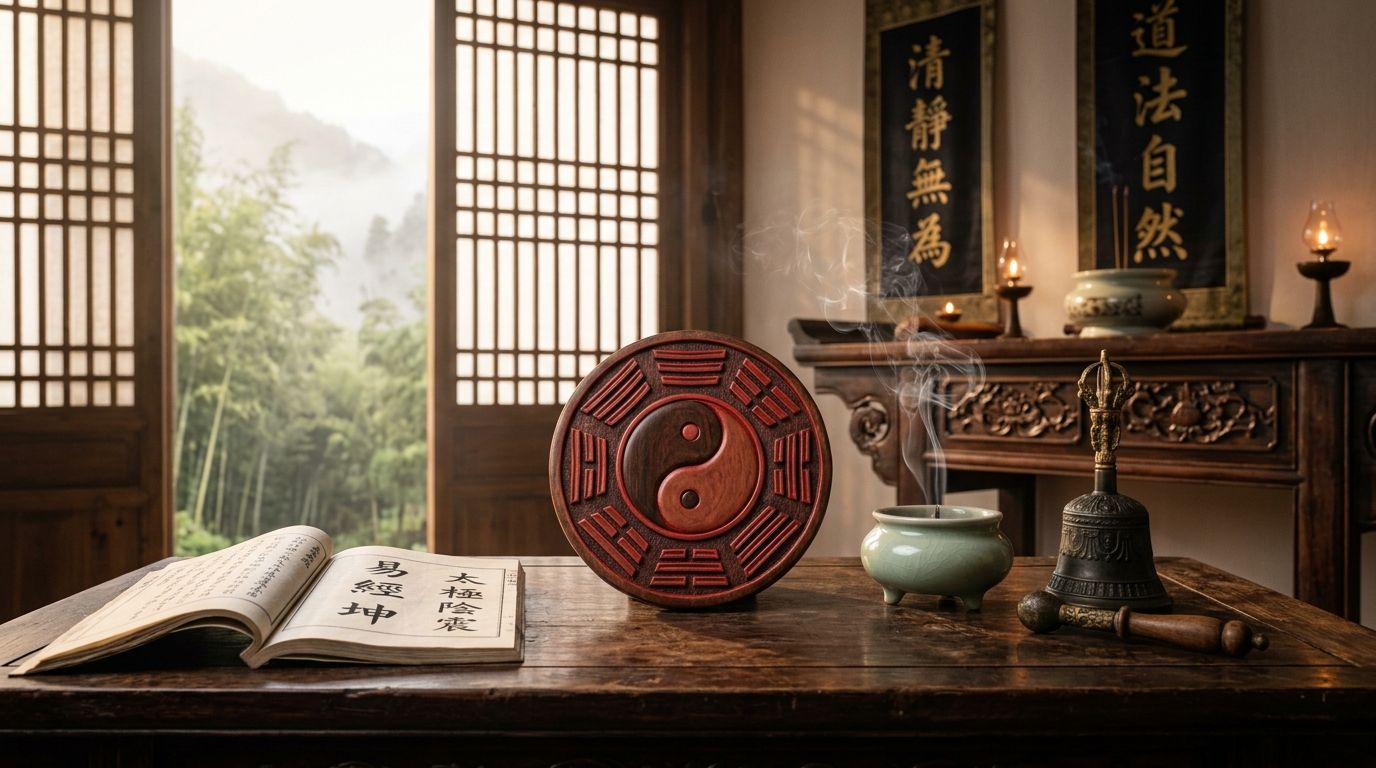
When you observe an authentic consecrated Tao symbol implement—such as the exquisite hand-carved medallion featured in traditional lineage shrines—the central Taiji is almost invariably encircled by the Eight Trigrams (Bagua 八卦). This sacred synthesis unites the primordial dynamic core with the cosmic directional compass.
Each trigram consists of three stacked lines: either solid Yang lines (———) or broken Yin lines (— —). Together, they represent the eight primary building blocks of physical reality:
- Zenith / South — Trigram (Hanzi): ☰ Qian (乾) · Cosmic Archetype: Pure Creative Heaven · Natural Element: Father / Firmament · Energetic Polarity: Supreme Yang
- Southeast — Trigram (Hanzi): ☱ Dui (兑) · Cosmic Archetype: Open Lake / Mist · Natural Element: Joyful Harmony · Energetic Polarity: Receptive Yang
- East — Trigram (Hanzi): ☲ Li (离) · Cosmic Archetype: Radiant Fire / Sun · Natural Element: Illuminating Clarity · Energetic Polarity: Internal Yin, External Yang
- Northeast — Trigram (Hanzi): ☳ Zhen (震) · Cosmic Archetype: Arousing Thunder · Natural Element: Dynamic Movement · Energetic Polarity: Initiating Yang
- Southwest — Trigram (Hanzi): ☴ Xun (巽) · Cosmic Archetype: Gentle Wind / Wood · Natural Element: Penetrating Growth · Energetic Polarity: Flexible Yin
- West — Trigram (Hanzi): ☵ Kan (坎) · Cosmic Archetype: Abyssal Water / Moon · Natural Element: Deep Nourishment · Energetic Polarity: Internal Yang, External Yin
- Northwest — Trigram (Hanzi): ☶ Gen (艮) · Cosmic Archetype: Immovable Mountain · Natural Element: Stillness / Rest · Energetic Polarity: Anchoring Yin
- Nadir / North — Trigram (Hanzi): ☷ Kun (坤) · Cosmic Archetype: Pure Receptive Earth · Natural Element: Mother / Ground · Energetic Polarity: Supreme Yin
The Two Sacred Arrangements:
- The Pre-Heaven Bagua (Xiantian 先天, Primordial Order):
Constructed by the primordial culture-hero Fuxi (伏羲), this arrangement pairs absolute opposites directly across from one another:
- Qian (Heaven 乾) sits at the zenith (South), directly opposing Kun (Earth 坤) at the nadir (North).
- Li (Fire 离) sits on the left (East), directly opposing Kan (Water 坎) on the right (West).
Functional Role: The Pre-Heaven arrangement represents ideal cosmic equilibrium before physical manifestation. When paired with the Tao symbol, it forms an invincible shield of pure celestial Yang energy. This is why authentic protective Bagua mirrors (Bagua Jing 八卦镜) and exorcistic seals (Fayin 法印) strictly utilize the Pre-Heaven formation to disperse negative spatial disturbances (Sha Qi 煞气).
- The Post-Heaven Bagua (Houtian 后天, Temporal Order):
Formulated by King Wen (周文王), this arrangement models the ceaseless temporal cycling of seasons on Earth:
- Li (Fire) moves to the Summer South; Kan (Water) moves to the Winter North.
- Zhen (Thunder) anchors the Spring East; Dui (Lake) anchors the Autumn West.
Functional Role: The Post-Heaven arrangement governs daily life, traditional Chinese medicine, emotional balance, and indoor Feng Shui arrangements.
When the Tao symbol spins at the center of the Bagua, it continuously receives temporal Qi from the Post-Heaven realm, refines it within the central furnace of the Taiji, and aligns it with the unshakeable perfection of Pre-Heaven harmony.
6. Consecrated Implements: Sacred Materials and Connoisseurship of Authentic Tao Symbol Artifacts
In authentic Taoist liturgical practice, a Tao symbol is never treated as mere decorative wallpaper or costume jewelry. When used as a spiritual anchor or protective instrument (Fa Qi 法器), it must be embodied in living, natural materials capable of holding and conducting celestial Yang resonance.
The ancient texts preserved in the Daozang (道藏) emphasize that physical matter carries energetic memory. Using synthetic, dead, or corrupted materials to represent the sacred Tao symbol creates discordant frequencies that negate its spiritual efficacy.
1. Lightning-Struck Jujube Wood (雷击枣木, Leiji Zaomu)
- The Supreme Energetic Medium: Natural jujube wood struck by celestial lightning during seasonal thunderstorms.
- Energetic Properties: Ingests and stores astronomical Yang electrostatic fire, functioning as a natural resonator against discordant Sha Qi.
- Connoisseurship & Identification: Dense, heavy grain with authentic micro-carbonization fissures along growth rings; emits a subtle warm, toasted caramel-woody aroma; hovers or sinks in water due to immense fibrous density.
2. Pure Mineral Cinnabar (朱砂, Zhusha)
- The King of Earth Minerals: Natural crystalline mercuric sulfide harvested from deep geothermal mineral veins.
- Energetic Properties: Radiates pure, stable earth-element Yang energy; traditionally employed to consecrate (Kai Guang) talismanic seals and awaken sacred sight (Dian Yan).
- Connoisseurship & Identification: Distinctive heavy metallic heft with cool tactile touch; lustrous deep vermilion-crimson crystalline facets; never fades, dissolves, or bleeds like synthetic dyes.
3. Aged Seasoned Peach Wood (桃木, Taomu)
- The Sacred Wood of the Sun: Matured mountain peach wood naturally air-cured across multiple seasons.
- Energetic Properties: As the earliest blossoming tree in spring, peach wood captures the primordial crest of nascent Yang Qi.
- Connoisseurship & Identification: Warm golden-honey grain; sweet, subtle botanical aroma; naturally resistant to decay and hand-carved by lineage craftsmen into ritual swords and Bagua amulets.
4. Old Mountain Sandalwood (老山檀, Laoshan Tan)
- The Fragrance of the Celestial Realm: High-resin wild sandalwood heartwood aged for decades.
- Energetic Properties: Pure aromatic plant resin acts as the "Vehicle of the Spirit" (Tong Shen 通神), clearing chaotic emotional clutter and centering the Lower Dantian.
- Connoisseurship & Identification: Rich, oily grain with deep balsamic notes; smoke burns clean with delicate white wisps that leave zero bitter chemical residue.
The Pitfall of Industrial Counterfeits
Modern commercial markets are flooded with counterfeit "Yin-Yang" charms manufactured from:
- Injection-molded epoxy resins and plastic polymers: Dead, insulating materials with zero energetic conductivity.
- Pressed sawdust composites bonded with toxic formaldehydes: Chemically contaminated wood that produces energetic stagnation.
- Synthetic chemical red paints disguised as cinnabar: Cheap red ink that lacks the crystalline geothermal vibration of authentic mineral cinnabar.
When choosing a Tao symbol medallion or altar implement, always seek authentic, hand-carved natural woods and pure mineral pigments that honor the craftsmanship of living lineage tradition.
7. Step-by-Step Practical Guide: Aligning, Consecrating, and Positioning the Tao Symbol on a Domestic Altar
For sincere international seekers who wish to enshrine the Tao symbol within their personal sacred space, the following liturgical protocol outlines how to consecrate, position, and honor the implement according to traditional temple standards.
Environmental Taboos and Placement Protocols
- Altar Elevation: The Tao symbol should always rest at or slightly above eye level when seated, honoring the lofty principle of Heaven. Never place sacred implements directly on the floor.
- Directional Alignment: Ideally, position your sanctuary facing South (the traditional throne of Yang) or East (the direction of the rising sun and the Azure Dragon).
- Prohibited Spaces: Never position a consecrated Tao symbol inside a bathroom, laundry room, master bedroom facing the bed, or directly beneath an overhead storage rack.
- Protective Exterior Mirror Usage: If using a carved Taiji Bagua mirror to deflect architectural discord (Sha Qi like a T-junction or sharp roof ridge), mount it strictly on the exterior of your home facing outward. It should never reflect inward into living quarters.
Step-by-Step Altar Protocol (Chenzhao Fenggong 晨朝奉供):
- Step 1: Spatial Cleansing with Natural Incense (Jing Tan 净坛)
Begin during the morning hours (ideally between 5:00 AM and 7:00 AM, the Mao Hour 卯时). Thoroughly wipe down the dark wood altar table with a clean cloth reserved solely for sacred implements. Ignite a single stick of pure aged sandalwood or agarwood incense. Wave the fragrant smoke gently across the altar space in three clockwise circles, silently reciting:
"Pure fragrance fills the ten directions; all earthly dust disperses into celestial light."
- Step 2: Cleansing Hands and Mind (Jingxin Jingkou 净心净口)
Wash your hands in clean water. Stand upright before the altar, roll your shoulders back, drop your chin slightly, and take three deep diaphragmatic breaths down into the Lower Dantian (Xia Dantian 下丹田). Allow the turbulent thoughts of your daily workday to settle like sediment in still water.
- Step 3: Aligning the Sacred Tao Symbol (An Zhi Faqi 安置法器)
Gently lift your hand-carved lightning-struck jujube wood or peach wood Tao symbol implement with both hands. Place it securely in an upright wooden stand in the central position of your altar, positioned directly behind the incense censer. Ensure the symbol is oriented correctly: the white Yang fish rising up toward the celestial zenith, and the dark Yin fish settling toward the earthly nadir.
- Step 4: Offering the Three Pure Waters (Sanqing Fengshui 三清奉水)
Fill three pristine porcelain offering cups with pure, filtered spring water. Place them in an unbroken horizontal line in front of the Tao symbol:
- Center Cup: Dedicated to the Tao and Yuanshi Tianzun (元始天尊).
- Left Cup: Dedicated to the Sacred Scriptures and Lingbao Tianzun (灵宝天尊).
- Right Cup: Dedicated to the Lineage Masters and Daode Tianzun (Laozi 道德天尊).
- Step 5: Forming the Sacred Ziwu Hand Seal (Ziwu Jue 子午诀)
Bring your hands together at the heart level to form the traditional Ziwu Seal (子午诀):
- Wrap the fingers of your left hand around your right thumb.
- Connect the tip of your left thumb to the base of your left ring finger (the Zi 子 position, representing Water and Midnight).
- Connect the tip of your right thumb to the top of your right middle finger (the Wu 午 position, representing Fire and Midday).
- This physical mudra locks the internal Tao symbol inside your hands, circulating Water and Fire in microcosmic harmony.
- Step 6: Offering the Three Sticks of Natural Incense (Sanxiang Dingxiang 三香定向)
Light three sticks of natural incense. Wave out the flame without blowing on it with your breath. Hold the incense with both hands at eye level, bowing respectfully. Insert the sticks into the censer one by one:
- First Stick (Center): "I honor the primordial Tao."
- Second Stick (Left): "I honor the living teachings."
- Third Stick (Right): "I honor the enlightened ancestors."
Ensure all three sticks stand perfectly straight and parallel, forming a tri-fold pillar of fragrant communication between Heaven, Earth, and humanity.
- Step 7: Concluding Reverence (San Libai 三礼拜)
Step back one pace, hold the Ziwu seal at your solar plexus, and perform three deep, mindful bows. Feel a golden warmth washing through your crown and down your spine, affirming that your sanctuary is aligned with the eternal rhythm of the Tao.
8. Neidan Cultivation: Embodying the Living Tao Symbol Through Microcosmic Orbit Meditation (Xiao Zhoutian)
The ultimate secret preserved in the esoteric monasteries of Wudang and Mount Longhu is this: the true Tao symbol is not an object outside yourself—it is the energetic structure of your own living body.
In the practice of Taoist Internal Alchemy (Neidan 内丹), the human organism is viewed as a miniature cosmos (Xiaotiandi 小天地). The external Tao symbol is simply an architectural mirror designed to awaken the internal Taiji spinning between your physical kidneys and navel.
Energetic Anatomy of the Microcosmic Orbit
- Apex of Yang (Baihui 百会, Crown): Located at the highest point of the skull, representing Heaven and the peak of ascending Yang fire.
- The Ascending Spinal Channel (Du Mai 督脉, Governor Vessel): Traverses upward from the tailbone along the spine, carrying the warming Yang current during conscious inhalation.
- The Central Crucible (Lower Dantian 下丹田, The Elixir Field): Situated two inches below the navel, serving as the rotating furnace where Yin and Yang coalesce into spiritual vitality.
- The Descending Front Midline (Ren Mai 任脉, Conception Vessel): Flows downward from the tongue and throat through the chest, guiding the cooling Yin water during mindful exhalation.
- Depth of Yin (Huiyin 会阴, Perineum): Positioned at the base of the pelvic floor, representing Earth and the gateway of receptive stillness.
The Microcosmic Orbit (Xiao Zhoutian 小周天) Meditation
To embody the Tao symbol in daily seated meditation (Jingzuo 静坐):
- The Posture: Sit comfortably on a firm cushion with an erect spine. Rest your tongue lightly against the upper palate of your mouth (the "Magpie Bridge" connecting the front and back energy channels). Rest your hands in your lap in the Ziwu seal.
- Igniting the Dantian: Bring your gentle, unforced awareness to the Lower Dantian (下丹田), two inches below the navel. Visualize a warm, golden sphere of light—the seed of Taiji—gently spinning in this sacred space.
- The Ascent of Yang Fire: As you inhale through your nose, gently contract the perineum (Huiyin 会阴). Visualize pure, warm Yang energy drawing up along the spine through the Governor Vessel (Du Mai 督脉), ascending past the tailbone, heart center, and neck, reaching the crown of your head (Baihui 百会). This is Yang reaching its astronomical zenith.
- The Descent of Yin Water: As you exhale, release the breath smoothly down the front midline along the Conception Vessel (Ren Mai 任脉)—flowing down from the throat, washing through the chest, and returning to pool into the Lower Dantian like cool, nourishing mountain water. This is Yin completing its restorative cycle.
- Harmonizing the Two: By continuously circulating the breath through this oval orbit, you become the living, breathing S-curve of the Tao symbol. Fire warms Water so it does not stagnate; Water cools Fire so it does not scorch. The mind dissolves into effortless tranquility (Qingjing 清静), embodying the highest virtue of Wu Wei (无为).
9. Frequently Asked Questions (FAQ)
Q1: What does the Tao symbol actually represent in authentic Taoism?
Answer: In authentic Taoist cosmology, the Tao symbol—historically known as the Taiji Tu (太极图, Diagram of the Supreme Ultimate)—represents the living, cyclical heartbeat of reality itself. Far from a simplistic Western dualism of "good versus evil", the Tao symbol illustrates how the undifferentiated primordial Source (Wuji 无极) divides into complementary, interdependent polarities (Yin 阴 and Yang 阳). The dynamic S-curve demonstrates that neither force is static or permanent; instead, as Yang reaches its zenith, the seed of Yin is naturally born, and as Yin reaches its maximum depth, Yang rekindles. The symbol is thus a sacred cosmic blueprint illustrating how all phenomena in the universe emerge, transform, harmonize, and inevitably return to stillness.
Q2: Why are there two opposing dots inside the Tao symbol?
Answer: The two circular dots within the Tao symbol are known in lineage tradition as the "Yin-Yang Fish Eyes" (Yin-Yang Yu 阴阳鱼). They embody the profound cosmological law that absolute polarity is impossible in an interdependent cosmos. Within the heart of pure Yang (radiant white) resides the primordial seed of Yin (dark dot), symbolizing the Summer Solstice where the days are longest yet the winter cooling cycle secretly begins. Conversely, within the deepest core of Yin (darkness/receptivity) sits the germ of Yang (white dot), mirroring the Winter Solstice where the longest night initiates the return of solar warmth. In personal spiritual cultivation (Neidan 内丹), these dots remind the practitioner that in extreme stillness (Yin), spiritual illumination (Yang) naturally sparks.
Q3: What is the difference between the Tao symbol (Taiji) and the Bagua (Eight Trigrams)?
Answer: The Tao symbol (Taiji Tu) and the Bagua (Eight Trigrams 八卦) represent sequential stages of universal cosmological unfolding described in the Yijing (易经·系辞): "The Supreme Ultimate generates the Two Polarities (Yin-Yang), the Two Polarities generate the Four Images (Sixiang), and the Four Images generate the Eight Trigrams." While the central Taiji represents the primordial duality in perpetual rotation, the surrounding Bagua breaks down this dynamic into eight distinct energetic vectors corresponding to Heaven (Qian 乾), Earth (Kun 坤), Water (Kan 坎), Fire (Li 离), Thunder (Zhen 震), Wind (Xun 巽), Mountain (Gen 艮), and Lake (Dui 兑). In consecrated ritual artifacts, the Taiji acts as the core energetic dynamo, while the Bagua serves as the protective compass directing and balancing spatial Qi.
Q4: How should an authentic consecrated Taiji Bagua artifact be positioned and cared for?
Answer: According to orthodox Taoist liturgical etiquette, an authentic consecrated Tao symbol implement (such as a lightning-struck jujube wood seal or peach wood mirror) must be treated with profound reverence. If utilized for environmental Feng Shui harmonization, it should be mounted facing outward toward the source of incoming architectural tension (Sha Qi 煞气), such as a busy road or sharp corner, and never aimed inward toward sleeping quarters or children's beds. If enshrined on a domestic altar, it should stand upright behind the central incense burner, elevated above floor level. Practitioners should avoid touching consecrated surfaces with unwashed hands, never place the sacred symbol in bathrooms or basements, and periodically cleanse its vibrational field using natural aged sandalwood (Laoshan Tan 老山檀) incense smoke.
10. Conclusion: Flowing with the Living Current of the Tao
When we look upon the sacred curves of the Tao symbol, we are not gazing at an arbitrary artistic design or a quaint relic of antiquity. We are beholding the eternal signature of existence itself.
In a modern world characterized by frantic rushing, polarized conflict, and artificial separation, the Tao symbol whispers a gentle, revolutionary reminder:
- You do not need to conquer the river; you only need to learn how to swim with its current.
- Your periods of quiet winter rest (Yin) are not failures of productivity, but the essential womb from which your next spring creative flourishing (Yang) will emerge.
- Light and shadow are not sworn enemies, but dance partners in the grand choreography of life.
Whether enshrined as an authentic hand-carved lightning-struck wood seal upon your home altar, visualized as a warm golden vortex during morning meditation, or simply worn as a mindful talisman against daily anxiety, the Tao symbol serves as an eternal compass. By aligning our thoughts, breath, and living spaces with its sacred geometry, we step out of friction and exhaustion, entering the serene, boundless, and effortless flow of the Great Way.