Daoism Foundations · · 19 min read
Taoismo Explained: Ancient Philosophy, Lineage History, Sacred Cosmology, and Consecrated Altar Artifacts
Explore the profound depth of Taoismo: from Laozi's Wu Wei philosophy and ancient temple lineages to sacred Bagua cosmology and consecrated altar artifacts.
By Daoismart Editorial
On this page
- Taoismo Explained: Ancient Philosophy, Lineage History, Sacred Cosmology, and Consecrated Altar Artifacts
- 1. The Primordial Stream: What Is Taoismo?
- The Ineffable Tao (道) and Its Virtue (De 德)
- Image (Xiang 象), Breath (Qi 炁), and Form (Xing 形)
- 2. Foundational Philosophy: The Core Principles of Taoismo
- 1. Wu Wei (无为): Effortless Action and Natural Flow
- 2. Ziran (自然): Spontaneity and Organic Unfolding
- 3. The Wit and Transcendence of Zhuangzi (庄子)
- 3. The Historical Evolution of Taoismo: From Mountain Hermits to Orthodox Lineages
- The Han Dynasty Transformation: Zhang Daoling and the Celestial Masters
- The Jin-Yuan Monastic Awakening: Wang Chongyang and Quanzhen
- Dissolving the False Dichotomy: Daojia vs. Daojiao
- 4. Comprehensive Lineage Matrix: The Major Traditions of Taoismo
- 5. Sacred Cosmology & Consecrated Artifacts (Fawu 法物) in Taoismo
- 1. Lightning-Struck Jujube Wood (Leiji Zaomu 雷击枣木)
- 2. Seasoned Mountain Peach Wood (Taomu 桃木)
- 3. Natural Mineral Cinnabar (Zhusha 朱砂)
- 4. The Canonical Rite of Kai Guang (开光, Opening the Light)
- 6. Step-by-Step Practical Guide: Establishing a Daily Sanctuary and Practice of Taoismo
- Step 1: Altar Location and Spatial Alignment (Anwei Dingxiang 安位定向)
- Step 2: Morning Cleansing and Mental Stillness (Jing Shen Jing Shou 净身净手)
- Step 3: Offering the Three Pure Waters and Incense Sticks (Sanxiang Sanquan 三香三泉)
- Step 4: Sealing Energy with the Ziwu Hand Mudra (Ziwu Jue 子午诀)
- Step 5: Diaphragmatic Dantian Breathing & Taiji Meditation (Jingzuo Taiji 静坐太极)
- 7. Frequently Asked Questions (FAQ)
- Q1: What is Taoismo, and how does it fundamentally differ from Western religious traditions?
- Q2: What is the relationship between philosophical Taoismo (Daojia) and religious Taoismo (Daojiao)?
- Q3: Why are consecrated artifacts and the Kai Guang ceremony essential in Taoismo?
- Q4: What are the primary home altar taboos when establishing a personal sacred space in Taoismo?
Taoismo Explained: Ancient Philosophy, Lineage History, Sacred Cosmology, and Consecrated Altar Artifacts
Key Takeaways (Executive Summary) - Direct Definition: Taoismo (globally recognized as Daoism or Taoism, 道教) is an ancient, unbroken philosophical and liturgical tradition originating in China that teaches harmonious coexistence with the Tao (道)—the ineffable primordial source and natural order of all creation—guided by the core virtues of Wu Wei (无为, effortless action) and Ziran (自然, natural spontaneity). - Cosmological Evolution: In Taoismo, cosmic manifestation follows a rigorous sequence: the boundless primordial void (Wuji 无极) gives rise to the supreme polarity (Taiji 太极), which differentiates into complementary forces (Yin and Yang 阴阳), the Five Elements (Wuxing 五行), and all physical life (Wanwu 万物). - Unity of Philosophy and Liturgy: Taoismo harmoniously integrates the profound philosophical wisdom of Daojia (道家)—transmitted by ancient sages such as Laozi (老子) and Zhuangzi (庄子)—with the living ritual, monastic, and liturgical traditions of Daojiao (道教), including the Zhengyi (正一) and Quanzhen (全真) lineages. - Living Sacred Implements: Consecrated lineage artifacts (Fawu 法物)—such as lightning-struck jujube wood seals (雷击枣木印), mountain peach wood swords (桃木剑), and mineral cinnabar (朱砂)—act as physical transceivers of pure Yang Qi, awakened through the authentic liturgical rite of Kai Guang (开光, Opening the Light). - Home Cultivation Protocol: Authentic daily practice of Taoismo is anchored in domestic sanctuary etiquette, dawn incense and fresh water offerings, the canonical Ziwu Hand Mudra (子午诀), and diaphragmatic Lower Dantian (下丹田) breathwork.
1. The Primordial Stream: What Is Taoismo?
Across global philosophical and spiritual traditions, few worldviews offer the tranquil elegance, ecological intimacy, and metaphysical profundity of Taoismo. Often transliterated in Western scholarship and international discourse as Taoism or Daoism (道教), Taoismo is not a static dogma of moral commandments, but a living, experiential navigation of cosmic reality.
To understand Taoismo, one must first discard the reductionist Western lens that splits existence into irreconcilable opposites: spirit versus matter, humanity versus nature, good versus evil. In the worldview of Taoismo, all phenomena belong to a single, continuous, self-generating cosmic fabric governed by the Tao (道).
The Ineffable Tao (道) and Its Virtue (De 德)
The opening lines of the monumental Daodejing (道德经), attributed to the primordial sage Laozi (老子), establish the supreme humility required when approaching Taoismo:
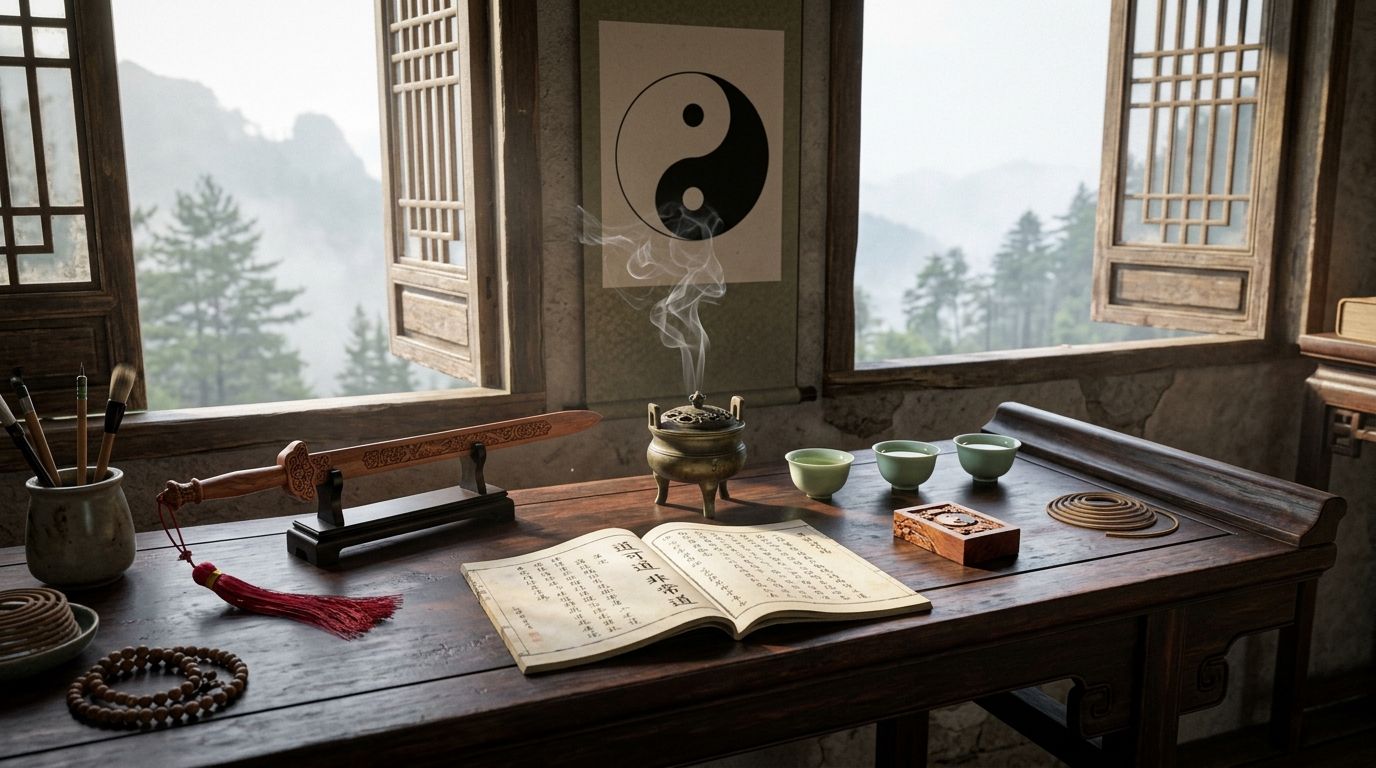
"The Tao that can be spoken is not the eternal Tao; The name that can be named is not the eternal name." — (道可道,非常道;名可名,非常名。)
The Tao (道) cannot be encapsulated in verbal formulations or dogmatic creeds. It is simultaneously the origin of the cosmos (the Mother of Ten Thousand Things), the unseen rhythm orchestrating planetary orbits and seasonal cycles, and the innermost essence of human consciousness. When the Tao crystallizes into personal character, natural integrity, and spiritual power, it is known as De (德, Virtue or Inner Efficacy). Thus, Taoismo is the art of cultivating De to abide within the Tao.
Image (Xiang 象), Breath (Qi 炁), and Form (Xing 形)
In the profound ontology of Taoismo, reality operates across three interdependent registers:
- Qi (炁, Primordial Breath): The subtle, animating life-force that permeates all space.
- Xiang (象, Cosmic Image/Pattern): The subtle geometric and archetypal blueprints that guide manifestation, represented by the Bagua (八卦) and sacred celestial talismans (Fu Lu 符箓).
- Xing (形, Physical Form): The tangible, crystallized material world of mountains, waters, human bodies, and handcrafted ritual implements.
In Taoismo, spiritual practice is never an escape from the physical world into an ethereal realm; rather, it is the conscious harmonization of Form (Xing) and Image (Xiang) with the pristine rhythm of Primordial Breath (Qi).
2. Foundational Philosophy: The Core Principles of Taoismo
The wisdom of Taoismo provides humanity with an antidote to modern psychological exhaustion, hyper-competition, and alienation from the natural world. At the center of this philosophical edifice stand three timeless principles:
1. Wu Wei (无为): Effortless Action and Natural Flow
Perhaps the most misunderstood concept in Western interpretations of Taoismo, Wu Wei (无为) is frequently mistranslated as "passivity," "inaction," or "lethargy." In authentic lineage teachings, Wu Wei denotes action without egoic contrivance—acting in so pure an alignment with environmental and situational dynamics that effort ceases to generate internal or external friction.
As water effortlessly carves canyons through solid granite not by brute force, but by soft persistence and seeking the lowest ground, the practitioner of Taoismo moves through worldly challenges with flexible, frictionless grace. In Chapter 37 of the Daodejing, Laozi writes:
"The Tao does nothing, yet nothing is left undone." — (道常无为而无不为。)
2. Ziran (自然): Spontaneity and Organic Unfolding
In Taoismo, Ziran (自然) literally translates to "self-so" or "of its own nature." It is the principle that flowers blossom without deliberation, rivers flow without anxious schedules, and planets orbit without coercion. Human suffering arises when artificial societal desires, obsessive ambition, and rigid mental constructs override Ziran.
Chapter 25 of the Daodejing delineates the grand hierarchy of cosmic resonance:
"Humanity models itself upon Earth; Earth models itself upon Heaven; Heaven models itself upon the Tao; and the Tao models itself upon Ziran." — (人法地,地法天,天法道,道法自然。)
3. The Wit and Transcendence of Zhuangzi (庄子)
While Laozi articulates the poetic architecture of Taoismo, the sage Zhuangzi (庄子) infuses it with transcendent humor, paradoxical parables, and psychological liberation. In the classic text Zhuangzi, concepts such as the Butterfly Dream (Zhuang Zhou Meng Die 庄周梦蝶) and The Fasting of the Heart (Xinzhai 心斋) challenge fixed notions of identity, urging seekers to wander freely in the realm of the boundless (Xiaoyaoyou 逍遥游).
3. The Historical Evolution of Taoismo: From Mountain Hermits to Orthodox Lineages
The historical trajectory of Taoismo spans over two and a half millennia, evolving from an elite philosophical tradition into an institutionalized, vibrant liturgical system that shaped East Asian civilization.
The Han Dynasty Transformation: Zhang Daoling and the Celestial Masters
Before the second century CE, Taoismo existed primarily as philosophical discourses, hermit lineages, and health-preservation traditions (Fangshi 方士). In 142 CE, on Mount Heming in Sichuan, the revered sage Zhang Daoling (张道陵) reported a profound celestial vision of Laozi, deified as Taishang Laojun (太上老君, The Grand Supreme Elderly Lord).
Taishang Laojun bestowed upon Zhang Daoling the title of First Celestial Master (Tianshi 天师) and transmitted the covenant to replace blood sacrifices with pure offerings of incense, water, and vegetarian feasts. This marked the formal inception of Daojiao (道教), giving birth to the Zhengyi (正一, Orthodox Unity) lineage, which remains celebrated for its liturgical talismanic mastery (Fu Lu 符箓) and householder priesthood.
The Jin-Yuan Monastic Awakening: Wang Chongyang and Quanzhen
In the twelfth century, amidst the turmoil of northern China, Master Wang Chongyang (王重阳) founded the Quanzhen (全真, Complete Perfection) lineage at Mount Zhongnan. Emphasizing celibate monasticism, internal alchemy (Neidan 内丹), and the harmonizing synthesis of Daoism, Chan Buddhism, and Confucian ethics, Quanzhen established famous centers such as the White Cloud Temple (Baiyunguan 白云观) in Beijing.
Dissolving the False Dichotomy: Daojia vs. Daojiao
A persistent error in twentieth-century Western academia was the rigid division between "pure philosophical Daoism" (Daojia) and "corrupt superstitious religious Daoism" (Daojiao). In authentic Chinese understanding, this distinction is an artificial modern construct.
Philosophical contemplation provides the theoretical root, while ritual liturgy, talismanic calligraphy, and altar cultivation provide the practical limbs. A Daoist priest chanting scriptures or consecrating a ritual implement is actively translating the abstract metaphysics of the Daodejing into tangible spatial frequency.
4. Comprehensive Lineage Matrix: The Major Traditions of Taoismo
To navigate the multifaceted landscape of Taoismo, practitioners and scholars refer to the foundational matrix below, contrasting orthodox lineages with common pop-culture distortions:
- Philosophical Taoismo (Daojia 道家) — Historical Inception & Canonical Sages: Pre-Qin Period; Laozi (老子), Zhuangzi (庄子), Liezi (列子). · Primary Spiritual Focus & Practices: Metaphysical inquiry, Wu Wei, natural spontaneity, ecological consciousness, non-contentious statecraft. · Sacred Implements & Altar Traditions: Minimalist study altars, brush and inkstone, thread-bound classical texts (Daodejing), celadon teacups. · Authentic Consecration (Kai Guang) Role: Cultivates inner awakening through intellectual and contemplative clarity rather than outer rites.
- Zhengyi Lineage (正一道, Orthodox Unity) — Historical Inception & Canonical Sages: 142 CE; Han Dynasty First Celestial Master Zhang Daoling (张道陵). · Primary Spiritual Focus & Practices: Liturgical rituals (Jiao 醮), protective talismans (Fu Lu 符箓), cosmic registers, household priestly service. · Sacred Implements & Altar Traditions: Lightning-struck jujube seals (Leiji Zaomu Fayin), celestial brass bells, cinnabar ink, five-directional banners. · Authentic Consecration (Kai Guang) Role: Essential: Implements must undergo canonical aperture dotting and spirit invocation to command Qi.
- Quanzhen Lineage (全真道, Complete Perfection) — Historical Inception & Canonical Sages: 12th Century CE; Jin Dynasty Master Wang Chongyang (王重阳). · Primary Spiritual Focus & Practices: Celibate monasticism, Neidan internal alchemy, Lower Dantian breathwork, harmonizing Three Teachings. · Sacred Implements & Altar Traditions: Meditation cushions (Putuan), peach wood swords, bronze censers with aged sandalwood, wooden fish (Muyu). · Authentic Consecration (Kai Guang) Role: Internal consecration: The practitioner's own inner alchemical furnace awakens the implement.
- Western Pop-Culture Misconceptions — Historical Inception & Canonical Sages: 20th Century New Age & Commercial Pop Media. · Primary Spiritual Focus & Practices: Superficial "yin-yang" aesthetics, fortune-telling fatalism, black magic superstition, commercial trinkets. · Sacred Implements & Altar Traditions: Mass-produced plastic resin statues, chemically dyed charms, toxic synthetic stick incense. · Authentic Consecration (Kai Guang) Role: Non-existent: Commercial items lack lineage transmission, ritual purity, and energetic potency.
5. Sacred Cosmology & Consecrated Artifacts (Fawu 法物) in Taoismo
In Taoismo, matter is not considered static or profane. It is the crystallization of cosmic vitality. Consequently, sacred implements (Fawu 法物) are created using natural materials that possess inherent energetic affinities with pure Yang Qi (Chunyang zhi Qi 纯阳之气).
1. Lightning-Struck Jujube Wood (Leiji Zaomu 雷击枣木)
Hailed across the canonical Daozang (道藏) as the "Sovereign of Sacred Woods," lightning-struck jujube wood is created when a living mountain jujube tree absorbs the celestial electric fire (Tianhuo 天火) of a natural thunderstorm.
- Connoisseurship Attributes: Authentic pieces display an irregular, dense reddish-dark grain with natural micro-fractures left by lightning energy. When rubbed between warm palms, genuine lightning-struck jujube wood exudes a distinct roasted caramel, aged woody aroma. It is exceptionally dense and will sink or rest low in water.
- Counterfeit Warning: Unscrupulous sellers routinely subject low-grade lumber to industrial electric probes or scorch wood with blowtorches. These fakes reek of bitter acrid chemical smoke and possess no genuine celestial lightning resonance.
2. Seasoned Mountain Peach Wood (Taomu 桃木)
Revered since ancient times as the Wood of Pure Solar Yang, peach wood possesses a radiant natural frequency that dissolves environmental stagnation (Sha Qi 煞气).
- Connoisseurship Attributes: Genuine peach wood ritual swords (Taomu Jian 桃木剑) are carved from wild mountain peach heartwood that has seasoned naturally for over three years. The wood possesses a warm, silky tan-reddish tone, tight grain structure, and exceptional resilience.
- Counterfeit Warning: Mass-market replicas are commonly cast from hollow polyresin or fashioned from soft plantation pine bleached with sulfur. Such substitutes lack organic Yang resonance and degrade rapidly.
3. Natural Mineral Cinnabar (Zhusha 朱砂)
Composed of natural crystalline mercuric sulfide (HgS), mineral cinnabar is the paramount sacred mineral in Taoismo, utilized for millennia to inscribe talismans, consecrate statues, and carve protective beads.
- Connoisseurship Attributes: Mined from geological veins in Hunan and Guizhou, natural cinnabar feels strikingly cold, dense, and heavy in the hand due to its remarkable specific gravity. It exhibits a lustrous deep vermilion color with distinct crystalline cleavage planes.
- Counterfeit Warning: Counterfeit cinnabar floods commercial markets, made from cheap red plastic resins combined with powdered stone and lead additives. These toxic fakes feel warm and lightweight, lacking the crystalline sheen and metallic coolness of the real mineral.
4. The Canonical Rite of Kai Guang (开光, Opening the Light)
In Taoismo, a sacred implement remains an inert decorative craft until consecrated through the liturgical rite of Kai Guang (开光). Conducted by an ordained Daoist priest who has observed strict purification and fasting (Zhaijie 斋戒), the ceremony comprises five canonical phases:
Through this rigorous liturgical alchemy, the physical implement is harmonized with celestial registers, serving as a reliable spatial anchor of peaceful energy.
6. Step-by-Step Practical Guide: Establishing a Daily Sanctuary and Practice of Taoismo
How does a sincere practitioner integrate the timeless wisdom of Taoismo into a modern home environment? Follow this five-step daily protocol to create an authentic personal sanctuary:
Step 1: Altar Location and Spatial Alignment (Anwei Dingxiang 安位定向)
The energetic integrity of your sanctuary begins with proper physical placement:
- Table Height and Stability: Select a solid wooden table resting at least waist-high against a solid, load-bearing wall. This represents unwavering support (Kaoshan 靠山).
- Directional Orientation: Orient the altar facing the main entrance of the room or eastward toward the morning sunrise (Chaoyang 朝阳), welcoming rising Yang Qi.
- Strict Taboos: Never position an altar inside a bedroom, on a dining table where meat or alcohol is served, or against a wall shared with a restroom or kitchen stove. Consecrated implements must never touch the bare floor or sit beneath hanging garments.
Step 2: Morning Cleansing and Mental Stillness (Jing Shen Jing Shou 净身净手)
Approach the sanctuary during the Mao Hour (卯时, 5:00 AM – 7:00 AM), when celestial Yang Qi awakens:
- Wash hands and face thoroughly with cool, clean water; rinse the mouth to purify physical speech.
- Gently wipe the altar surface with a dedicated silk cloth reserved strictly for sacred vessels.
- Silence mobile devices and release worldly anxieties, entering an attitude of serene reverence.
Step 3: Offering the Three Pure Waters and Incense Sticks (Sanxiang Sanquan 三香三泉)
Place three porcelain or celadon offering cups in a straight horizontal line before your sacred implements or calligraphy:
- Center Cup: Offered to Yuanshi Tianzun (元始天尊, Celestial Worthy of Primordial Beginning), embodying the unmanifest Tao.
- Left Cup (Observer's Left): Offered to Lingbao Tianzun (灵宝天尊, Celestial Worthy of Numinous Treasure), embodying sacred scripture and cosmic law.
- Right Cup (Observer's Right): Offered to Daode Tianzun (道德天尊 / Laozi), embodying lineage teachers and compassionate action.
Ignite three sticks of natural aged sandalwood or agarwood. Extinguish the flame with a gentle wave of the hand—never blow on ritual incense with your mouth:
- Insert the center stick first, honoring the Dao (Dao Xiang 道香).
- Insert the left stick second, honoring the Scripture (Jing Xiang 经香).
- Insert the right stick third, honoring the Lineage Master (Shi Xiang 师香).
Step 4: Sealing Energy with the Ziwu Hand Mudra (Ziwu Jue 子午诀)
Stand or sit upright before the altar with an aligned spine. Bring both hands together at the solar plexus to form the ancient Ziwu Mudra (子午诀):
- Wrap the fingers of your left hand around your right thumb.
- Rest the tip of your left thumb against the base of your left ring finger (the Zi 子 coordinate, embodying midnight, Water, and receptive Yin).
- Press the tip of your right thumb against the tip of your right middle finger (the Wu 午 coordinate, embodying midday, Fire, and radiant Yang).
- This sacred mudra connects the body's Conception (Ren) and Governing (Du) vessels, sealing vitality and harmonizing Fire and Water (Kan-Li Jiao-Gou 坎离交媾).
Step 5: Diaphragmatic Dantian Breathing & Taiji Meditation (Jingzuo Taiji 静坐太极)
Settle onto a firm meditation cushion before the altar for 15 to 20 minutes of silent cultivation:
- Rest the tip of your tongue lightly against the upper palate behind the upper front teeth, bridging the cranial energy circuit.
- Inhale softly and deeply through the nose, allowing the Lower Dantian (下丹田)—located roughly two inches below the navel—to gently expand like a soft balloon.
- Exhale slowly, feeling your abdomen gently contract while releasing bodily tension.
- Gently visualize the Taijitu (太极图) slowly turning within your Lower Dantian, circulating peaceful light and dissolving discordant mental turbulence into the tranquility of the Tao.
7. Frequently Asked Questions (FAQ)
Q1: What is Taoismo, and how does it fundamentally differ from Western religious traditions?
Answer: Taoismo (traditionally known as Daoism or Taoism, 道教) is an indigenous Chinese spiritual and philosophical tradition rooted in living in absolute harmony with the Tao (道)—the unnamable, primordial source and natural order of the cosmos. Unlike Western monotheistic religions centered on divine commandments, external judgment, or dogma, Taoismo emphasizes internal alignment, natural spontaneity (Ziran 自然), effortless action (Wu Wei 无为), and the dynamic balance of Yin and Yang (阴阳). Rather than demanding blind faith, Taoismo provides a practical path of bodily cultivation, meditation, and sacred ritual to return human consciousness to cosmic oneness.
Q2: What is the relationship between philosophical Taoismo (Daojia) and religious Taoismo (Daojiao)?
Answer: In traditional Chinese lineage understanding, Daojia (道家, philosophical Taoismo) and Daojiao (道教, religious and liturgical Taoismo) are not opposing factions, but the internal root and external branches of the same living tree. Daojia provides the core metaphysical doctrines—such as those articulated in Laozi's Daodejing and the Zhuangzi—while Daojiao embodies those very truths through community temple liturgy, sacred rituals, canonical monastic disciplines (such as Quanzhen 全真), celestial master lineages (such as Zhengyi 正一), internal alchemy (Neidan 内丹), and the consecration of sacred implements (Kai Guang 开光). True cultivation in Taoismo unifies philosophical contemplation with ritual embodiment.
Q3: Why are consecrated artifacts and the Kai Guang ceremony essential in Taoismo?
Answer: In orthodox Taoismo, a newly carved statue, wooden talisman, or ritual sword is regarded merely as an inert physical vessel until it undergoes the canonical liturgical rite of Kai Guang (开光, Opening the Light). Performed by an ordained Taoist priest (Daoshi 道士) through strict ritual purification (Zhaijie 斋戒), the ceremony cleanses the implement, invokes celestial masters (Sanqing 三清), and channels internal breath (Qi 炁) cultivated through Neidan into the object. Sacred apertures are consecrated with natural mineral cinnabar (Zhusha 朱砂), transforming the item into an active cosmic resonator that anchors protective Yang energy and harmonizes domestic space.
Q4: What are the primary home altar taboos when establishing a personal sacred space in Taoismo?
Answer: Traditional lineage rules in Taoismo emphasize four crucial guidelines for establishing a home sanctuary. First, ensure the altar table is placed at least waist-high against a solid, supportive wall, ideally facing the main room entrance or eastward toward the rising sun; never place it facing or sharing a wall with a restroom, kitchen stove, or bedroom. Second, sacred consecrated implements such as peach wood swords (Taomu Jian 桃木剑) or lightning-struck jujube wood seals (Leiji Zaomu Fayin 雷击枣木法印) must never be rested on the floor, under clotheslines, or in disorganized spaces. Third, never extinguish ritual incense by blowing with your mouth; always extinguish flames with a gentle wave of the hand. Fourth, keep consecrated wooden artifacts away from excessive humidity and direct heat, wrapping them in yellow or red silk when transported.
Authored by the Daoist Cultural Heritage & Sacred Arts Curatorial Guild. All textual citations, historical lineages, and connoisseurship standards conform to orthodox Daozang liturgical traditions.