Daoism Foundations · · 24 min read
Taoism vs Daoism: Linguistic Origins, Core Beliefs, Orthodox Lineages, and Sacred Altar Practices
Taoism vs Daoism: Uncover the linguistic origins of Wade-Giles vs Pinyin, philosophical Daojia vs religious Daojiao, sacred artifacts, and altar rites.
By Daoismart Editorial
On this page
- Taoism vs Daoism: Linguistic Origins, Core Beliefs, Orthodox Lineages, and Sacred Altar Practices
- 1. Taoism vs Daoism: The Anatomy of a Decades-Long Linguistic Confusion
- 2. Wade-Giles vs. Hanyu Pinyin: The Historical Mechanics of Romanization
- The British Diplomatic System: Wade-Giles (1859–1892)
- The Modern Global Standard: Hanyu Pinyin (1958)
- Comparative Analysis: Wade-Giles vs. Hanyu Pinyin Romanization
- 3. The Myth of the Great Divide: Philosophical Daojia vs. Religious Daojiao
- The Colonial Invention of the Dichotomy
- The Indivisible Truth of Lineage Tradition
- Structural Comparison: The Unified Spectrum of the Daoist Tradition
- 4. Canonical Foundations: Tracing the Sacred Literature from Daodejing to the Daozang
- The Primordial Pillar: Laozi and the Daodejing (道德经)
- Zhuangzi: The Psychology of Radical Spiritual Freedom
- The Revelation of Mount Heming: The Formal Birth of Daojiao (142 CE)
- The Vast Treasury: The Daozang (道藏)
- 5. Core Metaphysics: Navigating the Living Current of the Dao
- 1. The Dao (道): The Primordial Source and Rhythmic Law
- 2. De (德): Inherent Potency and Sacred Integrity
- 3. Wu Wei (无为): The Art of Effortless Action
- 4. Ziran (自然): Spontaneous Self-So-Ness
- 5. Yin-Yang (阴阳) and Wuxing (五行): Universal Polarity and Dynamic Cycles
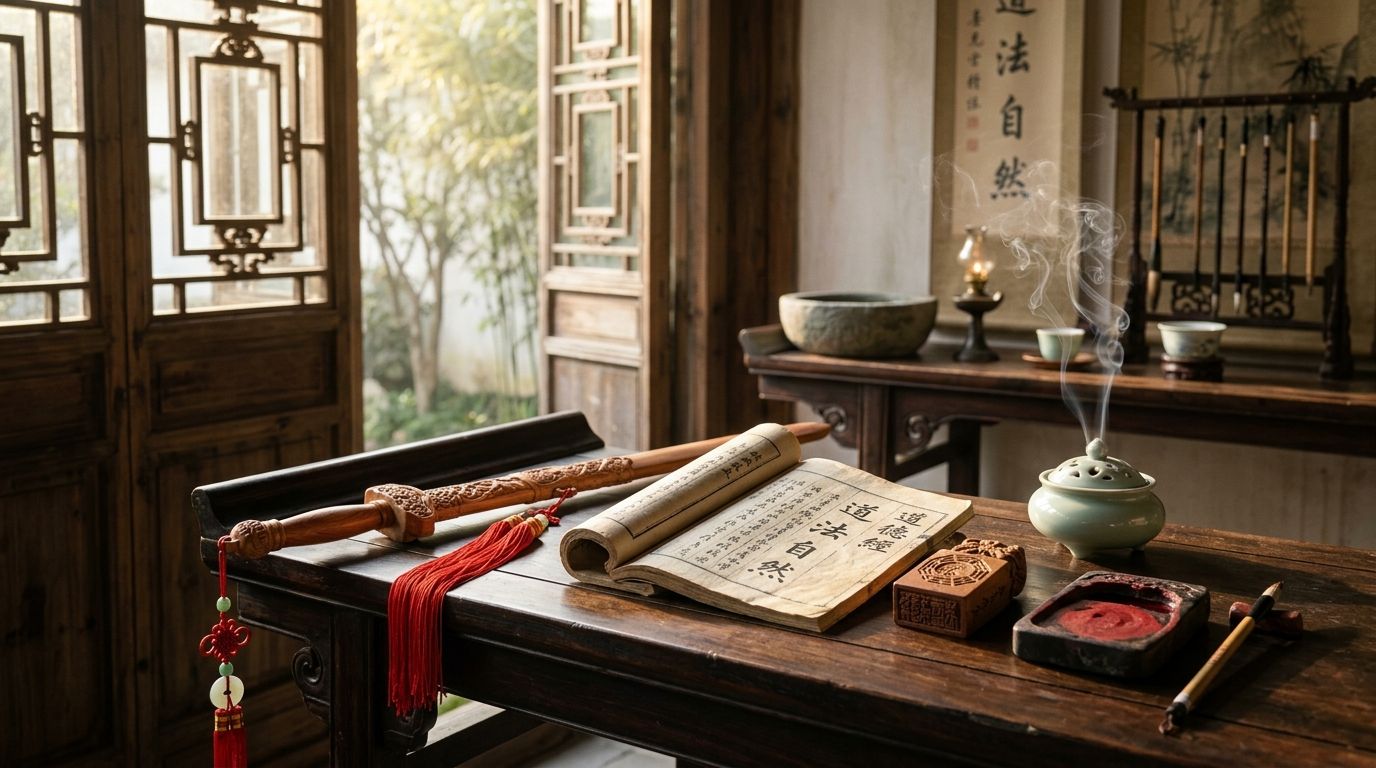
- 6. Consecrated Implements and Authentic Sacred Materials in Lineage Practice
- The Strict Requirement of Authentic Natural Materials
- The Solemn Rite of Kai Guang (开光, Opening of the Spiritual Light)
- 7. Step-by-Step Practical Guide: Establishing an Authentic Sanctuary and Dawn Offering Ritual (Chenzhao Fenggong 晨朝奉供)
- Preparation and Spatial Etiquette
- Step-by-Step Morning Liturgy:
- 8. Frequently Asked Questions (FAQ)
- Q1: What is the actual difference between Taoism and Daoism?
- Q2: Why do some Western sources claim Taoism is a philosophy while Daoism is a religion?
- Q3: How is the word properly pronounced in authentic Chinese?
- Q4: Which spelling should one use when searching for authentic artifacts and lineage teachings?
- 9. Conclusion: Embracing the Living Wholeness of the Way
Taoism vs Daoism: Linguistic Origins, Core Beliefs, Orthodox Lineages, and Sacred Altar Practices
Key Takeaways (Executive Summary) - The Core Resolution: In the debate of Taoism vs Daoism, the central historical truth is that both terms denote the exact same 2,500-year-old Chinese philosophical, spiritual, and liturgical tradition. There is zero doctrinal, theological, or lineage difference between them. - Linguistic Origins: The variation is entirely orthographic. Taoism derives from the 19th-century British Wade-Giles romanization system, whereas Daoism comes from Hanyu Pinyin (汉语拼音), the official international standard adopted in 1958. - Phonetic Reality: In spoken Chinese, the character 道 is pronounced with an unaspirated, resonant "D" sound (dào /daʊ/, rhyming with "cow"). The popular English pronunciation with a hard "T" (/taʊ/) is an accidental typographical byproduct of Western printers dropping the Wade-Giles aspiration apostrophe. - Deconstructing the Philosophy vs. Religion Myth: Western popular culture frequently mistakes "Taoism" for secular philosophy (Daojia 道家) and "Daoism" for ritualistic religion (Daojiao 道教). In orthodox Chinese tradition, philosophy and sacramental liturgy are the inseparable root and branches of a single living tree. - Sacred Embodiment: Far from being an abstract intellectual puzzle, the living Way is realized through Wu Wei (无为), internal alchemy (Neidan 内丹), consecrated lineage implements (Fa Qi 法器), and mindful daily altar devotions (Chenzhao Fenggong 晨朝奉供).
1. Taoism vs Daoism: The Anatomy of a Decades-Long Linguistic Confusion
Few questions in world religion and comparative philosophy produce as much persistent confusion among modern seekers as the distinction between Taoism vs Daoism. When browsing university libraries, searching online spiritual archives, or exploring authentic sacred art collections, one encounters both spellings interchangeably: Tao Te Ching alongside Daodejing, Lao Tzu beside Laozi, and Taoist temples contrasted with Daoist lineages.
Is Daoism a modern reform movement? Is Taoism a pure philosophy while Daoism is an elaborate folk religion? Or is one spelling simply superior to the other?
The unequivocal answer recognized by contemporary sinologists, linguists, and ordained lineage masters is this: Taoism and Daoism refer to the exact same continuous spiritual and cultural tradition originating in ancient China.
The entire dilemma between Taoism vs Daoism is not a theological schism or an ideological rift, but an artifact of historical translation. It is the story of how Western scholars, diplomats, and linguists struggled over two centuries to transcribe the intricate tonal subtleties of the Chinese language into the Latin alphabet.
Understanding this linguistic journey does more than resolve a spelling debate; it dismantles centuries of colonial misunderstanding, restores the authentic oral cadence of the sacred teachings, and opens the doorway to the true, living heart of the tradition—a tradition where profound metaphysical contemplation and consecrated physical ritual exist in complete, harmonious resonance.
2. Wade-Giles vs. Hanyu Pinyin: The Historical Mechanics of Romanization
To understand why Taoism vs Daoism exists, one must examine the mechanics of two competing romanization systems: the 19th-century Wade-Giles system and the 20th-century Hanyu Pinyin system.
The British Diplomatic System: Wade-Giles (1859–1892)
During the height of the Qing Dynasty, British diplomats and sinologists sought a standardized method to transcribe spoken Mandarin for English-speaking diplomats, military officers, and scholars.
- In 1859, Sir Thomas Wade, a British diplomat and sinologist, developed a romanization system based on the Beijing dialect.
- In 1892, Herbert Giles, a British consular officer and Cambridge professor, refined and popularized the system in his landmark Chinese-English Dictionary.
The Wade-Giles system was a brilliant academic achievement for its era, but it possessed a crucial typographic vulnerability regarding Chinese consonants. In Mandarin phonetics, consonants are distinguished not by vocal cord vibration (voiced vs. voiceless, like English "B" vs. "P"), but by aspiration (whether a puff of air is released when speaking):
- Unaspirated voiceless stop [t]: Pronounced softly, sounding to English speakers almost like a "d" (as in door or dow).
- Aspirated voiceless stop [tʰ]: Pronounced with an energetic burst of air, sounding like a typical English "t" (as in tea or tower).
Wade and Giles chose to represent the unaspirated sound with the letter t, and the aspirated sound with the letter t followed by an apostrophe (t'):
- The Chinese character 道 (unaspirated [t]) was transcribed as tao.
- The Chinese character 套 (aspirated [tʰ]) was transcribed as t'ao.
Herein lay the fatal flaw: Western printers, newsrooms, book publishers, and cartographers found the tiny apostrophe cumbersome and routinely omitted it. Consequently, both tao and t'ao appeared identically in print as tao. Unaware of the missing phonetic diacritic, generations of English speakers read the letter "t" and pronounced it with a hard, breathy English "t" (/taʊ/). Thus, an entire hemisphere began mispronouncing the primordial Source of the universe.
The Modern Global Standard: Hanyu Pinyin (1958)
In the 1950s, a committee of Chinese linguists led by Zhou Youguang developed Hanyu Pinyin (汉语拼音) to eliminate ambiguity, enhance international literacy, and establish a scientific, native phonetic standard. Pinyin was officially adopted by China in 1958, recognized by the International Organization for Standardization (ISO) in 1982, and formally embraced by the United Nations and the Library of Congress.
Pinyin eliminated confusing apostrophes by aligning Latin letters directly with intuitive acoustic values:
- The letter d is assigned to the unaspirated stop [t] (matching the true sound of 道, dào).
- The letter t is assigned to the aspirated stop [tʰ] (matching the true sound of 套, tào).
Under Hanyu Pinyin, Taoism became Daoism, Tao Te Ching became Daodejing, and Lao Tzu became Laozi. This was not an ideological revolution, but a long-overdue phonetic correction.
Comparative Analysis: Wade-Giles vs. Hanyu Pinyin Romanization
To clearly illustrate how the evolution of romanization altered the perception of sacred terms, examine the structured comparative table below:
- The Way / Source — Traditional Hanzi (汉字): 道 · Wade-Giles (19th Century): Tao · Hanyu Pinyin (Modern Standard): Dao · Authentic IPA Pronunciation: [taʊ̂] / dào (sounds like "dow") · Common Western Mispronunciation: Hard "T" (/taʊ/ as in "tower")
- The Tradition — Traditional Hanzi (汉字): 道家 / 道教 · Wade-Giles (19th Century): Taoism · Hanyu Pinyin (Modern Standard): Daoism · Authentic IPA Pronunciation: [taʊ̂.ɪ.zəm] / dàojiā / dàojiào · Common Western Mispronunciation: "Tay-o-ism" or "Tow-ism"
- The Foundational Text — Traditional Hanzi (汉字): 道德经 · Wade-Giles (19th Century): Tao Te Ching · Hanyu Pinyin (Modern Standard): Daodejing · Authentic IPA Pronunciation: [taʊ̂ tɤ̌ tɕíŋ] · Common Western Mispronunciation: "Tow Tee Ching"
- The Venerable Master — Traditional Hanzi (汉字): 老子 · Wade-Giles (19th Century): Lao Tzu · Hanyu Pinyin (Modern Standard): Laozi · Authentic IPA Pronunciation: [laʊ̀.tsɨ̀] · Common Western Mispronunciation: "Lay-oh Zoo"
- The Sage of Parables — Traditional Hanzi (汉字): 庄子 · Wade-Giles (19th Century): Chuang Tzu · Hanyu Pinyin (Modern Standard): Zhuangzi · Authentic IPA Pronunciation: [ʈʂwáŋ.tsɨ̀] · Common Western Mispronunciation: "Choo-ang Zoo"
- The Classic of Changes — Traditional Hanzi (汉字): 易经 · Wade-Giles (19th Century): I Ching · Hanyu Pinyin (Modern Standard): Yijing · Authentic IPA Pronunciation: [î tɕíŋ] · Common Western Mispronunciation: "Eye Ching"
- Effortless Action — Traditional Hanzi (汉字): 无为 · Wade-Giles (19th Century): Wu Wei · Hanyu Pinyin (Modern Standard): Wu Wei · Authentic IPA Pronunciation: [ǔ wěi] · Common Western Mispronunciation: "Woo Way"
- Spontaneous Nature — Traditional Hanzi (汉字): 自然 · Wade-Giles (19th Century): Tzu-jan · Hanyu Pinyin (Modern Standard): Ziran · Authentic IPA Pronunciation: [tsɨ̂ ɻǎn] · Common Western Mispronunciation: "Zoo-jan"
- Vital Cosmic Energy — Traditional Hanzi (汉字): 气 / 炁 · Wade-Giles (19th Century): Ch'i · Hanyu Pinyin (Modern Standard): Qi · Authentic IPA Pronunciation: [tɕʰî] · Common Western Mispronunciation: "Chee"
- Sacred Talismans — Traditional Hanzi (汉字): 符箓 · Wade-Giles (19th Century): Fu-lu · Hanyu Pinyin (Modern Standard): Fu Lu · Authentic IPA Pronunciation: [fǔ lû] · Common Western Mispronunciation: "Foo Loo"
- Consecration Rite — Traditional Hanzi (汉字): 开光 · Wade-Giles (19th Century): K'ai Kuang · Hanyu Pinyin (Modern Standard): Kai Guang · Authentic IPA Pronunciation: [kʰái kwáŋ] · Common Western Mispronunciation: "Kay Gwang"
3. The Myth of the Great Divide: Philosophical Daojia vs. Religious Daojiao
Beyond spelling, the discussion surrounding Taoism vs Daoism frequently encounters an even more pervasive misconception: the belief that there exist two completely different, mutually hostile traditions—one named "Taoism" that is purely intellectual and secular, and another named "Daoism" that is deeply superstitious and ritualistic.
The Colonial Invention of the Dichotomy
When 19th-century European scholars first translated classical Chinese texts into English, French, and German, they brought with them the intellectual biases of the European Enlightenment and Victorian Protestantism. They deeply admired the poetic aphorisms of the Daodejing, which championed personal simplicity, political non-intervention, and mystical harmony with nature. They identified this intellectual stream as Philosophical Taoism (Daojia 道家).
However, when Western travelers, diplomats, and missionaries ventured into actual Chinese communities, they encountered living temples filled with golden statues of the Three Pure Ones (Sanqing 三清), swirling clouds of sandalwood incense, ordained priests wearing embroidered ceremonial robes, written talismanic scriptures (Fu Lu 符箓), and elaborate consecration liturgies (Kai Guang 开光). Bewildered and culturally biased, early sinologists dismissed these sacramental traditions as Religious Taoism (Daojiao 道教), portraying them as a "corrupted, degenerate" deformation of Laozi's pristine philosophy.
Some contemporary popular writers have even attempted to map this false dichotomy onto the spelling itself, erroneously claiming that "Taoism is the philosophy, while Daoism is the religion."
The Indivisible Truth of Lineage Tradition
To authentic Chinese lineage masters, historical scholars, and practicing Daoists, this division is entirely artificial and profoundly inaccurate.
In orthodox understanding, Daojia and Daojiao are the inner wisdom and the outer expression of the same living organism:
- Daojia (道家) provides the ontological and metaphysical foundation: the contemplation of the Dao as the ineffable Source, the virtue of stillness (Jing 静), the wisdom of water, and the natural flow of Wu Wei.
- Daojiao (道教) provides the sacramental and transformative methodology: the practical disciplines through which human beings—possessing mortal bodies, emotional turbulent minds, and environmental vulnerabilities—can directly contact, cultivate, and embody that primordial Dao in physical reality.
Without the rigorous cosmology of Daojia, temple rituals would descend into mechanical superstition. Without the living sacramental technologies of Daojiao, philosophical principles would remain sterile mental theories unable to transform human suffering, heal physical ailments, or align environmental Qi.
As the venerable saying within the temples reminds us: "Philosophy illuminates the mind; sacred practice transmutes the flesh."
Structural Comparison: The Unified Spectrum of the Daoist Tradition
- Historical Emergence — Philosophical Aspect (Daojia 道家): c. 6th–4th Century BCE (Pre-Qin Era) · Liturgical & Monastic Aspect (Daojiao 道教): 142 CE (Revelation at Mount Heming) · Integrated Lineage Reality: An unbroken, evolving continuum spanning 2,500+ years
- Primary Pioneers — Philosophical Aspect (Daojia 道家): Laozi (老子), Zhuangzi (庄子), Liezi (列子) · Liturgical & Monastic Aspect (Daojiao 道教): Celestial Master Zhang Daoling (张道陵), Wang Chongyang (王重阳) · Integrated Lineage Reality: Revering Laozi simultaneously as the primordial Philosopher and deified Celestial Lord (Taishang Laojun 太上老君)
- Core Canon — Philosophical Aspect (Daojia 道家): Daodejing, Zhuangzi · Liturgical & Monastic Aspect (Daojiao 道教): The Daozang (道藏) (Over 1,400 sacred volumes) · Integrated Lineage Reality: Texts studied side by side: metaphysics informs ritual incantations
- Primary Cultivation — Philosophical Aspect (Daojia 道家): Mental detachment, observing nature, Zuowang (坐忘, sitting and forgetting) · Liturgical & Monastic Aspect (Daojiao 道教): Liturgical prayer, chanting, Neidan (内丹, internal alchemy), talisman writing · Integrated Lineage Reality: Uniting mental stillness with breath regulation and physical energy alignment
- Sacred Space — Philosophical Aspect (Daojia 道家): Scholar's library, mountain hut, natural wilderness · Liturgical & Monastic Aspect (Daojiao 道教): Temple sanctuaries, domestic consecrated home altars · Integrated Lineage Reality: Home altars designed as serene microcosms of cosmic nature
- Material Implements — Philosophical Aspect (Daojia 道家): Scholar's inkstone, bamboo flute, tea table · Liturgical & Monastic Aspect (Daojiao 道教): Consecrated seals (Fayin 法印), peach wood swords (Taomu Jian 桃木剑), censers · Integrated Lineage Reality: High-grade natural materials serving as functional resonators of celestial Yang energy
- Ultimate Objective — Philosophical Aspect (Daojia 道家): Intellectual tranquility, psychological freedom · Liturgical & Monastic Aspect (Daojiao 道教): Spiritual immortality (Xian 仙), transcendence of karmic cycles · Integrated Lineage Reality: Realizing total oneness between the individual body-mind and the cosmic Dao
4. Canonical Foundations: Tracing the Sacred Literature from Daodejing to the Daozang
Whether one approaches the tradition under the moniker of Taoism vs Daoism, its authority is eternally anchored in its sacred texts. The literature of the Way is neither a single dogmatic bible nor an arbitrary collection of regional folk tales; it is a meticulously preserved library of cosmology, herbal medicine, meditative science, and ritual liturgy.
The Primordial Pillar: Laozi and the Daodejing (道德经)
According to the grand historian Sima Qian, Laozi served as the royal keeper of archives at the court of Zhou. Disheartened by the moral degeneration and contrived political machinations of the warring feudal states, Laozi chose to renounce officialdom and rode westward toward the mountains on a water buffalo.
At the Hangu Pass (函谷关), the border guardian Yinxi recognized the sage's celestial countenance and begged him to record his wisdom before departing into the wilderness. Laozi paused and inscribed a concise masterpiece of approximately 5,000 Chinese characters, divided into 81 chapters: the Daodejing (道德经, The Classic of the Way and Its Virtue).
The text opens with the famous cosmological declaration:
道可道,非常道;名可名,非常名。 "The Dao that can be spoken of is not the eternal Dao; the name that can be named is not the eternal Name." (Chapter 1)
Laozi established the foundational cosmological sequence in Chapter 42:
道生一,一生二,二生三,三生万物。万物负阴而抱阳,冲气以为和。 "The Dao gives birth to the One; the One gives birth to the Two; the Two gives birth to the Three; the Three give birth to the ten thousand things. The ten thousand things carry Yin upon their backs and embrace Yang in their arms, blending their vital breaths to attain harmony."
Zhuangzi: The Psychology of Radical Spiritual Freedom
Following Laozi, the master writer Zhuangzi (庄子, c. 369–286 BCE) expanded the philosophy through dazzling allegories, comedic parables, and piercing psychological insights. In his foundational text, the Nan Hua Zhen Jing (南华真经), Zhuangzi cautioned against the traps of human ego, linguistic over-intellectualization, and societal conformity.
Zhuangzi introduced the profound meditative practices of Zuowang (坐忘, "sitting in oblivion") and Xinzhai (心斋, "fasting of the heart"). True alignment with the Dao is not achieved by accumulating more knowledge, but by shedding preconceptions until the mind mirrors the absolute tranquility of clear water.
The Revelation of Mount Heming: The Formal Birth of Daojiao (142 CE)
In the year 142 CE, amidst the misty peaks of Mount Heming (鹤鸣山) in modern Sichuan Province, the hermit scholar Zhang Daoling (张道陵) experienced a monumental celestial revelation. Laozi appeared to him in his exalted celestial form as Taishang Laojun (太上老君, The Grand Supreme Elderly Lord).
Taishang Laojun transmitted to Zhang Daoling sacred talismanic registries, liturgical covenants, and authority over cosmic energetic fields, conferring upon him the hereditary title of First Celestial Master (Tian Shi 天师). Zhang Daoling founded the Way of the Celestial Masters (Tianshi Dao 天师道):
- Replaced bloody animal sacrifices with pure offerings of clear water, fresh fruit, and natural incense.
- Established community healing halls and mutual-aid parishes.
- Initiated the unbroken institutional lineage that formalized the sacramental priesthood (Daoshi 道士) known today as the Zhengyi Lineage (正一道).
The Vast Treasury: The Daozang (道藏)
Over centuries, through the Tang, Song, and Ming dynasties, the sacred texts were systematically compiled into the monumental Daozang (道藏, The Daoist Canon). Organized under the "Three Caverns and Four Supplements" (Sandong Sifu 三洞四辅), the Canon comprises over 1,400 distinct scriptures encompassing:
- Deep metaphysical commentaries on the Daodejing and Yijing (易经).
- Internal alchemical treatises (Neidan 内丹) detailing the physiological refinement of Jing (essence), Qi (breath), and Shen (spirit).
- Liturgical protocols, talismanic manuals, astronomical charts, and temple architectural standards.
5. Core Metaphysics: Navigating the Living Current of the Dao
To genuinely understand why the spelling of Taoism vs Daoism ultimately dissolves in practical cultivation, one must grasp the five core metaphysical pillars that animate the tradition.
1. The Dao (道): The Primordial Source and Rhythmic Law
The Dao is not a personalized anthropomorphic God sitting on a celestial throne, nor is it a detached philosophical abstraction. It is the unoriginated, omnipresent ground of being—the silent, formless womb from which all stars, galaxies, living creatures, and energetic vibrations arise, flourish, and inevitably return. To live in alignment with the Dao is to live in rhythm with reality itself.
2. De (德): Inherent Potency and Sacred Integrity
If the Dao is the boundless ocean, De (德) is the specific drop that sustains a particular being. Often translated as "virtue" or "inner power," De is not moralistic self-righteousness; it is the natural, uncorrupted expression of the Dao within an individual. When a human, a pine tree, or a river acts in complete accordance with its authentic nature without artificial pretense, it radiates the quiet, irresistible authority of De.
3. Wu Wei (无为): The Art of Effortless Action
Perhaps no concept in the entire Taoism vs Daoism lexicon has suffered more Western distortion than Wu Wei (无为). Popular interpreters frequently mischaracterize it as passive resignation, fatalism, or lazy inaction.
- In authentic lineage practice, Wu (无) signifies the absence of egoic contrivance, selfish manipulation, and unnatural forcing.
- Wei (为) signifies deliberate action.
- Therefore, Wu Wei represents action in supreme resonance with the natural grain of reality. It is water carving through solid granite without strain; it is a master woodcarver following the natural grain of the timber; it is a statesman resolving a crisis before it even manifests. Wu Wei achieves maximal results with zero wasted friction.
4. Ziran (自然): Spontaneous Self-So-Ness
Ziran (自然), literally translating to "of itself so," represents the ultimate standard of cosmic order. As Chapter 25 of the Daodejing states:
人法地,地法天,天法道,道法自然。 "Humanity models itself upon Earth, Earth models itself upon Heaven, Heaven models itself upon the Dao, and the Dao models itself upon Ziran."
To embody Ziran is to strip away superficial masks, neurotic ambitions, and manufactured anxieties, returning to the uncarved, tranquil simplicity (Pu 朴) of original nature.
5. Yin-Yang (阴阳) and Wuxing (五行): Universal Polarity and Dynamic Cycles
The undifferentiated void (Wuji 无极) divides into dynamic polarity:
- Yin (阴): Receptive, dark, cooling, internal, quiet, and earth-bound.
- Yang (阳): Creative, radiant, warming, external, expressive, and heaven-bound.
The continuous interplay of Yin and Yang generates the Five Phases (Wuxing 五行): Wood (Mu 木), Fire (Huo 火), Earth (Tu 土), Metal (Jin 金), and Water (Shui 水). In traditional Daoist cultivation, these phases govern human internal organs, emotional balances, seasonal shifts, and environmental Feng Shui alignments.
6. Consecrated Implements and Authentic Sacred Materials in Lineage Practice
A vital realization that permanently bridges the gap between Taoism vs Daoism is that authentic Daoist practice has never been confined to theoretical reading. In both temple monasteries and traditional home sanctums, practitioners rely on sacred implements (Fa Qi 法器) to ground celestial energy into the physical realm.
In Daoist energetic science, sacred objects are not superstitious idols or decorative talismans; they function as precision energetic instruments—physical antennas crafted from natural materials that absorb, condense, and radiate pure celestial Yang energy (Yang Qi 阳气) while purifying discordant, stagnant Yin influences.
The Strict Requirement of Authentic Natural Materials
Lineage tradition strictly forbids the use of modern synthetic substitutes, such as injection-molded plastic resins, composite dust woods, or chemically fragranced artificial incenses. Synthetic materials possess chaotic, dead vibrational frequencies that cannot store spiritual Qi or anchor a sacred blessing.
+---------------------------------------------------------------------------------------+
+---------------------------------------------------------------------------------------+
- - Absorbs astronomical Yang electrostatic discharge from natural celestial strikes.
- - Used for ancestral lineage seals (Fayin 法印) and Bagua protective talismans.
- 2. Pure Mineral Cinnabar (朱砂, Zhusha)
- - Natural crystalline mercuric sulfide formed deep within geothermal earth veins.
- - The supreme earth-element Yang mineral; essential for consecration (Kai Guang).
- 3. Aged Seasoned Peach Wood (桃木, Taomu)
- - The "Wood of the Sun"; blooms early, dispels negative spatial Sha Qi (煞气).
- - Carved into ritual swords (Taomu Jian 桃木剑) for home and sanctuary protection.
- 4. Wild Natural Incense (老山檀 Sandalwood & 沉香 Agarwood)
- - Pure unadulterated plant resin; smoke serves as the "Vehicle of the Spirit."
- - Clears the five senses, elevates mental frequency, and invites celestial sages.
+---------------------------------------------------------------------------------------+
The Solemn Rite of Kai Guang (开光, Opening of the Spiritual Light)
An unconsecrated wooden carving or talismanic paper remains a common physical curiosity. To awaken the object into an active conduit of celestial harmony, an ordained Daoist priest performs the ancient, multi-stage liturgical rite of Kai Guang (开光):
- Jinghua (净化, Ritual Purification): The implement is thoroughly cleansed using pure spring water, sacred sea salt, and the aromatic smoke of wild sandalwood and dried mugwort to dispel any prior worldly contamination.
- Zhuang Zang (装脏, Relic Chamber Sealing): For consecrated statues, an internal cavity (Zang Qi 脏腔) is carved into the back. The priest places inside the Five Sacred Minerals (gold, silver, bronze, iron, tin), the Five Sacred Grains, traditional herbal medicines, five-colored silk cords aligning with the Five Phases, and an inscribed heart scripture (Xinjing 心经). This gives the sacred vessel an internal organic "heartbeat."
- Dian Yan (点眼, Dotting the Sensory Organs): Using a consecrated calligraphy brush dipped in pure mineral cinnabar and pure herbal elixir, the priest directs stellar Qi from the Big Dipper (Beidou 北斗), systematically dotting the eyes, ears, nose, tongue, hands, and feet while chanting the sacred awakening mantra:
"Point to the eyes, that they shine with the radiance of sun and moon; point to the ears, that they hear the prayers of the ten directions; point to the heart, that it remains an unshakeable mirror of the Dao."
7. Step-by-Step Practical Guide: Establishing an Authentic Sanctuary and Dawn Offering Ritual (Chenzhao Fenggong 晨朝奉供)
For sincere international seekers seeking to move beyond the academic debate of Taoism vs Daoism, establishing a respectful, clean domestic altar provides a powerful anchor of daily clarity, emotional stability, and energetic harmony.
Below is the orthodox step-by-step liturgical protocol practiced by Daoist householders and temple disciples every morning at dawn.
Preparation and Spatial Etiquette
- Auspicious Time: Best conducted during the Mao Hour (卯时, 5:00 AM – 7:00 AM), when the day's fresh Yang Qi begins its natural ascent.
- Cleanliness: Wash face and hands, rinse the mouth with pure water, and wear clean, modest clothing. Ensure the altar surface is wiped free of domestic dust with a dedicated altar cloth.
Step-by-Step Morning Liturgy:
- Step 1: Mindful Cleansing of Heart and Speech (Jingxin Jingkou 净心净口)
Stand upright before the altar table with feet shoulder-width apart. Drop your shoulders, breathe gently into your Lower Dantian (Xia Dantian 下丹田, two inches below the navel), and silently recite the ancient Spiritual Mantra for Purifying the Heart (Jingxin Shenzhou 净心神咒):
"My heart is pure and calm as water; my spirit rests in celestial stillness. All worldly dust dissolves away, returning home to the eternal Dao."
- Step 2: Offering the Three Pure Waters (Sanqing Fengshui 三清奉水)
Take the three porcelain or celadon offering cups from the altar table. Rinse them thoroughly with fresh spring or filtered water. Fill them evenly and place them in a straight line before the incense burner:
- Center Cup: Represents the Dao, honoring Yuanshi Tianzun (元始天尊).
- Left Cup (Observer's Right): Represents the Sacred Scriptures, honoring Lingbao Tianzun (灵宝天尊).
- Right Cup (Observer's Left): Represents the Lineage Masters, honoring Daode Tianzun (道德天尊).
- Step 3: Igniting the Three Stems of Pure Natural Incense (Fengxiang 奉香)
Take three sticks of natural aged sandalwood or agarwood incense. Hold them with both hands and light the tips with a clean flame:
- Crucial Rule: Never blow out the flame with your mouth, as human breath carries internal bodily impurities. Extinguish the flame by waving the sticks downward or gently fanning with your hand.
- Raise the incense sticks to brow level using both hands, aligning them with the third-eye point (Yintang 印堂).
- Step 4: Forming the Sacred Ziwu Hand Seal (Ziwu Jue 子午诀)
Interlock your hands in the traditional Ziwu Seal (子午诀):
- Enclose your right thumb in your left palm, wrapping the left fingers around the right fist.
- The tip of the left thumb connects with the base of the left ring finger (the Zi 子 position, representing Water and North), while the right thumb connects with the tip of the right middle finger (the Wu 午 position, representing Fire and South).
- This sacred hand seal harmonizes the internal microcosmic orbit of Water and Fire within your body.
- Step 5: Inserting the Incense into the Censer (Sanxiang Dingxiang 三香定向)
Step forward and place the three incense sticks into the censer with precision:
- Center Stick (First): Inserted strictly perpendicular into the center. Recite silently: "I dedicate this fragrance to the supreme Dao."
- Left Stick (Second): Inserted about one thumb-width to the left of center. Recite: "I dedicate this fragrance to the sacred teachings."
- Right Stick (Third): Inserted about one thumb-width to the right of center. Recite: "I dedicate this fragrance to the holy teachers and ancestors."
- All three sticks must stand perfectly upright and parallel, symbolizing the steadfast pillar uniting Heaven, Earth, and Humanity.
- Step 6: Three Receptive Prostrations (San Libai 三礼拜)
Take one step back. Holding the Ziwu seal at heart level, bow forward deeply three times (San Libai). As you bow, visualize clear golden-white celestial light descending through the crown of your head, washing through your spine, and pooling into your abdomen.
- Step 7: Seated Stillness and Observation (Zuowang 坐忘 / Jingzuo 静坐)
Conclude the morning offering by sitting on a meditation cushion before the altar for 15 to 20 minutes. Practice Zuowang (坐忘, sitting in forgetfulness):
- Close your eyes to eight parts closed, two parts open.
- Release all analytical thinking, career planning, and personal worries.
- Watch the gentle, fragrant coils of white smoke curling lazily toward the ceiling, allowing your heart rate and breath to synchronize with the tranquil, benevolent rhythm of the room.
8. Frequently Asked Questions (FAQ)
Q1: What is the actual difference between Taoism and Daoism?
Answer: There is no theological, philosophical, or spiritual difference between Taoism and Daoism; they refer to the exact same living tradition originating in ancient China over 2,500 years ago. The variation is purely linguistic and orthographic. "Taoism" represents the 19th-century British Wade-Giles romanization system, whereas "Daoism" is the standardized spelling according to modern Hanyu Pinyin. In authentic spoken Chinese, both represent the single Chinese character 道 and are pronounced with an unaspirated "D" sound (/daʊ/). Modern academic institutions, museums, and lineage practitioners predominantly use "Daoism" to accurately reflect native pronunciation and cultural sovereignty.
Q2: Why do some Western sources claim Taoism is a philosophy while Daoism is a religion?
Answer: This dichotomy is an artificial historical misconception created by 19th-century European orientalists and early translators. Colonial-era scholars celebrated the poetic, naturalist metaphysics of the Daodejing and Zhuangzi (which they termed "philosophical Taoism" or Daojia 道家) while dismissing the temple liturgies, celestial registries, and talismanic rituals (which they labeled "religious Daoism" or Daojiao 道教) as superstitious deviations. In orthodox Chinese tradition, however, Daojia and Daojiao are inseparable dimensions of a single living organism: Daojia provides the foundational cosmology, while Daojiao supplies the sacramental technologies, internal alchemical disciplines, and community liturgies required to physically embody that cosmology.
Q3: How is the word properly pronounced in authentic Chinese?
Answer: The Chinese character 道 is pronounced in Standard Mandarin Chinese with a fourth (falling) tone as dào, which sounds virtually identical to the English word "dow" (rhyming with "cow" or "now", but articulated with an unaspirated, crisp stop /daʊ/). It is never pronounced with a hard, breathy English "T" (/taʊ/) like "tower". The widespread English mispronunciation arose because the Wade-Giles system used an unaspirated "t" to represent the unaspirated /t/ sound (which sounds like "d" to English ears) and used an apostrophe ('t'') for the aspirated /tʰ/ sound. When Western publishers dropped the apostrophe, generations of readers naturally mispronounced the letter as a hard English "T".
Q4: Which spelling should one use when searching for authentic artifacts and lineage teachings?
Answer: Both spellings remain vital in modern research and commerce. "Taoism" remains dominant in popular culture, Western publishing archives, and commercial search queries due to two centuries of historical momentum. However, "Daoism" is the preferred terminology among contemporary scholars, university faculties, museums, and formally ordained Daoist priests (Daoshi 道士). To discover genuine lineage teachings, authentic consecrated artifacts (such as lightning-struck jujube wood seals and pure mineral cinnabar talismans), and traditional altar protocols, it is best to search both terms in conjunction with specific Chinese Pinyin keywords (e.g., "Daoism Leiji Zaomu", "Taoism Kai Guang", "Daodejing altar setup").
9. Conclusion: Embracing the Living Wholeness of the Way
When we peel back the historical layers of the Taoism vs Daoism debate, we discover that the controversy was never about the truth of the Way itself, but about the human mirrors through which it was reflected.
Whether written with a "T" or a "D", the timeless invitation of the tradition remains unchanged. It invites us to pause amidst the frantic, exhausting machinery of modern ambition; to soften our rigid opinions; and to remember that the universe is not an adversary to be conquered, but an organic, benevolent mother whose seasonal currents sustain our every breath.
By honoring the philosophical clarity of the Daodejing, maintaining the quiet reverence of a home altar, and welcoming the protective resonance of genuine consecrated artifacts, we step beyond sterile semantic arguments and enter the living current of the Dao—flowing like water, abiding in tranquility, and discovering effortless wholeness in every step of our journey.