Daoism Foundations · · 28 min read
Taoism Beliefs: Core Principles, Sacred Cosmology, Orthodox Lineages, and Living Altar Practices
Explore authentic Taoism beliefs: from Wu Wei, Yin-Yang, and the Three Treasures to sacred deities, canonical texts, and consecrated altar rituals.
By Daoismart Editorial
On this page
- Taoism Beliefs: Core Principles, Sacred Cosmology, Orthodox Lineages, and Living Altar Practices
- 1. The Metaphysical Foundation: What Are Core Taoism Beliefs?
- The Ineffable Dao (道): Source of All Manifestation
- De (德): The Living Integrity and Radiant Virtue of the Dao
- 2. Metaphysical Pillars: Yin-Yang, Wuxing, and the Dynamic Flow of Reality
- 1. The Interplay of Yin and Yang (阴阳)
- 2. The Five Phases (Wuxing 五行): The Continuous Dance of Qi
- 3. Tian Ren He Yi (天人合一): Cosmic Unity
- 3. The Ethical and Practical Path: Wu Wei and the Three Treasures
- Wu Wei (无为): The Power of Effortless Natural Action
- Ziran (自然): Spontaneous Authenticity and the Uncarved Block
- The Philosophical Three Treasures (Sanbao 三宝)
- 4. Sacred Cosmology & The Celestial Hierarchy: Deities, Lineages, and Texts
- 1. The Three Pure Ones (Sanqing 三清)
- 2. Celestial Luminaries: Doumu and the Northern Dipper (Beidou)
- 3. The Two Great Orthodox Lineages
- 5. Comparative Matrix: How Core Taoism Beliefs Manifest in Daily Life & Practice
- 6. Living the Beliefs: Sacred Implements (Fa Qi) and Consecration (Kai Guang)
- Authentic Natural Materials vs. Industrial Counterfeits
- The Sacred Rite of Kai Guang (开光, Opening the Light)
- 7. Step-by-Step Practical Guide: Cultivating Taoist Beliefs Through a Daily Altar Offering Protocol
- Essential Sanctuary Guidelines & Etiquette:
- Step-by-Step Practical Protocol:
- 8. Internal Alchemy (Neidan) and Daily Cultivation: Walking the Way in Modern Times
- Embodying Taoism Beliefs in Contemporary Life
- 9. Frequently Asked Questions (FAQ)
- Q1: What are the core Taoism beliefs in simple terms?
- Q2: Do Taoism beliefs require belief in an anthropomorphic God?
- Q3: How do Taoism beliefs differ from Buddhist and Confucian teachings?
- Q4: How can a modern practitioner begin embodying Taoism beliefs at home?
- 10. Conclusion: Walking the Way in the Modern World
Taoism Beliefs: Core Principles, Sacred Cosmology, Orthodox Lineages, and Living Altar Practices
Key Takeaways (Executive Summary) - Direct Definition: At their deepest philosophical and spiritual foundation, Taoism beliefs center on living in conscious harmony with the Dao (道, The Way)—the primordial, unnamable source, sustaining intelligence, and eternal generative rhythm of all manifest existence. - The Core Metaphysical Architecture: Orthodox Taoism beliefs rest upon four immutable cosmic pillars: Wu Wei (无为, effortless natural action), Ziran (自然, primordial spontaneity), the dynamic polarity of Yin and Yang (阴阳), and the continuous cyclical transformations of the Five Phases (Wuxing 五行). - The Three Treasures of Life: In classical canonical teachings, Taoism beliefs prioritize two sacred trinities known as the Three Treasures (Sanbao 三宝): the moral virtues of Compassion (Ci 慈), Frugality (Jian 俭), and Humility (Bugan Wei Tianxia Xian 不敢为天下先); and the internal alchemical energies of Essence (Jing 精), Vital Breath (Qi 炁), and Spirit (Shen 神). - Orthodox Lineages & Sacred Texts: Rooted in Laozi's immortal Daodejing (道德经) and the mystical paradoxes of the Zhuangzi (庄子), Taoism beliefs evolved into two profound living ecclesiastical traditions: the liturgical, family-based Zhengyi (正一, Orthodox Unity) lineage and the celibate, meditative Quanzhen (全真, Complete Reality) monastic order. - Embodied Liturgy & Consecrated Implements: Rather than remaining abstract theories, genuine Taoism beliefs are grounded in physical reality through daily sanctuary offerings and consecrated ritual implements (Fa Qi 法器)—crafted from sacred materials such as lightning-struck jujube wood (雷击枣木), seasoned peach wood (桃木), and pure mineral cinnabar (朱砂)—activated through the orthodox lineage rite of Kai Guang (开光, Opening the Light).
1. The Metaphysical Foundation: What Are Core Taoism Beliefs?
Across the millennia of East Asian spiritual evolution, few systems of thought have offered as profound, gentle, and ecologically unified an understanding of the universe as Taoism (also transliterated as Daoism). In contemporary Western discourse, the phrase often evokes romantic impressions: mist-shrouded peaks, hermits meditating in mountain grottos, or the elegant calligraphy of the Yin-Yang medallion.
Yet, when we investigate rigorously from the perspective of classical texts and living temple lineages: what are authentic Taoism beliefs?
At their core, Taoism beliefs originate from an organic, non-dogmatic perception of the cosmos. Taoism does not teach that the universe was crafted by an anthropomorphic, monarchical deity who dictates moral decrees from above and threatens sinners with eternal retribution. Instead, Taoism beliefs proclaim that reality is an unceasing, self-generating cosmic web animated by an underlying, omnipresent principle known simply as the Dao (道).
The Ineffable Dao (道): Source of All Manifestation
The foundational scripture of Taoism beliefs, the Daodejing (道德经), penned in the 6th century BCE by the venerable sage Laozi (老子), opens with an uncompromising warning:
道可道,非常道。名可名,非常名。 "The Dao that can be spoken of is not the eternal Dao; the name that can be named is not the eternal name." (Daodejing, Chapter 1)
In Taoism beliefs, the Dao is simultaneously transcendent and immanent:
- Transcendent: It precedes the existence of the heavens, the earth, space, and time. It is silent, formless, ungraspable by dualistic human intellect, and self-sustaining.
- Immanent: It permeates every grain of sand, every blade of grass, the orbit of distant galaxies, and the rhythm of every human heartbeat.
Because the Dao is not a personal entity with human-like emotions, ego, or arbitrary preferences, Taoism beliefs emphasize attunement over worship. To live well is not to beg for divine intervention, but to align one's actions, breath, and moral character so intimately with the natural flow of the Dao that resistance and suffering naturally dissolve.
De (德): The Living Integrity and Radiant Virtue of the Dao
Closely joined to the Dao is the concept of De (德), often translated into English as "virtue," "power," or "inner integrity." In Taoism beliefs, De is not rigid moralistic rule-following. Rather, De is the specific, individual manifestation of the universal Dao within a unique physical form.
When an acorn grows naturally into an oak tree without doubt or artificial pretense, it embodies De. When a river flows effortlessly around granite boulders into the ocean, it demonstrates De. When a human being sheds egotistical ambition, greed, and social posturing to act with spontaneous kindness and grounded clarity, they embody De. Taoism beliefs teach that when De is cultivated internally, one radiates an invisible spiritual protection and magnetic harmony that pacifies turmoil in the surrounding world.
2. Metaphysical Pillars: Yin-Yang, Wuxing, and the Dynamic Flow of Reality
To understand how Taoism beliefs interpret the physical universe, one must grasp its cosmological vocabulary: Taiji (太极), Yin-Yang (阴阳), and Wuxing (五行). These are not merely ancient theoretical symbols; they form the operational framework of classical Chinese medicine, architectural spatial alignment (Feng Shui 风水), martial arts (Taijiquan), and sacred altar liturgy.
1. The Interplay of Yin and Yang (阴阳)
In classical Taoism beliefs, reality is never dualistic in the Western sense of an irreconcilable battle between absolute good and absolute evil. Instead, the universe functions through complementary polarities emerging from the single unified breath of Taiji (太极):
- Yin (阴): Symbolizes the receptive, dark, quiet, cooling, nourishing, feminine, and hidden aspects of reality. It corresponds to the earth, the moon, water, winter, and midnight.
- Yang (阳): Symbolizes the active, bright, dynamic, warming, creative, masculine, and outward aspects of reality. It corresponds to heaven, the sun, fire, summer, and midday.
Crucially, Taoism beliefs maintain that Yin and Yang are fundamentally interdependent:
- They Generate Each Other: Day cannot exist without night; inhalation cannot occur without exhalation; restorative stillness (Yin) is the necessary womb from which creative movement (Yang) is born.
- They Transform Into Each Other: As canonized in the ancient Yijing (易经, Book of Changes), when Yang reaches its absolute zenith, Yin is spontaneously conceived within its core; when Yin plunges into its deepest midnight, the spark of Yang rekindles.
- Harmonious Equilibrium: Spiritual sickness, emotional misery, and ecological destruction arise solely when one polarity attempts to dominate or eliminate the other. The goal of all Taoism beliefs is dynamic, fluctuating balance (Zhonghe 中和).
2. The Five Phases (Wuxing 五行): The Continuous Dance of Qi
The rhythmic interplay of Yin and Yang expresses itself through the Five Phases (Wuxing 五行), which describe the five energetic movements through which matter and spirit circulate:
- Wood (木, Mu): Upward, generative growth, associated with spring dawn, the color green, the liver meridian, and compassionate vitality.
- Fire (火, Huo): Upward, radiant illumination, associated with summer midday, the color red, the heart meridian, and spiritual consciousness.
- Earth (土, Tu): Grounding, central stability, associated with seasonal transitions, the color yellow, the spleen/stomach, and nourishing balance.
- Metal (金, Jin): Inward, condensing refinement, associated with autumn dusk, the color white, the lung meridian, and discerning clarity.
- Water (水, Shui): Downward, fluid stillness, associated with winter midnight, the color black/deep blue, the kidney reserves, and profound primordial wisdom.
In Taoism beliefs, these phases interact through two fundamental cosmic cycles:
- The Generative Cycle (Xiangsheng 相生): Wood fuels Fire $
ightarrow$ Fire creates Earth (ash) $
ightarrow$ Earth bears Metal (ore) $
ightarrow$ Metal enriches Water (condensation) $
ightarrow$ Water nourishes Wood. - The Restraining Cycle (Xiangke 相克): Wood parts Earth $
ightarrow$ Earth dams Water $
ightarrow$ Water extinguishes Fire $
ightarrow$ Fire melts Metal $
ightarrow$ Metal chops Wood.
Understanding these cycles enables the Taoist practitioner to diagnose physical illnesses, harmonize home sanctuary energies, and design sacred ritual altars that balance all five elemental streams.
3. Tian Ren He Yi (天人合一): Cosmic Unity
Perhaps the most empowering dimension of Taoism beliefs is the doctrine of Tian Ren He Yi (天人合一)—the seamless unity of Heaven, Earth, and humanity. In Taoist anatomy, the human organism is not an alien inhabitant of an indifferent universe; it is a miniature universe, a conscious microcosm (Xiaotiandi 小天地) that mirrors the vast macrocosm (Datiandi 大天地).
The spinal column mirrors the cosmic mountain axis (Kunlun 昆仑); the breath mirrors the atmospheric wind; the eyes reflect the sun and moon; the five internal organ networks resonate with the Five Sacred Mountains and the Five Phases. Therefore, to heal oneself is to heal the cosmos; to harmonize one's personal heart-mind (Xin 心) is to bring peace to the world.
3. The Ethical and Practical Path: Wu Wei and the Three Treasures
Many outside observers wonder: If Taoism beliefs reject rigid commandments and moral guilt, how does a Taoist determine ethical action? The answer lies in the profound experiential principles of Wu Wei (无为), Ziran (自然), and the Three Treasures (Sanbao 三宝).
Wu Wei (无为): The Power of Effortless Natural Action
No concept within Taoism beliefs is more celebrated, yet more frequently misinterpreted, than Wu Wei (无为). Modern pop culture frequently mistranslates Wu Wei as "passivity," "sloth," or "fatalistic apathy."
In authentic lineage understanding, Wu Wei translates accurately as uncontrived action or action without self-conscious egoic friction. It means observing circumstances with crystal-clear objectivity, sensing the natural trajectory of events, and applying minimal, perfectly timed effort to achieve optimal harmony.
Laozi used Water (Shui 水) as the supreme living exemplar of Wu Wei:
上善若水。水善利万物而不争,处众人之所恶,故几于道。 "The highest virtue is like water. Water nourishes the ten thousand things and does not contend; it settles in the lowly places that everyone detests, and thus it is close to the Dao." (Daodejing, Chapter 8)
Water never violently clashes with the mountain; it yields effortlessly to rock, finds every opening, nourishes every seed along its path, and yet gradually dissolves the hardest granite over time. To embody Taoism beliefs through Wu Wei is to become like water: humble, flexible, yielding, yet possessing invincible cosmic strength.
Ziran (自然): Spontaneous Authenticity and the Uncarved Block
In ancient Chinese, Ziran literally signifies "of itself so" or "self-so-ness." It represents the intrinsic state of things when left unforced by artificial manipulation or coercive human ego.
Closely tied to Ziran is the ideal of Pu (朴), the "Uncarved Block." An uncarved piece of timber holds infinite latent potential precisely because it has not yet been chopped, carved, stained, and forced into an artificial utility. Taoism beliefs invite the seeker to shed acquired neuroses, status anxiety, and consumerist obsessions, returning to the pristine, uncarved simplicity of their original nature.
The Philosophical Three Treasures (Sanbao 三宝)
In Chapter 67 of the Daodejing, Laozi outlines the three ethical jewels that form the bedrock of Taoism beliefs:
我有三宝,持而保之。一曰慈,二曰俭,三曰不敢为天下先。 "I have three treasures that I hold and protect. The first is Compassion (Ci); the second is Frugality (Jian); the third is Not Daring to Put Oneself Ahead of Others (Bugan Wei Tianxia Xian)."
- Compassion (Ci 慈): Loving-kindness and empathy toward all living beings. Laozi notes that through deep compassion, one discovers authentic courage. Because a Taoist views all things as manifestations of the same single breath (Qi), inflicting cruelty on another is literally self-harm.
- Frugality (Jian 俭): Simplicity, moderation, and the conservation of physical, mental, and environmental resources. By not wasting energy on superficial desires or endless material consumption, one retains the expansive vitality necessary to be truly generous.
- Humility (Bugan Wei Tianxia Xian 不敢为天下先): Literally "not daring to be the first under heaven." This means relinquishing aggressive self-promotion, arrogance, and the urge to dominate others. By remaining receptive and unassuming, like the lowest valley into which all mountain streams flow, the humble cultivator becomes a reservoir of enduring spiritual power.
4. Sacred Cosmology & The Celestial Hierarchy: Deities, Lineages, and Texts
A widespread confusion in modern comparative religion is the supposed dichotomy between "philosophical Taoism" (Daojia 道家) and "religious Taoism" (Daojiao 道教). While Western academic textbooks often treat them as separated movements, orthodox practitioners understand them as the inner soul and outer body of a single unbroken sacred path.
Without philosophical insight, ritual degenerates into superstition; without ritual liturgy and energetic embodiment, philosophy remains an impotent intellectual exercise.
1. The Three Pure Ones (Sanqing 三清)
At the summit of the sacred liturgical hierarchy within Taoism beliefs reside the Sanqing (三清, Three Pure Ones). They are not historical human beings who became kings, but the supreme theological personifications of the three cosmic phases of the Dao:
- Yuanshi Tianzun (元始天尊, Heavenly Worthy of the Primordial Beginning): Resides in the Heaven of Jade Purity (Yuqing 玉清). He represents the unmanifest, primordial cosmic state of Wuji (无极) before form and time existed, holding the celestial pearl of pure potentiality.
- Lingbao Tianzun (灵宝天尊, Heavenly Worthy of the Numinous Treasure): Resides in the Heaven of Supreme Purity (Shangqing 上清). He represents the dynamic emergence of Taiji (太极), the sacred revelation of scriptures, and the harmonic balance between light and shadow.
- Daode Tianzun (道德天尊, Heavenly Worthy of the Way and Its Virtue): Resides in the Heaven of Great Purity (Taiqing 太清). Revered as the deified historical sage Laozi (Taishang Laojun 太上老君), he represents the active transmission of wisdom, spiritual compassion, and salvation to living beings in the manifest world.
2. Celestial Luminaries: Doumu and the Northern Dipper (Beidou)
In the liturgical traditions of Taoism beliefs, celestial bodies are living energetic vortexes. The Northern Dipper (Beidou 七星) is revered as the celestial clock and administrative center of terrestrial destiny, longevity, and spiritual protection. Disciples honor Doumu Yuanjun (斗姆元君), the Primordial Mother of the Dipper, an ancient cosmic goddess of radiant compassion who dispels demonic disharmony and governs the celestial stellar registers.
3. The Two Great Orthodox Lineages
Throughout two millennia of organized practice, Taoism beliefs have been transmitted through two monumental ecclesiastical lineages:
- Zhengyi Dao (正一道, The Orthodox Unity Lineage):
Founded in 142 CE by the first Celestial Master Zhang Daoling (张道陵) on Mount Heming in Sichuan. Zhengyi masters reside within their local communities, marry, raise families, and pass down sacred talismanic registers (Fu Lu 符箓) through ancestral lineages. Headquartered historically at Mount Longhu (龙虎山) in Jiangxi, Zhengyi focuses on protective liturgy, healing rites, community purification rituals (Jiao 醮), and exorcising discordant spiritual influences.
- Quanzhen Dao (全真道, The Way of Complete Reality):
Founded during the 12th century by Master Wang Chongyang (王重阳) in northern China. Quanzhen synthesized Taoist meditation with Confucian moral ethics and Chan Buddhist mindfulness. Quanzhen disciples live in monastic temples (such as the White Cloud Temple in Beijing), maintain strict vows of celibacy and vegetarianism, and focus on internal seated meditation (Jingzuo 静坐) and Neidan (内丹, Internal Alchemy).
5. Comparative Matrix: How Core Taoism Beliefs Manifest in Daily Life & Practice
To clearly visualize how abstract Taoism beliefs translate directly into practitioner cultivation and tangible altar traditions, study the structured comparative matrix below:
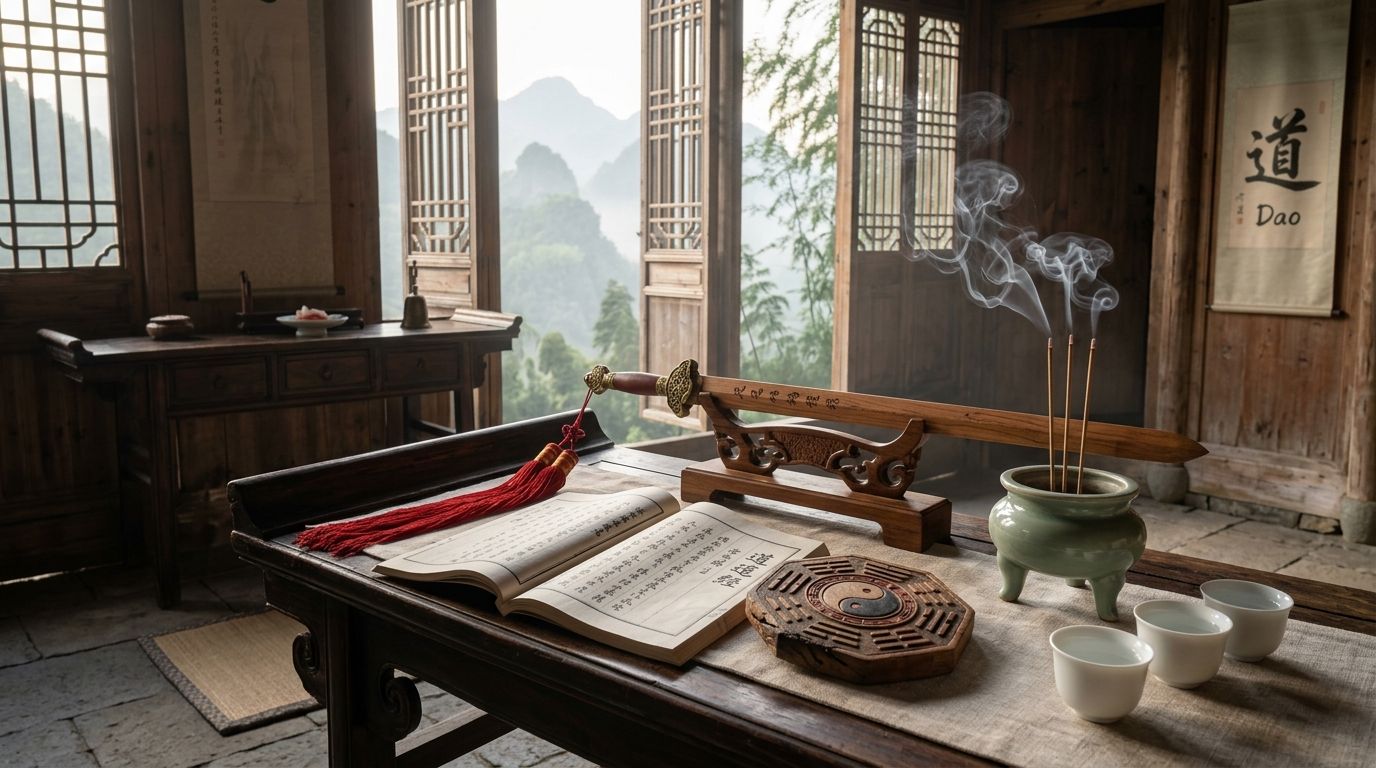
- The Ineffable Dao (道) — Cosmological Meaning: The nameless, eternal Source and sustaining womb of all existence. · Foundational Canonical Citation: Daodejing, Ch. 1: "The Dao that can be named is not the eternal Dao." · Practitioner's Internal Cultivation: Cultivating mental quietude; dissolving egoic attachment and intellectual arrogance. · Altar & Fa Qi Manifestation: Centering the altar with an open thread-bound scripture or sacred calligraphy tablet.
- Wu Wei (无为) — Cosmological Meaning: Effortless natural action; moving without contrived egoic friction. · Foundational Canonical Citation: Daodejing, Ch. 37: "The Dao never acts, yet nothing is left undone." · Practitioner's Internal Cultivation: Observing life's currents; acting with perfect timing; yielding gracefully like water. · Altar & Fa Qi Manifestation: Pure white smoke rising undisturbed from natural aged sandalwood incense.
- Yin-Yang Balance (阴阳) — Cosmological Meaning: Complementary polarities governing cosmic and bodily energy. · Foundational Canonical Citation: Daodejing, Ch. 42: "All things carry Yin and embrace Yang, harmonizing Qi." · Practitioner's Internal Cultivation: Balancing activity with deep rest; regulating internal breath and emotional extremes. · Altar & Fa Qi Manifestation: Hand-carved lightning-struck jujube wood Taiji Bagua medallion (雷击枣木太极八卦).
- The Five Phases (Wuxing 五行) — Cosmological Meaning: Five elemental phases of energy transforming in perpetual cycles. · Foundational Canonical Citation: Daozang (道藏), Wuxing Dayi (五行大义) cosmological canons. · Practitioner's Internal Cultivation: Nourishing the internal organ meridian networks; harmonizing diet with seasons. · Altar & Fa Qi Manifestation: Five-element color placements on the altar: wood, fire, earth, metal, water offerings.
- Ziran & Simplicity (自然与朴) — Cosmological Meaning: Authentic spontaneous nature; the uncarved block of purity. · Foundational Canonical Citation: Daodejing, Ch. 25: "Human follows Earth, Earth follows Heaven, Dao follows Ziran." · Practitioner's Internal Cultivation: Stripping away social pretension, consumerism, and superficial masks. · Altar & Fa Qi Manifestation: Raw, unlacquered natural aged peach wood ritual sword (老桃木法剑) and clean pottery.
- Sanbao: Three Virtues (三宝) — Cosmological Meaning: Compassion (Ci), Frugality (Jian), and Humility (Bugan Xian). · Foundational Canonical Citation: Daodejing, Ch. 67: "I have three treasures that I hold and protect..." · Practitioner's Internal Cultivation: Daily acts of quiet charity; modest living; avoiding boastful ambition. · Altar & Fa Qi Manifestation: Three pristine porcelain cups filled with fresh spring water (Sanqing Fengshui 三清供水).
- Tian Ren He Yi (天人合一) — Cosmological Meaning: The human body is a conscious microcosm of the living macrocosm. · Foundational Canonical Citation: Zhuangzi (庄子): Qiwulun (齐物论) on the oneness of self and universe. · Practitioner's Internal Cultivation: Microcosmic orbit breathing (Xiao Zhoutian 小周天); gathering Shen in the Dantian. · Altar & Fa Qi Manifestation: The sacred Ziwu Mudra (子午诀) locking the body's internal water-fire circuit.
6. Living the Beliefs: Sacred Implements (Fa Qi) and Consecration (Kai Guang)
In authentic Taoist theology, the physical and spiritual worlds are not divided by an impassable chasm. Physical objects are simply condensed Qi, while spiritual forces are rarefied Qi. Therefore, Taoism beliefs place immense reverence on consecrated implements (Fa Qi 法器), which serve as sacred physical anchors that ground celestial frequencies into the home sanctuary.
Authentic Natural Materials vs. Industrial Counterfeits
The sacred scriptures of the Daozang (道藏) insist that the energetic efficacy of an implement depends on the purity and vibrational history of its organic material:
- Lightning-Struck Jujube Wood (Leiji Zaomu 雷击枣木):
Known as the "Emperor of Divine Woods." When a wild mountain jujube tree is naturally struck by lightning during a thunderous summer storm, it absorbs pure celestial Yang energy (Tianhuo 天火). Lineage masters carve this rare wood into talismanic seals (Fayin 法印) and protective amulets.
Connoisseurship Truth: Genuine lightning wood exhibits natural lightning veins, a toasted caramel scent when warmed, and extreme density that sinks in water. It cannot be mimicked by cheap lumber scorched with industrial blowtorches.
- Seasoned Mountain Peach Wood (Taomu 桃木):
Peach trees are celebrated in Taoist lore as the wood of the solar dragon because they blossom earliest in spring, defeating winter darkness. Seasoned, wild peach wood carved into ritual swords (Taomu Jian 桃木剑) emits a natural protective aura that deflects discordant spatial tension (Sha Qi 煞气).
- Pure Mineral Cinnabar (Zhusha 朱砂):
Natural crystalline mercuric sulfide harvested from geothermal mineral veins. Cinnabar possesses an unmistakable metallic density and deep lustrous crimson facets. Used for millennia to awaken sacred implements, cinnabar radiates grounding Earth-element Yang energy, unlike synthetic red plastics or chemical dyes.
- Aged Old Mountain Sandalwood (Laoshan Tan 老山檀) & Jiangzhen Incense (降真香):
Pure aged sandalwood heartwood releases a velvety, sweet balsamic smoke that calms the central nervous system. Historically revered Jiangzhen Xiang (降真香)—meaning "the incense that summons genuine celestial spirits"—contains dense purple resin historically prized by temple priests for establishing sacred communion with the celestial realm.
The Sacred Rite of Kai Guang (开光, Opening the Light)
A core aspect of Taoism beliefs is that an artisan's carving remains a beautiful inert sculpture until it undergoes the liturgical ceremony of Kai Guang (开光, Opening the Light).
Conducted by an ordained priest who has completed rigorous ritual purification, the authentic Kai Guang process consists of:
- Purification (Jinghua 净化): Banishing stagnant mundane Qi from the object using consecrated spring water, sea salt, and fresh peach wood branches.
- Invoking Celestial Lineages (Qingshen 请神): Chanting esoteric incantations to invoke the blessings of the Three Pure Ones and the stellar deities of the Northern Dipper.
- Internal Projection of Qi (Zhu Qi 注炁): The master circulates internal Yang fire from the Lower Dantian through their hands and fingertips, infusing the object with focused spiritual intention.
- Dotting the Sacred Apertures (Dian Yan 点眼): Using a virgin calligraphy brush dipped in pure mineral cinnabar and consecrated dew, the master symbolically opens the eyes, ears, mouth, and heart of the implement.
- Organ-Filling (Zhuangzang 装脏): For hollow statues, sacred miniature scripture scrolls, five-element grains, precious herbal roots, and raw natural gemstones are sealed within the cavity, giving the artifact an energetic heartbeat.
7. Step-by-Step Practical Guide: Cultivating Taoist Beliefs Through a Daily Altar Offering Protocol
For sincere seekers around the world desiring to translate Taoism beliefs into daily somatic reality, establishing a regular morning altar ritual (Chenzhao Fenggong 晨朝奉供) creates an unshakeable sanctuary of peace.
Below is an authentic seven-step ritual and contemplative sequence adapted from classical temple liturgy for the modern domestic sanctuary:
Essential Sanctuary Guidelines & Etiquette:
- Altar Elevation: The altar table must be raised to chest or eye level; never place sacred vessels or scriptures directly on the floor.
- Orientation: Facing South (the solar seat of Yang) or East (the rising sun of Spring) is traditionally preferred.
- Spatial Boundaries: Avoid setting up an altar directly facing a bed, inside a bathroom, or underneath heavy exposed ceiling beams.
Step-by-Step Practical Protocol:
- Step 1: Spatial Cleansing with Natural Incense (Jing Tan 净坛)
Perform this protocol during early morning dawn (ideally between 5:00 AM and 7:00 AM, the Mao Hour 卯时). Gently dust the altar with a dedicated silk or cotton cloth. Light a thin stick or incense cone of pure aged sandalwood. Move the smoking stick clockwise three times around the altar table to disperse stagnant nocturnal Qi.
- Step 2: Mindful Cleansing of Body, Speech, and Mind (Jingxin Jingkou 净心净口)
Wash your hands thoroughly and rinse your mouth with fresh cool water. Stand upright before the altar, aligning your spine naturally. Inhale deeply down into your abdomen and exhale slowly, consciously letting go of yesterday's anxieties, rushing thoughts, and hurried agitation.
- Step 3: Offering the Three Pure Waters (Sanqing Fengshui 三清奉水)
Fill three small white porcelain or celadon cups with clean spring water. Place them in a straight horizontal line before the censer:
- Center Cup: Dedicated to the primordial Dao and Yuanshi Tianzun (元始天尊).
- Left Cup (Observer's Left): Dedicated to the sacred scriptures and Lingbao Tianzun (灵宝天尊).
- Right Cup (Observer's Right): Dedicated to the lineage masters and Daode Tianzun (Laozi 道德天尊).
Water represents the ultimate purity, fluidity, and nourishing essence of the Dao.
- Step 4: Lighting and Presenting the Three Incense Sticks (Sanxiang Dingxiang 三香定向)
Ignite three sticks of natural aged sandalwood or Jiangzhen incense. Extinguish the flame with a gentle wave of your hand—never blow directly on sacred incense with your breath. Hold the three sticks between your palms at heart level, bow from the waist, and insert them straight and upright into the censer from left to right:
- Center Stick: Dedicated to the Tao (Dao Xiang 道香).
- Left Stick: Dedicated to the sacred teachings (Jing Xiang 经香).
- Right Stick: Dedicated to the living teachers and lineage masters (Shi Xiang 师香).
Observe the fragrant smoke rising steadily toward heaven, symbolizing your sincerity ascending to the celestial realm.
- Step 5: Forming the Sacred Ziwu Hand Mudra (Ziwu Jue 子午诀)
Bring your hands together at the solar plexus to form the traditional Ziwu Mudra (子午诀):
- Enclose your right thumb inside the fingers of your left hand.
- Place your left thumb at the base of your left ring finger (the Zi 子 coordinate: representing North, Water, and midnight).
- Place your right thumb against the tip of your right middle finger (the Wu 午 coordinate: representing South, Fire, and noon).
This hand seal connects the energetic meridian circuits of the body, allowing internal Water and Fire to harmonize peacefully.
- Step 6: Seated Stillness & Lower Dantian Breathing (Jingzuo Zuowang 静坐坐忘)
Sit comfortably on a meditation cushion before the altar with an erect yet relaxed spine. Rest the tip of your tongue gently against the upper palate. Breathe smoothly and naturally through the nose into the Lower Dantian (下丹田), feeling warmth accumulate two inches below the navel. Practice Zuowang (坐忘, Sitting in Forgetfulness) for 15 to 20 minutes, allowing transient thoughts to drift away like passing clouds.
- Step 7: Canonical Reflection & Three Reverent Bows (Songjing Huixiang 诵经回向)
Conclude by contemplating a chapter from the Daodejing or reciting the sacred Qingjing Jing (清静经, Classic of Purity and Stillness). Step back one pace, hold your hands respectfully in the Ziwu seal, and bow deeply three times. Carry the centered stillness and clarity of the morning rite into your daily interactions, committing to practice Wu Wei in all things.
8. Internal Alchemy (Neidan) and Daily Cultivation: Walking the Way in Modern Times
Beyond altar rituals, the ultimate laboratory of Taoism beliefs is the living human body. The esoteric traditions of Mount Wudang teach that every human being possesses the Three Treasures (Sanbao 三宝) of internal life:
- Jing (精, Essence): The foundational physical fuel, hormonal vitality, and reproductive essence stored in the kidneys. In our modern lifestyle, Jing is depleted through chronic sleep deprivation, overstimulation, and chemical burnout. Taoism restores Jing through rest, nourishment, and emotional calm.
- Qi (炁, Vital Breath): The dynamic life-force energy circulating through the meridian pathways. Refined through conscious diaphragmatic breathwork, Qigong, and Taiji movement.
- Shen (神, Spirit / Consciousness): The clear, radiant light of spiritual awareness residing in the heart center. When Jing is plentiful and Qi flows freely, Shen shines with intuitive wisdom, free from panic, anxiety, and depression.
Embodying Taoism Beliefs in Contemporary Life
To live in accordance with Taoism beliefs in modern 21st-century society does not mean abandoning technology or living as an ascetic hermit. It means bringing the wisdom of the Dao into everyday moments:
- In Times of Stress: Step back and breathe into the belly. Remember that tension is rigid Yang, while healing is receptive Yin. Give yourself permission to pause.
- In Interpersonal Conflict: Do not meet fury with rigid resistance. Yield like water, understand the other person's pain, and redirect the conversation with calm empathy.
- In Ambition and Work: Avoid violent overexertion. Remember Chapter 9 of the Daodejing: "To keep on filling a cup to the brim is not as good as stopping in time. Sharpen a blade too much and its edge will soon be lost."
9. Frequently Asked Questions (FAQ)
Q1: What are the core Taoism beliefs in simple terms?
Answer: In simple terms, core Taoism beliefs center on living in spontaneous harmony with the Dao (道)—the nameless, eternal, and self-generating cosmic Source of all existence. Rather than emphasizing obedience to a judgmental creator deity, Taoism beliefs focus on aligning human consciousness with cosmic natural law through Wu Wei (无为, effortless natural action), cultivating Ziran (自然, authentic spontaneity), and maintaining dynamic equilibrium between Yin and Yang (阴阳). Practitioners nurture the Three Treasures of character—Compassion (慈), Frugality (俭), and Humility (不敢为天下先)—while refining physical vitality and mental tranquility through meditation, breathwork, and sacred altar offerings.
Q2: Do Taoism beliefs require belief in an anthropomorphic God?
Answer: No. Fundamental Taoism beliefs do not posit an anthropomorphic, monarchical creator who judges or punishes humans. The Dao is an impersonal, transcendent yet immanent cosmic principle that generates and sustains the universe through natural order (Dao Fa Zi Ran 道法自然). In religious and liturgical Taoism (Daojiao 道教), celestial deities—such as the Three Pure Ones (Sanqing 三清) and the Jade Emperor (Yuhuang Dadi 玉皇大帝)—are venerated not as jealous creators, but as sublime personifications of primordial cosmic breaths (Yuanqi 元炁) and historical immortals (Xian 仙) who mastered the Way. Worship is an act of reverent alignment and energetic attunement, not fearful submission.
Q3: How do Taoism beliefs differ from Buddhist and Confucian teachings?
Answer: While all three comprise China's "Three Teachings" (Sanjiao 三教), their core focuses differ markedly: Confucianism focuses outward on social ethics, filial piety (Xiao 孝), rituals (Li 礼), and societal hierarchy. Buddhism, originating in India, emphasizes the cessation of suffering (Dukkha) and liberation from cyclical rebirth (Samsara) through meditation, karma, and understanding emptiness (Sunyata). In contrast, Taoism beliefs focus on returning to primordial nature, effortless harmony with cosmic rhythms, physical longevity, and mystical integration with the universe. Historically, the three traditions synthesized harmoniously rather than competing dogmatically: Confucianism governs public duty, Buddhism addresses the afterlife, and Taoism provides inner spiritual freedom and ecological wholeness.
Q4: How can a modern practitioner begin embodying Taoism beliefs at home?
Answer: Embodying Taoism beliefs in contemporary daily life does not require taking monastic vows or retreating to a mountain cave. Beginners can start with four grounded practices: First, contemplate the foundational sacred texts—especially the Daodejing (道德经) and the inner chapters of Zhuangzi (庄子)—internalizing their wisdom without rigid intellectualization. Second, establish a quiet, dedicated sacred space or modest home altar featuring a natural bronze or celadon censer, three offering cups of fresh spring water, and pure aged sandalwood incense (Laoshan Tan 老山檀). Third, dedicate 15–20 minutes daily to seated quietude (Jingzuo 静坐) and deep abdominal breathing into the Lower Dantian (下丹田) to calm chaotic mental chatter. Finally, apply Wu Wei (无为) in daily decisions: avoid unnecessary confrontation, embrace seasonal rhythms, practice humility, and flow like water around life's obstacles.
10. Conclusion: Walking the Way in the Modern World
When we step back to survey the vast panorama of Taoism beliefs, we encounter not an archaic museum piece of ancient folklore, but a timeless compass for sane, wholesome, and luminous living.
In an anxious world fractured by endless deadlines, chronic digital overstimulation, and aggressive ideological division, the gentle wisdom of the Way whispers an eternal truth:
- You do not need to fight against the river of life; when you align with its natural current, the universe itself carries you forward.
- Your quiet moments of rest and restoration (Yin) are not unproductive lapses of ambition, but the sacred soil from which your next season of creative vitality (Yang) will flourish.
- By returning to the simplicity of the Uncarved Block (Pu 朴) and practicing uncontrived action (Wu Wei 无为), you tap into the silent, effortless power that guides the stars across the heavens.
Whether you ground your practice before a consecrated home altar adorned with lightning-struck jujube wood and sweet sandalwood smoke, find deep stillness in morning abdominal breathing, or simply choose patience and compassion over irritation during a chaotic workday, the Great Way is never distant. Breathe deeply, let go of striving, and let the Dao guide your journey.