Daoism Foundations · · 23 min read
The Tao Religion: Beliefs, History, Sacred Rituals, and Living Traditions of Orthodox Daoism
Explore the authentic Tao religion (Daojiao): from cosmic origins and the Three Pure Ones to sacred temple altars, Kai Guang rites, and daily spiritual cultivation.
By Daoismart Editorial
On this page
- The Tao Religion: Beliefs, History, Sacred Rituals, and Living Traditions of Orthodox Daoism
- 1. What Is the Tao Religion? Defining Daojiao and Dispelling Modern Myths
- Daojia (道家) vs. Daojiao (道教): Untangling the Colonial Dichotomy
- 2. Cosmic Theology and Pantheon of the Tao Religion
- The Three Pure Ones (Sanqing 三清): The Primordial Trinity
- The Four Sovereigns (Siyu 四御) and Celestial Administration
- 3. Structural Comparison: The Two Living Lineages of the Tao Religion
- 4. Sacred Cosmology and Core Doctrines of the Tao Religion
- 1. Dao Fa Ziran (道法自然): The Way Models Nature
- 2. Tian Ren He Yi (天人合一): The Living Cosmic Microcosm
- 3. Changsheng Jiushi (长生久视) and the Internal Alchemy of Jing, Qi, Shen
- 4. Sanbao (三宝): The Three Treasures of the Tao Religion
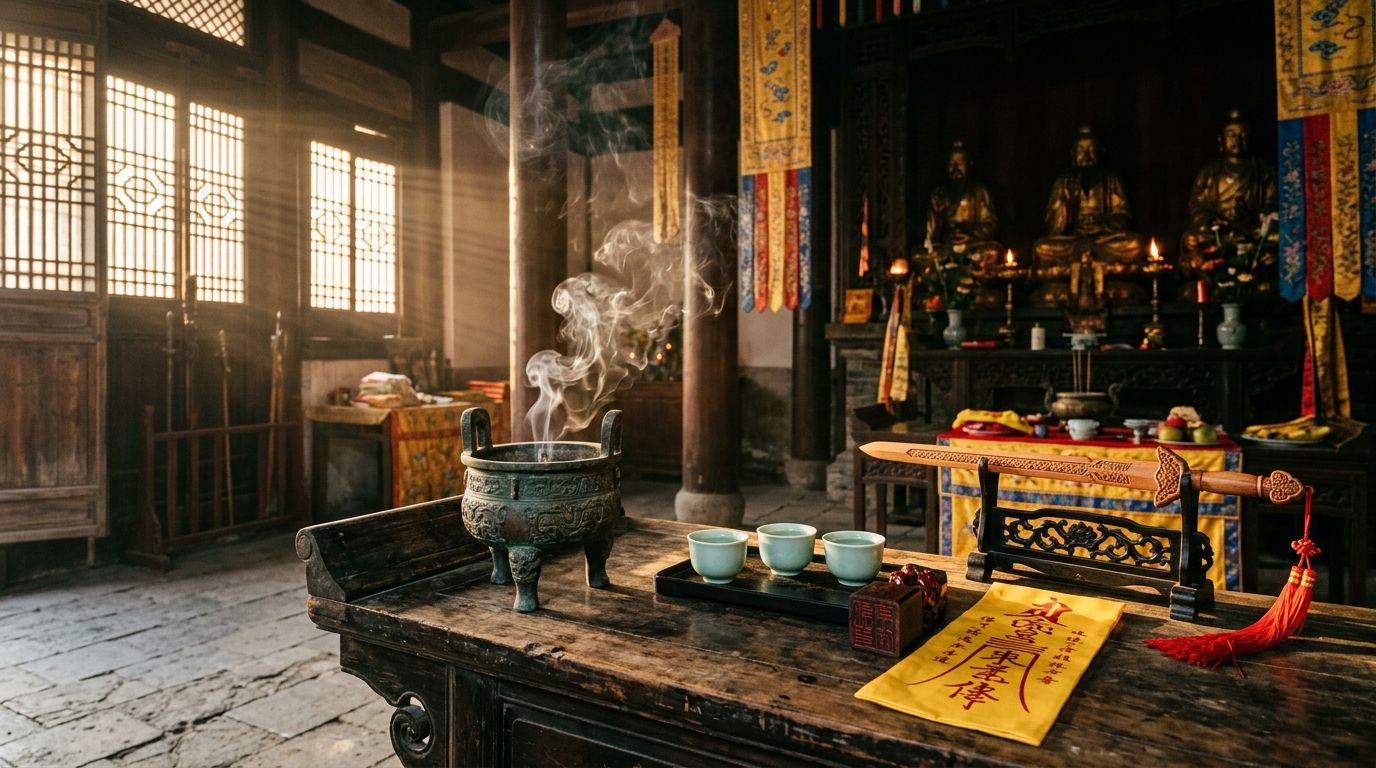
- 5. Sacred Implements (Fawu 法物), Talismans, and Material Connoisseurship
- Peachwood Swords (Taomu Jian 桃木剑)
- Lightning-Struck Jujube Wood (Leiji Zaomu 雷击枣木)
- Talismanic Arts: The Writing of Fu Lu (符箓)
- The Canonical Rite of Kai Guang (开光, Opening the Light)
- 6. Practical Guide: Five-Step Sacred Etiquette and Daily Altar Harmonization
- Step 1: Altar Placement & Spatial Taboos (Anwei Dingxiang 安位定向)
- Step 2: Morning Cleansing of Body & Speech (Jingshen Jingshou 净身净手)
- Step 3: Offering the Three Pure Waters & Sandalwood Incense (Sanxiang Sanquan 三香三泉)
- Step 4: Sealing Microcosmic Qi with the Ziwu Hand Mudra (Ziwu Jue 子午诀)
- Step 5: Diaphragmatic Dantian Breathwork & Scripture Contemplation (Jingzuo Xiuxi 静坐修习)
- 7. Frequently Asked Questions (FAQ)
- Q1: What is the Tao religion, and how does it differ from philosophical Taoism?
- Q2: Is the Tao religion polytheistic, pantheistic, or monotheistic?
- Q3: What role do sacred artifacts (Fawu) and talismans (Fu Lu) play in the Tao religion?
- Q4: Can an individual practice the Tao religion outside of China or without an ordained temple nearby?
The Tao Religion: Beliefs, History, Sacred Rituals, and Living Traditions of Orthodox Daoism
Key Takeaways (Executive Summary) - Direct Definition: The Tao religion (known natively as Daojiao 道教) is an indigenous Chinese organized world religion centered on the living veneration and realization of the Tao (道, the Cosmic Way) through formal monastic lineages, ordained priesthoods, canonical scriptures (Daozang 道藏), and sacred ritual liturgies. - Philosophy vs. Religion: While modern Western discourse frequently bifurcates philosophical Taoism (Daojia 道家) from religious practice, authentic lineage tradition recognizes the Tao religion as the complete practical and ritual embodiment of classical wisdom—transforming metaphysical concepts of Wu Wei (无为) and Ziran (自然) into liturgical sacraments, internal alchemy (Neidan 内丹), and communal blessings. - Cosmic Hierarchy & Lineages: Orthodox Tao religion reveres the Three Pure Ones (Sanqing 三清) as the supreme primordial Trinity, manifesting through two primary living branches: the liturgical, householder Zhengyi (正一, Orthodox Unity) tradition founded by First Celestial Master Zhang Daoling, and the ascetic, monastic Quanzhen (全真, Complete Perfection) tradition founded by Wang Chongyang. - Sacred Consecration & Artifacts: Living shrines in the Tao religion employ canonical implements (Fawu 法物)—including lightning-struck jujube wood seals (Leiji Zaomu), cinnabar-inscribed talismans (Fu Lu), and peachwood swords (Taomu Jian)—vitalized through the esoteric Kai Guang (开光, Opening the Light) rite. - Daily Cultivation Protocol: Orthodox adherents practice daily veneration through the dawn Mao Hour (5:00 AM – 7:00 AM) offering of the Three Pure Waters, natural aged sandalwood or Jiangzhen incense, the Ziwu Hand Mudra (子午诀), and diaphragmatic Lower Dantian (下丹田) breathwork.
1. What Is the Tao Religion? Defining Daojiao and Dispelling Modern Myths
Across global spiritual heritage, few traditions possess the nuanced depth, mystical majesty, and enduring vitality of the Tao religion. In its indigenous homeland of China, this venerable path is designated as Daojiao (道教), translating literally as the "Teachings and Sacraments of the Great Way." Spanning over five millennia of shamanic roots, classical philosophy, imperial ritual, and unbroken esoteric lineage transmission, the Tao religion represents one of the world's most sophisticated systems of cosmological harmony, bodily cultivation, and spiritual transcendence.
Yet, outside of East Asia, the Tao religion remains widely misunderstood. Popular Western culture often reduces Taoism to an abstract lifestyle philosophy, a countercultural aesthetic of effortless detachment, or an exotic collection of breathing exercises. To understand the living tradition as preserved in temples from the sacred peaks of Wudang to Mount Longhu, one must examine the organic continuity between the philosophical insights of the sages and the sacred liturgies of the priesthood.
Daojia (道家) vs. Daojiao (道教): Untangling the Colonial Dichotomy
A common inquiry from Western seekers is whether Taoism is "a philosophy or a religion." During the 19th and early 20th centuries, European sinologists and colonial translators imposed Western theological categories upon China, asserting that there was an original, pristine "philosophical Daoism" (Daojia 道家) authored by Laozi and Zhuangzi, which was supposedly "corrupted" in later centuries by an elaborate, superstitious "religious Daoism" (Daojiao 道教).
To an ordained Taoist priest (Daoshi 道士), this separation is completely unfounded:
- Daojia (道家) represents the philosophical, textual, and cosmological foundation—the root and core wisdom of the tree.
- Daojiao (道教) is the living blossom, fruit, and practical foliage of that exact same tree. It provides the disciplined liturgical frameworks, ethical precepts, sacred temple spaces, consecrated implements, and alchemical methodologies through which the philosophical ideals of the Daodejing are actualized in bodily reality.
Without Daojiao, the philosophy of Laozi remains an intellectual abstraction. Without Daojia, religious rituals lose their metaphysical anchor. In the Tao religion, knowing the Way (Zhi Dao 知道) and embodying the Way through dedicated ritual action (Xing Dao 行道) are indivisible halves of a single spiritual truth.
2. Cosmic Theology and Pantheon of the Tao Religion
Unlike monotheistic faiths that conceive of God as an anthropomorphic supreme monarch who created the world ex nihilo, the Tao religion teaches that the cosmos originates from the self-generating, spontaneous unfolding of the Tao (道). The Tao is formless, nameless, and inexhaustible. As Chapter 42 of the Daodejing famously records:
"The Tao gives birth to One; One gives birth to Two; Two gives birth to Three; and Three gives birth to the ten thousand things." — (道生一,一生二,二生三,三生万物。)
In liturgical theology, this cosmological unfolding manifests through a magnificent, orderly celestial hierarchy.
The Three Pure Ones (Sanqing 三清): The Primordial Trinity
At the pinnacle of veneration in the Tao religion reside the Three Pure Ones (Sanqing 三清). They are not historical human beings who were elevated after death; rather, they are the personalized hypostases of primordial cosmic breath (Yuanqi 元炁):
- Yuanshi Tianzun (元始天尊, Celestial Worthy of Primordial Beginning): Residing in the Heaven of Pure Clarity (Qingwei Tian), he embodies the state of Wuji (无极)—the undifferentiated, silent, infinite cosmic void prior to the inception of time and matter.
- Lingbao Tianzun (灵宝天尊, Celestial Worthy of Numinous Treasure): Residing in the Heaven of Grand Mystery (Yuyu Tian), he embodies the emergence of Taiji (太极)—the cosmic order, sacred mathematical patterns, and the celestial scripts that regulate the movement of stars and seasons.
- Daode Tianzun (道德天尊, Celestial Worthy of the Way and Its Virtue): Also reverently hailed as Taishang Laojun (太上老君). He embodies the manifest universe (Wanwu 万物) and the compassionate descent of celestial wisdom into mortal history. He is the divine incarnation who appeared on earth as Laozi to transmit the Daodejing.
The Four Sovereigns (Siyu 四御) and Celestial Administration
Beneath the Three Pure Ones operates the celestial administration tasked with sustaining cosmic and terrestrial equilibrium:
- The Jade Emperor (Yuhuang Dadi 玉皇大帝): Oversees the executive governance of the celestial bureaucracy, spiritual realms, and karmic records of mortals.
- The Emperor of the Purple Subtlety (Ziwei Dadi 紫微大帝): Controls the celestial axes, stellar constellations, and terrestrial weather patterns.
- The Sovereign of the Earth (Houtu Empress 后土娘娘): Nurtures the physical earth, mountains, rivers, agriculture, and subterranean energies.
3. Structural Comparison: The Two Living Lineages of the Tao Religion
Throughout its two millennia of organized history, the Tao religion has unified dozens of regional and esoteric schools into two primary institutional lineages: Zhengyi (正一) and Quanzhen (全真). A structured comparison reveals how both traditions express the core tenets of the Tao through distinct cultural modes:
- Founding Patriarch & Date — Zhengyi Dao (正一道 - Orthodox Unity): First Celestial Master Zhang Daoling (张道陵), 142 CE (Mount Heming, Sichuan). · Quanzhen Dao (全真道 - Complete Perfection): Patriarch Wang Chongyang (王重阳), 12th century CE (Mount Zhongnan, Shaanxi). · Secular / Western Misconceptions: Regarded as disconnected folk cults or recent 19th-century superstitious inventions.
- Institutional Center — Zhengyi Dao (正一道 - Orthodox Unity): Mount Longhu (龙虎山, Dragon Tiger Mountain), Jiangxi Province. · Quanzhen Dao (全真道 - Complete Perfection): Baiyun Guan (北京白云观, White Cloud Temple), Beijing. · Secular / Western Misconceptions: Assumed to have no headquarters, no historical seats, and no formal hierarchies.
- Priestly Lifestyle & Ordination — Zhengyi Dao (正一道 - Orthodox Unity): Huoju Daoshi (火居道士): Priests may marry, maintain families, live within communities, and pass lineage registers to heirs. · Quanzhen Dao (全真道 - Complete Perfection): Chujia Daoshi (出家道士): Strict monastic celibacy, community monastery life, vegetarianism, and long ascetic hair buns (Ziwu Jin). · Secular / Western Misconceptions: Confused with wandering magicians, martial artists, or fortune-telling street peddlers.
- Primary Liturgical Focus — Zhengyi Dao (正一道 - Orthodox Unity): Liturgical Jiao (醮) ceremonies, Fu Lu (符箓) talismanic talismans, thunder rituals (Leifa 雷法), and communal blessings. · Quanzhen Dao (全真道 - Complete Perfection): Neidan (内丹) internal alchemy meditation, scriptural chanting, breath refinement, and ethical introspection. · Secular / Western Misconceptions: Believed to consist solely of physical martial arts (Tai Chi) or silent secular relaxation.
- Scriptural Transmission — Zhengyi Dao (正一道 - Orthodox Unity): Canonical talismanic registers (Lu 箓), liturgy manuals, and ritual incantations (Zhou 咒). · Quanzhen Dao (全真道 - Complete Perfection): Daodejing, Qingjing Jing, synthesis with Heart Sutra and Confucian Classic of Filial Piety. · Secular / Western Misconceptions: Misunderstood as having no canonical literature outside of popular translations of Laozi.
- Canonical Implements (Fawu) — Zhengyi Dao (正一道 - Orthodox Unity): Consecrated seals of lightning-struck wood (Fayin), peachwood swords, bronze bells (Sanqing Ling), cinnabar ink. · Quanzhen Dao (全真道 - Complete Perfection): Meditation cushions, stone censers, pure brass water bowls, hand prayer beads (Chaoxhu), whisks (Fuchen). · Secular / Western Misconceptions: Reduced to decorative trinkets, plastic souvenirs, or secular feng shui baubles.
4. Sacred Cosmology and Core Doctrines of the Tao Religion
The theological superstructure of the Tao religion rests upon four interconnected cosmological principles that govern the health of the human body, the stability of society, and the rhythm of nature:
1. Dao Fa Ziran (道法自然): The Way Models Nature
In Chapter 25 of the Daodejing, Laozi lays out the supreme hierarchy of universal alignment:
"Humanity models itself upon Earth; Earth models itself upon Heaven; Heaven models itself upon the Tao; and the Tao models itself upon Ziran." — (人法地,地法天,天法道,道法自然。)
In the Tao religion, Ziran (自然) does not merely mean physical flora and fauna; it describes the quality of being so of itself—unforced, organic, and inherently balanced. True righteousness is not the aggressive imposition of arbitrary human morality, but the humble alignment of human consciousness with the rhythmic cycles of the four seasons, the rising and setting of celestial bodies, and the natural flow of life.
2. Tian Ren He Yi (天人合一): The Living Cosmic Microcosm
The Tao religion views the human body not as an ephemeral, sinful cage for the soul, but as a sacred microcosm (Xiaotiande 小天地, a "miniature Heaven and Earth"):
- The five primary internal organs (Wuzang 五脏—Heart, Liver, Spleen, Lungs, Kidneys) directly correspond to the Five Elements (Wuxing 五行), the five celestial directions, and the five cardinal planets.
- The spine corresponds to the pillars of heaven; the breath corresponds to atmospheric wind and clouds; the eyes correspond to the sun and moon.
- Because the human body is structurally isomorphic with the cosmos, harmonizing one's internal emotional Qi naturally reverberates outward, bringing tranquility to one's environment and lineage.
3. Changsheng Jiushi (长生久视) and the Internal Alchemy of Jing, Qi, Shen
While many world religions focus almost exclusively on salvation in the afterlife, the Tao religion places supreme value on life in the present body. The canonical goal of Changsheng Jiushi (长生久视, Longevity and Extended Vision) is attained through Neidan (内丹, Internal Alchemy):
- Jing (精, Essence): The foundational physical and reproductive vitality of the body.
- Qi (炁, Vital Breath): The dynamic energetic currents circulating through the twelve acupuncture meridians.
- Shen (神, Spiritual Awareness): The radiant, immortal consciousness seated in the Upper Dantian (Niwan Gong 泥丸宫).
Through the internal alchemical cycle of Lian Jing Hua Qi (refining essence into breath), Lian Qi Hua Shen (refining breath into spirit), and Lian Shen Huan Xu (refining spirit to return to the primordial void), the Taoist adept reverses the degenerative cycle of aging and achieves conscious union with the immortal Tao.
4. Sanbao (三宝): The Three Treasures of the Tao Religion
Just as Buddhism preserves the Three Jewels, the Tao religion mandates solemn refuge in its own Three Treasures (Sanbao 三宝):
- The Dao (道宝): Taking refuge in the Great Way, affirming that the primordial source is the eternal mother of all beings.
- The Scripture (经宝): Taking refuge in the sacred canon (Daozang 道藏), the 5,485 scrolls of celestial revelations and philosophical guidance compiled over centuries.
- The Master (师宝): Taking refuge in the ordained lineage teachers, whose living transmission, precepts, and moral instructions guide disciples away from ignorance.
5. Sacred Implements (Fawu 法物), Talismans, and Material Connoisseurship
In orthodox temple liturgies and home sanctuary altars, sacred implements (Fawu 法物) are not secular decorations; they are precisely tuned energetic tools designed to focus cosmic frequencies, stabilize spatial Qi, and dispel malevolent turbulence. Authentic Daoist connoisseurship adheres to strict traditional criteria, sharply distinguishing genuine liturgical materials from modern industrial counterfeits:
Peachwood Swords (Taomu Jian 桃木剑)
In Daoist demonology and spatial metaphysics, peach wood is considered the supreme botanical repeller of stagnant Yin Qi. In ancient legends, the giant Shenshu and Yulü guarded the heavenly ghost gate beneath a celestial peach tree. When hand-carved from seasoned, wild mountain peach wood and inscribed with the Seven Stars of the Big Dipper (Beidou Qixing 北斗七星), a peachwood sword serves as a steadfast protective guardian for the home.
Lightning-Struck Jujube Wood (Leiji Zaomu 雷击枣木)
Known within the tradition as the "King of Sacred Woods," Leiji Zaomu is created when a living wild jujube tree on a high mountain ridge is struck by lightning during a sudden thunderstorm. The instant fusion of intense celestial electrical energy (Tianhuo 天火) with the dense, water-nourished wood creates an implement of immense Yang potency. It is prized above all other materials for the carving of Celestial Master seals (Tianshi Fayin 天师法印), command blocks (Jingban 惊板), and protective talismans.
Talismanic Arts: The Writing of Fu Lu (符箓)
A Fu Lu (符箓) is not a random piece of folklore; it is an exact sonic and spatial manifestation of celestial authority. An ordained priest must undertake ritual purification, cultivate internal Qi in the Lower Dantian, invoke the relevant celestial deities, and inscribe the talisman on untreated yellow silk or mulberry bark paper with natural crystalline cinnabar while holding the sacred Ziwu Mudra (子午诀). The talisman operates as an energetic key, unlocking celestial protection for the household.
The Canonical Rite of Kai Guang (开光, Opening the Light)
A statue, talisman, or amulet remains an inert physical object until it undergoes the canonical liturgical rite of Kai Guang (开光) conducted by an ordained priest:
Through this rigorous liturgical transmission, the material vessel is spiritually awakened, establishing a permanent conduit of divine harmony and protection.
6. Practical Guide: Five-Step Sacred Etiquette and Daily Altar Harmonization
For practitioners and sincere admirers of the Tao religion seeking to cultivate peace, focus, and cosmic alignment at home, following canonical ritual etiquette ensures that one's personal sanctuary remains spiritually elevated:
Step 1: Altar Placement & Spatial Taboos (Anwei Dingxiang 安位定向)
The spatial foundation of your sanctuary establishes its energetic stability:
- Solid Support: Position your altar against a sturdy, load-bearing interior wall. This serves as an unshakeable energetic mountain (Kaoshan 靠山).
- Auspicious Height: The altar table must be at least waist-high (traditionally measuring between 38 to 42 inches), ensuring that one naturally looks slightly upward toward the sacred images.
- Directional Orientation: Position the altar facing toward the main entrance of the room or eastward toward the morning sunrise (Chaoyang 朝阳), inviting the dawn Yang Qi celebrated in the proverb Ziqi Donglai (紫气东来).
- Strict Spatial Taboos: Never establish an altar inside a bedroom, on a dining table where meat or alcohol is consumed, or against a wall shared with a restroom, kitchen stove, or trash disposal area. Keep sacred implements elevated off the floor at all times.
Step 2: Morning Cleansing of Body & Speech (Jingshen Jingshou 净身净手)
Conduct your daily devotion during the auspicious Mao Hour (卯时, 5:00 AM – 7:00 AM), when primordial Yang Qi begins its daily ascent across nature:
- Wash hands and face thoroughly with cool, fresh water. Rinse your mouth to cleanse ordinary speech before addressing the divine.
- Gently dust the altar surface using a dedicated clean cloth reserved exclusively for sacred vessels.
- Turn off mobile devices, release worldly preoccupations, and stand before the altar with calm, undivided attention.
Step 3: Offering the Three Pure Waters & Sandalwood Incense (Sanxiang Sanquan 三香三泉)
Place three porcelain or celadon offering cups in a straight line before the sacred image:
- Fill each cup with fresh, pure mountain spring water or filtered water:
- Center Cup: Offered to the Tao (道) and Yuanshi Tianzun.
- Left Cup (Observer's Left): Offered to the Scripture (经) and Lingbao Tianzun.
- Right Cup (Observer's Right): Offered to the Lineage Masters (师) and Daode Tianzun (Laozi).
Next, ignite three sticks of natural aged sandalwood or Jiangzhen incense:
- Extinguish open flames with a gentle wave of the right hand. Never blow on ritual incense with your breath, as human breath is considered mundanely turbid.
- Hold the three sticks with both hands at heart level, bow reverently, and insert them into your censer:
- Insert the center stick first, affirming: "I take refuge in the unnamable Tao." (Dao Xiang 道香)
- Insert the left stick second, affirming: "I take refuge in the sacred Scriptures." (Jing Xiang 经香)
- Insert the right stick third, affirming: "I take refuge in the Ancestral Masters." (Shi Xiang 师香)
Step 4: Sealing Microcosmic Qi with the Ziwu Hand Mudra (Ziwu Jue 子午诀)
Stand with feet shoulder-width apart, knees softly unlocked, and spine gently erect. Bring your hands together at the solar plexus to form the ancient Daoist Ziwu Mudra (子午诀):
- Enclose your right thumb inside the fingers of your left hand.
- Place the tip of your left thumb against the base of your left ring finger (the Zi 子 position, representing midnight, Water, and receptive Yin).
- Press the tip of your right thumb against the tip of your right middle finger (the Wu 午 position, representing midday, Fire, and radiant Yang).
- This canonical hand seal unites the body's Conception Vessel (Ren Mai 任脉) and Governing Vessel (Du Mai 督脉), locking vital essence within and preventing the outward dissipation of vital Qi during meditation.
Step 5: Diaphragmatic Dantian Breathwork & Scripture Contemplation (Jingzuo Xiuxi 静坐修习)
Sit comfortably on a meditation cushion before the altar for 15 to 20 minutes of quiet contemplation:
- Lightly touch the tip of your tongue to the roof of your mouth just behind the front teeth, bridging the heavenly energy bridge (Queqiao 鹊桥).
- Inhale silently and deeply through the nose, directing the breath into the Lower Dantian (下丹田)—located roughly two inches below the navel—feeling the abdomen softly expand.
- Exhale slowly and evenly, releasing bodily tension, mental chatter, and selfish desires.
- Quietly recite or contemplate Chapter 16 of the Daodejing:
"Attain utmost emptiness; preserve absolute stillness. The ten thousand things arise together; in their contemplation, I behold their return." — (致虚极,守静笃。万物并作,吾以观复。)
- Conclude by bowing three times before the altar, stepping back with mindfulness and carrying the tranquility of the Tao into your daily endeavors.
7. Frequently Asked Questions (FAQ)
Q1: What is the Tao religion, and how does it differ from philosophical Taoism?
Answer: The Tao religion (Daojiao 道教) is the comprehensive, organized spiritual tradition of Daoism that encompasses liturgical worship, ordained priesthoods, canonical scriptures (Daozang 道藏), sacred temple altars, talismanic arts (Fu Lu 符箓), and internal alchemy (Neidan 内丹). While philosophical Taoism (Daojia 道家) refers primarily to the classical metaphysical literature of the Warring States period (such as the Daodejing and Zhuangzi), the Tao religion is the living ecclesiastical and ritual embodiment of those philosophical insights, established as an organized movement in 142 CE by First Celestial Master Zhang Daoling.
Q2: Is the Tao religion polytheistic, pantheistic, or monotheistic?
Answer: Orthodox Daoist theology defies standard Western theological labels. At its metaphysical foundation, the Tao religion is centered on the Tao (道)—the unnamable, singular, formless origin of all existence. However, in liturgical reality, the religion venerates the Three Pure Ones (Sanqing 三清) as the cosmic trinity embodying primordial Qi, alongside an extensive pantheon of celestial deities, stellar sovereigns (such as the Jade Emperor and Doumu), ancestral lineage masters, and guardian immortals. Rather than separate anthropomorphic gods competing for supremacy, these divine beings represent celestial emanations and specialized frequencies of the one eternal Tao.
Q3: What role do sacred artifacts (Fawu) and talismans (Fu Lu) play in the Tao religion?
Answer: In the Tao religion, sacred implements (Fawu 法物)—such as lightning-struck jujube wood seals (Leiji Zaomu), peachwood swords (Taomu Jian), bronze censers, and hand-written yellow silk talismans (Fu Lu 符箓)—are neither superstition nor mere symbolic art. When consecrated through the orthodox liturgical rite of Kai Guang (开光, Opening the Light), these implements serve as tangible conduits of pure Yang energy, celestial protection, and spatial purification. They anchor benevolent cosmic frequencies within a sanctuary, dispelling turbid Qi and aiding the practitioner's inner alchemical concentration.
Q4: Can an individual practice the Tao religion outside of China or without an ordained temple nearby?
Answer: Yes. Sincere self-cultivation in the Tao religion begins with aligning one's daily conduct with the Tao through simplicity, ethical compassion, and reverence for nature (Dao Fa Ziran 道法自然). Practitioners around the world can establish a respectful personal sanctuary altar at home following canonical spatial guidelines, offer fresh spring water and natural sandalwood incense each dawn, practice diaphragmatic Lower Dantian breathwork, and recite the Daodejing or Qingjing Jing (Scripture of Purity and Stillness). Respecting orthodox lineage guidelines, avoiding counterfeit commercial artifacts, and maintaining humble daily mindfulness allow anyone to experience the living blessings of the Tao.
Authored by the Daoist Cultural Heritage & Sacred Arts Curatorial Guild. All historical chronicles, canonical citations, and ritual methodologies conform to orthodox Daozang liturgical standards.