Daoism Foundations · · 25 min read
Tao Meaning: The Primordial Way, Metaphysical Essence, Living Lineage Wisdom, and Sacred Altar Implements
Explore the profound Tao meaning: the unnamable cosmic mother, Wu Wei, inner alchemy, and consecrated altar implements in orthodox living Daoism.
By Daoismart Editorial
On this page
- Tao Meaning: The Primordial Way, Metaphysical Essence, Living Lineage Wisdom, and Sacred Altar Implements
- 1. The Multidimensional Architecture: Deconstructing the Authentic Tao Meaning
- The Calligraphic Glyphic Anatomy of 道
- The Cosmological Genesis: From Wuji to the Ten Thousand Things
- 2. Historical Evolution: The Shifting Tao Meaning Across Chinese Dynasties
- From Confucian Morality to Cosmic Absolute
- The Wade-Giles vs. Pinyin Clarification
- 3. The Three Treasures (Sanbao 三宝): The Triple Expression of the Tao Meaning
- 1. Compassion (Ci 慈): The Maternal Shield
- 2. Frugality (Jian 俭): Preserving Vital Reserves
- 3. Daring Not to Compete (Bugan Wei Tianxia Xian 不敢为天下先)
- 4. The Functional Mechanics: Living the Tao Meaning Through Wu Wei and Ziran
- Ziran (自然): Spontaneous Self-So Nature
- Wu Wei (无为): Demystifying Effortless Action
- The Water Metaphor: The Supreme Teacher of the Tao
- 5. Somatic Realization: Internal Alchemy (Neidan 内丹) and the Energetic Channels
- The Four Stages of Internal Transformation
- 6. The Tao in Physical Form: Consecrated Sacred Implements (Fawu 法物)
- Lightning-Struck Jujube Wood (Leiji Zaomu 雷击枣木)
- The Seven Stars Mountain Peachwood Sword (Taomu Jian 桃木剑)
- Pure Crystalline Mineral Cinnabar (Zhusha 朱砂)
- 7. Lineage Connoisseurship: Authentic Sacred Fawu vs. Tourist Imitations
- 8. The Five Canonical Stages of Kai Guang (开光, Opening the Light)
- 9. Step-by-Step Daily Practice: A 5-Step Protocol to Embody the Tao Meaning
- 10. Frequently Asked Questions (FAQ)
- What is the primary Tao meaning in classical Chinese philosophy?
- How does the Tao meaning differ from Western conceptions of God or the Divine?
- How can an ordinary person practically apply the Tao meaning to modern work and relationships?
- Why do orthodox Taoist lineages utilize physical altar implements if the Tao meaning is formless and immaterial?
Tao Meaning: The Primordial Way, Metaphysical Essence, Living Lineage Wisdom, and Sacred Altar Implements
Key Takeaways & Core Principles - The Definitive Tao Meaning: At its etymological root, the character Tao (道, historically romanized as Tao and in standard modern Pinyin as Dao) signifies a "road," "path," or "way of walking." In orthodox lineage metaphysics, the Tao meaning encompasses three inseparable dimensions: the formless cosmic mother (Wuji 无极 / Chang Tao 常道), the dynamic ordering law of natural cycles (Taiji 太极), and the living path of human ethical and spiritual attunement. - Cosmic Emergence Over Anthropomorphic Design: Unlike Western theological doctrines of an external deity imposing commandments, the Tao meaning represents an impersonal, self-generating cosmic rhythm. As Chapter 25 of the Daodejing (道德经) declares, "The Tao models its own spontaneity" (Dao Fa Ziran 道法自然), nourishing the universe without asserting ownership or control. - Effortless Action in Daily Life: Living the Tao meaning centers upon Wu Wei (无为)—non-contrived, non-coercive action. Rather than promoting lethargy or passivity, Wu Wei guides human beings to navigate career, family, and relationships with the adaptive, frictionless resilience of flowing water (Shang Shan Ruo Shui 上善若水). - Somatic Alchemy and Energetic Balance: Sincere comprehension of the Tao meaning demands physical embodiment through Internal Alchemy (Neidan 内丹). Cultivators refine coarse essence (Jing 精) into vital breath (Qi 炁) and spiritual awareness (Shen 神) within the Three Dantians (San Dantian 三丹田). - Sacred Physical Anchors (Fawu 法物): In orthodox cosmology, matter is condensed life-force (Qi Ning Wei Wu 炁凝为物). Consecrated implements—such as lightning-struck jujube wood seals (Leiji Zaomu Yin 雷击枣木印), peachwood Seven Stars swords (Taomu Jian 桃木剑), and natural crystalline cinnabar (Zhusha 朱砂)—serve as material focal points that stabilize domestic energy fields and assist meditation.
1. The Multidimensional Architecture: Deconstructing the Authentic Tao Meaning
For over two and a half millennia, seekers across continents and traditions have sought to grasp the full breadth of the Tao meaning. Yet in the very opening declaration of the foundational Daodejing (道德经), the venerable sage Laozi (老子) issues a profound cautionary insight:
$\text{“The Tao that can be spoken is not the eternal Tao; The name that can be named is not the eternal name.”}$
$\text{(道可道,非常道;名可名,非常名。)}$
This opening line is not an evasive riddle or intellectual cop-out; it is a precise metaphysical statement regarding the limitations of human conceptualization. When exploring the Tao meaning, one must recognize that linguistic symbols and philosophical categories are mere finger-pointers pointing toward the radiant moon. To reduce the Tao solely to an intellectual definition is to confuse the map with the vast, living landscape.
The Calligraphic Glyphic Anatomy of 道
The Chinese ideogram Tao (道) carries immense philosophical depth embedded within its ancient strokes. In classical etymology, the character is composed of two distinct visual components:
- The Radical Chuo (辶 / 辵): Located along the left and lower perimeter, this radical depicts a human foot taking a deliberate step forward along a path, symbolizing movement, physical action, personal journey, and ongoing progression through time and space.
- The Graph Shou (首): Forming the upper and right core, this character represents a human head, crown, supreme leader, origin, or highest consciousness.
When joined together, the visual synthesis reveals the fundamental Tao meaning: walking the path with awakened consciousness, or the origin that journeys through its own manifestation. The Tao is simultaneously the primary headspring from which life emerges and the continuous pathway upon which that life travels. The Tao is never a static destination; it is an eternal, living process of unfolding and returning.
The Cosmological Genesis: From Wuji to the Ten Thousand Things
In Chapter 42 of the Daodejing, Laozi delineates the cosmological mechanics underpinning the deeper Tao meaning with pristine mathematical clarity:
$\text{“The Tao gives birth to One; One gives birth to Two; Two gives birth to Three; Three gives birth to the ten thousand things.”}$
$\text{(道生一,一生二,二生三,三生万物。)}$
- The Tao (道) is Wuji (无极)—the primordial, unnamable absolute void holding infinite potential before the emergence of space and time.
- The One (一) represents Taiji (太极) and the waking of the primordial unified breath (Yuanqi 元炁).
- The Two (二) designates the polar differentiation of Yin (阴) and Yang (阳)—the rhythmic pulsation of darkness and light, coolness and heat, rest and activity.
- The Three (三) arises from the harmonious interaction of Yin and Yang, generating the unifying breath (Chongqi 冲气).
- The Ten Thousand Things (万物, Wanwu) comprise every manifest reality: galaxy clusters, planetary oceans, mountain forests, animal life, and human beings.
Thus, when inquiring into the Tao meaning, one discovers that the Tao is not an aloof monarch residing outside nature; it is the intrinsic fabric, energetic pulse, and structural rhythm of every atom in the cosmos.
2. Historical Evolution: The Shifting Tao Meaning Across Chinese Dynasties
To comprehend the richness of the modern Tao meaning, one must examine how the term transitioned across ancient Chinese philosophical schools and liturgical traditions.
From Confucian Morality to Cosmic Absolute
Prior to Laozi, the word Tao was utilized predominantly by early scholars and Confucians (Rujia 儒家) to designate ethical conduct, human statecraft, and proper ancestral rites (Li 礼). For Confucius (Kongzi 孔子), the "Tao" was the "Way of the Ancient Kings"—a structured socio-political code preserving civilized harmony.
Laozi and his successor Master Zhuangzi (Zhuang Zhou 庄周) enacted a breathtaking metaphysical revolution. They took this conventional word and elevated it to the absolute headspring of all existence. For the Daoist sages, human ethics are merely secondary ripples; true virtue (De 德) emerges spontaneously only when human beings harmonize directly with the cosmic Tao meaning rather than clinging to artificial, rigid legalistic rules.
The Wade-Giles vs. Pinyin Clarification
International practitioners frequently wonder whether "Tao" and "Dao" signify distinct concepts. In reality, both spellings represent the exact same Chinese ideogram: 道.
- Wade-Giles ("Tao"): Formulated in the 19th century by British diplomats Sir Thomas Wade and Herbert Giles, this phonetic system transcribed unaspirated consonant sounds using the Roman letter "t". Through landmark English translations by James Legge, Arthur Waley, and Alan Watts, the spelling "Tao" entered the Western literary and philosophical canon.
- Hanyu Pinyin ("Dao"): Promulgated in 1958 and adopted by the United Nations, Pinyin transcribes the unaspirated sound using "d", reflecting standard modern Mandarin pronunciation more accurately to international linguists.
Whether rendered as Tao or Dao, the underlying Tao meaning remains identical: the primordial cosmic wellspring and the living path of self-cultivation.
3. The Three Treasures (Sanbao 三宝): The Triple Expression of the Tao Meaning
In orthodox Daoist cultivation, the profound abstraction of the Tao meaning is rendered tangible through the Three Treasures (Sanbao 三宝), which manifest across moral, celestial, and somatic levels:
1. Compassion (Ci 慈): The Maternal Shield
In Chapter 67 of the Daodejing, Laozi identifies Ci (慈) as the foremost ethical protector. Classical Daoist compassion is not sentimental indulgence; it is the deep, maternal reverence that Heaven holds toward all manifest life. A practitioner rooted in compassion is invulnerable to spiritual malice because their intent mirrors the universe's unconditional generosity.
2. Frugality (Jian 俭): Preserving Vital Reserves
Jian (俭) denotes deliberate restraint and moderation in desires, speech, and material consumption. By refusing to squander physical, mental, and financial reserves on superficial prestige, the cultivator retains abundant energetic reserves. In Daoist philosophy, true generosity is possible only when one possesses internal surplus through frugality.
3. Daring Not to Compete (Bugan Wei Tianxia Xian 不敢为天下先)
Often translated as humility, this virtue warns against forcing oneself to the front of worldly competitions. Just as the great ocean lies lower than all mountain tributaries and thereby becomes the sovereign reservoir of all waters, the Daoist master remains humble, patient, and grounded, leading others through gentle support from behind.
4. The Functional Mechanics: Living the Tao Meaning Through Wu Wei and Ziran
To embody the Tao meaning in ordinary daily affairs, one relies upon two fundamental operating principles: Ziran (自然) and Wu Wei (无为).
Ziran (自然): Spontaneous Self-So Nature
In contemporary Chinese, Ziran is commonly translated as "nature" or "the natural world." However, its classical metaphysical definition is far more precise:
- Zi (自): Self, spontaneous, intrinsic.
- Ran (然): So, as it is, in this manner.
Thus, Ziran signifies "that which is of itself so"—unforced, organic self-generation. When Chapter 25 of the Daodejing summarizes the cosmic hierarchy, it concludes:
$\text{Humanity models Earth, Earth models Heaven,}$
$\text{Heaven models the Tao, and the Tao models Spontaneity.}$
$\text{(人法地,地法天,天法道,道法自然。)}$
The Tao possesses no authoritarian ruler, written constitution, or external coercion. It generates and nurtures all things effortlessly from within its own spontaneous nature. When human beings align with the Tao meaning, they strip away fabricated pretension, anxious posturing, and neurotic planning, resting in their authentic, uncarved simplicity (Pu 朴).
Wu Wei (无为): Demystifying Effortless Action
No concept within Daoist thought has suffered more distortion in popular Western interpretations than Wu Wei (无为). It is frequently misconstrued as total inaction, indolence, apathy, or nihilistic passivity.
In genuine lineage teaching, Wu Wei does not mean doing nothing; it means doing nothing that is contrived, coercive, or contradictory to the grain of nature. The character Wei (为) denotes calculated, aggressive, ego-driven forcing; the prefix Wu (无) signifies its absence.
Therefore, Wu Wei represents effortless mastery, action in harmony with natural timing, and frictionless responsiveness.
The Water Metaphor: The Supreme Teacher of the Tao
In Chapter 8 of the Daodejing, Laozi presents water as the supreme physical teacher illustrating the functional Tao meaning:
"The highest good is like water. Water benefits all things and does not compete with them. It dwells in the low places that all men disdain. Therefore, it is close to the Tao." (上善若水。水善利万物而不争,处众人之所恶,故几于道。)
Water is completely soft and yielding, yet over time it cuts through the hardest granite canyons. It assumes the exact shape of any vessel it enters, yet it never loses its intrinsic nature. In human relationships, cultivating the Tao meaning entails responding like water: yielding without breaking, nourishing others without arrogance, and flowing gracefully around rigid obstacles.
5. Somatic Realization: Internal Alchemy (Neidan 内丹) and the Energetic Channels
In authentic Daoist tradition, the Tao meaning cannot remain an intellectual doctrine filed away in libraries. It must be physically experienced and embodied within the biological vessel. In classical cosmology, the human body is recognized as a living microcosm reflecting the macrocosmic universe (Tian Ren He Yi 天人合一, The Unity of Heaven and Humanity).
The Four Stages of Internal Transformation
Daoist internal alchemy (Neidan 内丹) systematizes human spiritual realization into a sequential four-phase progression:
- Refining Essence into Vital Breath (Lian Jing Hua Qi 炼精化炁): Conserving reproductive energy and somatic vitality in the Lower Dantian through stillness, turning dense physical fluids into active electromagnetic life-force.
- Refining Vital Breath into Spirit (Lian Qi Hua Shen 炼炁化神): Directing circulating Qi along the Microcosmic Orbit (Xiao Zhoutian 小周天) through the Ren (Conception) and Du (Governing) vessels, dissolving emotional blockages in the Middle Dantian.
- Refining Spirit into Emptiness (Lian Shen Huan Xu 炼神还虚): Dissolving individual ego identification into boundless universal stillness within the Upper Dantian.
- Refining Emptiness to Unite with the Tao (Lian Xu He Dao 炼虚合道): Transcending the boundary between self and cosmos, fully realizing the eternal Tao meaning in daily existence.
6. The Tao in Physical Form: Consecrated Sacred Implements (Fawu 法物)
A widespread paradox for students first examining the Tao meaning is understanding why an ancient tradition emphasizing formlessness, silence, and immaterial emptiness produces an elaborate array of sacred implements (Fawu 法物).
The resolution lies in the Daoist metaphysical law:
$\text{“When vital breath condenses, it forms physical matter; when it disperses, it returns to the formless void.”}$
$\text{(炁聚为物,炁散为虚。)}$
Physical matter and spiritual energy are not separate realms; they are two ends of a single vibrational continuum. Consecrated sacred implements are specialized spiritual technologies crafted from specific organic materials that naturally capture, store, and radiate pure celestial Yang Qi (Tian Zhi Yangqi 天之阳炁) into human living quarters.
Lightning-Struck Jujube Wood (Leiji Zaomu 雷击枣木)
In orthodox Daoist liturgical arts, high-mountain jujube timber struck naturally by cloud-to-ground lightning is revered as the supreme energetic wood. In a split second, tens of thousands of volts of celestial atmospheric thunderbolts penetrate the dense, slowly matured grain of the mountain tree.
Known as Leiji Zaomu (雷击枣木), this timber represents the rare cosmic union of Heaven's ultimate Yang Fire and Earth's enduring Yin Wood. When carved by hand into canonical seals—such as the Yangping Zhidugong Seal (阳平治都功印) of the Celestial Masters—the implement acts as a permanent domestic energetic anchor, dissolving heavy energetic stagnation.
The Seven Stars Mountain Peachwood Sword (Taomu Jian 桃木剑)
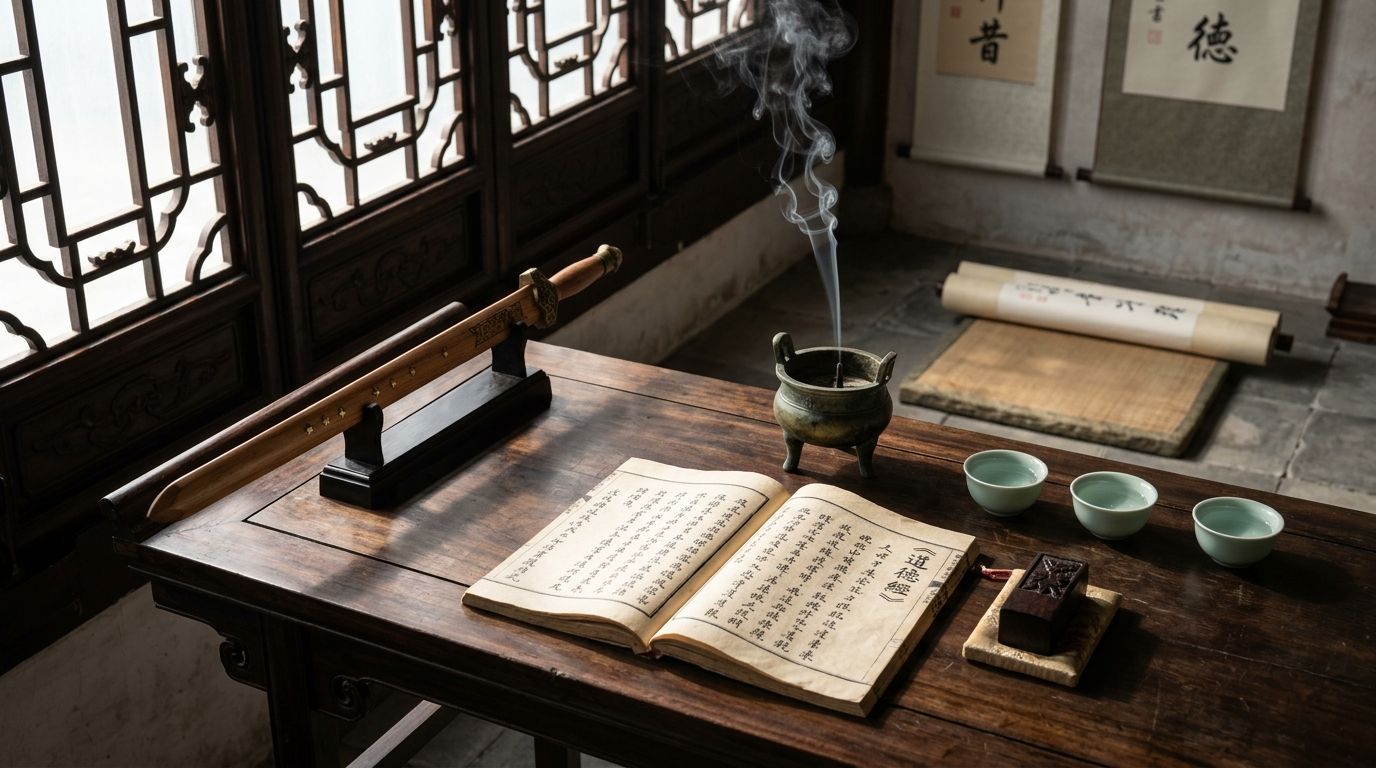
Carved from seasoned mountain peach heartwood and hand-inlaid with brass stars reflecting the Big Dipper (Beidou Qixing 北斗七星), the Taomu Jian (桃木剑) is an essential domestic protective implement.
In Chinese medicine and metaphysics, wild peachwood is classified as solar timber that naturally repels chaotic, low-vibrational frequencies. Displayed respectfully on a scholar's desk or domestic altar, the wooden sword cuts through mental fatigue and restores spatial coherence.
Pure Crystalline Mineral Cinnabar (Zhusha 朱砂)
For millennia, Daoist masters have utilized pure crystalline mineral cinnabar (Zhusha 朱砂)—natural mercuric sulfide formed under intense tectonic geothermal pressure. With an extraordinary specific gravity and a vivid vermilion hue, genuine cinnabar is recognized as the earth's most potent mineral conductor of solar Yang Qi. Blended with pure spring water, it forms the sacred red ink required for inscribing celestial talismans (Fu Lu 符箓).
7. Lineage Connoisseurship: Authentic Sacred Fawu vs. Tourist Imitations
A sincere practitioner seeking to align with the Tao meaning approaches physical implements with uncompromising connoisseurship. An altar adorned with cheap synthetic plastics, painted sawdust, or chemical fragrances introduces discordant chaotic frequencies into a sanctuary.
The comprehensive structured comparative matrix below provides international seekers with exact diagnostic criteria to distinguish authentic lineage implements from commercial souvenir counterfeits:
- Lightning-Struck Jujube Wood (Leiji Zaomu 雷击枣木) — Authentic Lineage Fawu (正统法物): Harvested from wild mountain ridge trees naturally struck by lightning; natural scorch fissures; exceptionally dense, sinking in water; emits a rich, toasted amber aroma upon friction rubbing. · Commercial Tourist Imitation (工业仿品): Rapid-growth softwood or industrial fiberboard charred artificially with propane torches; lightweight, floating easily; emits an acrid petroleum solvent stench. · Energetic & Material Diagnostic Signature: Intense Yang Density: Creates an immediate grounding, warming sensation in the lower Dantian during meditation.
- Seven Stars Peachwood Sword (Taomu Jian 桃木剑) — Authentic Lineage Fawu (正统法物): Hand-carved from seasoned mountain peach heartwood dried across 3+ winters; warm honey-caramel patina; hand-inlaid solid brass Big Dipper stars; natural grain curls. · Commercial Tourist Imitation (工业仿品): Plantation pine or pressed sawdust dipped in thick synthetic red lacquer paint; brittle, prone to warping; painted gold foil or plastic glued-on star dots. · Energetic & Material Diagnostic Signature: Spatial Purification: Clears room acoustics, dissolves mental cloudiness, and creates a crisp, protective boundary.
- Pure Crystalline Cinnabar (Zhusha 朱砂) — Authentic Lineage Fawu (正统法物): Mined crystalline mineral mercuric sulfide; noticeably heavy in the palm; cool to the touch; sparkles with authentic crystalline micro-facets under natural sunlight. · Commercial Tourist Imitation (工业仿品): Powdered industrial red lead or plastic polymer resin blended with talcum powder; lightweight; rubs off chalky residue; discolors under sunlight. · Energetic & Material Diagnostic Signature: Radiant Yang Fire: Provides potent spiritual shielding and conductively carries calligraphy talismanic mantras.
- Temple Grade Aromatic Incense (Tanxiang & Jiangzhen) — Authentic Lineage Fawu (正统法物): Aged wild sandalwood (Laoshan Tanxiang) and natural Jiangzhen resin blended with natural plant-bark binders; translucent, clean white smoke; soothing, sweet wood aroma. · Commercial Tourist Imitation (工业仿品): Industrial wood pulp infused with synthetic aromatic chemicals and chemical potassium nitrate burn accelerators; dark grey smoke that burns the throat and eyes. · Energetic & Material Diagnostic Signature: Atmospheric Bridge: Shifts beta brainwaves into calm meditative alpha rhythms, aligning breath with stillness.
- Solid Cast Bronze Tripod Censer (Tong Xianglu 铜香炉) — Authentic Lineage Fawu (正统法物): Heavy, solid cast brass or bronze; hand-burnished aged patina; produces a clear, long-sustaining bell chime when tapped; disperses thermal heat safely. · Commercial Tourist Imitation (工业仿品): Stamped sheet zinc or hollow pot metal coated with shiny yellow electroplating; flat dull hollow clatter; paint blisters and emits toxic odor when coals heat up. · Energetic & Material Diagnostic Signature: Earth-Metal Grounding: Serves as the sacred domestic furnace, anchoring ambient room Qi into harmonious stillness.
8. The Five Canonical Stages of Kai Guang (开光, Opening the Light)
Even an implement carved from authentic mountain timber remains merely a handsome piece of woodwork until it undergoes the orthodox lineage liturgy of Kai Guang (开光, Opening the Light) conducted by an ordained Daoist priest (Daoshi 道士):
Without authentic Kai Guang consecration, a physical item is merely decorative art; with canonical Kai Guang, it becomes an empowered, living spiritual conduit aligned with the primordial Tao meaning.
9. Step-by-Step Daily Practice: A 5-Step Protocol to Embody the Tao Meaning
To transition from conceptual contemplation into tangible daily realization, sincere practitioners maintain a structured morning ritual. Follow this classical five-step lineage protocol to embody the Tao meaning within your home sanctuary:
- Step 1: Sanctuary Direction & Altar Alignment (Anwei Dingxiang 安位定向): Position your meditation space or domestic altar facing South (the direction of pure solar Yang) or East (the direction of morning dawn and wooden renewal). Ensure the surface is impeccably clean, elevated above waist height, and free of clutter.
- Step 2: Dawn Purification of Hands and Breath (Jingshen Jingshou 净身净手): Upon waking, cleanse your hands and face with cool water. Rinse your mouth to clear nocturnal energetic stagnation, silently calming your thoughts and setting aside worldly worries.
- Step 3: Offering the Three Pure Waters & Sandalwood Incense (Sanxiang Sanquan 三香三泉): Place three clean porcelain cups filled with fresh mountain spring water before your altar, symbolizing the Three Treasures (Jing, Qi, Shen). Light three slender sticks of wild sandalwood or Jiangzhen incense. Holding them with both hands at forehead level, offer a bow of sincere gratitude before inserting them into your bronze censer.
- Step 4: Lower Dantian Tu Na Breathwork with the Ziwu Mudra (Ziwu Jue 子午诀): Sit upright on a natural rush cushion (Putuan 蒲团). Form the Yin-Yang Hand Seal (Ziwu Jue 子午诀) by clasping the left thumb inside the right hand, resting your palms gently on your lap over the Lower Dantian. Practice deep, silent diaphragmatic breathing: inhale through the nose down to the navel, feeling the abdomen expand like an uncarved vessel; exhale slowly, releasing tension.
- Step 5: Seated Oblivion (Zuowang 坐忘) & Scripture Contemplation: Spend 10 to 15 minutes in total seated stillness (Zuowang 坐忘), allowing thoughts to dissolve like morning mist without clinging to them. Conclude by reading a single chapter of the Daodejing, letting its poetic cadence illuminate your upcoming day with the living Tao meaning.
10. Frequently Asked Questions (FAQ)
What is the primary Tao meaning in classical Chinese philosophy?
In classical Chinese philosophy, the primary Tao meaning begins with the ideogram 道, literally translating to a "path," "road," or "method of movement." However, in the metaphysics articulated by Laozi in the Daodejing, the Tao meaning deepens into the primordial, uncaused wellspring of all existence. It represents the formless, boundless cosmic womb (Wuji 无极) from which Heaven, Earth, and the Ten Thousand Things (Wanwu 万物) continually emerge, circulate, and ultimately return. Rather than an anthropomorphic creator, the Tao meaning designates the self-generating cosmic rhythm and ordering principle that governs nature without force or ego.
How does the Tao meaning differ from Western conceptions of God or the Divine?
The essential difference between the Tao meaning and traditional Western theism lies in personhood, transcendence, and control. In Western monotheism, God is traditionally conceived as an omnipotent, personal deity who possesses emotional will, hands down moral commandments, judges human deeds, and intervenes from beyond creation. In contrast, the Tao meaning signifies an impersonal, non-anthropomorphic principle that is radically immanent within all matter. As Laozi observed in Chapter 51 of the Daodejing, the Tao gives birth to all things, nourishes them, yet claims no ownership, acts without boasting, and leads without dominating—a quality known as Mysterious Virtue (Xuande 玄德).
How can an ordinary person practically apply the Tao meaning to modern work and relationships?
Practically applying the Tao meaning does not require abandoning worldly responsibilities or retreating to remote mountain caves. Instead, it transforms how one navigates daily obligations by embodying Wu Wei (无为), non-coercive action, and Ziran (自然), natural spontaneity. Cultivators align with the Tao meaning by yielding like water when meeting aggressive opposition, conserving biological energy through emotional moderation (Jian 俭), refusing the exhausting urge to compete or boast (Bugan Wei Tianxia Xian 不敢为天下先), and acting in harmony with the natural cycles of rest and activity rather than forcing outcomes against timing.
Why do orthodox Taoist lineages utilize physical altar implements if the Tao meaning is formless and immaterial?
Orthodox Taoist cosmology reconciles the physical and metaphysical through the doctrine that "vital breath condenses to form matter" (Qi Ning Wei Wu 炁凝为物). While the ultimate Tao meaning transcends tangible form, physical materials—such as high-mountain lightning-struck jujube wood (Leiji Zaomu), aged wild peachwood, and natural crystalline cinnabar (Zhusha)—naturally store dense, coherent solar Yang Qi. When consecrated through canonical Kai Guang (开光) rituals, these implements act as physical energetic antennas. They anchor peaceful frequencies within human living environments, protect contemplative focus, and bridge finite mortal consciousness with the eternal rhythm of the Tao.