Daoism Foundations · · 20 min read
Tao Definition: Cosmic Origin, Metaphysical Principles, Sacred Implements, and Daily Attunement
Explore the authentic Tao definition: the primordial cosmic origin, Yin-Yang balance, Wu Wei effortless action, sacred implements, and daily peace.
By Daoismart Editorial
On this page
- Tao Definition: Cosmic Origin, Metaphysical Principles, Sacred Implements, and Daily Attunement
- 1. What Is the Tao? Etymology, Primordial Cosmology, and the Ineffable Source
- The Anatomy of the Character: Dao (道)
- The Mother of All Things and the Mysterious Female (Xuanpin 玄牝)
- 2. Core Metaphysical Mechanisms: How the Tao Operates in Creation
- 1. Wu Wei (无为, Effortless Non-Contrivance)
- 2. Ziran (自然, Spontaneous Self-So-Ness)
- 3. Yin-Yang (阴阳) Dynamic Equilibrium
- 4. Shang Shan Ruo Shui (上善若水, The Supreme Virtue of Water)
- 3. Comparative Taxonomy: Four Dimensions of the Tao Definition
- 4. Microcosmic Embodiment: Internal Alchemy (Neidan) and the Microcosmic Body
- The Three Dantians (Elixir Fields)
- Fasting of the Heart (Xinzhai 心斋) and Sitting in Oblivion (Zuowang 坐忘)
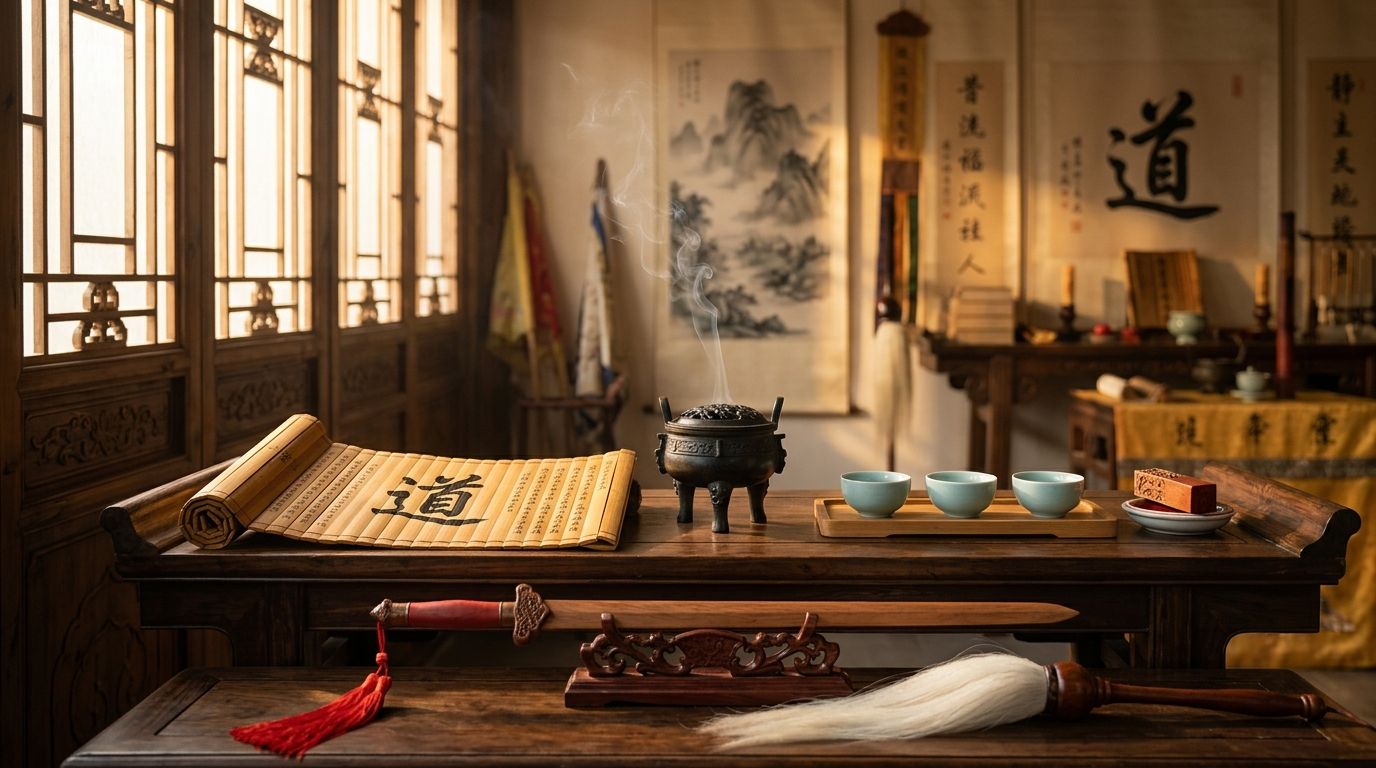
- 5. Grounding the Tao in Form: Sacred Implements (Fawu 法物) and Material Connoisseurship
- The Canonical Rite of Kai Guang (开光, Opening the Light)
- 6. Step-by-Step Guide: Attuning Daily Life to the Tao (Five-Step Protocol)
- Step 1: Spatial Sanctuary Orientation & Taboos (Anwei Dingxiang 安位定向)
- Step 2: Dawn Purification of Body & Speech (Jingshen Jingshou 净身净手)
- Step 3: Offering the Three Pure Waters & Sandalwood Incense (Sanxiang Sanquan 三香三泉)
- Step 4: Sealing Microcosmic Qi with the Ziwu Hand Mudra (Ziwu Jue 子午诀)
- Step 5: Lower Dantian Breathwork & Scripture Contemplation (Dantian Jingzuo 丹田静坐)
- 7. Frequently Asked Questions (FAQ)
- Q1: What is the most accurate Tao definition in classical Chinese philosophy and religion?
- Q2: How does the Tao differ from Western concepts of God or the Divine?
- Q3: What is the practical relationship between Wu Wei and the Tao definition?
- Q4: Why do practitioners of the Tao use consecrated physical objects like wood seals and swords if the Tao is formless?
Tao Definition: Cosmic Origin, Metaphysical Principles, Sacred Implements, and Daily Attunement
Key Takeaways (Executive Summary) - Precise Tao Definition: The Tao definition designates the primordial, unnamable, and self-generating source of all cosmic existence in classical Chinese metaphysics and religion, representing both the ultimate formless void (Wuji 无极) and the living, dynamic rhythm (Taiji 太极) through which the universe spontaneously unfolds. - Etymology & Character Symbolism: The Chinese ideogram Dao (道) combines the radical chuo (辶, dynamic motion or the spiritual path) with shou (首, the head, supreme source, or conscious awakening), revealing the Way as both the eternal origin and the continuous journey of walking in harmony with nature. - Core Operational Metaphysics: The Tao operates through Wu Wei (无为, effortless action without contrivance), Ziran (自然, self-so spontaneity), the perpetual pulsation of Yin-Yang (阴阳), and the nurturing matrix of the Mysterious Female (Xuanpin 玄牝). - Microcosmic Realization (Tian Ren He Yi 天人合一): Humanity is an active microcosm of the cosmos (Xiaotiande 小天地); practitioners refine the Three Treasures (Sanbao 三宝: Jing 精, Qi 炁, Shen 神) through Internal Alchemy (Neidan 内丹) to return to primordial stillness. - Anchoring the Tao in Sacred Form (Fawu 法物): The formless Tao is tangibly grounded and focused through consecrated sacred implements—including lightning-struck jujube wood seals (Leiji Zaomu), seasoned peachwood swords (Taomu Jian), and cinnabar talismans (Fu Lu)—consecrated through the orthodox liturgical rite of Kai Guang (开光, Opening the Light). - Daily Attunement Protocol: Modern seekers align with the Tao through the dawn Mao Hour (5:00 AM – 7:00 AM) offering of the Three Pure Waters, natural aged sandalwood incense, the Ziwu Hand Mudra (子午诀), and diaphragmatic Lower Dantian (下丹田) breathwork.
1. What Is the Tao? Etymology, Primordial Cosmology, and the Ineffable Source
To arrive at an authentic Tao definition, one must first confront the opening paradox of the Daodejing (道德经), codified in the 6th century BCE by the venerable sage Laozi (老子):
"The Tao that can be spoken is not the eternal Tao; The name that can be named is not the eternal name." — (道可道,非常道;名可名,非常名。)
Unlike the transcendent, anthropomorphic deity of Western monotheism who creates the cosmos ex nihilo through external decree, the Tao definition denotes an immanent, organic, self-generating principle. The Tao is not a being, but the ground of all being; not an object within reality, but the mysterious fabric of reality itself.
The Anatomy of the Character: Dao (道)
The ancient ideogram Dao (道) offers profound metaphysical insight into the authentic Tao definition:
- The Radical Chuo (辶 / 辵): Depicts a human foot in rhythmic motion upon an open path. It denotes experiential practice, movement, continuity, and the living pilgrimage of existence.
- The Component Shou (首): Depicts a human head crowned with hair or eyes directed forward. It signifies the primary source, conscious leadership, supreme wisdom, and the primordial origin of perception.
Joined together, Dao (道) reveals that the Way is both the ultimate transcendent source from which all manifestation flows and the practical road upon which mortals consciously walk. To understand the Tao definition is not an abstract intellectual thesis; it is a somatic, ethical, and spiritual discipline of walking in step with the pulse of nature.
The Mother of All Things and the Mysterious Female (Xuanpin 玄牝)
In Chapter 25 of the Daodejing, Laozi describes this boundless mystery:
"There is a thing nebulously formed, born before Heaven and Earth. Silent and void, standing alone and unchanging, revolving everywhere without exhaustion. It may be regarded as the Mother of the world. I do not know its name; I style it 'Tao'."
Rather than a patriarchal monarch, the Tao is celebrated as the cosmic womb—the Mysterious Female (Xuanpin 玄牝) described in Chapter 6:
"The valley spirit never dies; it is called the Mysterious Female. The gateway of the Mysterious Female is called the root of Heaven and Earth. Continuous, like a thread of silk, it seems to exist; use it without strain."
The Tao accomplishes all things without claiming ownership, nurtures all living entities without subjugating them, and recedes into tranquil mystery so that creation may flourish spontaneously.
2. Core Metaphysical Mechanisms: How the Tao Operates in Creation
To grasp how the Tao definition translates from cosmic ontology into experiential reality, Daoist master lineages identify four primary operational dynamics:
1. Wu Wei (无为, Effortless Non-Contrivance)
Perhaps the most misunderstood concept in Eastern philosophy, Wu Wei does not mean passive inertia, lazy apathy, or total inaction. Rather, it signifies action unclouded by egoic tension, manipulative contrivance, or artificial force. It is the effortless mastery of the skilled archer, the spontaneous grace of water carving a mountain canyon, or the natural rhythm of a tree shedding autumn leaves without existential anxiety. When a person aligns with the Tao, their actions flow from intrinsic necessity (De 德) rather than calculating vanity.
2. Ziran (自然, Spontaneous Self-So-Ness)
In classical Chinese, Ziran literally translates to "self-thus" or "spontaneously so." In Chapter 25, the Daodejing establishes the cosmic hierarchy:
"Humanity models itself upon Earth; Earth models itself upon Heaven; Heaven models itself upon the Tao; and the Tao models itself upon Ziran." — (人法地,地法天,天法道,道法自然。)
The Tao has no external master or moral code to obey; its highest nature is effortless spontaneity. True Daoist spiritual development is therefore a process of unlearning social artificiality, peeling away rigid conditioning, and returning to the uncarved block of pristine simplicity (Pu 朴).
3. Yin-Yang (阴阳) Dynamic Equilibrium
The Tao does not manifest as a static monolith; it pulsates in an eternal dance of complementary opposites:
- Yin (阴): Receptive, shadowy, interior, cool, nourishing, and yielding.
- Yang (阳): Radiant, expansive, exterior, warm, animating, and firm.
In the Tao definition, health, longevity, and spiritual illumination depend upon sustaining harmony between these two cosmic polarities. Extremes of either polarity naturally trigger an inversion into its opposite: intense midday Yang gives birth to evening Yin; the bitter cold of winter nurtures the budding warmth of spring.
4. Shang Shan Ruo Shui (上善若水, The Supreme Virtue of Water)
Water is the consummate material embodiment of the Tao. Chapter 8 of the Daodejing notes:
"The highest good is like water. Water benefits all things without competing, settling in low places that people disdain. Therefore, it is close to the Tao." — (上善若水。水善利万物而不争,处众人之所恶,故几于道。)
Water yields to every obstacle yet cuts through granite over time. It nourishes all vegetation without demanding tribute. By adopting the humble, yielding character of water, the Daoist adept masters the secret strength of the universe.
3. Comparative Taxonomy: Four Dimensions of the Tao Definition
To clarify the multi-layered spectrum of the Tao definition and dispel frequent modern misconceptions, the following analytical matrix contrasts classical philosophy, liturgical rituals, monastic alchemy, and popular secular myths:
- Primary Focus — Classical Philosophy (Daojia 道家): Metaphysical origin, cosmic ontology, and ethical liberation. · Liturgical Religion (Daojiao 道教): Liturgical sacraments, celestial covenants, and community blessings. · Internal Alchemy (Neidan 内丹): Somatic bio-energetics, consciousness refinement, and immortality. · Popular Western Misconceptions: Vague New Age positivity, lifestyle aesthetic, or passive fatalism.
- The Concept of the Tao — Classical Philosophy (Daojia 道家): The unnamable, primordial principle animating Heaven and Earth. · Liturgical Religion (Daojiao 道教): The divine order embodied in the Three Pure Ones (Sanqing) and celestial masters. · Internal Alchemy (Neidan 内丹): The primordial Golden Elixir (Jindan) cultivated within the human body. · Popular Western Misconceptions: Equated simply with "going with the flow" or doing whatever feels easy.
- Foundational Texts — Classical Philosophy (Daojia 道家): Daodejing (Laozi), Zhuangzi, Liezi. · Liturgical Religion (Daojiao 道教): Daozang (5,485 scrolls), liturgical registers, Qingjing Jing. · Internal Alchemy (Neidan 内丹): Cantong Qi (Wei Boyang), Wuzhen Pian (Zhang Boduan). · Popular Western Misconceptions: Mistakenly blended with Buddhist Zen, Confucius, or fortune cookies.
- Sacred Material Implements — Classical Philosophy (Daojia 道家): Ink stone, coarse bamboo scrolls, unadorned tea bowls, simple zithers. · Liturgical Religion (Daojiao 道教): Lightning-struck jujube seals, peachwood swords, cinnabar Fu talismans. · Internal Alchemy (Neidan 内丹): Incense censer, meditation cushion, pure water coupe, prayer beads. · Popular Western Misconceptions: Plastic trinkets, cheap lucky cats, commercial brass coins on red string.
- Consecration & Rites — Classical Philosophy (Daojia 道家): Contemplative reading, spontaneous nature walking, quiet reflection. · Liturgical Religion (Daojiao 道教): Canonical Kai Guang (开光) rites, purification incantations, Jiao offerings. · Internal Alchemy (Neidan 内丹): Internal circulation of Microcosmic Orbit (Xiao Zhoutian), Dantian breathing. · Popular Western Misconceptions: Presumed to require no training, ordination, or sacred spatial respect.
- Ultimate Attainment — Classical Philosophy (Daojia 道家): Spontaneous equanimity, freedom from societal rigidities (Pu). · Liturgical Religion (Daojiao 道教): Communal harmony, ancestral protection, divine warding. · Internal Alchemy (Neidan 内丹): Transmutation of mortal body into luminous transcendent spirit (Xian). · Popular Western Misconceptions: Gaining psychic powers, levitation, or escapist detachment from duty.
4. Microcosmic Embodiment: Internal Alchemy (Neidan) and the Microcosmic Body
A vital dimension of the orthodox Tao definition is the doctrine of Tian Ren He Yi (天人合一)—the absolute indivisibility of humanity and the cosmos. In Daoist somatic medicine and meditation, the human body is venerated as a living miniature universe (Xiaotiande 小天地). The macrocosmic Tao outside is mirrored identically within the internal landscape of the human organism:
The Three Dantians (Elixir Fields)
Within the human vessel, the dynamic currents of the Tao coalesce at three primary energetic reservoirs:
- Lower Dantian (下丹田, Ocean of Qi - Qihai 气海): Situated roughly two to three inches below the navel within the abdominal core. This is the physiological root of generative essence (Jing 精) and vitality.
- Middle Dantian (中丹田, Crimson Palace - Jiangong 绛宫): Located at the center of the chest at the sternum level. Associated with the heart organ, emotional equilibrium, compassion, and the breath of life (Qi 炁).
- Upper Dantian (上丹田, Mud-Pill Palace - Niwan Gong 泥丸宫): Located in the center of the brain behind the brow point. The luminous chamber where individual awareness merges into cosmic spirit (Shen 神).
Fasting of the Heart (Xinzhai 心斋) and Sitting in Oblivion (Zuowang 坐忘)
In the teachings of Master Zhuangzi (庄子), attuning the human mind to the Tao requires two profound meditative technologies:
- Xinzhai (心斋, Fasting of the Heart): Calming the chatter of sensory desire and intellectual cleverness until the mind becomes as clear and empty as an unfilled vessel. In this receptive void, the Tao quietly enters and fills the space.
- Zuowang (坐忘, Sitting in Oblivion): Letting go of bodily tension, social ego, labels, and personal grudges. Sitting quietly without conceptual attachment, the practitioner forgets the self and awakens to the unbroken unity of the Tao.
5. Grounding the Tao in Form: Sacred Implements (Fawu 法物) and Material Connoisseurship
A common Western inquiry asks: If the Tao is formless and nameless, why does Daoist tradition place such profound reverence upon sacred material implements (Fawu 法物)?
The liturgical doctrine of Qi-Xiang (器象, Implements as Cosmic Emblems) explains this relationship. While the Tao is infinite and formless, mortal human consciousness operates within space and time. Sacred implements serve as focal lenses—tangible energetic conduits that anchor benevolent celestial frequencies, harmonize turbulent environmental Qi, and dissolve stagnant Yin energies.
However, authentic Daoist practice demands rigorous material connoisseurship. A genuine consecrated implement possesses innate electromagnetic and vibrational properties, whereas mass-manufactured souvenir replicas provide zero energetic resonance:
The Canonical Rite of Kai Guang (开光, Opening the Light)
For an implement or deity statue to serve as a genuine conduit of the Tao, it must undergo the canonical ordination rite of Kai Guang (开光) administered by an ordained priest (Daoshi 道士):
- Jing Tan (净坛, Sanctifying the Space): Sprinkling mountain spring water using fresh peach twigs while chanting the Canonical Purification Incantations to clear ambient disharmony.
- Qing Shen (请神, Invoking the Celestial Sovereigns): Chanting the Golden Light Incantation (Jinguang Zhou 金光咒) and burning sacred talismans to summon benevolent cosmic guardians.
- Zhu Qi (注炁, Infusing Conscious Qi): The officiating master circulates breath from the Lower Dantian to the fingertips, directing focused celestial Yang Qi into the artifact via the sacred Sword Finger Mudra (Jianjue 剑诀).
- Dian Yan (点眼, Consecrating the Sensory Gateways): Using a wild boar bristle brush dipped in natural cinnabar ink, the master dots the eyes, ears, nose, mouth, heart, and base of the implement, awakening its spiritual resonance.
- Zhuang Zang (装脏, Sealing Internal Treasures): For sacred statues, sacred relics are sealed into the hollow dorsal chamber: five-color silk cords (representing the Five Elements), medicinal herbs, five grains, precious natural minerals, and hand-inscribed protective scriptures.
Through authentic Kai Guang, a simple wooden or metallic object ceases to be inert matter; it becomes an active focal beacon of the Tao.
6. Step-by-Step Guide: Attuning Daily Life to the Tao (Five-Step Protocol)
Walking in harmony with the Tao definition does not require abandoning family life or withdrawing into remote mountain caves. Sincere daily cultivation can be integrated into modern living through the following canonical five-step morning protocol:
Step 1: Spatial Sanctuary Orientation & Taboos (Anwei Dingxiang 安位定向)
The spatial setting where you commune with the Tao dictates the clarity of your practice:
- Solid Wall Support (Kaoshan 靠山): Position your meditation desk or sacred altar against a solid, load-bearing interior wall. Avoid placing it beneath suspended structural beams or against hollow glass partitions.
- Waist-High Elevation: The sacred table must stand at least 38 to 42 inches above the floor, fostering an attitude of natural reverence. Never place consecrated items directly on the floor.
- Directional Facing: Orient the altar facing either the primary room doorway or eastward toward the morning sun, greeting the auspicious purple dawn energy (Ziqi Donglai 紫气东来).
- Spatial Taboos: Never position an altar inside a bedroom, on a dining table where meat or alcohol is consumed, or against a shared wall with a bathroom, laundry room, or cooking stove.
Step 2: Dawn Purification of Body & Speech (Jingshen Jingshou 净身净手)
Perform your daily devotion during the Mao Hour (卯时, 5:00 AM – 7:00 AM), when the universe's dawn Yang Qi begins its daily ascent:
- Wash your face and hands thoroughly with cool, fresh water.
- Rinse your mouth cleanly to purify daily speech before greeting the sacred realm.
- Silence mobile phones and computer monitors; take three mindful, deep breaths to shed worldly anxieties.
Step 3: Offering the Three Pure Waters & Sandalwood Incense (Sanxiang Sanquan 三香三泉)
Place three porcelain or celadon offering cups in a straight line across the front of the altar:
- Fill each cup with fresh, pure mountain spring water or filtered water:
- Center Cup: Dedicated to the Dao (道宝) and Yuanshi Tianzun.
- Left Cup (Observer's Left): Dedicated to the Scriptures (经宝) and Lingbao Tianzun.
- Right Cup (Observer's Right): Dedicated to the Lineage Masters (师宝) and Daode Tianzun (Laozi).
Ignite three sticks of natural aged sandalwood or Jiangzhen incense:
- Extinguish any open flame with a swift, gentle wave of the hand. Never blow upon ritual incense with your breath, as human breath is considered mundane and turbid.
- Raise the incense sticks to eye level with both hands, bow reverently, and insert them into your bronze censer:
- Insert the center stick first, silently affirming: "I return to the primordial Dao."
- Insert the left stick second, affirming: "I return to the sacred Scriptures."
- Insert the right stick third, affirming: "I return to the Lineage Masters."
Step 4: Sealing Microcosmic Qi with the Ziwu Hand Mudra (Ziwu Jue 子午诀)
Stand or sit with an upright, relaxed spine. Bring your hands together at the solar plexus to form the ancient Ziwu Mudra (子午诀):
- Enclose the right thumb inside the curled four fingers of the left hand.
- Place the tip of the left thumb against the base of the left ring finger (the Zi 子 position, embodying midnight, Water, and receptive Yin).
- Press the tip of the right thumb against the tip of the right middle finger (the Wu 午 position, embodying midday, Fire, and radiant Yang).
- This mudra unites the Conception Vessel (Ren Mai 任脉) and Governing Vessel (Du Mai 督脉), locking the body's internal life-force within and shielding against external energetic dissipation.
Step 5: Lower Dantian Breathwork & Scripture Contemplation (Dantian Jingzuo 丹田静坐)
Conclude with 15 to 20 minutes of seated stillness (Jingzuo 静坐):
- Place the tip of the tongue against the roof of the mouth behind the upper teeth to complete the energetic Magpie Bridge (Queqiao 鹊桥).
- Inhale quietly and deeply through the nostrils, allowing the breath to settle into the Lower Dantian (下丹田) below the navel, feeling the lower abdomen gently expand.
- Exhale slowly through the nostrils, letting go of obsessive desires, regrets, and physical tension.
- Silently contemplate Chapter 16 of the Daodejing:
"Attain utmost emptiness; preserve profound stillness. All things arise together; in their quiet return, I observe their cycle." — (致虚极,守静笃。万物并作,吾以观复。)
- Bow three times toward the altar, step back quietly, and carry the centered equanimity of the Tao into your daily endeavors.
7. Frequently Asked Questions (FAQ)
Q1: What is the most accurate Tao definition in classical Chinese philosophy and religion?
Answer: The most accurate Tao definition recognizes it as the primordial, unnamable, and self-generating source of all cosmic reality. In classical philosophy (Daojia), the Tao represents the ultimate ground of being and the natural order through which all phenomena spontaneously arise and return. In orthodox religious tradition (Daojiao), the Tao is also understood as the living celestial wisdom manifested through the Three Pure Ones (Sanqing 三清), embodied in canonical scriptures (Daozang), and accessible through sacred liturgy, consecrated implements, and internal alchemical meditation (Neidan).
Q2: How does the Tao differ from Western concepts of God or the Divine?
Answer: Unlike traditional Western theological concepts of God as an anthropomorphic supreme king who creates the universe outside of Himself and exercises moral judgment, the Tao is non-anthropomorphic, boundless, and completely immanent. The Tao does not rule by command or demand worship; it operates like a loving, humble mother or natural gravity. It gives birth to all things, sustains them without domination (Wu Wei), and allows each being to fulfill its unique natural destiny (Ziran) without external coercion.
Q3: What is the practical relationship between Wu Wei and the Tao definition?
Answer: Wu Wei (无为) is the behavioral expression of the Tao in mortal human life. It translates literally as "non-action," but functionally means "action in complete harmony with natural law without egoic forcing." To practice Wu Wei is to stop swimming against the cosmic current, shedding rigid over-calculation, pride, and manipulative ambition. Like water finding its natural path around boulders, a person practicing Wu Wei accomplishes great endeavors with effortless elegance, maximum efficiency, and zero internal friction.
Q4: Why do practitioners of the Tao use consecrated physical objects like wood seals and swords if the Tao is formless?
Answer: While the Tao is fundamentally formless, human life is experienced within physical form. In orthodox lineage theology, consecrated sacred objects (Fawu 法物)—such as lightning-struck jujube wood seals (Leiji Zaomu), seasoned peachwood swords (Taomu Jian), and cinnabar talismans (Fu Lu)—function as tangible resonant anchors. When consecrated through the liturgical rite of Kai Guang (开光), these implements serve as physical antennae that concentrate pure celestial Yang Qi, harmonize environmental disturbances, and create a tranquil sanctuary where mortal consciousness can safely commune with the formless Tao.
Authored by the Daoist Cultural Heritage & Sacred Arts Curatorial Guild. All historical chronicles, canonical citations, and ritual methodologies conform to orthodox Daozang liturgical standards.