Daoism Foundations · · 23 min read
The Sacred Taoism Symbol Guide: Metaphysical Origins of the Taiji, Bagua, Celestial Talismans, and Consecrated Artifacts
Explore the profound meaning of each sacred Taoism symbol: from the Yin-Yang Taijitu and Bagua trigrams to consecrated talismans, altar rites, and lineage artifacts.
By Daoismart Editorial
On this page
- The Sacred Taoism Symbol Guide: Metaphysical Origins of the Taiji, Bagua, Celestial Talismans, and Consecrated Artifacts
- 1. The Primordial Visual Language: What Is a Sacred Taoism Symbol?
- The Metaphysical Foundation: Image (Xiang 象), Qi (炁), and Form (Xing 形)
- Beyond Dualism: The Non-Dual Wisdom of the Dao
- 2. The Core Pantheon of Sacred Taoist Symbols: Metaphysical Anatomy and Canonical Meanings
- 1. The Taijitu (太极图): The Supreme Polarity and the Living S-Curve
- 2. The Bagua (八卦): Earlier Heaven (Xiantian) vs. Later Heaven (Houtian)
- 3. Hetu and Luoshu (河图与洛书): The Primordial River Charts of Cosmic Mathematics
- 4. The Five Elements Dynamic Wheel (Wuxing 五行)
- 5. Sacred Celestial Talismans (Fu Lu 符箓): Living Calligraphic Contracts
- 3. Comprehensive Comparative Analysis: Authentic Lineage Taoism Symbols vs. Modern Pop-Culture Distortions
- 4. Connoisseurship of Symbol-Bearing Artifacts: Natural Heritage vs. Industrial Counterfeits
- 1. Lightning-Struck Jujube Wood (Leiji Zaomu 雷击枣木)
- 2. Seasoned Mountain Peach Wood (Taomu 桃木)
- 3. Natural Mineral Cinnabar (Zhusha 朱砂)
- 4. The Liturgical Rite of Kai Guang (开光, Opening the Light)
- 5. Step-by-Step Practical Guide: Consecrating, Orienting, and Meditating with a Taoism Symbol
- Step 1: Selecting and Respectfully Orienting the Symbol (Anwei Dingxiang 安位定向)
- Step 2: Dawn Cleansing and Pure Demeanor (Jing Shen Jing Shou 净身净手)
- Step 3: Offering the Three Waters and Incense Sticks (Sanxiang Sanquan 三香三泉)
- Step 4: Forming the Sacred Ziwu Hand Mudra (Ziwu Jue 子午诀)
- Step 5: Diaphragmatic Dantian Breathing and Taiji Visualization (Jingzuo Taiji 静坐太极)
- 6. Frequently Asked Questions (FAQ)
- Q1: What is the primary and most famous Taoism symbol, and what does it truly mean?
- Q2: What is the crucial difference between the Earlier Heaven and Later Heaven Bagua symbols?
- Q3: Are Taoist symbols mere artistic decorations, or do they require formal consecration?
- Q4: What are the essential traditional taboos when displaying a Bagua or Taoist symbol at home?
The Sacred Taoism Symbol Guide: Metaphysical Origins of the Taiji, Bagua, Celestial Talismans, and Consecrated Artifacts
Key Takeaways (Executive Summary) - Direct Definition: An authentic Taoism symbol is an energetic diagram, cosmological map, and sacred frequency resonator—most prominently the Taijitu (太极图, Supreme Polarity Diagram) and Bagua (八卦, Eight Trigrams)—that bridges the unmanifest Tao (道) with the physical world, cultivating dynamic equilibrium between cosmic Yin and Yang (阴阳). - Cosmological Genesis: Every classical Taoism symbol springs from a meticulous metaphysical sequence preserved in the I Ching (易经) and Daodejing (道德经): from formless primordial void (Wuji 无极) emerges supreme movement (Taiji 太极), dividing into complementary polarities (Liangyi 两仪), elemental matrices (Wuxing 五行), and all manifest life (Wanwu 万物). - Beyond Pop-Culture Superstition: A sacred Taoism symbol is neither a simplistic decorative logo nor a magical superstition. It represents a precise mathematical and vibrational blueprint designed to balance spatial energetic currents (Qi 气) and dissolve discordant environmental disturbances (Sha Qi 煞气). - Sacred Lineage Artifacts: In orthodox Zhengyi (正一) and Quanzhen (全真) traditions, symbols are carved into living natural mediums—such as lightning-struck jujube wood (雷击枣木), mountain peach wood (桃木), and pure mineral cinnabar (朱砂)—and awakened through the canonical rite of Kai Guang (开光, Opening the Light). - Practical Cultivation: True connection with any Taoism symbol requires mindful engagement through respectful domestic altar placement, pure dawn incense offerings, the ancient Ziwu Mudra (子午诀), and internal alchemy (Neidan 内丹) Lower Dantian meditation.
1. The Primordial Visual Language: What Is a Sacred Taoism Symbol?
Across thousands of years of Eastern civilization, few visual glyphs have penetrated global consciousness as deeply as the classical Taoism symbol. From ancient stone steles perched atop Mount Wudang to the personal altars of modern practitioners, these enigmatic circles, broken lines, and calligraphic talismans command immediate contemplation.
Yet, in contemporary Western culture, a Taoism symbol is frequently misconstrued as a mere decorative graphic, a commercial tattoo design, or a dualistic emblem of "light battling darkness." In the orthodox Daoist tradition (Daojiao 道教), nothing could be further from the truth.
The Metaphysical Foundation: Image (Xiang 象), Qi (炁), and Form (Xing 形)
In canonical Taoist ontology, physical reality does not exist in isolation. As recorded in the foundational commentary of the I Ching (易经·系辞):
"Changes have Taiji, which gives birth to the Two Modes; the Two Modes give birth to the Four Images; the Four Images give birth to the Eight Trigrams." — (易有太极,是生两仪,两仪生四象,四象生八卦。)
A sacred Taoism symbol is an energetic diagram (Xiang 象) that acts as a structural bridge between unmanifest primordial breath (Qi 炁) and crystallized matter (Xing 形). When an enlightened master contemplates or traces a Taoism symbol, they are not engaging in conceptual abstraction; they are tuning human consciousness to the exact acoustic and geometric frequencies of cosmic creation.
Beyond Dualism: The Non-Dual Wisdom of the Dao
Unlike Western philosophical frameworks characterized by moral dualism—where good and evil, spirit and matter, light and dark are locked in eternal existential warfare—every authentic Taoism symbol celebrates non-duality (Wu Ji Bi Fan 物极必反 and Yin Yang Xiang Hu 阴阳相互).
In Chapter 28 of the Daodejing (道德经), the supreme sage Laozi (老子) instructs:
"Know the male, but keep to the female; become the ravine of the world. Being the ravine of the world, eternal virtue will not depart, and you return again to the state of the newborn child." — (知其雄,守其雌,为天下溪。为天下溪,常德不离,复归于婴儿。)
Thus, every genuine Taoism symbol teaches us that opposites are not enemies; they are interdependent cosmic partners whose perpetual interplay generates all vitality.
2. The Core Pantheon of Sacred Taoist Symbols: Metaphysical Anatomy and Canonical Meanings
To study the sacred art of Daoism is to enter a magnificent universe of geometric revelation. Below is the authoritative exposition of the primary symbols that define authentic Daoist cosmology, spiritual practice, and ritual craft.
1. The Taijitu (太极图): The Supreme Polarity and the Living S-Curve
The Taijitu (太极图) is the supreme Taoism symbol recognized worldwide. Commonly termed the "Yin-Yang symbol," its classical design incorporates intricate metaphysical codes that many casual observers overlook:
- The Flowing S-Curve (The Dynamic Median): The dividing line between the light (Yang) and dark (Yin) halves is never a rigid, sharp vertical split. Instead, it forms a graceful sinusoidal S-curve. This curve illustrates that cosmic transformation occurs smoothly and continuously. As Yang reaches its absolute maximum, it gently curves inward to yield to Yin; as Yin reaches its deepest cold, it naturally gives birth to warmth.
- The Fish Eyes (The Inherent Seed of the Other): Within the belly of the white Yang section rests a black circle; within the belly of the dark Yin section rests a white circle. This vital visual code proves that absolute purity of one polarity cannot exist alone. At the heart of summer solstice (peak Yang), the first breath of winter chill is conceived; at the depth of winter midnight (peak Yin), the primordial spark of solar dawn awakens.
- Lineage Heritage: While the concept of Taiji dates to primordial antiquity, the formalized geometric diagram was preserved and transmitted during the Song Dynasty by the immortal hermit Chen Tuan (陈抟老祖) of Mount Hua and elucidated by master Zhou Dunyi (周敦颐) in his monumental work Taijitu Shuo (太极图说).
2. The Bagua (八卦): Earlier Heaven (Xiantian) vs. Later Heaven (Houtian)
Surrounding or complementing the Taiji, the Bagua (八卦) constitutes eight fundamental trigrams, each composed of three stacked lines: either solid unbroken Yang lines (—) representing active celestial energy, or broken Yin lines (-- --) representing receptive terrestrial energy.
In orthodox lineage tradition, practitioners strictly differentiate between two distinct arrangements of this vital Taoism symbol:
Earlier Heaven Bagua (Xiantian Bagua 先天八卦):
Attributed to the primordial sage Fuxi (伏羲), this Taoism symbol represents the universe in its pristine, uncorrupted, transcendental state of energetic balance before time began. Opposite trigrams perfectly cancel and complement each other: Heaven (Qian 乾) sits at the absolute South, facing Earth (Kun 坤) at the North; Fire (Li 离) sits at the East, balancing Water (Kan 坎) at the West. This arrangement is utilized on consecrated lineage seals (Fayin 法印) and protective boundary talismans because its pure symmetrical geometry creates an unshakeable energetic vortex that dissolves disordered environmental turbulence.
Later Heaven Bagua (Houtian Bagua 后天八卦):
Formulated by King Wen of Zhou (周文王), this arrangement describes how energy actually circulates within manifest space and physical time. Here, Fire (Li 离) rises to the South, Water (Kan 坎) sinks to the North, Thunder (Zhen 震) awakens in the East (representing Spring dawn), and Lake (Dui 兑) ripens in the West (representing Autumn dusk). This arrangement forms the core foundation of traditional architectural harmony, domestic room orientation, and seasonal health cultivation (Yangsheng 养生).
3. Hetu and Luoshu (河图与洛书): The Primordial River Charts of Cosmic Mathematics
Deep within esoteric Daoist cosmology lie two numerical diagrams that predate written calligraphy: the Hetu (河图, Yellow River Chart) and the Luoshu (洛书, Luo River Scroll).
- The Hetu: Legend records that during the reign of Fuxi, a mythical Dragon-Horse (Longma 龙马) emerged from the rushing waters of the Yellow River, bearing mysterious constellations of dark and light circular dots upon its flank. The Hetu reveals the generative pairings of numbers that govern the Five Elements: 1 and 6 generate Water; 2 and 7 generate Fire; 3 and 8 generate Wood; 4 and 9 generate Metal; 5 and 10 generate Earth.
- The Luoshu: Centuries later, during the Great Flood, a divine Sacred Turtle (Shenggui 神龟) emerged before the Great Yu from the Luo River. The markings on its shell revealed the ancient 3x3 Magic Square (Nine Palaces Jiugong 九宫), where every row, column, and diagonal sums precisely to 15. This mathematical Taoism symbol is revered as the celestial blueprint of spatiotemporal dynamics, governing sacred step rituals like the Pace of Yu (Yubu 禹步) performed during temple ceremonies.
4. The Five Elements Dynamic Wheel (Wuxing 五行)
The five cosmic phases—Wood (Mu 木), Fire (Huo 火), Earth (Tu 土), Metal (Jin 金), and Water (Shui 水)—are never static chemical elements in Chinese thought; they are dynamic vectors of transforming Qi.
- The Generating Cycle (Xiangsheng 相生): Wood fuels Fire $
ightarrow$ Fire ashes nourish Earth $
ightarrow$ Earth compresses into Metal $
ightarrow$ Metal condenses Water $
ightarrow$ Water nourishes Wood. - The Controlling Cycle (Xiangke 相克): Wood parts Earth $
ightarrow$ Earth dams Water $
ightarrow$ Water douses Fire $
ightarrow$ Fire melts Metal $
ightarrow$ Metal chops Wood.
Every authentic Taoism symbol bearing five-element geometry serves to re-align unbalanced bodily organs (Liver/Wood, Heart/Fire, Spleen/Earth, Lung/Metal, Kidney/Water) and bring domestic sanctuary spaces into natural harmony.
5. Sacred Celestial Talismans (Fu Lu 符箓): Living Calligraphic Contracts
Among the most sacred and visually arresting forms of Taoism symbol is the Fu (符), often referred to in the West as a Daoist talisman. In the canonical tradition of the Zhengyi (正一) lineage, a Fu is not a superstitious scribble; it is a sacred energetic decree composed in Cloud Script (Yunzuan 云篆)—the primordial script said to have coalesced out of cosmic breath before physical worlds took shape.
An authentic Daoist talisman contains five distinct anatomical components:
When drawn on handmade yellow mulberry paper or golden raw silk using pure mineral cinnabar (Zhusha 朱砂), an authentic talisman acts as a portable acoustic transceiver of heavenly harmony.
3. Comprehensive Comparative Analysis: Authentic Lineage Taoism Symbols vs. Modern Pop-Culture Distortions
Across decades of commercial globalization, numerous sacred Daoist emblems have suffered reductionism and distortion. The comparative matrix below presents an authoritative distinction between orthodox lineage doctrine and popular Western misconceptions:
- The Taijitu (太极图, Supreme Polarity) — Metaphysical Meaning & Canonical Lineage Origin: Non-dual cosmic womb; perpetual harmonic flow of Yin and Yang; unity preceding and embracing duality (Daodejing Ch. 42). · Common Western Pop-Culture Distortion: Reduced to a pop-art yin-yang tattoo or a binary battle of "good vs. evil" / "moral light vs. moral dark." · Authentic Consecration (Kai Guang) & Altar Protocol: Inscribed upon sacred bronze censers, altar cloths, and meditation mats to center the mind in unswerving stillness.
- Earlier Heaven Bagua (先天八卦, Fuxi Arrangement) — Metaphysical Meaning & Canonical Lineage Origin: Primordial cosmic symmetry; pure static balance of Heaven (Qian) and Earth (Kun) before temporal manifestation. · Common Western Pop-Culture Distortion: Frequently confused with the Later Heaven Bagua; hung haphazardly indoors as general "lucky Feng Shui decor." · Authentic Consecration (Kai Guang) & Altar Protocol: Must strictly be oriented outward on exterior gates/doors or carved onto Lightning-Struck Jujube Wood Seals (雷击枣木印). Never pointed at sleeping spaces.
- Later Heaven Bagua (后天八卦, King Wen Arrangement) — Metaphysical Meaning & Canonical Lineage Origin: Manifest spatiotemporal flow; maps solar seasons, directional elements, and bodily organs (I Ching Book of Changes). · Common Western Pop-Culture Distortion: Mistaken for a magical hex or curse shield; used erroneously in external spirit-dispelling rites. · Authentic Consecration (Kai Guang) & Altar Protocol: Utilized for calculating room alignments, personal compass directions (Luopan 罗盘), and seasonal seasonal altar arrangements.
- Sacred Talismans (Fu Lu 符箓) — Metaphysical Meaning & Canonical Lineage Origin: Celestial legal contracts written in Cloud Script (Yunzuan); vibrational conduits transmitting Heavenly decree. · Common Western Pop-Culture Distortion: Believed to be superstitious "instant magic wish papers" or sold as cheap mass-printed inkjet souvenirs. · Authentic Consecration (Kai Guang) & Altar Protocol: Hand-drawn by fasting Daoshi using virgin wolf-hair brushes and natural mineral cinnabar (朱砂); activated through breath transmutation (Zhu Qi 注炁).
- Peach Wood Ritual Sword (Taomu Jian 桃木剑) — Metaphysical Meaning & Canonical Lineage Origin: Solar Yang implement resonant with Spring dawn; cuts through stagnant Qi and dissolves demonic mental afflictions without physical violence. · Common Western Pop-Culture Distortion: Misconstrued as a lethal martial combat weapon or decorative wall prop meant to "threaten spirits." · Authentic Consecration (Kai Guang) & Altar Protocol: Hand-carved from 3-year seasoned mountain peach heartwood; blessed through altar incense smoke; displayed on a dedicated horizontal stand facing north or east.
- Lightning-Struck Jujube Seal (Leiji Zaomu Fayin 雷击枣木法印) — Metaphysical Meaning & Canonical Lineage Origin: The supreme administrative seal of Daoist liturgy; carries the primordial celestial fire (Tianhuo 天火) of thunderbolts to command energy currents. · Common Western Pop-Culture Distortion: Counterfeited as industrially electrocuted timber or burnt scrap pine stamped with generic commercial characters. · Authentic Consecration (Kai Guang) & Altar Protocol: Enshrined on the domestic altar wrapped in imperial yellow or red silk. Awakened through canonical aperture dotting (Dian Yan 点眼).
4. Connoisseurship of Symbol-Bearing Artifacts: Natural Heritage vs. Industrial Counterfeits
In orthodox Daoism, physical substance is not dead matter; it is the physical condensation of primordial breath (Qi Ju Wei Xing 气聚为形). Therefore, an authentic Taoism symbol must be carved or inscribed upon natural materials that possess inherent energetic purity.
For modern collectors, scholars, and spiritual seekers, distinguishing genuine heritage materials from toxic mass-market imitations is essential to maintaining spiritual integrity.
1. Lightning-Struck Jujube Wood (Leiji Zaomu 雷击枣木)
Known within the Daozang (道藏) as the "Supreme Commander of Woods," this sacred medium is created when a living wild mountain jujube tree is naturally struck by celestial lightning.
- Visual & Olfactory Hallmarks: Genuine pieces exhibit a deep, uneven reddish-black grain with natural fractal lightning fissures. When rubbed gently between warm palms, it emits a subtle, roasted caramel and aged woody fragrance. It has remarkable density and will sink or float low in water.
- The Fake Counterfeit: Commercial merchants often subject ordinary low-grade lumber to industrial high-voltage electrical coils or scorch timber with blowtorches. These fakes reek of bitter petroleum charcoal and lack the delicate caramelized fragrance and structural density of genuine mountain wood struck by Heaven's fire (Tianhuo 天火).
2. Seasoned Mountain Peach Wood (Taomu 桃木)
Since the Zhou Dynasty, peach wood has been venerated as the premier botanical essence of pure Solar Yang (Chunyang zhi Mu 纯阳之木).
- Authentic Standards: Harvested from high-altitude wild mountain peach trees and seasoned naturally in shaded mountain air for over three years. Genuine aged peach wood exhibits a warm, silky tan-reddish tone, fine interlocking wood grain, and remarkable tensile strength.
- The Fake Counterfeit: Modern online marketplaces flood consumers with molded hollow polyresin stained to mimic wood grain, or soft industrial pine chemically bleached with sulfur. Such synthetic products disrupt domestic energetic harmony and release volatile organic compounds when exposed to altar heat.
3. Natural Mineral Cinnabar (Zhusha 朱砂)
For over three millennia, Daoist masters have used mineral cinnabar (natural mercuric sulfide, HgS) to inscribe talismans, consecrate statues, and carve protective beads.
- Authentic Standards: Mined from deep crystalline geological veins in Hunan and Guizhou, genuine mineral cinnabar possesses extraordinary specific gravity (feeling strikingly cold, heavy, and metallic in the palm) with an unmistakable deep crimson luster and sub-metallic crystal cleavage.
- The Fake Counterfeit: Unscrupulous vendors mix cheap red plastic polymers with industrial red dyes and lead weights. These fake substitutes look excessively glossy, feel light or plasticky, and emit pungent chemical fumes when heated.
4. The Liturgical Rite of Kai Guang (开光, Opening the Light)
A Taoism symbol carved on wood or cast in bronze remains an inert physical vessel until awakened through the sacred lineage liturgy of Kai Guang (开光). Administered strictly by an ordained Taoist priest (Daoshi 道士) who maintains ritual fasting (Zhaijie 斋戒), this ceremony includes five distinct stages:
Through this esoteric procedure, the Taoism symbol ceases to be an artistic representation and becomes an active spiritual transceiver linked directly to the celestial registers.
5. Step-by-Step Practical Guide: Consecrating, Orienting, and Meditating with a Taoism Symbol
How can an earnest seeker honor and cultivate resonance with a sacred Taoism symbol in modern daily life? Follow this authoritative five-step protocol designed for household sanctuary spaces (Tan 坛):
Step 1: Selecting and Respectfully Orienting the Symbol (Anwei Dingxiang 安位定向)
The spatial location of your Taoism symbol dictates its energetic interaction with your home:
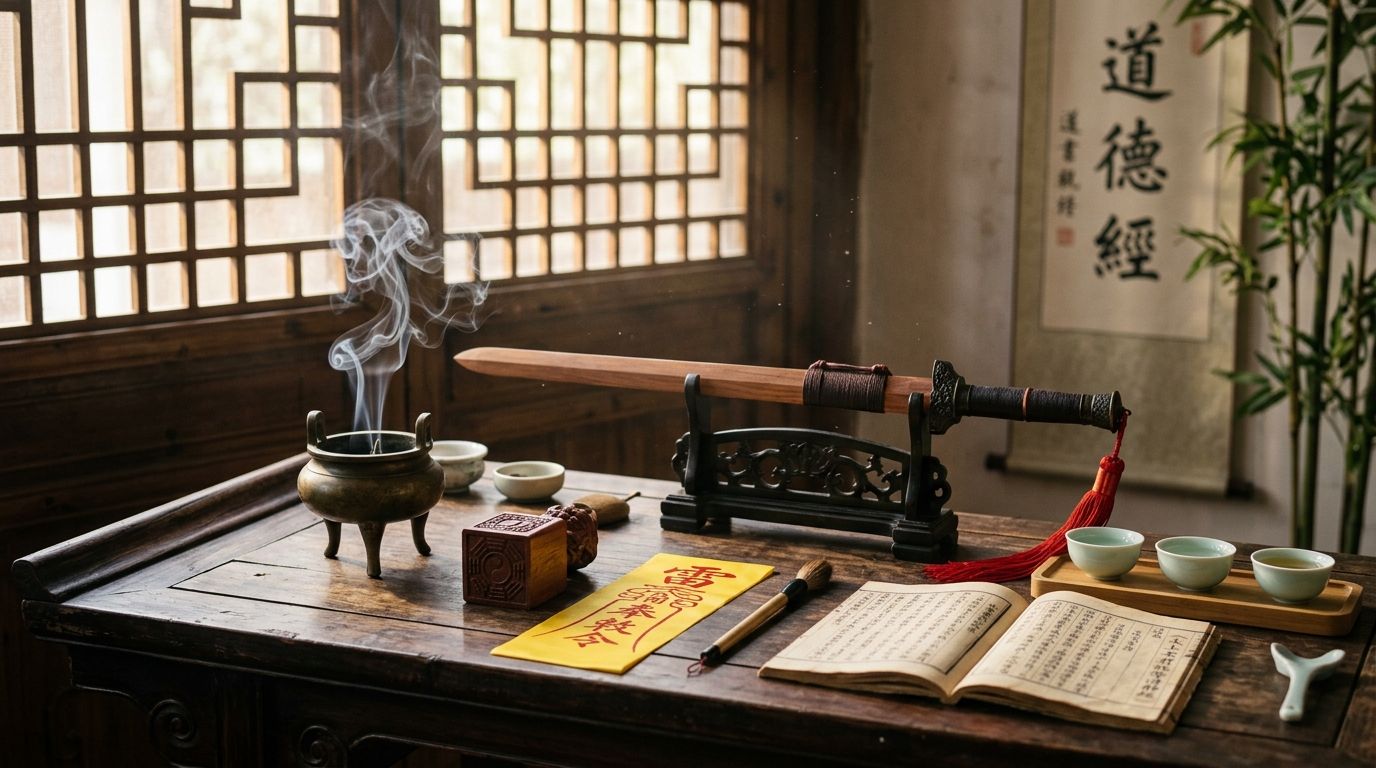
- Altar Space: Place your consecrated symbol implement (such as a peach wood sword, a Taiji Bagua seal, or a framed talisman) upon a dedicated, elevated wooden table. Ensure it sits at least waist-high, against a solid supporting wall, facing toward the room's main entrance or eastward toward the morning sunrise.
- Crucial Taboos: Never place a Taoism symbol or consecrated artifact inside a sleeping bedroom, on a dining table where meat and alcohol are consumed, or along a shared bathroom wall. Never point a reflective Bagua mirror inward toward your living room or toward a neighbor's residence; reflective Bagua mirrors belong strictly outdoors, directed at oppressive external structures (such as sharp roof ridges or power poles).
Step 2: Dawn Cleansing and Pure Demeanor (Jing Shen Jing Shou 净身净手)
Perform your daily alignment during the Mao Hour (卯时, 5:00 AM – 7:00 AM), when the day's first Yang Qi begins its natural ascent:
- Wash your hands and face thoroughly with cool, fresh water; rinse your mouth to purify physical speech.
- Approach your sanctuary table with calm mindfulness, setting aside all smartphones, mental preoccupations, and daily anxieties.
- Gently dust the altar surface with a clean, dedicated silk cloth reserved solely for sacred duties.
Step 3: Offering the Three Waters and Incense Sticks (Sanxiang Sanquan 三香三泉)
Prepare three small celadon offering cups filled with fresh spring water or light mountain green tea, arranging them horizontally before your Taoism symbol:
- Center Cup: Dedicated to Yuanshi Tianzun (元始天尊), representing the primordial, unmanifest Tao.
- Left Cup (Observer's Left): Dedicated to Lingbao Tianzun (灵宝天尊), representing the sacred scriptures and cosmic law.
- Right Cup (Observer's Right): Dedicated to Daode Tianzun (道德天尊 / Laozi), representing the living lineage masters.
Next, ignite three slender sticks of authentic aged sandalwood or natural agarwood. Extinguish the flame with a gentle waft of your hand—never blow upon incense with mouth breath:
- Insert the center stick first, honoring the Dao (Dao Xiang 道香).
- Insert the left stick second, honoring the Sacred Teachings (Jing Xiang 经香).
- Insert the right stick third, honoring the Lineage Teachers (Shi Xiang 师香).
Step 4: Forming the Sacred Ziwu Hand Mudra (Ziwu Jue 子午诀)
Stand or sit upright before your altar table with a naturally lengthened spine. Bring both hands together at the solar plexus to form the ancient Ziwu Mudra (子午诀):
- Enfold your left hand fingers gently around your right thumb.
- Rest the tip of your left thumb at the base of your left ring finger (the Zi 子 coordinate, embodying midnight, Water, and pure receptivity).
- Touch the tip of your right thumb to the tip of your right middle finger (the Wu 午 coordinate, embodying midday, Fire, and radiant Yang).
- This sacred mudra connects the body's Ren (Conception) and Du (Governing) energetic vessels, sealing your internal vitality and harmonizing the Fire and Water meridians (Kan-Li Jiao-Gou 坎离交媾).
Step 5: Diaphragmatic Dantian Breathing and Taiji Visualization (Jingzuo Taiji 静坐太极)
Sit comfortably upon a meditation cushion before the altar for 15 to 20 minutes:
- Lightly rest the tip of your tongue against the upper palate of your mouth, bridging the energetic circuit between the crown and torso.
- Direct your inner gaze downward into your Lower Dantian (下丹田), situated approximately two inches below your navel.
- As you inhale smoothly through your nose, feel your lower abdomen gently expand like a soft balloon. As you exhale, feel it gently relax.
- Close your eyes and gently visualize the sacred Taijitu (太极图) slowly rotating within your Lower Dantian—its white Yang light and dark Yin tranquility swirling in frictionless, eternal balance. Allow all chaotic thoughts to dissolve into this serene cosmic vortex, returning your mind to the pristine peace of the Tao.
6. Frequently Asked Questions (FAQ)
Q1: What is the primary and most famous Taoism symbol, and what does it truly mean?
Answer: The most celebrated Taoism symbol is the Taijitu (太极图), widely known across the Western world as the Yin-Yang symbol. Far from representing a dualistic battle between "good" and "evil," this sacred Taoism symbol embodies the dynamic, non-dual harmony of the cosmos. The interlocking dark (Yin) and light (Yang) halves depict polar forces in continuous, flowing equilibrium—such as stillness and movement, shade and sun, water and fire. The two dots ("fish eyes") indicate that within the zenith of Yang lies the seed of Yin, and at the depth of Yin lies the germ of Yang, demonstrating the eternal law of cyclical transformation.
Q2: What is the crucial difference between the Earlier Heaven and Later Heaven Bagua symbols?
Answer: The Earlier Heaven Bagua (Xiantian Bagua 先天八卦, attributed to the legendary sage Fuxi) represents the primordial, timeless balance of cosmic forces before physical manifestation, where Heaven (Qian 乾) rests at the top and Earth (Kun 坤) at the bottom in perfect static symmetry. In contrast, the Later Heaven Bagua (Houtian Bagua 后天八卦, formulated by King Wen) maps the temporal, seasonal, and spatial unfolding of physical life on Earth, placing Fire (Li 离) at the South and Water (Kan 坎) at the North. In traditional practice, Earlier Heaven symbols are carved on protective lineage seals and external mirrors to repel turbulent Sha Qi, whereas Later Heaven symbols govern domestic Feng Shui alignments and energetic room orientation.
Q3: Are Taoist symbols mere artistic decorations, or do they require formal consecration?
Answer: In orthodox Daoist lineages (such as Zhengyi 正一 and Quanzhen 全真), an unconsecrated Taoism symbol or implement remains a physical object without spiritual potency. To transform a symbolic artifact—such as a lightning-struck jujube wood seal, a peach wood sword, or a cinnabar talisman—into a living cosmic acoustic resonator, it must undergo the canonical liturgical rite of Kai Guang (开光, Opening the Light). During this ceremony, an ordained Taoist priest purifies the object, invokes celestial masters, projects internal breath (Qi) cultivated through Neidan, and dots the sacred apertures with natural mineral cinnabar.
Q4: What are the essential traditional taboos when displaying a Bagua or Taoist symbol at home?
Answer: Traditional lineage rules emphasize three core taboos for displaying any Taoism symbol at home. First, never hang a reflective convex or concave Bagua mirror (Bagua Jing 八卦镜) inside living quarters; mirrors belong strictly on exterior walls facing outward to neutralize external architectural Sha Qi, and must never be aimed directly at a neighbor's front door or windows. Second, sacred symbol-bearing artifacts such as consecrated seals (Fayin 法印) or peach wood swords (Taomu Jian 桃木剑) should be enshrined respectfully on an elevated altar, clean bookshelf, or study table, never placed on the floor, beneath hanging laundry, or inside bedrooms. Third, keep consecrated wooden implements away from heavy dampness and direct harsh heat, wrapping them in red silk when transported.
Authored by the Daoist Cultural Heritage & Sacred Arts Curatorial Guild. All rituals, canonical citations, and connoisseurship guidelines conform to orthodox Daozang liturgical standards.