Daoism Foundations · · 32 min read
Philosopher Lao Tzu: Historical Sage of the Tao Te Ching, Living Lineage Wisdom, and Sacred Altar Veneration
Discover philosopher Lao Tzu, author of the Tao Te Ching: cosmic metaphysics, Wu Wei, living lineage rituals, and sacred altar veneration.
By Daoismart Editorial
On this page
- Philosopher Lao Tzu: Historical Sage of the Tao Te Ching, Living Lineage Wisdom, and Sacred Altar Veneration
- 1. The Historical Riddle and Celestial Theophany: Who Was Philosopher Lao Tzu?
- The Archival Scholar of the Royal Zhou Dynasty
- The Historic Encounter: Confucius Inquires About the Rites
- The Western Journey Through the Hangu Pass and the Inscription of the Daodejing
- The Divine Transformation: From Mortal Sage to Taishang Laojun
- 2. Metaphysical Pillars: Deconstructing the Core Philosophy of Lao Tzu
- 1. The Tao (道): The Ineffable Cosmic Ground
- 2. De (德): The Inherent Potency of the Way
- 3. Wu Wei (无为): Effortless Action and Dynamic Non-Coercion
- 4. Ziran (自然): That Which Is of Itself So
- 5. The Supreme Teacher: The Water Philosophy (Shang Shan Ruo Shui 上善若水)
- 3. Comparative Matrix: Philosopher Lao Tzu vs. Western Philosophy & Confucianism
- 4. Somatic Alchemy: From Lao Tzu's Philosophy to Internal Alchemy (Neidan 内丹)
- The Three Alchemical Principles Taught by Lao Tzu
- 5. The Material Sacred: Honoring Philosopher Lao Tzu Through Consecrated Implements (Fawu 法物)
- The Sacred Iconography of Philosopher Lao Tzu
- 6. Connoisseurship Diagnostic Matrix: Authentic Lineage Implements vs. Tourist Curios
- 7. The Five Canonical Stages of Kai Guang (开光) Consecration for Laozi Altar Implements
- 8. Step-by-Step Daily Practice: A 5-Step Morning Contemplation Protocol Honoring Philosopher Lao Tzu
- Step 1: Sanctuary Direction and Altar Alignment (Anwei Dingxiang 安位定向)
- Step 2: Purification of Hands, Mouth, and Intent (San Jing 三净)
- Step 3: Offering Pure Mountain Spring Water and Sandalwood Incense (Sanxiang Yizhan 三香一盏)
- Step 4: Daodejing Intoning and Contemplation (Song Jing Ming Li 诵经明理)
- Step 5: Seated Stillness and Diaphragmatic Breathwork (Jingzuo Shoujing 静坐守静)
- 9. Frequently Asked Questions (FAQ)
- Was philosopher Lao Tzu a real historical figure or a mythological creation?
- What is the fundamental difference between philosopher Lao Tzu's Daoism and Confucianism?
- Why is philosopher Lao Tzu venerated as the deity Taishang Laojun in religious Daoism?
- How can modern people set up a respectful study and meditation altar for philosopher Lao Tzu at home?
Philosopher Lao Tzu: Historical Sage of the Tao Te Ching, Living Lineage Wisdom, and Sacred Altar Veneration
Key Takeaways & Core Principles - The Master Sage of the Way: As the preeminent Eastern philosopher Lao Tzu (老子, historically known as Li Er 李耳 and Master Dan 老聃, c. 6th–5th century BCE), he stands as the fountainhead of philosophical Daoism (Daojia 道家) and the deified cosmic avatar Taishang Laojun (太上老君) in liturgical Daoism (Daojiao 道教). - The Core Text of Cosmic Rhythm: Philosopher Lao Tzu authored the timeless 5,000-character Tao Te Ching (Daodejing 道德经), articulating the primordial, formless cosmic source (Wuji 无极), the rhythmic balance of natural cycles (Taiji 太极), and the living doctrine of non-coercive action (Wu Wei 无为). - Historical Resonance and the Dragon Encounter: Ancient records document that when Confucius (Kongzi 孔子) visited philosopher Lao Tzu to inquire into ancient rites, Confucius emerged spellbound, comparing the master to a celestial dragon soaring freely upon winds and clouds beyond human measurement. - Blueprint for Somatic Alchemy: Moving far beyond passive armchair intellectualism, philosopher Lao Tzu formulated the foundational mechanics of Internal Alchemy (Neidan 内丹), instructing practitioners to "breathe like the bellows of heaven and earth" and return to the pristine vitality of the newborn infant (Fu Gui Yu Ying'er 复归于婴儿). - Sacred Physical Anchors (Fawu 法物): In living temple lineages, philosopher Lao Tzu is honored not merely as an abstract historical figure, but through consecrated physical artifacts—including hand-carved hardwood statues, lightning-struck jujube wood master seals (Leiji Zaomu Yin 雷击枣木印), Big Dipper peachwood swords (Taomu Jian 桃木剑), and pure wild incense—that ground cosmic serenity within the domestic sanctuary.
1. The Historical Riddle and Celestial Theophany: Who Was Philosopher Lao Tzu?
For over twenty-five centuries, global thinkers, mystics, and seekers have turned to philosopher Lao Tzu as the ultimate guide to the mysterious art of living in harmony with nature. Yet behind the poetic enigma of the Tao Te Ching lies a multifaceted legacy: a brilliant historical court archivist, an enigmatic recluse departing westward upon a water buffalo, and an immortal celestial teacher revered across Daoist temples worldwide.
The Archival Scholar of the Royal Zhou Dynasty
Historical records compiled by the imperial court historian Sima Qian (司马迁) in the landmark Shiji (史记, Records of the Grand Historian, c. 1st century BCE) provide the most authoritative historical biography of philosopher Lao Tzu. His personal name was Li Er (李耳), his courtesy name was Boyang (伯阳), and his posthumous respectful title was Dan (聃). He hailed from Quren Village in Ku County, situated within the southern State of Chu (modern-day Luyi County, Henan Province).
As a young scholar of profound intellect, philosopher Lao Tzu was appointed to the prestigious post of Shoushi (守藏室之史)—the official Keeper of the Royal Archives for the Zhou Dynasty court at Luoyang. This royal library was the intellectual epicentre of the ancient Chinese world, housing centuries of royal astrological charts, divination logs from the Shang and early Zhou dynasties, historical chronicles, and ancestral ritual texts.
Immersed for decades within this vast repository of human rise and fall, philosopher Lao Tzu developed his signature insight into the inexorable laws of nature: that human empires, prideful rulers, and rigid structures inevitably exhaust themselves and crumble, whereas that which remains soft, yielding, humble, and attuned to the cosmic Way endures forever.
The Historic Encounter: Confucius Inquires About the Rites
One of the most celebrated moments in Eastern intellectual history occurred when Confucius (Kongzi 孔子), then establishing his school of ethical philosophy, travelled to Luoyang specifically to interview the elder philosopher Lao Tzu regarding the ancient ceremonial rites (Wen Li 问礼).
According to Chapter 63 of the Shiji, philosopher Lao Tzu delivered a piercing, unvarnished teaching to the ambitious younger scholar:
"Those whom you speak of have long since rotted away with their bones; only their words remain. When the noble person finds their time, they rise in office; if not, they drift like tumbleweeds in the wind. I have heard that a wise merchant conceals his treasures so deeply that he appears empty, and a superior noble endowed with profound virtue presents a countenance of foolish simplicity. Rid yourself of your haughty air and many desires, your pompous affectations and wild ambitions. None of these profit your true person. This is all I have to tell you." (子所言者,其人与骨皆已朽矣,独其言在耳。且君子得其时则驾,不得其时则蓬累而行。吾闻之,良贾深藏若虚,君子盛德,容貌若愚。去子之骄气与多欲,态色与淫志,是皆无益于子之身。吾所以告子,若是而已。)
Shaken to the depths of his being, Confucius returned to his disciples in profound reverent silence. When pressed by his students to evaluate the master, Confucius gave his immortal testimony:
"I know that birds can fly, fish can swim, and beasts can run. The runner may be netted, the swimmer hooked, and the flyer shot down with an arrow. But as for the Dragon, I cannot tell how it rides on the wind and clouds to ascend into heaven. Today I have met Lao Tzu; is he not indeed like the Dragon?" (吾今日见老子,其犹龙邪!)
In the eyes of ancient China's greatest moralist, philosopher Lao Tzu was not a pedantic academic, but an untamed, cosmic force—unfathomable, boundless, and soaring beyond the grasp of artificial intellectual categories.
The Western Journey Through the Hangu Pass and the Inscription of the Daodejing
As the Eastern Zhou Dynasty steadily decayed into warfare, political intrigue, and moral degeneration, philosopher Lao Tzu chose the path of the noble recluse (Yinshi 隐士). Relinquishing his archival post, he mounted a humble green-black water buffalo (Qingniu 青牛) and journeyed westward toward the mountainous frontiers.
As the sage approached the Hangu Pass (函谷关)—the strategic gateway connecting the central plains to the western mountains—the fortress magistrate, Yin Xi (关尹子), who was an adept astronomer and seer, observed a radiant celestial phenomenon: an auspicious purple mist rolling gently from the east (Ziqi Donglai 紫气东来, "The Purple Qi Arrives from the East"). Recognizing that a supreme sage was arriving, Yin Xi knelt before philosopher Lao Tzu and made a historic plea:
"Since you are about to retreat into seclusion, I entreat you to compose a book for our transmission before you depart." (子将隐矣,强为我著书。)
Moved by the magistrate's sincerity and recognizing that the future of humanity would require a beacon of cosmic truth during coming ages of turmoil, philosopher Lao Tzu paused his journey. Taking up brush and ink, he inscribed a pristine manuscript of approximately 5,000 Chinese characters, structured into two complementary sections:
- The Book of the Way (Dao Jing 道经, Chapters 1–37): Exploring the metaphysical root of all reality, the void of Wuji, and cosmic creation.
- The Book of Virtue (De Jing 德经, Chapters 38–81): Delineating how human beings, leaders, and cultivators practically embody the cosmic Way in statecraft, personal ethics, and internal vitality.
Having handed the bamboo scroll to Yin Xi, philosopher Lao Tzu passed through the western gate into the mists of the western mountains, leaving behind what would become the most translated, scrutinized, and revered masterpiece of Asian philosophy: the Tao Te Ching (Daodejing 道德经).
The Divine Transformation: From Mortal Sage to Taishang Laojun
While secular academia views philosopher Lao Tzu purely through a historical lens, living Daoist tradition understands that great spiritual beings operate across multiple octaves of reality. During the Eastern Han Dynasty (142 CE), the immortal master Zhang Daoling (张道陵) received a supreme direct revelation upon Mount Heming (鹤鸣山) in Sichuan.
In this celestial theophany, philosopher Lao Tzu revealed himself in his primordial, deified form as Taishang Laojun (太上老君, The Grand Supreme Elderly Lord), also titled Daode Tianzun (道德天尊, The Heavenly Lord of the Way and Virtue)—the third supreme deity of the Three Pure Ones (Sanqing 三清).
Liturgical Daoism recognizes that Taishang Laojun is the living, eternal soul of the cosmic Way itself. Across cyclic kalpas (cosmic epochs), he incarnates into human history under various names—most luminously as the historical philosopher Lao Tzu—to preserve the celestial teachings, bestow sacred talismans (Fu Lu 符箓), transmit alchemical methods, and safeguard the peace of Heaven and Earth.
2. Metaphysical Pillars: Deconstructing the Core Philosophy of Lao Tzu
The philosophical framework of philosopher Lao Tzu is neither an intellectual puzzle nor a dogma demanding blind obedience. It is an experiential map describing the living mechanics of reality. To comprehend the worldview of philosopher Lao Tzu, one must analyze the foundational pillars that anchor the Tao Te Ching.
1. The Tao (道): The Ineffable Cosmic Ground
In the opening verse of the Tao Te Ching, philosopher Lao Tzu establishes the primary boundary of human epistemology:
$\text{“The Tao that can be spoken is not the eternal Tao; The name that can be named is not the eternal name.”}$
$\text{(道可道,非常道;名可名,非常名。)}$
The Tao is not an anthropomorphic creator standing outside the universe, crafting planets like a potter making jars. Instead, philosopher Lao Tzu conceptualizes the Tao as the boundless, formless matrix (Wuji 无极) and self-generating wellspring of all existence. In Chapter 25, the sage describes its cosmic presence:
"There is a thing confusedly formed, born before Heaven and Earth. Silent and void, it stands alone and does not change, goes everywhere and does not tire. It may be regarded as the Mother of all under Heaven. I do not know its name; I style it 'Tao.' Forced to give it a name, I call it 'Great.'" (有物混成,先天地生。寂兮寥兮,独立而不改,周行而不殆,可以为天下母。吾不知其名,字之曰道,强为之名曰大。)
2. De (德): The Inherent Potency of the Way
While Tao is the transcendent and immanent cosmic principle, De (德) is the specific crystallization of that principle within individual beings and physical things. Often translated as "virtue," De in the lexicon of philosopher Lao Tzu does not refer to puritanical moral rectitude or learned polite behavior. Rather, De is inner power, authentic charisma, and unforced vital integrity.
When an acorn grows into an oak tree without strain or conscious calculation, it is operating through its inherent De. When a human being strips away social pretension and acts from the silent center of the heart, their De shines forth naturally, disarming conflict and radiating profound spiritual authority.
3. Wu Wei (无为): Effortless Action and Dynamic Non-Coercion
Perhaps no concept formulated by philosopher Lao Tzu has suffered more misunderstanding among international readers than Wu Wei (无为). Often mistranslated as "doing nothing," passivity, or lazy resignation, Wu Wei is in truth the supreme art of frictionless mastery.
The character Wei (为) signifies artificial, ego-driven, contrived manipulation; the prefix Wu (无) denotes its absence. Thus, Wu Wei means:
- Refusing to force outcomes against the natural grain of circumstances.
- Acting at the precise moment when the internal and external conditions are ripe.
- Achieving maximum result with minimum expenditure of vital force.
As philosopher Lao Tzu asserts in Chapter 37:
$\text{“The Tao never acts, yet through it all things are accomplished.”}$
$\text{(道常无为而无不为。)}$
Just as the sun does not consciously exert effort to radiate warmth, and gravity does not break a sweat holding planets in orbit, the cultivator who practices Wu Wei acts with such effortless alignment that their deeds seem to unfold spontaneously from the situation itself.
4. Ziran (自然): That Which Is of Itself So
If Wu Wei is the method of practice, Ziran (自然) is the ultimate state of reality. Etymologically composed of Zi (自, self, spontaneous) and Ran (然, so, as it is), Ziran designates the organic, unforced spontaneity of the natural order.
In Chapter 25, philosopher Lao Tzu reveals the cosmic ladder of harmony:
$\text{“Humanity models Earth, Earth models Heaven, Heaven models the Tao, and the Tao models Spontaneity.”}$
$\text{(人法地,地法天,天法道,道法自然。)}$
Notice that the Tao does not model a higher external monarch; it models its own inherent spontaneity. To live in Ziran is to abandon fabricated neuroses and dwell in one's authentic, uncarved nature (Pu 朴).
5. The Supreme Teacher: The Water Philosophy (Shang Shan Ruo Shui 上善若水)
To provide tangible visual clarity for his teachings, philosopher Lao Tzu repeatedly turned to the element of water. In Chapter 8 of the Tao Te Ching, he writes:
"The highest good is like water. Water benefits all things and does not compete with them. It dwells in the lowly places that everyone disdains. Therefore, it is close to the Tao." (上善若水。水善利万物而不争,处众人之所恶,故几于道。)
Water is universally yielding, soft, and adaptable, taking the shape of any vessel it enters. Yet over centuries, gentle drops of water hollow out the hardest limestone caverns. For philosopher Lao Tzu, this reveals the great paradox of existence: the soft overcomes the hard; the yielding conquers the rigid (Rou Ruo Sheng Gang Qiang 柔弱胜刚强).
3. Comparative Matrix: Philosopher Lao Tzu vs. Western Philosophy & Confucianism
To fully appreciate the singular brilliance of philosopher Lao Tzu, it is illuminating to contrast his insights with major Western philosophical milestones—from Pre-Socratic thought to Enlightenment rationalism—as well as his primary Eastern contemporary, Confucianism.
The comprehensive structured comparative matrix below provides international scholars and practitioners with exact diagnostic markers across the core branches of philosophy:
- Primary Absolute (Ontology) — Philosopher Lao Tzu (Classical Daoism): The Formless Tao (道 / 无极): An impersonal, self-generating cosmic wellspring preceding all form; nourishes all yet claims no ownership. · Confucianism (Kongzi & Mengzi): The Mandate of Heaven (Tianming 天命): An ethical, semi-personal moral cosmos rewarding human virtue and filial devotion. · Pre-Socratic / Stoicism (Heraclitus & Marcus Aurelius): The Logos (Universal Reason): Rational cosmic order and perpetual flux (Heraclitus' Fire); deterministic natural providence. · Spinozan Metaphysics & Modern Existentialism: Substance / Nature (Deus sive Natura): God and Nature as one infinite, indivisible substance operating under mathematical necessity.
- Human Action (Ethics) — Philosopher Lao Tzu (Classical Daoism): Wu Wei (无为): Dynamic non-coercion, effortless spontaneity, yielding like water, discarding rigid moral codes to uncover natural De. · Confucianism (Kongzi & Mengzi): Li (礼) & Ren (仁): Deliberate moral cultivation, strict adherence to social etiquette, filial piety, and hierarchical duties. · Pre-Socratic / Stoicism (Heraclitus & Marcus Aurelius): Rational Will & Duty: Conforming one's rational intellect to universal law; emotional detachment (apatheia) and stoic endurance. · Spinozan Metaphysics & Modern Existentialism: Intellectual Love of God: Overcoming passive passions through adequate ideas and rational comprehension of necessity.
- Political Philosophy — Philosopher Lao Tzu (Classical Daoism): Harmonious Non-Interference: "Govern a great nation as you would fry a small fish"—with delicate non-meddling; empowering the natural simplicity of the people. · Confucianism (Kongzi & Mengzi): Benevolent Meritocracy: Rule by educated moral gentlemen (Junzi 君子); governance through exemplary moral charisma and structured rituals. · Pre-Socratic / Stoicism (Heraclitus & Marcus Aurelius): The Cosmopolitan Polis: Rational citizenship within the cosmic city; duty to the state balanced against universal brotherhood. · Spinozan Metaphysics & Modern Existentialism: Democratic Rational Social Contract: Safeguarding individual freedom of thought and democratic stability through secular constitutional law.
- Epistemology & Language — Philosopher Lao Tzu (Classical Daoism): Radical Skepticism of Language: "Those who know do not speak; those who speak do not know." Direct intuitive attunement over logical categorization. · Confucianism (Kongzi & Mengzi): The Rectification of Names (Zhengming 正名): Strict linguistic precision ensuring titles correspond to social reality and ethical roles. · Pre-Socratic / Stoicism (Heraclitus & Marcus Aurelius): Dialectical & Empirical Logic: Logos as rational speech and cosmic truth decipherable through keen human observation and reasoned discourse. · Spinozan Metaphysics & Modern Existentialism: Geometric & Mathematical Deduction: Truth attained through clear and distinct rational ideas and deductive geometric demonstration.
- Relationship to Death & Change — Philosopher Lao Tzu (Classical Daoism): Cyclical Transformation of Qi (气化): Life and death are natural seasonal shifts of condensation and dispersion; resting peacefully in the cosmic mother. · Confucianism (Kongzi & Mengzi): Ancestral Continuity: Immortality realized through genealogical lineage, historical memory, and dutiful ancestral veneration. · Pre-Socratic / Stoicism (Heraclitus & Marcus Aurelius): Natural Dissolution: Return of constituent elements to the cosmic fire; meeting mortality with dignified equanimity. · Spinozan Metaphysics & Modern Existentialism: Eternal Perspective (Sub specie aeternitatis): Transcending temporal anxieties by perceiving one's existence as an eternal modification of infinite Substance.
4. Somatic Alchemy: From Lao Tzu's Philosophy to Internal Alchemy (Neidan 内丹)
A common fallacy among Western readers is treating the Tao Te Ching purely as a book of political advice or lyrical poetry. In orthodox temple lineages—such as the Quanzhen Longmen (全真龙门派, Dragon Gate) tradition founded by Qiu Chuji—philosopher Lao Tzu is recognized as the ultimate ancestor of Internal Alchemy (Neidan 内丹).
Every chapter of the Tao Te Ching contains coded physiological and meditative instructions designed to reverse the dissipation of vital life-force and achieve somatic immortality (Chang Sheng Jiu Shi 长生久视).
The Three Alchemical Principles Taught by Lao Tzu
- Returning to the Root (Gui Gen 归根): In Chapter 16, philosopher Lao Tzu instructs the meditator to "attain utmost emptiness; maintain steadfast tranquility" (Zhi Xu Ji, Shou Jing Du 致虚极,守静笃). In sitting meditation (Jingzuo 静坐 or Zuowang 坐忘), when the practitioner stills the endless chatter of the intellect, the scattered sensory energy returns down into the Lower Dantian (下丹田) below the navel, revitalizing the body's genetic essence (Jing 精).
- The Infant's Breathing (Ying'er Hu Xi 婴儿呼吸): In Chapter 10, philosopher Lao Tzu poses the direct cultivation challenge: "Can you concentrate your vital Qi and achieve utmost softness like that of a newborn infant?" A newborn does not breathe shallowly from the chest with shoulders hunched in anxiety; the infant breathes deeply from the diaphragm and abdominal core, completely relaxed, vibrant, and whole. Daoist Tu Na (吐纳) breathwork reconstructs this primordial breathing pattern.
- The Celestial Bellows (Tuo Yue 橐龠): In Chapter 5, the sage compares the energetic connection between the human torso and the cosmos to a leather bellows (Tuo Yue 橐龠). When the pelvic floor (Huiyin 会阴) and the crown of the head (Baihui 百会) are aligned along the central axis, respiration creates an energetic pump that circulates life-force through the Microcosmic Orbit (Xiao Zhoutian 小周天), clearing chronic physical blockages and nourishing the internal organs.
5. The Material Sacred: Honoring Philosopher Lao Tzu Through Consecrated Implements (Fawu 法物)
A profound mystery for newcomers to Daoism is why an ancient master who praised formlessness and simplicity is honored on temple altars surrounded by exquisite physical implements (Fawu 法物).
The resolution lies in the fundamental Daoist cosmological axiom:
$\text{“When primordial breath condenses, it forms physical matter; when it disperses, it returns to the formless void.”}$
$\text{(炁聚为物,炁散为虚。)}$
Physical artifacts and transcendent spiritual realities are not hostile opposites; they are varying densities of the exact same divine breath (Yuanqi 元炁). When handcrafted from noble, natural materials and consecrated through orthodox ritual, sacred implements act as physical energetic anchors—resonating like tuning forks with the celestial frequency of philosopher Lao Tzu.
The Sacred Iconography of Philosopher Lao Tzu
When depicted on traditional Daoist altars, philosopher Lao Tzu is represented through precise, spiritually coded iconography:
- The Flowing White Beard and Eyebrows: Symbolizing primordial wisdom, timeless patience, and the cultivation of pure longevity.
- The High Cranial Dome (Shou Tou 寿头): Representing an awakened Upper Dantian (Niwan Gong 泥丸宫), overflowing with refined spiritual illumination (Shen 神).
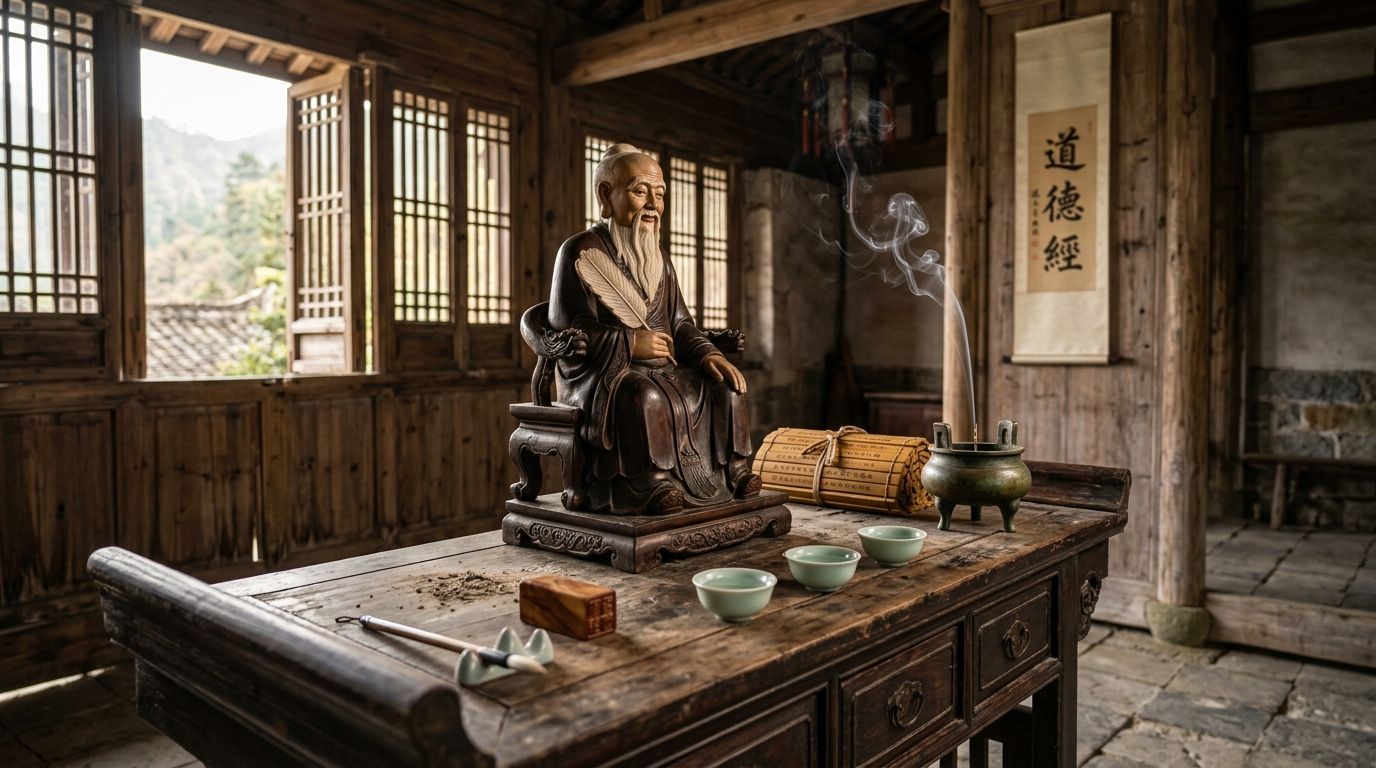
- The Palm-Leaf or Feather Fan (Bafan 把扇): Symbolizing the effortless dispersing of worldly delusion and the fanning of the internal alchemical fires of the heart and lower abdomen.
- The Seated Water Buffalo (Qingniu 青牛): Representing the untamed, primordial animal instincts of human nature patiently harnessed and mastered through yielding gentle virtue.
6. Connoisseurship Diagnostic Matrix: Authentic Lineage Implements vs. Tourist Curios
A sincere seeker intending to create a dedicated study and meditation sanctuary honoring philosopher Lao Tzu must cultivate uncompromising material connoisseurship. An altar cluttered with synthetic petrochemical plastics, machine-pressed sawdust, and toxic synthetic fragrances generates chaotic, heavy vibrational static that disrupts peaceful meditation.
The comprehensive structured comparative matrix below provides collectors and international practitioners with rigorous diagnostic criteria to verify authentic lineage implements:
- Philosopher Lao Tzu Statues (Laozi Shengxiang 老子圣像) — Authentic Lineage Fawu (正统法物): Hand-carved from seasoned high-mountain boxwood (Huangyangmu), aged Laoshan sandalwood, or lost-wax cast heavy bronze with hand-burnished fire gilding; expressive, deeply serene facial carving. · Commercial Tourist Imitation (工业仿品): Low-cost polyurethane resin, injection-molded plastic, or cold-cast gypsum plaster coated with toxic chemical bronze spray paint; facial features are blank, asymmetrical, and commercially rushed. · Energetic & Material Diagnostic Signature: Substantial Grounding: Authentic bronze or aged hardwood creates an immediate physical weight in the hands and establishes a calm, dignified domestic gravity.
- Daodejing Scripture Editions (Zhenjing Faben 真经法本) — Authentic Lineage Fawu (正统法物): Hand-transcribed onto authentic mulberry bark paper or seasoned mountain bamboo slips strung with natural silk cord; written with genuine mineral cinnabar ink or traditional pine soot ink. · Commercial Tourist Imitation (工业仿品): Industrial offset machine-printed on bleached chemical wood-pulp paper; glued commercial bookbindings; synthetic chemical dye inks that emit a sharp solvent smell. · Energetic & Material Diagnostic Signature: Scriptural Living Presence: Natural mineral ink and mulberry paper breathe with room humidity and carry the living vitality of the sacred 5,000 characters.
- Lightning-Struck Jujube Seals (Leiji Zaomu Yin 雷击枣木印) — Authentic Lineage Fawu (正统法物): Harvested from authentic wild mountain jujube trees struck by natural atmospheric lightning; visible natural lightning fissures; sinks in water; emits a rich, toasted amber wood fragrance upon friction rubbing. · Commercial Tourist Imitation (工业仿品): Rapid-growth orchard wood or compressed fiberboard superficially charred with a commercial propane blowtorch; exceptionally lightweight; floats in water; smells of burnt kerosene and charcoal. · Energetic & Material Diagnostic Signature: Celestial Thunder Yang Qi: Concentrates a profound, warming, and protective magnetic field that dissipates domestic disharmony and anxious nightmares.
- Seven Stars Peachwood Swords (Taomu Jian 桃木剑) — Authentic Lineage Fawu (正统法物): Carved from slow-growth mountain peach heartwood air-dried across three full winters; natural warm amber grain; inlaid with solid brass Big Dipper constellation stars (Beidou Qixing). · Commercial Tourist Imitation (工业仿品): Plantation pine wood or pressed composite sawdust dipped in synthetic scarlet chemical lacquer; brittle blade prone to snapping; glued-on metallic foil or plastic star stickers. · Energetic & Material Diagnostic Signature: Solar Spatial Clearing: Naturally purifies room acoustics, dissolves sluggish environmental dampness, and restores clear mental focus.
- Temple-Grade Altar Incense (Tanxiang & Jiangzhen Xiang) — Authentic Lineage Fawu (正统法物): 100% pure wild Hainan Jiangzhen wood resin (Acronychia pedunculata) and aged wild Indian Laoshan sandalwood bound with natural elm bark powder; smoke is delicate, translucent, and sweet. · Commercial Tourist Imitation (工业仿品): Industrial wood shavings steeped in synthetic musk fragrance chemicals, petroleum burning oils, and toxic potassium nitrate burn accelerators; smoke is thick, acrid, and stings the eyes and throat. · Energetic & Material Diagnostic Signature: Atmospheric Bridge to Stillness: Shifts cerebral brainwaves from hyperactive beta stress into deep alpha and theta meditative tranquility within minutes of lighting.
7. The Five Canonical Stages of Kai Guang (开光) Consecration for Laozi Altar Implements
In orthodox Daoist traditions, a freshly sculpted wooden or cast bronze figure of philosopher Lao Tzu is treated strictly as an artistic cultural object until it undergoes the canonical liturgy of Kai Guang (开光, Opening the Light) conducted by an ordained Daoist priest (Daoshi 道士).
This ritual protocol transforms a dormant physical material into an active spiritual conduit attuned to the primordial wisdom of Taishang Laojun:
- Jing Tan (净坛, Purifying the Altar Space): Sprinkling mountain spring water with fresh peach twigs while chanting the Purification Incantations (Jinghua Zhou 净化咒) to eliminate all mundane energetic static from the sanctuary.
- Qing Shen (请神, Celestial Invocation): The priest recites the Golden Light Incantation (Jinguang Zhou 金光咒) and burns hand-written memorials (Biaowen 表文) to invite the lineage masters and Taishang Laojun to witness and empower the artifact.
- Zhu Qi (注炁, Infusing Internal Breath): Harnessing years of internal alchemical cultivation (Neidan), the officiating priest directs pure primordial life-force (Yuanqi 元炁) from their Lower Dantian through the sword-finger mudra (Jian Jue 剑诀) into the central meridian of the sacred implement.
- Dian Yan (点眼, Awakening Sensory Portals): Using a virgin wolf-hair calligraphy brush saturated with pure crystalline cinnabar (Zhusha 朱砂) and spring water, the priest touches the eyes ("eyes open to see cosmic truth"), ears ("ears open to hear the cries of the world"), mouth ("mouth open to speak the eternal Tao"), and heart of the statue.
- Zhuang Zang (装脏, Consecrating the Five Elements): For hollow statues, sacred elements representing the Five Phases are sealed inside: five-color raw silks (representing the five cardinal directions), five sacred grains (representing abundance and earthly nourishment), high-mountain medicinal herbs, and hand-inscribed protective talismans.
8. Step-by-Step Daily Practice: A 5-Step Morning Contemplation Protocol Honoring Philosopher Lao Tzu
To truly benefit from the teachings of philosopher Lao Tzu, one must transition from theoretical book study into lived daily embodiment. Maintain this classical five-step lineage protocol each morning before your study desk or altar to harmonize your mind and living space with the rhythm of the Tao:
Step 1: Sanctuary Direction and Altar Alignment (Anwei Dingxiang 安位定向)
Position your sacred desk or altar table against a solid interior wall, ideally facing East (the direction of rising Yang Qi and the arrival of the Purple Mist, Ziqi Donglai) or South (the direction of supreme light and clarity). Ensure the space is impeccably clean, well-ventilated, and free from electronic clutter. Place your consecrated statue or calligraphy plaque of philosopher Lao Tzu at the center eye-level.
Step 2: Purification of Hands, Mouth, and Intent (San Jing 三净)
Before stepping before the altar, wash your hands in cool running water. Rinse your mouth to clear lingering mundane speech. Take three deep, unhurried breaths, deliberately releasing all anxieties regarding work, deadlines, and social obligations. Approach the altar with the reverence of one stepping into a timeless mountain forest.
Step 3: Offering Pure Mountain Spring Water and Sandalwood Incense (Sanxiang Yizhan 三香一盏)
Place a pristine celadon or ceramic teacup filled with fresh, pure mountain spring water before the image of philosopher Lao Tzu. The water represents the supreme teacher of Chapter 8—yielding, clear, and humble.
Light three sticks of natural aged Laoshan sandalwood incense:
- The first stick represents Dao (道)—the cosmic wellspring.
- The second stick represents Jing (经)—the sacred scripture and wisdom of the Tao Te Ching.
- The third stick represents Shi (师)—the venerable master philosopher Lao Tzu and living lineage ancestors.
Hold the incense sticks with both hands at the level of your brow, bow respectfully from the waist, and insert them vertically into your cast bronze tripod censer. Observe the ascending spiral of white smoke, allowing its natural botanical fragrance to calm your olfactory nerves and quiet the mind.
Step 4: Daodejing Intoning and Contemplation (Song Jing Ming Li 诵经明理)
Select a single chapter of the Tao Te Ching to read slowly aloud. Do not rush through multiple verses; intone the words with measured, rhythmic cadence.
For example, recite Chapter 16 (Attain Utmost Emptiness) or Chapter 8 (The Highest Good Is Like Water). Allow the acoustic vibration of the ancient verses to resonate in your chest, meditating deeply upon how this wisdom applies directly to your current personal challenges.
Step 5: Seated Stillness and Diaphragmatic Breathwork (Jingzuo Shoujing 静坐守静)
Sit comfortably on a natural rush or cotton meditation cushion (Putuan 蒲团) before the altar, keeping the spine naturally erect without rigidity. Form the Ziwu Mudra (子午诀) with your hands resting gently in your lap:
- Rest your left thumb on the base of your left ring finger (the Zi 子 position).
- Wrap your right hand gently around the outside of your left hand, with your right thumb pressing into the center of your left palm (the Wu 午 position).
Close your eyes eighty percent, letting a sliver of soft morning light enter your gaze. Inhale slowly and silently through the nose down into the Lower Dantian, feeling the abdomen expand naturally like an infant's breath. Exhale smoothly, feeling all tension, pride, and hurry dissolve into the floor. Rest in this profound stillness (Zuowang 坐忘) for fifteen to thirty minutes, completely absorbing the tranquil blessing of philosopher Lao Tzu.
9. Frequently Asked Questions (FAQ)
Was philosopher Lao Tzu a real historical figure or a mythological creation?
Historical records from Sima Qian's Shiji (Records of the Grand Historian, written c. 1st century BCE) document philosopher Lao Tzu as Li Er (李耳, courtesy name Boyang 伯阳, posthumously Dan 聃), an archivist of the royal Zhou court in Luoyang during the 6th–5th century BCE. Ancient historical texts verify his meeting with Confucius (Kongzi), who compared Lao Tzu to an unfathomable dragon riding the celestial winds. While later religious traditions revere him as the primordial cosmic deity Taishang Laojun (太上老君), modern scholarship recognizes an authentic historical philosopher whose archival wisdom and oral transmissions formed the core of the 5,000-character Tao Te Ching.
What is the fundamental difference between philosopher Lao Tzu's Daoism and Confucianism?
While both schools emerged during the turbulent Spring and Autumn Period seeking societal harmony, their fundamental methodologies differ profoundly. Confucianism focuses on human-centered artificial cultivation, prescribing rigid social hierarchies, ritual propriety (Li 礼), and moral benevolence (Ren 仁). In contrast, philosopher Lao Tzu taught that excessive human rules and forced morality disrupt spontaneous cosmic harmony. Daoism advocates returning to unforced natural simplicity (Ziran 自然) through effortless action (Wu Wei 无为), asserting that when humanity aligns with the cosmic Way (Dao 道), virtuous conduct emerges spontaneously without external coercion.
Why is philosopher Lao Tzu venerated as the deity Taishang Laojun in religious Daoism?
In orthodox Daoist cosmology, philosophical principles are not separate from cosmic energies. As Daoism crystallized into organized liturgical lineages (such as the Celestial Masters Zhengyi tradition founded by Zhang Daoling in 142 CE), philosopher Lao Tzu was recognized as the human avatar of Daode Tianzun (道德天尊, Heavenly Lord of the Way and Virtue), one of the Three Pure Ones (Sanqing 三清). Known liturgically as Taishang Laojun (太上老君, The Grand Supreme Elderly Lord), this veneration acknowledges that the eternal Tao manifests through historical sages across cosmic epochs to transmit sacred scriptures, protective talismans, and healing arts to humanity.
How can modern people set up a respectful study and meditation altar for philosopher Lao Tzu at home?
Setting up a home study and veneration altar for philosopher Lao Tzu requires dignified simplicity rather than opulent ostentation. Position the altar against a stable wall facing East or South in a clean, quiet space. Place a consecrated statue or calligraphy plaque of philosopher Lao Tzu or Taishang Laojun at the center, flanked by an antique copy or bamboo slip edition of the Tao Te Ching. In front of the sacred image, place an authentic cast bronze censer burning pure aged sandalwood (Laoshan Tanxiang) or wild Jiangzhen resin, flanked by three celadon cups of fresh spring water symbolizing purity of body, speech, and mind. Maintain absolute cleanliness and practice silent meditation before the altar daily.