Daoism Foundations · · 20 min read
Laozi and the Tao Te Ching: The Way of Wu Wei, Deification as Taishang Laojun, and Sacred Altar Veneration
Explore Laozi and the Tao Te Ching: core philosophy, deification into Taishang Laojun, sacred altar veneration, and consecrated Taoist artifacts.
By Daoismart Editorial
On this page
- Key Takeaways: The Sacred Legacy of Laozi and the Tao Te Ching
- 1. Who Was Laozi? The Keeper of the Archives and the Genesis of the Tao Te Ching
- The Historical Footprints in the Shiji
- The Encounter with Confucius: The Mystery of the Dragon
- The Departure through Hangu Pass and Yin Xi
- The Philosophical Core of the 5,000 Characters
- 2. From Ancient Sage to Cosmic Divinity: The Deification of Laozi as Taishang Laojun
- The Descent on Mount Heming (142 CE)
- Laozi Within the Three Pure Ones (Sanqing 三清)
- The Doctrine of Cosmic Manifestations (Laozi Bianhua)
- 3. Consecrated Artifacts and Sacred Material Culture of Laozi Veneration
- 1. The Consecrated Statue of Laozi (Taishang Laojun Xiang 太上老君像)
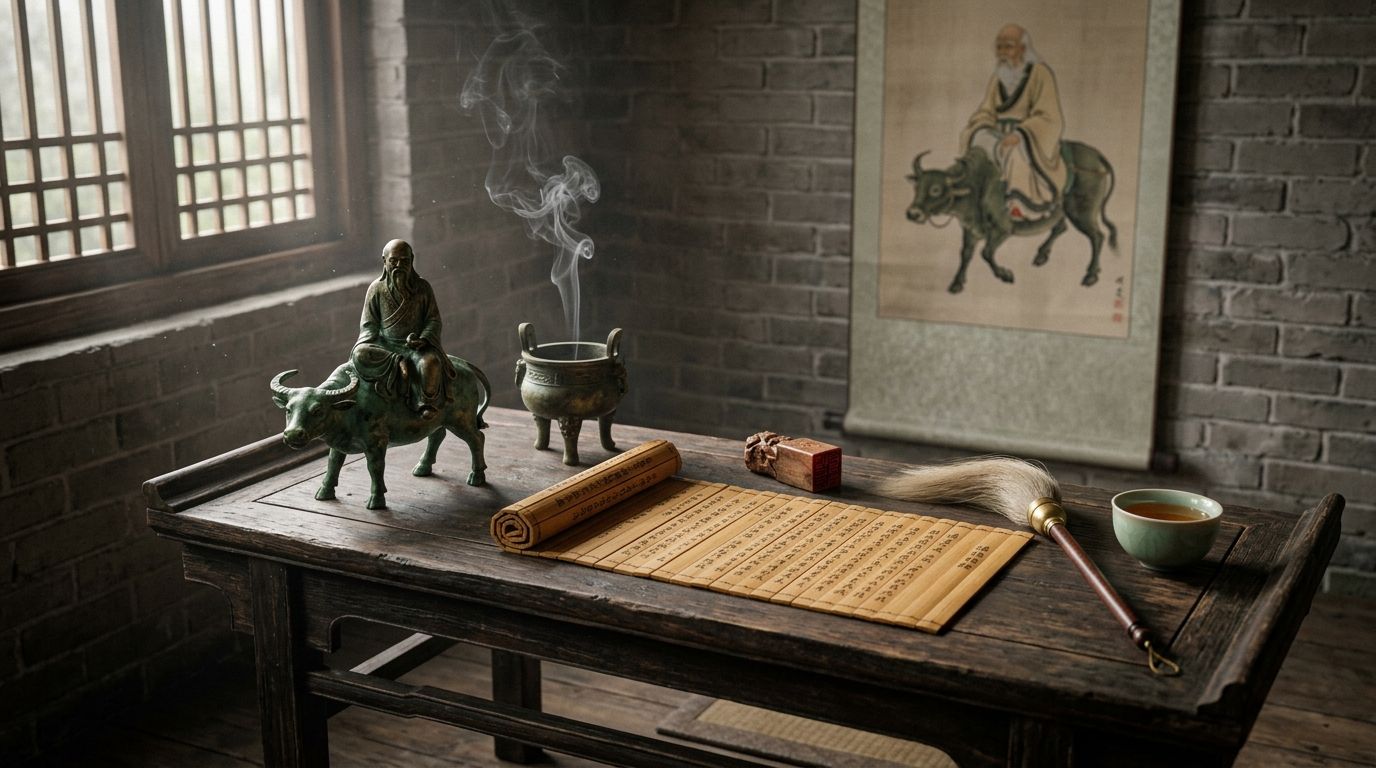
- 2. Bamboo Slip Scrolls of the Daodejing (Zhu Jian Daodejing 竹简道德经)
- 3. The Patinated Tripod Censer and Sacred Aromatic Woods
- 4. Lightning-Struck Jujube Wood Seals (Lei Ji Zao Mu Fa Yin 雷击枣木法印)
- 5. The Consecration Rite: Kai Guang (开光) and Zhuang Zang (装脏)
- 4. Material Authentication Matrix: Authentic Sacred Laozi Artifacts vs. Commercial Replicas
- 5. Step-by-Step Daily Devotional Protocol to Laozi and the Tao Te Ching
- Step 1: Mind-Body Purification (Jing Shen 净身 & Jing Kou 净口)
- Step 2: Sacred Illumination and Orientation (Zhi Deng 致灯)
- Step 3: Presenting the Three Pure Water Offerings (San Bei Shui 三杯水)
- Step 4: Triple Incense Invocation to the Three Pure Ones (San Zhu Xiang 三炷香)
- Step 5: Recitation of Daodejing Chapter 1 and the Qingjing Jing
- Step 6: Zuowang Stillness & Lower Dantian Breathing (Xiao Zhou Tian 小周天)
- 6. Frequently Asked Questions (FAQ)
- Is Laozi considered a historical philosopher or a celestial deity in Taoism?
- What is the true practical meaning of Wu Wei (无为) in Laozi's Tao Te Ching?
- How should a modern seeker set up an authentic devotional or study altar for Laozi at home?
- Why is Taishang Laojun depicted holding an Eight Trigrams palm fan or a horsetail whisk?
Key Takeaways: The Sacred Legacy of Laozi and the Tao Te Ching
Core Direct Definition: Laozi (老子, fl. 6th century BCE), historically transliterated as Lao Tzu, is the foundational patriarch of philosophical Daoism (Daojia 道家) and the legendary author of the five-thousand-character Tao Te Ching (Daodejing 道德经). Within orthodox liturgical Daoism (Daojiao 道教), Laozi is venerated as Taishang Laojun (太上老君—The Grand Supreme Elderly Lord) and Daode Tianzun (道德天尊—The Celestial Worthy of Dao and De), one of the supreme Three Pure Ones (Sanqing 三清). Laozi revealed the cosmic reality of the Dao (道), the virtue of effortless natural action (Wu Wei 无为), and radical spontaneity (Ziran 自然). Far from mere academic theory, living Daoist tradition honors Laozi through daily altar veneration, consecrated statues (Kai Guang 开光), sacred bamboo scripture scrolls, and internal alchemical meditation (Neidan 内丹).
1. Who Was Laozi? The Keeper of the Archives and the Genesis of the Tao Te Ching
To comprehend Daoist spiritual culture, one must begin with the enigmatic figure of Laozi (老子). Emerging during the tumultuous Spring and Autumn period (770–476 BCE) of ancient China, Laozi walked through a world fractured by warfare, political ambition, and moral deterioration. While other thinkers proposed elaborate social hierarchies and rigid ritual codes, Laozi offered an entirely different vision: a return to primordial simplicity, harmonious yielding, and deep resonance with the unseen currents of the universe.
The Historical Footprints in the Shiji
The earliest and most authoritative biographical account of Laozi survives in Chapter 63 of Sima Qian’s monumental Han Dynasty text, the Records of the Grand Historian (Shiji 史记):
- Identity and Origin: His personal name was Li Er (李耳), his courtesy name was Boyang (伯阳), and he was posthumously remembered as Dan (聃). He was a native of the village of Quren, Li Township, in Ku County within the State of Chu (modern-day Luyi County, Henan Province).
- The Keeper of the Royal Archives: Laozi served as the Shi (史), the Chief Archivist and Historian of the Royal Library of the Eastern Zhou dynasty court in Luoyang. In this role, he was the custodian of classical astrological charts, ancestral divination records, sacred imperial genealogies, and ancient wisdom texts. This profound archival mastery granted him unparalleled insight into the rise and fall of civilizations, cementing his conviction that rigid human contrivance inevitably leads to societal collapse.
The Encounter with Confucius: The Mystery of the Dragon
According to both the Shiji and the canonical Zhuangzi (庄子), the young Confucius (Kongzi 孔子) traveled to Luoyang specifically to interview the venerable archivist Laozi regarding ancestral rites (Li 礼). Laozi offered Confucius a startlingly direct counsel, advising him to discard his proud airs, excessive ambitions, and rigid moralizing, as they were useless to his true nature.
Upon returning to his own disciples, a shaken and awestruck Confucius confessed:
"Birds fly, fish swim, and beasts run; the running can be netted, the swimming hooked, and the flying shot with an arrow. But as for the Dragon, I do not know how it rides upon the wind and clouds to ascend into Heaven. Today I have seen Laozi; he is like the Dragon!" (吾今日见老子,其犹龙邪!)
In Chinese metaphysics, the dragon represents formless, shape-shifting Yang energy—free from spatial entrapment, impossible to domesticate, and completely one with the cosmic void.
The Departure through Hangu Pass and Yin Xi
As the political authority of the Zhou dynasty deteriorated into chaos, Laozi resolved to leave the central plains behind. He mounted a humble green water ox (Qingniu 青牛) and set forth toward the rugged western frontier.
At Hangu Pass (Hangu Guan 函谷关), a strategic mountain fortress nestled between towering gorges, the pass governor and master astronomer Yin Xi (Yin Xi 尹喜, later revered in the Daoist pantheon as Master Wenshi 文始真人) stood watch. Gazing eastward at dawn, Yin Xi beheld an extraordinary celestial omen: a dense, swirling cloud of purple vapor three thousand li wide rolling through the mountain passes (Ziqi Donglai 紫气东来—The Purple Qi Arrives from the East).
Recognizing that an immortal sage was approaching, Yin Xi swept the roadway, washed his hands, and prostrated before the elder. Yin Xi beseeched Laozi:
"Since you are about to withdraw into seclusion, I implore you: compose a book for our salvation before you depart."
Laozi paused at the border outpost and set his brush to bamboo slats, inscribing five thousand classical Chinese characters. The resulting masterpiece became known as the Tao Te Ching (Daodejing 道德经). After transmitting this sacred text to Yin Xi, Laozi rode his ox into the western mists, dissolving beyond the horizon of recorded history.
The Philosophical Core of the 5,000 Characters
The Tao Te Ching is divided into two books comprising eighty-one poetic chapters: the Dao Jing (道经, Chapters 1–37, exploring the cosmic metaphysical source) and the De Jing (德经, Chapters 38–81, exploring virtue, inner potency, and harmonious living). Its foundational teachings continue to guide cultivators worldwide:
- The Formless Dao (道): Chapter 1 proclaims that the ultimate truth transcends linguistic confinement: "The Dao that can be spoken of is not the eternal Dao; The name that can be named is not the eternal Name" (道可道,非常道;名可名,非常名). The Dao is the self-existent, inexhaustible mother of Heaven and Earth.
- Wu Wei (无为—Effortless Action): Chapter 37 teaches: "The Dao never acts, yet nothing is left undone" (道常无为而无不为). Wu Wei is not indolence, but action stripped of egotistical friction, moving in perfect alignment with natural timing.
- Ziran (自然—Self-So / Natural Spontaneity): Chapter 25 defines the supreme cosmic hierarchy: "Man models Earth, Earth models Heaven, Heaven models the Dao, and the Dao models Ziran" (人法地,地法天,天法道,道法自然).
- The Supreme Virtue of Water (Shang Shan Ruo Shui 上善若水): In Chapter 8, Laozi writes: "The highest good is like water. Water benefits all ten thousand things and does not compete; it dwells in the lowly places that all disdain, and thus comes closest to the Dao" (上善若水。水善利万物而不争,处众人之所恶,故几于道).
- The Uncarved Block (Pu 朴): Laozi urges the seeker to strip away artificial social constructs, returning to the untouched, pristine innocence of raw timber (Pu), resting in deep peace before fragmentation occurs.
2. From Ancient Sage to Cosmic Divinity: The Deification of Laozi as Taishang Laojun
In Western academia, an artificial divide is often drawn between "philosophical Daoism" (Daojia) and "religious Daoism" (Daojiao). To native lineage practitioners, however, philosophy and liturgical religion are two branches of a single living tree. While Daojia articulates the metaphysical blueprint, Daojiao provides the consecrated vehicles, liturgical rituals, and alchemical methodologies required to embody that blueprint in physical reality.
The Descent on Mount Heming (142 CE)
The historical apotheosis of Laozi crystallized in the Eastern Han Dynasty. In the year 142 CE, on the mist-shrouded peaks of Mount Heming (鹤鸣山) in modern Sichuan, a profound cosmic revelation unfolded. The historical Laozi descended in a blazing chariot of celestial light before the hermit-scholar Zhang Daoling (张道陵).
In this epiphany, Laozi revealed his true primordial identity: he was not merely an ancient human archivist who had lived in the Zhou dynasty, but Taishang Laojun (Taishang Laojun 太上老君—The Grand Supreme Elderly Lord). Laozi appointed Zhang Daoling as his earthly regent, inaugurating the title of Celestial Master (Tian Shi 天师) and establishing the Zhengyi (正一) Orthodox Unity tradition. Taishang Laojun transmitted sacred liturgical registers, the demon-quelling sword, and talismanic scriptures (Fu Lu 符箓), charging the Celestial Master to deliver suffering humanity from plague, demonic oppression, and spiritual darkness.
Laozi Within the Three Pure Ones (Sanqing 三清)
In orthodox Daoist cosmological theology, the universe originates from Primordial Chaos (Hundun 混沌), which differentiates into Three Cosmic Purity Heavens presided over by the Three Pure Ones (Sanqing 三清):
- Yuanshi Tianzun (元始天尊—Celestial Worthy of Primordial Beginning): Embodiment of the Jade Purity Heaven (Yuqing 玉清) and the Primordial Breath (Yuanshi Qi).
- Lingbao Tianzun (灵宝天尊—Celestial Worthy of Numinous Treasure): Embodiment of the Supreme Purity Heaven (Shangqing 上清) and the Numinous Daoist Scriptures.
- Daode Tianzun (道德天尊—Celestial Worthy of the Way and Its Power): The cosmic personification of the Great Purity Heaven (Taiqing 太清)—who is none other than Taishang Laojun (Laozi).
As Daode Tianzun, Laozi serves as the primary cosmic teacher and divine communicator. While Yuanshi Tianzun represents unmanifested cosmic stillness, Laozi embodies active revelation—the compassionate bridge between the formless mystery and embodied human seekers.
The Doctrine of Cosmic Manifestations (Laozi Bianhua)
The canonical Daoist scripture Laozi Bianhua Jing (老子变化经—The Scripture of the Transformations of Laozi) and texts preserved in the monumental Ming Daozang (道藏) outline the doctrine of cyclic avataric descent. Taishang Laojun does not exist bound to a single human century. He is the breath of the cosmos who crystallizes into human form whenever civilization reaches a critical spiritual crossroads:
- In the era of the legendary Three Sovereigns, he manifested as Xuanzhong Fashi (玄中法师) to teach the foundational arts of living.
- During the reign of the Yellow Emperor (Huangdi 黄帝), he descended as Guangchengzi (广成子) atop Mount Kongtong, initiating the emperor into the secrets of longevity and non-attachment.
- In the Eastern Zhou Dynasty, he descended as Li Er (Laozi) to record the Tao Te Ching.
3. Consecrated Artifacts and Sacred Material Culture of Laozi Veneration
In living Daoist practice, a sacred altar (Tan Chang 坛场) is not an idol-worshipping shrine, but an energetic nexus—a consecrated micro-universe where physical craftsmanship resonates with macrocosmic celestial frequencies. When honoring Laozi and cultivating the wisdom of the Tao Te Ching, practitioners utilize specific consecrated implements (Fa Qi 法器) to stabilize spatial energy, dissolve mental clutter, and anchor Pure Yang (Chun Yang 纯阳) vitality.
[ Cosmic Source: The Great Dao (道) ]
│
Taishang Laojun
(Daode Tianzun 道德天尊 / Laozi)
│
┌──────────────────┴──────────────────┐
▼ ▼
[ Spiritual Cultivation ] [ Sacred Material Implements ]
• Tao Te Ching Recitation • Consecrated Bronze Statue (Kai Guang)
• Zuowang Meditative Stillness • Bamboo Slip Scripture Scrolls (Zhu Jian)
• Lower Dantian Breathing • Lightning-Struck Jujube Wood Seal
• Daily Three Water Offerings • Tripod Censer & Aged Sandalwood / Jiangzhen
1. The Consecrated Statue of Laozi (Taishang Laojun Xiang 太上老君像)
Traditional statues of Laozi depict the sage with exacting iconographic accuracy:
- Facial Features: He is portrayed as a venerable elder with elongated ears symbolizing celestial receptivity, silver-white hair gathered in a classic Daoist topknot (Zun Fa 髻发), and a flowing white beard that radiates compassionate, tranquil wisdom.
- The Ox Mount: Often shown seated serenely upon the back of the green water ox (Qingniu). In Daoist Five Elements (Wuxing 五行) theory, the ox represents the Earth element (stability, grounding, endurance), while the color green represents Wood (spring, renewal, life force). Laozi riding the ox symbolizes the spiritual adept subduing and directing primal earth vitality through effortless non-struggle.
- The Palm Fan and Whisk: In his right hand, Taishang Laojun often wields the Eight Trigrams Palm Fan (Bagua Shan 八卦扇), representing the stirring of celestial breath to fan the alchemical inner fires while clearing turbid karmic miasmas. Alternatively, he carries the Horsetail Whisk (Fuchen 拂尘), signifying the sweeping away of worldly illusions (Chen Xin 尘心).
- Lost-Wax Cast Bronze: Authentic statues are cast in solid brass or lost-wax patinated bronze, metals associated with solar Yang density and acoustic resonance during bell-strike liturgies.
2. Bamboo Slip Scrolls of the Daodejing (Zhu Jian Daodejing 竹简道德经)
On an authentic scholar-cultivator altar, physical texts of the Tao Te Ching are reverenced as physical manifestations of the Jing (经), the second of the Three Treasures (San Bao 三宝):
- Bamboo Slips: Traditional editions hand-engraved onto natural cured bamboo slats linked by woven silk thread recreate the physical medium of the Spring and Autumn period. Bamboo embodies resilience, hollow inner receptivity (Xu Xin 虚心), and upright integrity.
- Altar Placement: Displayed horizontally on an aged wooden book rest or unrolled before the incense burner, the physical presence of the sacred text purifies the intellectual atmosphere of the home library, anchoring contemplative focus.
3. The Patinated Tripod Censer and Sacred Aromatic Woods
Incense is the sacred telegraph of the Daoist altar (Xiang Yan Tong Shen 香烟通神—The fragrant smoke connects human heart with celestial spirits):
- The Tripod Censer (Xiang Lu 香炉): Typically cast in bronze with three supporting legs representing the Three Pure Ones and two upright ears representing Yin and Yang.
- Laoshan Sandalwood (老山檀): Aged heartwood from natural sandalwood trees. Sandalwood cools nervous agitation, stabilizes heart rate, and induces deep parasympathetic relaxation ideal for scripture chanting.
- Wild Jiangzhen Incense (降真香): Known historically as the "True Descent Incense," wild Jiangzhen resin was documented in the Ming Dynasty Daozang as the supreme incense of Daoist ritual. Its complex, honeyed herbal aroma is burned to invoke celestial protectors and banish stagnant environmental Qi (Xie Qi 邪气).
4. Lightning-Struck Jujube Wood Seals (Lei Ji Zao Mu Fa Yin 雷击枣木法印)
For ceremonial blessing and home energetic stabilization, Daoist masters carve the sacred seal: Taishang Laojun Chi Ling (太上老君敕令—By the Divine Decree of Taishang Laojun):
- The Miracle of Lightning-Struck Wood: Authentic seals are carved exclusively from wild jujube trees struck by natural cloud-to-ground lightning atop sacred peaks. Lightning represents the celestial fire of Heaven (Tian Huo 天火), permanently altering the wood's cellular structure.
- Mineral Cinnabar (Zhusha 朱砂): When stamping seals or consecrated paper talismans, authentic crystalline cinnabar powder blended with spring water is utilized. Unlike artificial red dyes, natural cinnabar absorbs geothermal Yang energy across millions of years, acting as an energetic resonator.
5. The Consecration Rite: Kai Guang (开光) and Zhuang Zang (装脏)
An implement purchased from an art dealer remains merely a decorative handicraft until it undergoes the liturgical ceremony of Kai Guang (开光—Opening of the Light):
- Purification (Jing Hua 净化): The vessel is cleansed with pure mountain spring water infused with fresh peach twigs (Tao Zhi 桃枝) and enveloped in dense sandalwood smoke to clear residual manufacturing energies.
- Internal Enshrinement (Zhuang Zang 装脏): Through an opening at the base of the hollow bronze statue, the priest deposits the internal spiritual organs:
- The Five Sacred Metals (Gold, Silver, Copper, Iron, Tin) anchoring cosmic mineral balance.
- The Five Sacred Grains (Rice, Millet, Barley, Wheat, Soybean) symbolizing abundance and nourishment.
- The Five Sacred Healing Herbs balancing the five elemental organs.
- Micro-inscribed Scripture Rolls containing the full text of the Tao Te Ching and Qingjing Jing.
- Illuminating the Senses (Dian Yan 点眼): The priest walks the sacred Pace of Yu (Yu Bu 禹步), uses a polished convex bronze mirror to focus morning sunlight onto the statue's third eye, and dots the crown, eyes, ears, mouth, and heart with pure cinnabar, awakening the statue into an active spiritual bridge.
4. Material Authentication Matrix: Authentic Sacred Laozi Artifacts vs. Commercial Replicas
When curating sacred objects for spiritual cultivation or scholarly study, discerning practitioners evaluate physical integrity, geological provenance, and ritual status:
- Statue Metallurgy — Authentic Consecrated Laozi Altar Implement: Solid lost-wax cast brass or hand-patinated bronze; resonant acoustic tone · Mass-Market Commercial Decor / Souvenir: Hollow stamped zinc alloy, plastic resin with electroplated metallic paint
- Scripture Medium — Authentic Consecrated Laozi Altar Implement: Natural kiln-cured bamboo slats or Mulberry thread-bound silk paper · Mass-Market Commercial Decor / Souvenir: Machine-printed synthetic paper or chemically bleached plywood veneer
- Sacred Wood (Seals) — Authentic Consecrated Laozi Altar Implement: Certified natural lightning-struck jujube wood (Lei Ji Zao Mu) or aged peach · Mass-Market Commercial Decor / Souvenir: Chemically laser-scorched MDF, composite particle board, or dyed birch
- Pigment & Inks — Authentic Consecrated Laozi Altar Implement: Pure geological crystalline cinnabar (Zhusha) ground with consecrated water · Mass-Market Commercial Decor / Souvenir: Toxic chemical azo dyes, synthetic oil paints, or petroleum red ink
- Aromatic Incense — Authentic Consecrated Laozi Altar Implement: Wild-harvested Jiangzhen incense resin, aged Mysore/Laoshan sandalwood · Mass-Market Commercial Decor / Souvenir: Sawdust sticks soaked in synthetic fragrance oils and chemical burn accelerators
- Ritual Status — Authentic Consecrated Laozi Altar Implement: Liturgically awakened through traditional Kai Guang and Zhuang Zang · Mass-Market Commercial Decor / Souvenir: Commercial novelty item sold without ritual preparation or spiritual consecration
- Energetic Experience — Authentic Consecrated Laozi Altar Implement: Centering, deeply grounding, clarifies spatial Qi, induces meditative peace · Mass-Market Commercial Decor / Souvenir: Inert, off-gassing chemical scents, induces sensory fatigue or headaches
5. Step-by-Step Daily Devotional Protocol to Laozi and the Tao Te Ching
Cultivating the living spirit of Laozi requires neither mountain seclusion nor monastic renunciation. By establishing a tranquil scholar-altar in your personal sanctuary, you can weave the serenity of the Tao Te Ching into your modern morning routine.
Follow this sequential six-step protocol each morning:
Step 1: Mind-Body Cleansing ──► Step 2: Altar Illumination & Orientation
│
▼
Step 4: Triple Incense Invocation ◄── Step 3: Presenting Three Water Offerings
│
▼
Step 5: Scripture Recitation (Daodejing / Qingjing Jing)
│
▼
Step 6: Zuowang Stillness & Lower Dantian Breathing (Xiao Zhou Tian)
Step 1: Mind-Body Purification (Jing Shen 净身 & Jing Kou 净口)
Begin your morning by rinsing your face and hands with cool water. Rinse your mouth thoroughly. Put on loose, breathable clothing made of natural linen or cotton. Turn off mobile phones and electronic notifications. Stand before your altar space, close your eyes, and take three long, slow exhalations through parted lips, discharging stagnant physical fatigue and mental hurry.
Step 2: Sacred Illumination and Orientation (Zhi Deng 致灯)
Approach your altar, ideally oriented facing south (the direction of Pure Yang) or east (the direction of rising Wood vitality). Ignite the altar oil lamp or a pure beeswax candle using matches. As the flame settles into a steady, golden teardrop, reflect upon the eternal light of the Dao piercing the darkness of worldly confusion.
Step 3: Presenting the Three Pure Water Offerings (San Bei Shui 三杯水)
Arrange three small celadon or polished brass cups in a straight, horizontal line directly before the statue of Laozi or the bamboo scripture scroll:
- Fill each cup with clean spring water or freshly brewed light green tea.
- The Left Cup: Dedicated to the Dao (The Primordial Source).
- The Center Cup: Dedicated to the Jing (The Sacred Wisdom of the Tao Te Ching).
- The Right Cup: Dedicated to the Shi (The Lineage Masters, Patriarch Laozi, and Ancestors).
Reflect upon Chapter 8 of the Tao Te Ching: let your consciousness aspire to be yielding, transparent, and nourishing like water.
Step 4: Triple Incense Invocation to the Three Pure Ones (San Zhu Xiang 三炷香)
Select three sticks of natural aged sandalwood or wild Jiangzhen incense. Ignite the tips, extinguishing any open flame with a gentle wave of your right hand (never blow on altar incense with human breath):
- Hold the three burning sticks between your thumb and index fingers at heart level, raising them reverently to the level of your eyebrows (Qi Mei 齐眉).
- Bow from the waist three times with calm reverence.
- Insert the first stick into the center of the bronze censer, praying: "I dedicate this fragrance to the Great Dao, seeking pure stillness."
- Insert the second stick to the left, praying: "I dedicate this fragrance to the Sacred Scriptures, seeking luminous clarity."
- Insert the third stick to the right, praying: "I dedicate this fragrance to Master Laozi and the Ancestral Teachers, seeking guiding virtue."
Step 5: Recitation of Daodejing Chapter 1 and the Qingjing Jing
Sit comfortably before the altar in a kneeling (Zheng Zuo) or cross-legged posture. Open your bamboo slips or text of the Tao Te Ching. Chant Chapter 1 aloud in a steady, resonant tone, feeling the vibrations of the words resonate through your chest:
"The Dao that can be spoken of is not the eternal Dao; The name that can be named is not the eternal Name..."
Follow this by reading the Taishang Laojun Shuo Chang Qingjing Jing (太上老君说常清静经—Scripture of Constant Purity and Tranquility):
"The human mind loves stillness, but desires agitate it; The human heart loves purity, but thoughts disturb it. If one can perpetually cast aside desires, the heart naturally becomes tranquil; Settle the mind, and the spirit naturally becomes pure." (人心好静,而欲牵之;常能遣其欲,而心自静,澄其心,而神自清。)
Step 6: Zuowang Stillness & Lower Dantian Breathing (Xiao Zhou Tian 小周天)
Transition smoothly from vocal chanting into motionless internal meditation (Zuowang 坐忘—Sitting in Oblivion):
- Physical Posture: Keep your spine naturally upright without rigid tension. Relax your shoulders. Lightly rest the tip of your tongue against the upper palate behind your front teeth, forming the Heavenly Bridge connecting the Ren and Du energetic vessels.
- Hand Seal: Form the Taiji Mudra (Taiji Yin 太极印) in your lap: clasp your left thumb inside your left fist, and envelop your left fist within your right hand.
- Embryonic Breathing: Breathe gently, quietly, and continuously through the nose. Allow each breath to sink effortlessly down into the Lower Dantian (Xia Dantian 下丹田), located two inches beneath your navel.
- Resting in the Uncarved Block: As thoughts arise, do not fight them or indulge them. Observe them like clouds passing across an endless blue sky. Remain in this effortless presence for 20 to 30 minutes.
- Closing: Rub your palms together vigorously until hot, gently warm your eyes and face, bow toward the altar in the classic Daoist Gongshou (拱手) greeting, and carry the unruffled serenity of Laozi into your daily affairs.
6. Frequently Asked Questions (FAQ)
Is Laozi considered a historical philosopher or a celestial deity in Taoism?
In authentic Daoist tradition, Laozi is understood as both a historical mortal sage and the eternal cosmic embodiment of the Dao. Historically, Laozi (Li Er) served as the keeper of royal archives in Luoyang during the Spring and Autumn period and recorded the 5,000-character Tao Te Ching before departing westward through Hangu Pass. Religiously and liturgically, orthodox Daoism (Daojiao) venerates Laozi as Taishang Laojun (太上老君—The Grand Supreme Elderly Lord) and Daode Tianzun (道德天尊—Celestial Worthy of Dao and De), one of the supreme Three Pure Ones (Sanqing). Daoist theology teaches that Taishang Laojun exists prior to the creation of the cosmos, manifesting throughout cyclical world ages to transmit celestial scriptures and guide humanity back into harmony with Ziran (natural spontaneity).
What is the true practical meaning of Wu Wei (无为) in Laozi's Tao Te Ching?
Wu Wei (无为) is frequently misunderstood in the West as passive inaction, apathy, or fatalistic resignation. In canonical Daoist philosophy and energetic cultivation, Wu Wei translates accurately as "non-contrived action" or "effortless action without self-interested friction." It describes a state of supreme internal alignment where a practitioner does not force artificial desires, rigid dogmas, or aggressive ego onto the natural order of reality. Just as water carves valleys and nurtures all living organisms without striving or clashing (Shang Shan Ruo Shui 上善若水), a cultivator practicing Wu Wei acts decisively, fluidly, and spontaneously at the precise moment required by cosmic circumstances, producing maximum harmony with minimal energetic friction.
How should a modern seeker set up an authentic devotional or study altar for Laozi at home?
To set up an authentic home altar (Tan Chang 坛场) dedicated to Laozi, choose a clean, peaceful space facing south or east, free from clutter, drafts, or domestic distractions. At the center, place either a consecrated bronze statue of Laozi / Taishang Laojun or a thread-bound edition / bamboo slip scroll of the Tao Te Ching. In front of the sacred image or text, position three small celadon or brass cups filled daily with fresh spring water representing the Three Treasures (Dao, Jing, Shi). In the center of the table, place a solid bronze or celadon censer (Xiang Lu) filled with clean plant ash for burning natural sandalwood (Laoshan Tan) or wild Jiangzhen incense. Practitioners maintain dignity by keeping the space pristine, never smoking or consuming alcohol near the altar, and illuminating a single pure beeswax candle during morning meditation.
Why is Taishang Laojun depicted holding an Eight Trigrams palm fan or a horsetail whisk?
The iconic sacred implements held by Taishang Laojun carry profound esoteric symbolism in Daoist liturgy and internal alchemy (Neidan). When depicted holding the Eight Trigrams Palm Fan (Bagua Shan 八卦扇), Laozi represents the cosmic power to fan the sacred alchemical fire (Wen Huo and Wu Huo), transmuting internal lead into spiritual gold while dispelling the turbid heat of ignorance and negative karma. When depicted holding the Horsetail Whisk (Fuchen 拂尘), the soft flowing hairs symbolize the power to gently brush away the worldly dust of delusion (Chen Xin 尘心), obsessive desires, and ego attachments, guiding the cultivator into crystalline stillness (Qingjing).