Daoism Foundations · · 25 min read
Lao Tze: The Father of Taoism, Sacred Wisdom of the Tao Te Ching, and Orthodox Lineage Cultivation
Discover the authentic heritage of Lao Tze: from the historical Zhou archives and the Tao Te Ching to cosmic deification, sacred altars, and consecrated artifacts.
By Daoismart Editorial
On this page
- Lao Tze: The Father of Taoism, Sacred Wisdom of the Tao Te Ching, and Orthodox Lineage Cultivation
- 1. The Enigmatic Sage: Who Was Lao Tze?
- The Historical Record: Li Er of the Imperial Archives
- The Dragon Encounter: When Confucius Met Lao Tze
- The Purple Cloud and the Departure through Hangu Pass
- 2. Core Philosophy: Deconstructing the Tao Te Ching
- 1. The Ineffable Tao (道) and Its Inner Virtue (De 德)
- 2. Wu Wei (无为): Effortless Action and Frictionless Living
- 3. Ziran (自然): Aligning with Organic Self-Unfolding
- 4. Shang Shan Ruo Shui (上善若水): The Supreme Virtue of Water
- 3. From Historical Philosopher to Cosmic Sovereign: Lao Tze in Orthodox Daoism (Daojiao)
- Deification as Taishang Laojun and Daode Tianzun
- The Foundation of Orthodox Daojiao: Mount Heming and Zhang Daoling
- The Quanzhen Monastic Transmission: Mount Zhongnan and Internal Alchemy
- 4. Comprehensive Comparison Matrix: Dimensions of Lao Tze
- 5. Consecrated Artifacts (Fawu 法物) and Altar Iconography of Lao Tze
- 1. Sacred Iconography: The Image of Lao Tze
- 2. Hand-Carved Boxwood (Huangyangmu 黄杨木) & Lightning-Struck Jujube Wood (Leiji Zaomu 雷击枣木)
- 3. The Unrolled Tao Te Ching: Bamboo Slips and Mulberry Xuan Paper
- 4. Natural Resinous Incense: Aged Sandalwood and Wild Jiangzhen
- 5. The Canonical Rite of Kai Guang (开光, Opening the Light)
- 6. Step-by-Step Practical Guide: Honoring Lao Tze at a Home Altar
- Step 1: Altar Placement & Spatial Orientation (Anwei Dingxiang 安位定向)
- Step 2: Morning Cleansing & Mental Quieting (Jingshen Jingshou 净身净手)
- Step 3: Offering the Three Pure Waters & Sandalwood Incense (Sanxiang Sanquan 三香三泉)
- Step 4: Sealing Qi with the Ziwu Hand Mudra (Ziwu Jue 子午诀)
- Step 5: Diaphragmatic Dantian Breathing & Verse Contemplation (Jingzuo Xiuxi 静坐修习)
- 7. Frequently Asked Questions (FAQ)
- Q1: Who was Lao Tze, and is he the exact same figure as Laozi and Lao Tzu?
- Q2: What is the core philosophical teaching of Lao Tze in the Tao Te Ching?
- Q3: How did Lao Tze transform from a historical philosopher into the supreme deity Taishang Laojun?
- Q4: How should a practitioner set up a home altar to honor Lao Tze, and what are the essential taboos?
Lao Tze: The Father of Taoism, Sacred Wisdom of the Tao Te Ching, and Orthodox Lineage Cultivation
Key Takeaways (Executive Summary) - Direct Definition: Lao Tze (also transliterated as Laozi or Lao Tzu, 老子; personal name Li Er 李耳, c. 6th–5th century BCE) is the revered patriarch of Daoist philosophy (Daojia 道家) and the supreme divine teacher (Taishang Laojun 太上老君) in liturgical Daoism (Daojiao 道教). - Literary Foundation: He authored the foundational 5,000-character masterwork, the Tao Te Ching (Daodejing 道德经), articulating the eternal principles of the Tao (道, the Cosmic Source), De (德, Inner Virtue), Wu Wei (无为, effortless action), and Ziran (自然, natural spontaneity). - Sage to Cosmic Sovereign: In orthodox lineage tradition, Lao Tze transcends mortal boundaries; revered as Daode Tianzun (道德天尊), he is the third of the Three Pure Ones (Sanqing 三清) who periodically manifests across cosmic eons to restore harmony between Heaven, Earth, and humanity. - Consecrated Artifacts: Traditional veneration of Lao Tze on a home sanctuary altar incorporates authentic sacred implements (Fawu 法物)—such as hand-carved lightning-struck jujube wood (Leiji Zaomu), seasoned mountain peach wood, hand-inscribed bamboo scriptures, and natural mineral cinnabar (Zhusha)—awakened through the canonical Kai Guang (开光) consecration rite. - Daily Cultivation Protocol: Sincere disciples honor Lao Tze through dawn spring water offerings, natural aged sandalwood incense, the Ziwu Hand Mudra (子午诀), and diaphragmatic Lower Dantian (下丹田) breathwork, aligning daily consciousness with the stillness of the Tao.
1. The Enigmatic Sage: Who Was Lao Tze?
Across the tapestry of world philosophy and sacred spiritual heritage, few figures command the quiet majesty, timeless reverence, and contemplative depth of Lao Tze. While Western thinkers often sought to conquer nature through rigid logic and mechanical categorization, Lao Tze offered a radically harmonious path: attuning human consciousness to the self-so, effortless unfolding of the cosmos.
Yet, who was the historical sage behind the myth? And how did his teachings evolve into an unbroken two-and-a-half-millennium tradition that continues to guide millions worldwide?
The Historical Record: Li Er of the Imperial Archives
The earliest comprehensive biographical account of Lao Tze appears in Chapter 63 of the monumental Records of the Grand Historian (Shiji 史记), composed by the great Han Dynasty historian Sima Qian (司马迁). According to Sima Qian:
- Name and Lineage: His surname was Li (李), his personal name was Er (耳), his courtesy name was Boyang (伯阳), and he was posthumously titled Dan (聃), reflecting his long ears—a traditional physiological sign of profound longevity and cosmic receptivity.
- Imperial Office: Lao Tze was appointed as the Keeper of the Imperial Archives (Shoushangzang shi 守藏室史) for the royal court of the Eastern Zhou Dynasty in Luoyang. In ancient China, this was one of the most intellectually exalted positions: the imperial archivist was the custodian of astronomical charts, ancestral genealogies, ancient jade tablets, meteorological annals, and the foundational divination manuals of the Xia, Shang, and Zhou dynasties.
Living amidst the vast scrolls of imperial memory, Lao Tze observed the inexorable rise and fall of warring states, the hubris of prideful ministers, and the catastrophic collapse of rulers who sought to impose artificial order upon an organic world. This profound historical observation crystallized his conviction that human contrivance produces discord, whereas alignment with the natural order produces lasting peace.
The Dragon Encounter: When Confucius Met Lao Tze
One of the most celebrated moments in Eastern intellectual history is the historic meeting between Confucius (Kongzi 孔子) and Lao Tze. Confucius, younger and deeply concerned with social order, ritual propriety (Li 礼), and moral duty (Ren 仁), traveled to the Zhou capital to seek the elder archivist's guidance.
Lao Tze listened patiently to Confucius's meticulous categories and delivered a piercing insight:
"The men of whom you speak, and their bones, have long since rotted away, and only their words remain. When a noble person finds their time, they ride in a carriage; when the time is against them, they wander with the wind. Rid yourself of your arrogance, your manifold desires, your affectations, and your extravagant ambitions. None of these profit your person. This is all I have to tell you." — (子所言者,其人与骨皆已朽矣,独其言在耳。且君子得其时则驾,不得其时则蓬累而行。去子之骄气与多欲,态色与淫志,是皆无益于子之身。吾所以告子,若是而已。)
Shaken to the core, Confucius returned to his disciples in profound silence for three days. When asked why he did not speak, Confucius replied:
"Birds, I know they can fly; fish, I know they can swim; beasts, I know they can run. Those that run can be trapped with nets; those that swim can be caught with lines; those that fly can be brought down with arrows. But as for the dragon, I cannot fathom how it mounts the wind and clouds to ascend into the heavens. Today I have seen Lao Tze, and he is like a dragon!" — (吾今日见老子,其犹龙邪!)
The Purple Cloud and the Departure through Hangu Pass
As the Eastern Zhou Dynasty dissolved into corruption and fratricidal warfare, Lao Tze resolved to withdraw from worldly office. Dressing in coarse linen robes, he mounted a humble green water buffalo (Qingniu 青牛) and rode westward toward the rugged frontier.
At the perilous mountain fortress of Hangu Pass (Hangu Guan 函谷关), the fortress warden and astute astrologer Yin Xi (尹喜) gazed toward the eastern horizon at dawn and beheld a glorious canopy of purple mist rising above the mountains (Ziqi Donglai 紫气东来, The Purple Qi Arrives from the East). Recognizing that a sublime sage was approaching, Yin Xi ordered the pass swept and bowed before Lao Tze's buffalo, pleading:
"Master, since you are about to withdraw into seclusion, I implore you to compose a book for me to preserve your wisdom for all generations."
Moved by Yin Xi's sincere thirst for the truth, Lao Tze rested at the pass and set brush to silk and bamboo, composing an eighty-one-chapter, five-thousand-character treatise divided into two parts: the Book of the Way (Dao Jing 道经) and the Book of Virtue (De Jing 德经).
Having completed the Tao Te Ching (道德经), Lao Tze passed beyond the western gate and dissolved into the mist of the high plateau, leaving behind the spiritual cornerstone of East Asian civilization.
2. Core Philosophy: Deconstructing the Tao Te Ching
The five thousand characters penned by Lao Tze do not constitute a systematic academic textbook, but an evocative, poetic prism of cosmic laws. To read the Tao Te Ching is to undergo an internal recalibration. At its heart lie four indispensable pillars:
1. The Ineffable Tao (道) and Its Inner Virtue (De 德)
The opening lines of Chapter 1 establish the radical epistemological humility demanded by Lao Tze:
"The Tao that can be spoken of is not the eternal Tao; The name that can be named is not the eternal name. Nameless is the origin of Heaven and Earth; Named is the mother of the ten thousand things." — (道可道,非常道;名可名,非常名。无名天地之始;有名万物之母。)
The Tao (道) is not a personalized anthropomorphic deity sitting upon a cloud, demanding sacrifices or issuing commandments. It is the unnamable, primordial ground of being, the silent rhythm orchestrating quantum fluctuations, galactic rotations, and cellular respiration alike. When this cosmic rhythm is cultivated and embodied within an individual's daily life, it manifests as De (德, Virtue, Inner Efficacy, or Spiritual Integrity).
2. Wu Wei (无为): Effortless Action and Frictionless Living
In modern Western discourse, Wu Wei is frequently misconstrued as passivity, lethargy, fatalism, or antisocial detachment. In authentic lineage teachings, Wu Wei literally means action without egoic contrivance. It is the art of acting in such complete alignment with the natural grain of reality that action accomplishes its goal without generating collateral friction or psychological resistance.
In Chapter 37, Lao Tze writes:
"The Tao does nothing, yet nothing is left undone. If lords and kings could preserve it, all creatures would transform of their own accord." — (道常无为而无不为。侯王若能守之,万物将自化。)
Consider a skilled captain navigating an ocean vessel: rather than battling towering tidal surges with brute force, the navigator adjusts the sails, harmonizing with currents and winds to cross vast expanses effortlessly. That is the essence of Wu Wei.
3. Ziran (自然): Aligning with Organic Self-Unfolding
In the vocabulary of Lao Tze, Ziran (自然) translates literally as "self-so" or "originating from itself." It represents the intrinsic rhythm of nature: flowers blossom in spring without anxiety; autumn leaves fall without remorse; the moon waxes and wanes without consultation.
In Chapter 25, Lao Tze outlines the sublime hierarchy of universal alignment:
"Humanity models itself upon Earth; Earth models itself upon Heaven; Heaven models itself upon the Tao; and the Tao models itself upon Ziran." — (人法地,地法天,天法道,道法自然。)
When human institutions disconnect from Ziran, disease, ecological devastation, and social conflict inevitably erupt. Healing begins with returning to the simplicity of the uncarved block (Pu 朴).
4. Shang Shan Ruo Shui (上善若水): The Supreme Virtue of Water
Perhaps no metaphor in the Tao Te Ching is more celebrated than Lao Tze's contemplation of water in Chapter 8:
"The highest good is like water. Water benefits all things without competing with them, and rests in places that humanity disdains; therefore, it is close to the Tao." — (上善若水。水善利万物而不争,处众人之所恶,故几于道。)
Water possesses unmatched softness, yet over time it effortlessly dissolves the most impenetrable granite mountains. It adapts perfectly to every vessel it enters—round in a bowl, square in a box, winding in a stream—never losing its essential nature. In human conduct, Lao Tze teaches that gentleness, humility, and non-contention (Bu Zheng 不争) consistently triumph over brute muscular aggression.
3. From Historical Philosopher to Cosmic Sovereign: Lao Tze in Orthodox Daoism (Daojiao)
A widespread misunderstanding among modern secular readers is that Lao Tze was solely an abstract philosopher whose memory was later corrupted by superstitious religious rituals. In orthodox Daoist lineages, this distinction between "pure philosophy" (Daojia) and "liturgical religion" (Daojiao) is completely artificial.
Deification as Taishang Laojun and Daode Tianzun
In orthodox liturgical theology, Lao Tze is recognized as the earthly incarnation of Taishang Laojun (太上老君, The Grand Supreme Elderly Lord), formally titled Daode Tianzun (道德天尊, The Celestial Worthy of the Way and Its Virtue).
As the third member of the supreme Daoist Trinity—the Three Pure Ones (Sanqing 三清)—Taishang Laojun fulfills the divine role of Teacher and Cosmic Herald:
- Yuanshi Tianzun (元始天尊) represents the primordial, unmanifest void (Wuji 无极).
- Lingbao Tianzun (灵宝天尊) represents the dynamic balance of cosmic patterns, scriptures, and energetic registers (Taiji 太极).
- Daode Tianzun (Lao Tze) represents the manifest physical universe (Wanwu 万物) and the merciful descent of divine teachings into human history to rescue souls from delusion.
Canonical Daoist scriptures, such as the Laozi Bianhua Jing (老子变化经, Scripture of the Transformations of Laozi), document that Taishang Laojun did not begin with the Zhou Dynasty; rather, he has appeared throughout cosmic history under diverse names, guiding humanity whenever civilization lost its harmony with Heaven.
The Foundation of Orthodox Daojiao: Mount Heming and Zhang Daoling
In the year 142 CE, on the misty summit of Mount Heming in modern Sichuan Province, Taishang Laojun descended in radiant golden light before the hermit-cultivator Zhang Daoling (张道陵).
The deified Lao Tze bestowed upon Zhang Daoling the title of First Celestial Master (Tianshi 天师), transmitting the sacred talismans (Fu Lu 符箓), liturgical registers, and the solemn covenant of Orthodox Unity (Zhengyi Mengwei 正一盟威). Taishang Laojun commanded Zhang Daoling to abolish animal blood sacrifices and guide humanity toward pure worship through:
- Natural incense and pure mountain spring water.
- High moral conduct, self-reflection, and repentance.
- Community parish registers (Zhi 治) supporting the sick, orphaned, and elderly.
This monumental revelation marked the formal birth of organized liturgical Daoism (Daojiao 道教), establishing an unbroken lineage that endures today in the Zhengyi (正一) tradition.
The Quanzhen Monastic Transmission: Mount Zhongnan and Internal Alchemy
In the 12th century, Master Wang Chongyang (王重阳) founded the Quanzhen (全真, Complete Perfection) lineage at Mount Zhongnan. For Quanzhen monastics, Lao Tze is venerated as the supreme ancestral guide of Neidan (内丹, Internal Alchemy).
Quanzhen cultivation takes Lao Tze's admonition from Chapter 16—"Attain utmost emptiness; preserve absolute stillness" (Zhi xu ji, shou jing du 致虚极,守静笃)—as the foundational manual for transforming Jing (essence) into Qi (vital breath) and Qi into Shen (spirit). To an ordained Daoist priest, chanting the Tao Te Ching before a consecrated altar is not an academic exercise; it is an active sonic alignment that harmonizes the microcosm of the practitioner's body with the macrocosm of the stars.
4. Comprehensive Comparison Matrix: Dimensions of Lao Tze
To clarify the rich multi-dimensional identity of Lao Tze and dispel common Western misunderstandings, examine the comparative matrix below:
- Identity & Origins — Historical Archivist (Zhou Dynasty): Li Er (李耳), court librarian and archivist of Eastern Zhou (c. 6th century BCE). · Liturgical Deity (Taishang Laojun / Daode Tianzun): Eternal hypostasis of Primordial Qi (Yuanqi 元炁); third of the Three Pure Ones (Sanqing). · Modern Secular / Pop-Culture Distortions: Mythical folk character, generic cartoonish zen hermit, or purely fictional persona.
- Primary Canonical Works — Historical Archivist (Zhou Dynasty): The five-thousand-character Tao Te Ching (Daodejing 道德经). · Liturgical Deity (Taishang Laojun / Daode Tianzun): Daozang (道藏) liturgical canons, Laozi Bianhua Jing, talismanic registers (Fu Lu). · Modern Secular / Pop-Culture Distortions: Out-of-context soundbites, "fortune cookie" quotes, and internet memes misattributed to Laozi.
- Core Spiritual Function — Historical Archivist (Zhou Dynasty): Social critic, political philosopher of non-interference, master of self-preservation. · Liturgical Deity (Taishang Laojun / Daode Tianzun): Cosmic teacher, master of salvation, lineage protector, transformer of human destiny. · Modern Secular / Pop-Culture Distortions: Excuse for passive fatalism, procrastination, lifestyle minimalism, or nihilism.
- Sacred Altar Treatment — Historical Archivist (Zhou Dynasty): Celebrated in scholar studios with inkstones, scrolls, and contemplative incense. · Liturgical Deity (Taishang Laojun / Daode Tianzun): Enthroned on temple and home altars with three waters, sandalwood, and consecrated vessels. · Modern Secular / Pop-Culture Distortions: Treated as decorative kitsch, commercial home decor, or plastic trinkets without reverence.
- Cultivation Methodology — Historical Archivist (Zhou Dynasty): Intellectual contemplation, ethical humility, non-contentious societal action. · Liturgical Deity (Taishang Laojun / Daode Tianzun): Fasting (Zhaijie), repentance, scriptural chanting, Neidan breathwork, mudra seals. · Modern Secular / Pop-Culture Distortions: Superficial relaxation techniques divorced from lineage discipline and moral grounding.
5. Consecrated Artifacts (Fawu 法物) and Altar Iconography of Lao Tze
In authentic Daoist tradition, an altar is not a showcase of secular collectibles; it is an active sacred nexus (Tan 坛) where celestial frequencies interact with the terrestrial home. When venerating Lao Tze, lineage standards mandate strict discernment regarding materials and ritual awakening.
1. Sacred Iconography: The Image of Lao Tze
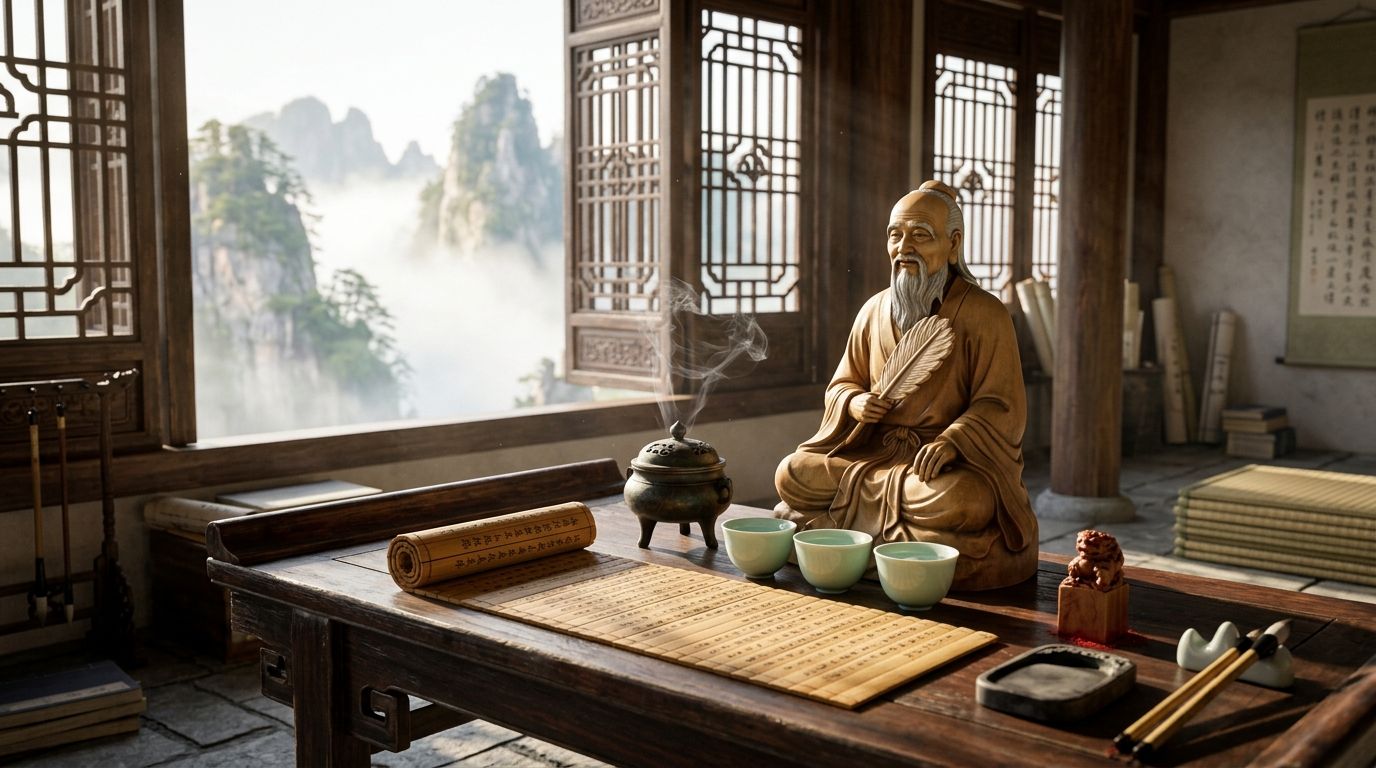
Orthodox statues and painted scrolls depict Lao Tze with precise symbolic iconographic features:
- Silver Hair and Flowing Beard: Representing primordial maturity, timeless wisdom, and boundless patience.
- Domed Cranium: Symbolizing the awakening of the Upper Dantian (Niwan Gong 泥丸宫), brimming with celestial spiritual energy.
- The Feather Fan (Yushan 羽扇) or Taiji Seal: In his right hand, Lao Tze often holds a crane-feather fan, signifying the gentle dispersion of earthly illusions and the guidance of pure celestial breezes. In other depictions, he holds the Taiji diagram or a sacred Ruyi scepter.
- Flowing Daoist Robes: Draped loosely over his frame, embodying Wu Wei—freedom from artificial constriction and effortless harmony with the wind.
2. Hand-Carved Boxwood (Huangyangmu 黄杨木) & Lightning-Struck Jujube Wood (Leiji Zaomu 雷击枣木)
When selecting a statue of Lao Tze for a home altar:
- Boxwood (黄杨木): Renowned for its silky texture, slow mountain growth (often taking decades to yield a carvable branch), and natural resistance to decay. Over decades of daily altar devotion, genuine boxwood absorbs incense oils and natural light, transforming into a deep, lustrous caramel patina that glows with quiet warmth.
- Lightning-Struck Jujube Wood (雷击枣木): Used for sacred lineage seals (Fayin 法印) and protective amulets. Having absorbed the sudden, pure Yang fire of celestial lightning (Tianhuo 天火), genuine lightning jujube wood resonates with unmatched protective potency. Authentic specimens sink low in water and emit a distinctive, comforting roasted-amber aroma when warmed.
- Counterfeit Warning: Mass-market online marketplaces are saturated with molded polyresin replicas painted to mimic aged wood. These synthetic items smell of acrid petroleum, feel unnaturally light or chalky, and generate discordant static energy in a sacred sanctuary.
3. The Unrolled Tao Te Ching: Bamboo Slips and Mulberry Xuan Paper
A traditional scholar-cultivator altar dedicated to Lao Tze frequently features an unrolled thread-bound copy or hand-carved bamboo slip scroll (Zhujian 竹简) of the Tao Te Ching.
- Placed immediately before the statue, the physical scripture serves as the Jing Bao (经宝, Sacred Scripture Treasure), reminding the practitioner that reading and contemplating the sage's words is itself a sacred liturgical act.
4. Natural Resinous Incense: Aged Sandalwood and Wild Jiangzhen
In Daoist ritual cosmology, incense smoke serves as the energetic bridge between human aspiration and celestial perception:
- Aged Laoshan Sandalwood (老山檀): Possesses a grounding, milky-sweet woody resonance that instantly calms the restless mental mind (Xin Ma 心马) and settles the Lower Dantian.
- Wild Jiangzhen Incense (降真香): Revered in canonical Daozang liturgies as the supreme offering resin whose sacred smoke penetrates directly to the celestial palaces of the Three Pure Ones.
- Ritual Taboo: Never use cheap dyed synthetic incense sticks scented with chemical solvents. Burning artificial incense creates toxic physical air and pollutes the subtle spatial Qi of the altar.
5. The Canonical Rite of Kai Guang (开光, Opening the Light)
In orthodox Daoism, an un-consecrated statue or amulet is regarded merely as a beautiful piece of carved wood or stone. It becomes a living portal of blessings only through the liturgical rite of Kai Guang (开光):
Through this rigorous liturgical process conducted by an ordained Daoist priest (Daoshi 道士), the physical vessel is consecrated, anchoring benevolent protective energy within the household.
6. Step-by-Step Practical Guide: Honoring Lao Tze at a Home Altar
To establish a daily practice honoring Lao Tze and cultivating the serene balance of the Tao Te Ching in your home, adhere to this five-step canonical protocol:
Step 1: Altar Placement & Spatial Orientation (Anwei Dingxiang 安位定向)
The spatial foundation of your sanctuary determines its energetic stability:
- Solid Support: Position your altar table against a solid, load-bearing interior wall. This provides a steadfast energetic mountain (Kaoshan 靠山).
- Table Height: The surface of the altar should be at least waist-high (traditionally matching auspicious dimensions on a Lu Ban Feng Shui ruler), ensuring that one naturally looks slightly upward toward the sage.
- Directional Alignment: Face the altar toward the room's main entrance or eastward toward the rising morning sun (Chaoyang 朝阳), inviting the dawn Yang Qi celebrated in Ziqi Donglai.
- Strict Location Taboos: Never establish an altar inside a bedroom, in a basement without natural ventilation, or directly adjacent to or sharing a wall with a restroom, kitchen stove, or waste receptacle. Sacred implements must never be placed on the floor or under clotheslines.
Step 2: Morning Cleansing & Mental Quieting (Jingshen Jingshou 净身净手)
Perform your daily rite during the Mao Hour (卯时, 5:00 AM – 7:00 AM), when the celestial dragon rises and Yang Qi awakens in nature:
- Wash hands and face thoroughly with cool, fresh water. Rinse your mouth to purify physical speech.
- Gently wipe the altar surface using a dedicated clean yellow or white silk cloth reserved exclusively for sacred vessels.
- Silence all electronic notifications, release the anxieties of worldly business, and stand before the altar in an attitude of quiet reverence.
Step 3: Offering the Three Pure Waters & Sandalwood Incense (Sanxiang Sanquan 三香三泉)
Arrange three celadon or porcelain cups in a straight line before Lao Tze's statue:
- Fill each cup with fresh, pure mountain spring water or filtered water.
- Center Cup: Offered to the Tao (道) and Yuanshi Tianzun.
- Left Cup (Observer's Left): Offered to the Scripture (Jing 经) and Lingbao Tianzun.
- Right Cup (Observer's Right): Offered to the Master (Shi 师), honoring Lao Tze / Taishang Laojun.
Next, ignite three sticks of natural aged sandalwood incense:
- Extinguish any open flame with a quick, gentle wave of the right hand. Never blow on ritual incense with your breath, as human breath is considered mundanely turbid.
- Hold the three sticks with both hands at eye level, bow gently toward Lao Tze, and insert them into your bronze or ceramic censer:
- Insert the center stick first, silently affirming: "I take refuge in the unnamable Tao." (Dao Xiang 道香)
- Insert the left stick second, silently affirming: "I take refuge in the sacred Scriptures." (Jing Xiang 经香)
- Insert the right stick third, silently affirming: "I take refuge in the Ancestral Master Lao Tze." (Shi Xiang 师香)
Step 4: Sealing Qi with the Ziwu Hand Mudra (Ziwu Jue 子午诀)
Stand with feet shoulder-width apart, knees softly relaxed, and spine comfortably erect. Bring your hands together at the solar plexus to form the ancient Daoist Ziwu Mudra (子午诀):
- Enclose your right thumb within the fingers of your left hand.
- Place the tip of your left thumb against the base of your left ring finger (the Zi 子 position, representing midnight, Water, and receptive Yin).
- Press the tip of your right thumb against the tip of your right middle finger (the Wu 午 position, representing midday, Fire, and radiant Yang).
- This canonical hand seal bridges the body's Conception Vessel (Ren Mai 任脉) and Governing Vessel (Du Mai 督脉), locking vital essence within and preventing the outward dissipation of vital Qi.
Step 5: Diaphragmatic Dantian Breathing & Verse Contemplation (Jingzuo Xiuxi 静坐修习)
Settle onto a firm meditation cushion before the altar for 15 to 20 minutes of silent contemplation:
- Lightly touch the tip of your tongue to the roof of your mouth just behind your upper teeth, completing the celestial energy circuit (Queqiao 鹊桥).
- Breathe gently, slowly, and silently through the nose. Allow each inhalation to descend deeply into the Lower Dantian (下丹田)—located roughly two inches below your navel—feeling the abdomen gently expand like a soft balloon.
- With each exhalation, release muscular tension, mental rigidity, and ambition.
- Silently contemplate Chapter 10 of the Tao Te Ching:
"In concentrating your vital breath and attaining supreme softness, can you be like a newborn infant?" — (专气致柔,能如婴儿乎?)
- Allow the fragrant sandalwood smoke to envelop your senses, resting in the stillness of the primordial Tao.
7. Frequently Asked Questions (FAQ)
Q1: Who was Lao Tze, and is he the exact same figure as Laozi and Lao Tzu?
Answer: Yes. Lao Tze, Laozi, and Lao Tzu are different Western transliterations of the exact same Chinese patriarch (老子). The variations arise from different romanization systems: "Lao Tzu" and "Lao Tze" stem from the 19th-century Wade-Giles and older European transliteration conventions, whereas "Laozi" is the contemporary official Hanyu Pinyin standard. Born Li Er (李耳) with the courtesy name Boyang (伯阳) during the Spring and Autumn period (c. 6th century BCE), he served as Keeper of the Imperial Archives for the royal court of the Eastern Zhou Dynasty before authoring the five-thousand-character Tao Te Ching and departing westward into the mountains.
Q2: What is the core philosophical teaching of Lao Tze in the Tao Te Ching?
Answer: The central message of Lao Tze in the Tao Te Ching revolves around returning to absolute harmony with the Tao (道)—the unnamable, primordial source and organic rhythm of all creation. Rather than imposing artificial rules, aggressive control, or rigid intellectual structures, Lao Tze advocates Wu Wei (无为, effortless, frictionless action) and Ziran (自然, natural spontaneity). By cultivating humility, flexibility, and the yielding, life-giving qualities of water (Shang Shan Ruo Shui 上善若水), practitioners learn to achieve enduring results without creating destructive egoic friction or environmental disharmony.
Q3: How did Lao Tze transform from a historical philosopher into the supreme deity Taishang Laojun?
Answer: In orthodox Daoist theology, Lao Tze was never viewed merely as an ordinary human philosopher who was later deified out of superstition. Rather, he is understood as the earthly physical manifestation of Taishang Laojun (太上老君, The Grand Supreme Elderly Lord), also titled Daode Tianzun (道德天尊). As the third member of the supreme Daoist Trinity—the Three Pure Ones (Sanqing 三清)—Taishang Laojun personifies the compassionate transmission of cosmic wisdom to humanity. Over cyclical cosmic eons, he manifests across different historical epochs (Huashu 化书) to deliver sacred scriptures and internal alchemy methods, including his historic 142 CE revelation to First Celestial Master Zhang Daoling on Mount Heming.
Q4: How should a practitioner set up a home altar to honor Lao Tze, and what are the essential taboos?
Answer: To establish a personal sanctuary honoring Lao Tze, place an authentic hand-carved wooden statue or portrait on a sturdy table at least waist-high against a solid, supportive wall, facing the room's entrance or eastward toward the morning sun. Never position the altar inside a bedroom, on a dining table where meat or alcohol is served, or against a wall shared with a restroom or kitchen. Daily veneration should be observed during the dawn Mao Hour (5:00 AM – 7:00 AM) with clean hands and mind, offering three cups of pure spring water and three sticks of natural aged sandalwood incense. Always extinguish incense flames with a gentle wave of the hand rather than blowing with your breath, and keep consecrated implements (Fawu 法物) treated with deep care and reverence.
Authored by the Daoist Cultural Heritage & Sacred Arts Curatorial Guild. All historical chronicles, canonical citations, and ritual methodologies conform to orthodox Daozang liturgical standards.