Daoism Foundations · · 26 min read
Is Taoism a Religion? Philosophy vs. Faith, Sacred Lineages, Altar Traditions, and Consecrated Implements
Explore whether Taoism is a religion or philosophy: unpack living lineage rituals, cosmic pantheons, Wu Wei, and consecrated sacred altar implements.
By Daoismart Editorial
On this page
- Is Taoism a Religion? Philosophy vs. Faith, Sacred Lineages, Altar Traditions, and Consecrated Implements
- 1. The Great Misunderstanding: Western Dichotomy vs. Eastern Continuity
- The Origins of the Modern Misconception
- 2. Historical Genesis: From Ancient Hermits to Organized Celestial Masters
- The Revelation of Mount Heming (142 CE)
- 3. The Two Great Living Pillars: Zhengyi and Quanzhen Lineages
- The Zhengyi Tradition (正一道): Liturgy and Celestial Talismans
- The Quanzhen Tradition (全真道): Monastic Stillness and Internal Alchemy
- 4. The Theological Landscape: The Impersonal Source and the Celestial Hierarchy
- The Tao: An Impersonal, Benevolent Source
- The Three Pure Ones (Sanqing 三清)
- 5. Comparative Matrix: Taoism vs. Abrahamic Monotheism and Buddhism
- 6. Somatic Practice: Religious Cultivation Through the Living Body
- The Practice of Seated Forgetting (Zuowang 坐忘)
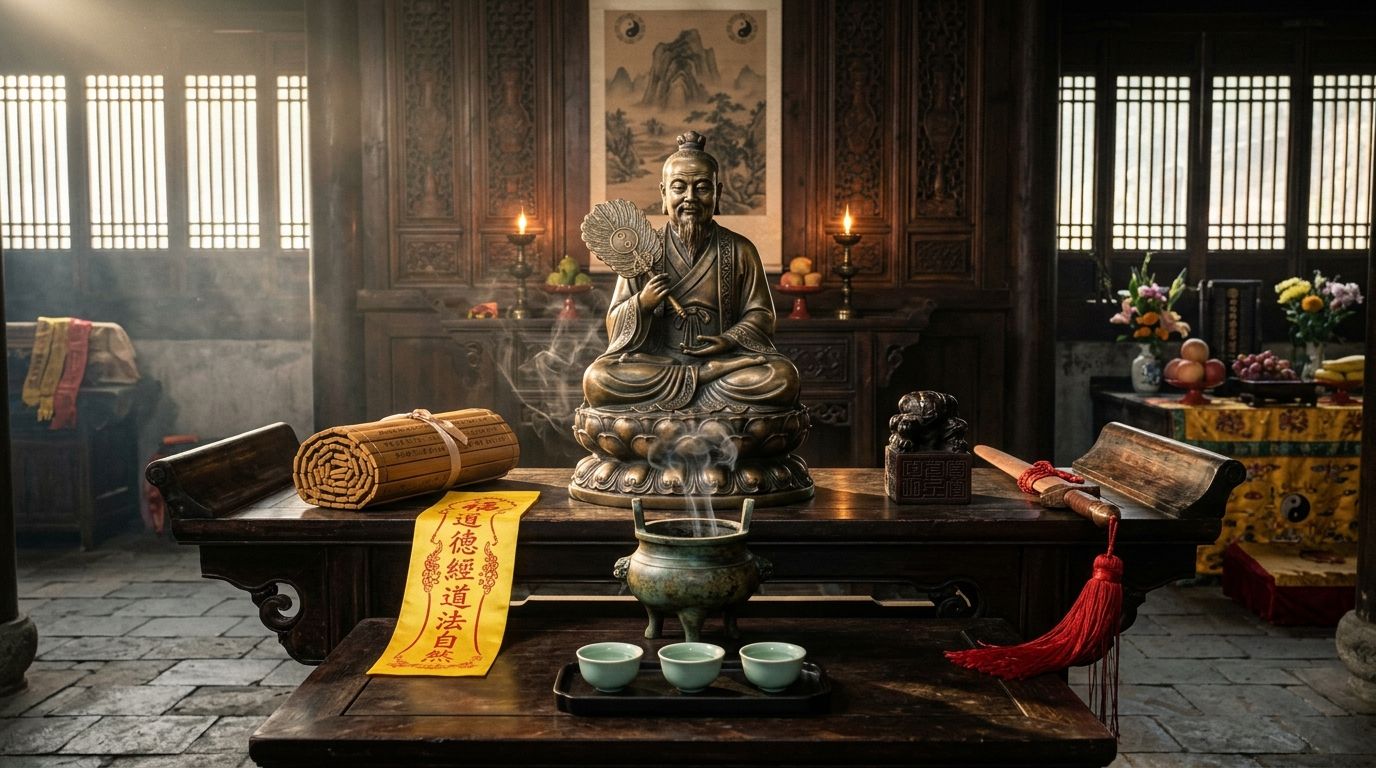
- 7. The Material Sacred: Why Taoism Uses Statues, Swords, and Talismans
- The Authentic Consecration Protocol: Kai Guang (开光) and Zhuangzang (装脏)
- 8. Connoisseurship Diagnostic Matrix: Authentic Lineage Implements vs. Tourist Curios
- 9. Practical Step-by-Step Guide: Establishing a Respectful Taoist Home Sanctuary
- Step 1: Spatial Placement & Optimal Orientation
- Step 2: Establish the Central Focal Anchor
- Step 3: Arrange the Three Sacred Offerings (San Gong 三供)
- Step 4: The Daily Morning Offering Protocol (Chen Jian Gongke)
- Step 5: Sacred Maintenance and Behavioral Taboos
- 10. Frequently Asked Questions (FAQ)
- Is Taoism considered a religion or a philosophy by scholars and practitioners?
- Do Taoists worship gods the same way Western monotheists worship God?
- Can non-Chinese seekers practice Taoism as a religion?
- Why do Taoist altars feature physical implements like swords, incense burners, and talismans?
Is Taoism a Religion? Philosophy vs. Faith, Sacred Lineages, Altar Traditions, and Consecrated Implements
Key Takeaways & Core Principles - Direct Definitive Resolution: When asking is taoism a religion, the definitive answer is that Taoism is simultaneously an ancient metaphysical philosophy (Daojia 道家) and an organized, living liturgical religion (Daojiao 道教). - The Dual Organic Continuum: Rather than mutually exclusive rivals, philosophy and religion in Taoism form an inseparable root-and-blossom relationship. Daojia articulates the cosmic metaphysics of the ineffable Tao (道), non-coercive action (Wu Wei 无为), and spontaneous nature (Ziran 自然), while Daojiao provides the living ecclesiastical architecture, liturgical rituals, ordained priesthoods, and sacred practices that ground these truths into daily human experience. - Two Living Lineage Streams: Orthodox religious Taoism is anchored by two grand traditions: the liturgical, ritual-focused Zhengyi (正一道, Orthodox Unity) lineage featuring married community priests, and the monastic, celibate Quanzhen (全真道, Complete Perfection) lineage centered upon rigorous Internal Alchemy (Neidan 内丹). - Theology Beyond Monotheism: Unlike Western Abrahamic faiths centered upon dogma, original sin, and an anthropomorphic judge, Taoism recognizes an impersonal cosmic matrix (Wuji 无极) manifesting as celestial deities—most notably the Three Pure Ones (Sanqing 三清)—representing divine embodiments of primordial cosmic breath (Yuanqi 元炁). - The Material Sacred (Fawu 法物): Far from mere abstract speculation, religious Taoism grounds spiritual transcendence in physical reality through consecrated ritual implements—including lightning-struck jujube wood master seals (Leiji Zaomu Yin 雷击枣木印), Big Dipper peachwood swords (Taomu Jian 桃木剑), pure sandalwood incense, and hand-drawn cinnabar talismans (Fu Lu 符箓)—awakened through authentic Kai Guang (开光) consecration rites.
1. The Great Misunderstanding: Western Dichotomy vs. Eastern Continuity
For centuries, international seekers, academics, and spiritual practitioners have wrestled with a persistent question: is taoism a religion or a philosophical lifestyle?
To the modern Western intellect—conditioned by rigid dichotomies between secular philosophy and dogmatic faith—the landscape of Taoism often appears baffling. In academic bookshops, the Tao Te Ching and Zhuangzi are classified under classical philosophy alongside Socrates, Marcus Aurelius, and Spinoza. Yet step into a working Taoist temple in Mount Longhu, Beijing, or Chengdu, and one is immediately immersed in a vibrant religious world: billowing clouds of sandalwood incense, ordained priests chanting sacred liturgies, bronze bells and wooden fish drums resonating, and elaborate altars venerating radiant cosmic deities.
The Origins of the Modern Misconception
The belief that "authentic" Taoism is solely a pristine intellectual philosophy, and that religious Taoism is a corrupted superstitious deviation, was largely invented by 19th-century European Protestant missionaries and early colonial Sinologists. Translators such as James Legge celebrated the philosophical texts for their poetic, stoic naturalism. However, when observing real Chinese temple practices—with their elaborate rituals, exorcisms, and celestial iconography—they dismissed living liturgical Taoism as "debased magic."
In traditional Chinese thought, this distinction does not exist as a conflict. The Chinese language designates:
- Daojia (道家): The "Family of the Way"—the philosophical, metaphysical, and cosmological discourse.
- Daojiao (道教): The "Teachings of the Way"—the institutional religion, monastic orders, ritual methodologies, and practical cultivation disciplines.
As the preeminent 20th-century French Sinologist Kristofer Schipper remarked, Daojia and Daojiao are simply the inner marrow and outer limbs of the exact same living tradition. Philosophy provides the intellectual blueprint; religion provides the lived physical and spiritual practice.
2. Historical Genesis: From Ancient Hermits to Organized Celestial Masters
To understand why is taoism a religion, one must trace its organic evolution over two and a half millennia. Taoism did not spring into existence through a single decree; it emerged as a profound synthesis of ancient shamanism, astronomical observation, philosophical contemplation, and celestial revelation.
The Revelation of Mount Heming (142 CE)
The pivotal transition that formally consolidated Taoism into an organized world religion occurred in 142 CE, during the Eastern Han Dynasty. Upon Mount Heming (鹤鸣山) in modern Sichuan Province, a renowned scholar and hermit named Zhang Daoling (张道陵) underwent a monumental spiritual awakening.
According to historical and lineage chronicles, the philosopher Laozi appeared to Zhang Daoling in his transcendent cosmic form as Taishang Laojun (太上老君, The Grand Supreme Elderly Lord). The deity bestowed upon Zhang Daoling the title of Tian Shi (天师, Celestial Master) and entrusted him with the "Covenant of Orthodox Unity with the Powers" (Zhengyi Mengwei 正一盟威).
Taishang Laojun instructed the Celestial Master to replace blood-sacrificing folk cults with a clean, ethical spiritual community founded upon three commitments:
- Moral self-examination and compassionate communal living.
- The registration of households into celestial parishes (Zhi 治).
- Liturgical offerings of pure incense, scripture recitation, and sacred talismans (Fu Lu 符箓) in place of animal sacrifices.
This marked the birth of Tianshi Dao (天师道, The Way of the Celestial Masters)—the historical foundation of religious Taoism that continues uninterrupted to this day under the Zhengyi (正一) lineage.
3. The Two Great Living Pillars: Zhengyi and Quanzhen Lineages
Today, religious Taoism is organized around two primary orthodox lineages, each preserving distinct aspects of spiritual cultivation, ecclesiastical organization, and ritual expertise.
The Zhengyi Tradition (正一道): Liturgy and Celestial Talismans
The Zhengyi (Orthodox Unity) school represents the original Celestial Masters lineage. Headquartered at the historic Dragon and Tiger Mountain (Longhu Shan 龙虎山) in Jiangxi Province, Zhengyi is deeply woven into domestic and community life.
Zhengyi priests are typically Huoju Daoshi (火居道士)—ordained lineage holders who live among families, marry, and pass down ritual registers (Lu 箓) across generations. Their primary ministerial responsibilities include:
- Conducting communal thanksgiving and balance liturgies (Jiao 醮).
- Consecrating sacred statues and altars through ancient Kai Guang (开光) rites.
- Transcribing empowered red-cinnabar talismans (Fu Lu 符箓) to clear malevolent energies, protect homes, and harmonize domestic relationships.
- Guiding the deceased through the underworld toward celestial realms in grand ancestral funeral liturgies.
The Quanzhen Tradition (全真道): Monastic Stillness and Internal Alchemy
Founded in the 12th century by the ascetic master Wang Chongyang (王重阳) and his seven legendary disciples (the Seven Immortals of the North, including Qiu Chuji of the Dragon Gate branch), Quanzhen (Complete Perfection) emerged as a monastic reform movement.
Quanzhen priests are Chujia Daoshi (出家道士)—men and women who take lifelong monastic vows of celibacy, adopt strict vegetarian diets, wear traditional blue robes and hair coiled in topknots (Ziji 髻), and reside in mountain monasteries such as the White Cloud Temple (Baiyun Guan 白云观) in Beijing or the mystical peaks of Mount Wudang (武当山).
Quanzhen synthesizes the moral rigor of Confucianism, the meditative insight of Chan (Zen) Buddhism, and the deep energetic arts of classical Daoism. Its supreme focus is Internal Alchemy (Neidan 内丹)—cultivating the internal elixir of radiant spiritual consciousness through silent meditation (Zuowang 坐忘) and breath regulation (Tu Na 吐纳).
4. The Theological Landscape: The Impersonal Source and the Celestial Hierarchy
A core reason Western observers repeatedly ask is taoism a religion is because Taoism does not fit the monotheistic model of God. In Christianity, Judaism, and Islam, God is an omnipotent, supreme person who creates the universe ex nihilo, issues divine commandments, and judges souls at the end of time.
Taoism operates on an entirely distinct cosmological paradigm: panentheism rooted in cosmic spontaneity.
The Tao: An Impersonal, Benevolent Source
In Taoism, the Tao (道) is not a deity with an ego, emotions, or human-like desires. As Chapter 25 of the Tao Te Ching affirms:
$\text{“Silent and void, it stands alone and does not change; It may be regarded as the Mother of the ten thousand things.”}$
$\text{(寂兮寥兮,独立而不改,周行而不殆,可以为天下母。)}$
The Tao does not demand blind worship, nor does it punish disobedience. Rather, it operates like universal gravitational resonance: when human beings live in accordance with its laws (practicing humility, moderation, and compassion), their lives flourish smoothly; when they violently force circumstances, they exhaust their vitality and suffer decay.
The Three Pure Ones (Sanqing 三清)
How does formless cosmic breath interact with human consciousness? Through divine energetic crystallization (Yuanqi 元炁). At the apex of the Taoist religious pantheon stand the Three Pure Ones (Sanqing 三清), representing the primordial triune emanations of reality:
- Yuanshi Tianzun (元始天尊, The Heavenly Lord of Primordial Beginning): Residing in the Realm of Jade Purity (Yuqing), he personifies the unmanifest origin of the cosmos before the separation of Heaven and Earth.
- Lingbao Tianzun (灵宝天尊, The Heavenly Lord of Numinous Treasure): Residing in the Realm of Higher Purity (Shangqing), he embodies the cosmic vibration, sacred resonance, and transmission of divine scriptures.
- Daode Tianzun (道德天尊, The Heavenly Lord of the Way and Its Virtue): Residing in the Realm of Great Purity (Taiqing), he is the deified manifestation of Taishang Laojun (Laozi), who directly descends into history to guide mortal cultivators toward the immortal Way.
Beneath the Three Pure Ones operates an intricate, orderly spiritual bureaucracy managed by the Jade Emperor (Yuhuang Dadi 玉皇大帝), along with stellar deities like the Seven Stars of the Northern Dipper (Beidou Qixing 北斗七星) and deified historical heroes such as Lord Guan (Guan Yu 关羽), representing martial integrity and righteous protection.
5. Comparative Matrix: Taoism vs. Abrahamic Monotheism and Buddhism
To provide rigorous diagnostic clarity for international researchers and sincere practitioners, the comparative matrix below contrasts Taoism against Western Abrahamic Monotheism and Indian-origin Buddhism across seven fundamental theological and operational dimensions:
- Ultimate Reality — Taoism (Daojia & Daojiao): The Cosmic Tao (道): An impersonal, formless, self-generating motherly source of all existence; neither creates ex nihilo nor judges. · Abrahamic Monotheism (Christianity / Islam): Personal God (Yahweh / Allah): An omnipotent, personal creator distinct from creation; establishes moral laws and issues ultimate judgment. · Buddhism (Mahayana & Theravada): Emptiness (Shunyata) / Dependent Origination: No permanent cosmic source; all phenomena arise dependently, devoid of inherent self-existence.
- View of the Divine — Taoism (Daojia & Daojiao): Panentheistic Emanations: Deities (Sanqing, Immortals) are energetic condensations of primordial Qi (Yuanqi); guides and cosmic allies rather than tyrants. · Abrahamic Monotheism (Christianity / Islam): Transcendent Supreme Monarch: Absolute monotheism; worship belongs exclusively to the One God; depiction or division of divinity is forbidden. · Buddhism (Mahayana & Theravada): Buddhas and Bodhisattvas: Enlightened beings of boundless compassion who aid sentient beings; not creator gods, but liberated teachers.
- Human Nature & Sin — Taoism (Daojia & Daojiao): Inherent Original Goodness: Humans are natural microcosms of Heaven and Earth. Suffering arises from misalignment (Shi He 失和), not inherent depravity or original sin. · Abrahamic Monotheism (Christianity / Islam): Fallen Nature & Original Sin: Humanity inherited spiritual estrangement through original transgression; redemption requires divine grace or submission. · Buddhism (Mahayana & Theravada): Inherent Buddha-Nature obscured by Ignorance: Suffering (Dukkha) stems from delusion (Avidya), craving (Tanha), and clinging to an illusionary self.
- Supreme Goal of Cultivation — Taoism (Daojia & Daojiao): Somatic Transcendence & Immortality (Xian 仙): Harmonizing the physical body, vital breath, and spirit to dwell in ageless longevity and unity with the Way. · Abrahamic Monotheism (Christianity / Islam): Heavenly Salvation & Eternal Life: Resurrection and eternal fellowship with God in paradise after bodily death and universal judgment. · Buddhism (Mahayana & Theravada): Liberation from Samsara (Nirvana): Extinction of karmic rebirth cycles; awakening to non-self and extinguishing the fires of greed, anger, and delusion.
- Scriptural Corpus — Taoism (Daojia & Daojiao): The Daoist Canon (Daozang 道藏): 5,485 volumes encompassing metaphysics, meditation, ritual liturgy, herbal medicine, astronomy, and alchemy. · Abrahamic Monotheism (Christianity / Islam): The Holy Bible / The Noble Qur'an: A single closed canonical revelation recording divine commandments, sacred history, and moral covenants. · Buddhism (Mahayana & Theravada): The Tripitaka / Mahayana Sutras: Vast philosophical discourses, monastic codes (Vinaya), and alchemical psychological analyses (Abhidharma).
- Approach to the Body — Taoism (Daojia & Daojiao): Sacred Alchemical Cauldron (Ding Lu 鼎炉): The physical vessel is sacred; it is purified and preserved through breath, diet, herbs, and seated stillness. · Abrahamic Monotheism (Christianity / Islam): Temple of the Spirit or Fallen Flesh: Often viewed with suspicion as an arena of worldly temptation; subordinated to spiritual salvation. · Buddhism (Mahayana & Theravada): Transient Aggregates (Skandhas): Regarded as impermanent, unsatisfactory, and non-self; cultivated through moderation without attachment.
- Role of Material Implements (Fawu 法物) — Taoism (Daojia & Daojiao): Vibrational Resonators & Energetic Anchors: Consecrated natural materials (peachwood, thunder jujube, bronze, cinnabar) channel cosmic frequencies. · Abrahamic Monotheism (Christianity / Islam): Sacramental Emblems or Forbidden Idols: Used as devotional aids in Catholicism/Orthodoxy; strictly rejected as idolatry in Protestantism and Islam. · Buddhism (Mahayana & Theravada): Devotional & Mindful Symbols: Statues and malas serve as focal points for mindfulness, devotion, and merit-making.
6. Somatic Practice: Religious Cultivation Through the Living Body
A defining hallmark confirming that is taoism a religion of the highest order is its comprehensive system of somatic, physiological, and energetic transformation known as Internal Alchemy (Neidan 内丹).
In many Western religious traditions, spirituality is predominantly cognitive: one recites creeds, confesses mental assent, and prays with words. In religious Taoism, words are merely pointers. True cultivation is an organic physical process conducted inside the laboratory of the human organism.
The Practice of Seated Forgetting (Zuowang 坐忘)
Recorded in the Zhuangzi (Chapter 6) and systematically codified by Tang Dynasty Taoist master Sima Chengzhen (司马承祯) in the Zuowanglun (坐忘论, Discourse on Sitting and Forgetting), Zuowang is the crown jewel of Taoist contemplative practice.
To practice Zuowang is to sit peacefully, release rigid conceptual thinking, drop all social masks and ambitions, and gently allow the scattered sensory awareness to settle down into the navel center. The practitioner forgets their personal ego, forgets societal anxieties, and merges effortlessly into the boundless rhythmic breath of the universe.
7. The Material Sacred: Why Taoism Uses Statues, Swords, and Talismans
To an outsider observing a Taoist temple or home sanctuary, another paradox emerges: if the Tao is formless and nameless, why does religious Taoism utilize consecrated statues, bronze bells, wooden swords, and intricate paper talismans?
The answer is found in the fundamental cosmological law of Taoism:
$\text{“When primordial Qi condenses, it forms physical matter; when it disperses, it returns to the formless void.”}$
$\text{(炁聚为物,炁散为虚。)}$
Physical matter is not dirty, profane, or opposed to spirit; it is simply Qi in a tangible, condensed octave. Consecrated physical implements (Fawu 法物) serve as electromagnetic transducers and energetic anchors that stabilize cosmic tranquility within domestic and temple environments.
The Authentic Consecration Protocol: Kai Guang (开光) and Zhuangzang (装脏)
A common tourist curio bought in a market is merely decorative wood, plaster, or bronze. To become an authentic spiritual vessel on a Taoist altar, the implement must undergo the solemn ritual of Kai Guang (开光, "Opening of the Light") and Zhuangzang (装脏, "Internal Consecration"):
- Purification (Jinghua 净化): The statue or implement is thoroughly cleansed using spring water steeped in sacred mountain peach twigs, mugwort, and pure wild incense.
- Internal Enshrinement (Zhuangzang 装脏): Through a sacred aperture at the base or back of the statue, the ordained priest places five precious metals (gold, silver, copper, iron, tin), five sacred grains, aromatic herbs, and hand-written talismans. This forms the physical and energetic "internal organs" of the deity.
- The Mirror and Sun Activation (Yin Yang Jing 阴阳镜): Using a polished bronze mirror under direct solar light, celestial Yang energy is concentrated and projected into the heart and brow of the statue.
- The Dotting of the Senses (Dian Qiqiao 点七窍): Using a consecrated brush dipped in natural mineral cinnabar, the priest empowers the eyes, ears, nostrils, and mouth of the statue, awakening its spiritual perception to receive human offerings and protect the home.
8. Connoisseurship Diagnostic Matrix: Authentic Lineage Implements vs. Tourist Curios
A sincere seeker establishing an authentic Taoist devotional space must cultivate discerning connoisseurship. Synthetic materials, petrochemical resins, and machine-stamped tourist trinkets emit discordant vibrational static that disrupts peaceful meditation.
The diagnostic comparison matrix below provides clear benchmarks for distinguishing authentic lineage fawu from commercial reproductions:
- Laozi & Deified Statues (Shengxiang 圣像) — Authentic Lineage Fawu (正统开光法物): Hand-carved from seasoned mountain boxwood, aged Laoshan sandalwood, or lost-wax cast heavy bronze; features a serene, dignified, and compassionate facial expression. · Commercial Tourist Imitation (工业仿品): Injection-molded petrochemical plastic, cold-cast gypsum plaster, or resin coated with toxic chemical bronze spray; features crude, blank, or grotesque expressions. · Diagnostic Marker & Energetic Impact: Physical Weight & Grounding: Authentic bronze or aged hardwood creates an immediate physical gravity and warmth; plastic replicas feel cold, brittle, and hollow.
- Lightning-Struck Jujube Seals (Leiji Zaomu Yin 雷击枣木印) — Authentic Lineage Fawu (正统开光法物): Harvested from wild mountain jujube trees naturally struck by lightning; natural electrical fissures visible; dense, sinks in water; emits a rich, toasted nutty aroma upon friction rubbing. · Commercial Tourist Imitation (工业仿品): Rapid-growth orchard wood superficially scorched with a propane blowtorch or laser machine; feather-light, floats on water; emits a sharp smell of burnt charcoal and chemical varnish. · Diagnostic Marker & Energetic Impact: Celestial Yang Resonance: Authentic lightning wood carries the immense kinetic fire of thunder (Leiting Yangqi), dispelling lingering nightmares and domestic gloom.
- Seven Stars Peachwood Swords (Taomu Jian 桃木剑) — Authentic Lineage Fawu (正统开光法物): Sourced from aged wild mountain peach heartwood air-dried across three winters; warm reddish-amber tone with dense grain; hand-inlaid with solid brass Big Dipper stars. · Commercial Tourist Imitation (工业仿品): Cheap soft pine or compressed particle board painted with crimson chemical enamel; star markings are glued stickers or gold paint; breaks easily upon light stress. · Diagnostic Marker & Energetic Impact: Pure Solar Protection: Authentic mountain peachwood is dense and naturally aromatic, clearing heavy indoor stagnation and stabilizing room Feng Shui.
- Empowered Talismans (Fu Lu 符箓) — Authentic Lineage Fawu (正统开光法物): Hand-transcribed by an ordained priest onto organic handmade bamboo or mulberry bark paper; written with pure natural mineral cinnabar (Zhusha); infused with breath cultivation. · Commercial Tourist Imitation (工业仿品): Mass machine-printed offset lithographs on glossy bleached wood pulp paper; printed with toxic chemical orange printer ink; possesses zero practitioner breath or intent. · Diagnostic Marker & Energetic Impact: Living Energetic Matrix: Natural cinnabar is a heavy, radiant solar mineral that holds energetic charge; chemical dye is completely inert and lacks spiritual transmission.
- Altar Censer Incense (Xiangdao 香道) — Authentic Lineage Fawu (正统开光法物): 100% pure wild Hainan Jiangzhen resin, wild agarwood (Chenxiang), or aged Australian/Indian sandalwood powder; free from synthetic binders or perfumes. · Commercial Tourist Imitation (工业仿品): Industrial incense sticks glued with coal dust, potassium nitrate (for burning), and synthetic chemical fragrance oils; emits acrid, eye-watering smoke that leaves black soot. · Diagnostic Marker & Energetic Impact: Clarity of Olfactory Channels: Pure botanical incense produces slender, clean white smoke that calms the central nervous system and deepens meditative focus.
9. Practical Step-by-Step Guide: Establishing a Respectful Taoist Home Sanctuary
For those seeking to anchor the tranquil wisdom of the Tao within their domestic environment, setting up a home altar (Daotan 道坛) or meditation sanctuary is a transformative practice. It provides a dignified focal point for daily reflection, mindfulness, and alignment with cosmic rhythms.
Follow this standard, step-by-step protocol to establish a harmonious sacred space:
Step 1: Spatial Placement & Optimal Orientation
Select a quiet, dignified location in your home, preferably in a study, library, or living room. Avoid placing the altar directly facing a bathroom, inside a bedroom, or under a heavy structural ceiling beam.
- Ideal Orientation: Position the altar against a solid wall facing East (the direction of the rising sun, the Azure Dragon, and celestial spring energy) or South (the direction of pure solar Yang).
- Height: The altar surface should ideally sit at chest or heart level when standing, representing dignity and respect.
Step 2: Establish the Central Focal Anchor
At the center of your altar, place your primary sacred image. This can be:
- An authentic, consecrated bronze or hardwood statue of Taishang Laojun (Laozi), the Three Pure Ones (Sanqing), or Lord Guan (Guandi).
- If a statue is unavailable, a beautifully hand-transcribed calligraphy scroll of the character DAO (道) on mulberry paper serves as a sublime, orthodox alternative.
- Flank the central image with a copy of the Tao Te Ching or Zhuangzi on traditional bamboo slips or silk-bound paper.
Step 3: Arrange the Three Sacred Offerings (San Gong 三供)
Traditional Taoist altars feature three primary offerings representing the purification of body, speech, and mind:
- The Three Pure Waters (San Bei Shui 三杯水): Place three clean porcelain or celadon cups in a straight line before the deity. Fill them each morning with fresh, pure spring water. The center cup represents the Tao; the left represents Heaven; the right represents Earth.
- The Bronze Tripod Censer (Xianglu 香炉): Position a patinated bronze or celadon ceramic incense censer centered in front of the water cups. Fill it with clean natural plant ash.
- The Sacred Lamp or Candle (Mingdeng 明灯): Place a small pure vegetable-oil lamp or pair of beeswax candles at the outer edges of the altar, symbolizing the inextinguishable light of primordial wisdom.
Step 4: The Daily Morning Offering Protocol (Chen Jian Gongke)
Cultivate a calm, consistent morning rhythm to start each day:
- Wash your hands and rinse your mouth to maintain physical purity.
- Replace the water in the three cups with fresh spring water.
- Light a single stick of pure aged sandalwood or Hainan Jiangzhen incense. Hold the stick with both hands at eye level, bow gently toward the altar three times, and insert the stick vertically into the center of the censer.
- Step back, place your hands together in the traditional Taiji Yin-Yang Clasp (Taiji Shouyin 太极手印)—the left hand gently cupping the right thumb over the right fist—and bow three times with silent gratitude.
- Sit quietly on a meditation cushion before the altar for 10 to 20 minutes in Zuowang stillness, letting your respiration settle deeply into your Lower Dantian.
Step 5: Sacred Maintenance and Behavioral Taboos
- Cleanliness: Dust the altar daily using a dedicated, clean silk or cotton cloth that is never used for ordinary household cleaning.
- Atmospheric Calm: Never raise your voice, engage in heated arguments, or consume heavy alcohol directly in front of the sanctuary.
- Natural Integrity: Avoid burning artificial synthetic perfumes or cheap chemical incense sticks that emit toxic acrid smoke; allow only pure botanical scents to permeate the space.
10. Frequently Asked Questions (FAQ)
Is Taoism considered a religion or a philosophy by scholars and practitioners?
Both scholars of Asian religions and living lineage practitioners recognize Taoism as an organic continuum encompassing both philosophy (Daojia 道家) and religion (Daojiao 道教). Daojia provides the profound intellectual and metaphysical foundation—articulating the cosmic principles of Wu Wei (effortless action), Ziran (natural spontaneity), and the formless Tao. Daojiao provides the living somatic methods, temple liturgy, monastic communities, ordained priesthood, and sacred implements that enable human beings to realize and embody these philosophical truths within daily life. Rather than opposing forces, they are the root and branches of the exact same spiritual tree.
Do Taoists worship gods the same way Western monotheists worship God?
No. The concept of the divine in religious Taoism is radically different from Western Abrahamic monotheism. The ultimate reality is the ineffable Tao (道), which is an impersonal, self-sustaining cosmic source and rhythm rather than an anthropomorphic ruler who issues moral decrees or condemns souls. The deities venerated in Taoist temples—such as the Three Pure Ones (Sanqing 三清) and the Jade Emperor (Yuhuang Dadi)—are understood as divine energetic condensations (Yuanqi 元炁) of the Tao. Veneration is not based on fearful submission, but on seeking energetic harmony, spiritual mentorship, and reverent attunement with primordial cosmic virtues.
Can non-Chinese seekers practice Taoism as a religion?
Yes, absolutely. The cosmic Tao is inherently universal and knows no national, ethnic, or cultural boundaries. While learning fundamental Chinese philosophical terminology and ritual etiquette certainly enriches one's journey, sincere practitioners from any background can embrace Taoism. Many begin as lay cultivators—studying canonical scriptures like the Daodejing, practicing Zuowang (seated stillness) and Qigong, and establishing a respectful home altar. For those called to deeper dedication, international temples and ordained lineage masters worldwide offer formal discipleship (Bai Shi 拜师) and initiation in both the Zhengyi and Quanzhen traditions.
Why do Taoist altars feature physical implements like swords, incense burners, and talismans?
In Taoist metaphysics, matter and spirit are not hostile opposites, but differing densities of the exact same vital life-force (Qi ju wei wu, Qi san wei xu 炁聚为物,炁散为虚). Physical implements (Fawu 法物)—such as lightning-struck jujube wood master seals (Leiji Zaomu Yin), Big Dipper peachwood swords (Taomu Jian), and cinnabar talismans (Fu Lu)—serve as physical energetic anchors. When handcrafted from noble, natural materials and awakened through authentic consecration (Kai Guang 开光), these implements channel solar Yang Qi, dispel discordant spatial vibrations, and ground the transcendent serenity of the Tao into everyday life.