Daoism Foundations · · 23 min read
Founder of Daoism: Laozi, Zhang Daoling, and the Sacred Evolution from Cosmic Philosophy to Living Religion
Who was the founder of Daoism? Discover the dual origins of Laozi and Celestial Master Zhang Daoling, sacred lineage implements, and living rites.
By Daoismart Editorial
On this page
- Founder of Daoism: Laozi, Zhang Daoling, and the Sacred Evolution from Cosmic Philosophy to Living Religion
- 1. The Dual Heritage: Untangling the Founder of Daoism (Daojia vs. Daojiao)
- Daojia (道家): The Philosophical Lineage
- Daojiao (道教): The Organized Liturgical Church
- 2. Laozi: The Primordial Sage and the Philosophy of the Daodejing
- The Encounter with Confucius (Kongzi Wen Li 孔子问礼)
- Departing the Hangu Pass (Hangu Guan 函谷关) and the 5,000 Words
- 3. Zhang Daoling and Mount Heming: The Birth of Institutional Daojiao
- The Sacred Epiphany on Mount Heming (142 CE)
- Practical Communal Salvation: The Five Pecks of Rice
- 4. Master Matrix: Laozi vs. Zhang Daoling
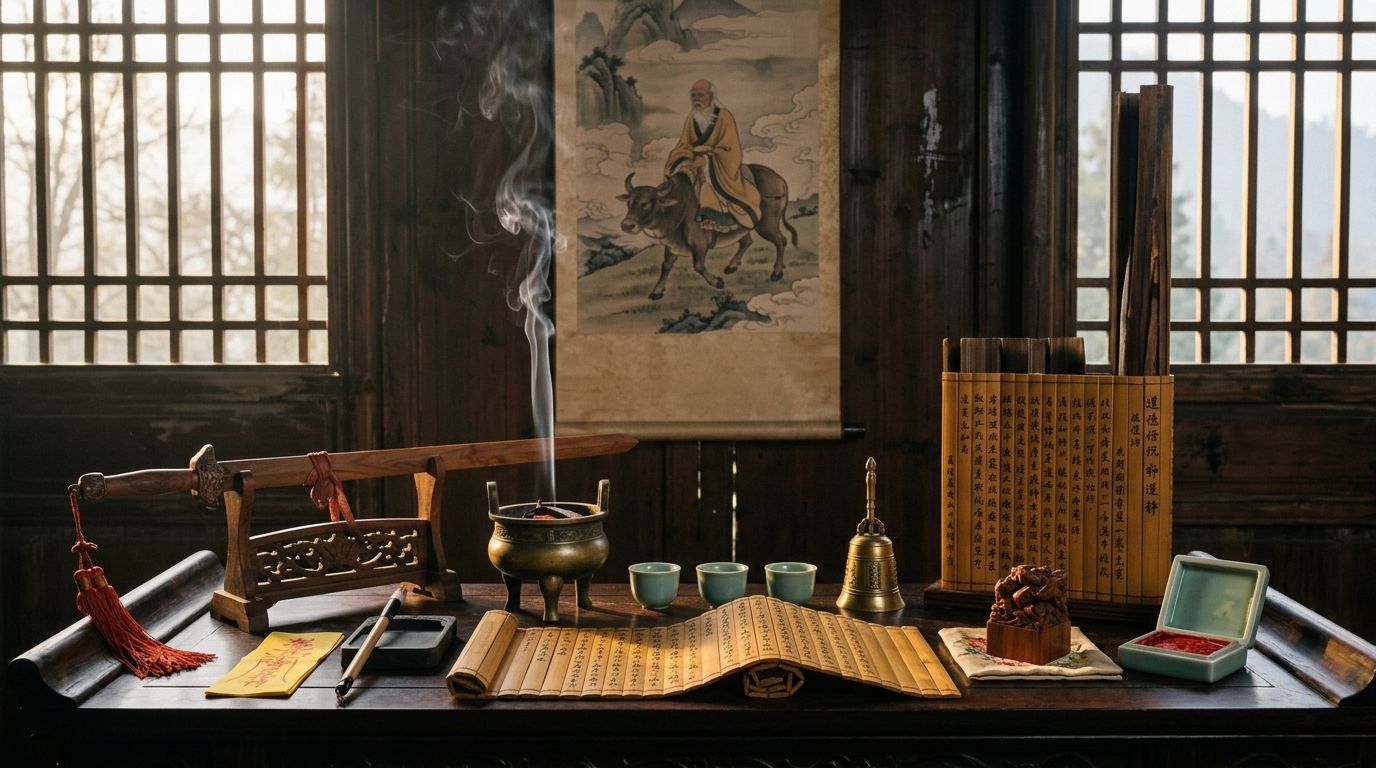
- 5. Sacred Lineage Implements (Fawu 法物) of the Celestial Masters
- 1. The Yangping Zhidugong Seal (阳平治都功印)
- 2. The Slaying-Evil Peachwood Swords (Zhanxie Jian 斩邪剑)
- 3. The Three Pure Bell (Sanqing Ling 三清铃)
- 4. Cinnabar Talismans (Fu Lu 符箓)
- 6. Connoisseurship: Genuine Fawu vs. Commercial Counterfeits
- The Indispensable Role of Kai Guang (开光, Opening the Light)
- 7. Step-by-Step Daily Sanctuary & Altar Devotion Protocol
- Step 1: Orienting the Altar and Observing Spatial Taboos (Anwei Dingxiang 安位定向)
- Step 2: Dawn Body and Speech Purification (Jingshen Jingshou 净身净手)
- Step 3: Offering the Three Pure Waters & Sandalwood Incense (Sanxiang Sanquan 三香三泉)
- Step 4: Microcosmic Locking with the Ziwu Hand Mudra (Ziwu Jue 子午诀)
- Step 5: Lower Dantian Meditation & Daodejing Contemplation (Dantian Jingzuo 丹田静坐)
- 8. Frequently Asked Questions (FAQ)
- Q1: Who is officially recognized as the founder of Daoism—Laozi or Zhang Daoling?
- Q2: How did the early teachings of Daoism differ fundamentally from Confucianism?
- Q3: Why was Laozi transformed from an ancient philosopher into a celestial deity in religious Daoism?
- Q4: What role do the sacred implements (Fawu) of the Celestial Masters play in contemporary Daoist practice?
Founder of Daoism: Laozi, Zhang Daoling, and the Sacred Evolution from Cosmic Philosophy to Living Religion
Key Takeaways (Executive Summary) - Dual Heritage of the Founder: Deciding who was the founder of Daoism requires distinguishing between philosophical Daoism (Daojia 道家) and liturgical religious Daoism (Daojiao 道教). Laozi (老子, c. 6th Century BCE) is universally celebrated as the primordial philosophical founder of Daoism through the revelation of the Daodejing (道德经), while Grandmaster Zhang Daoling (祖天师张道陵, 34–156 CE) is the historical and liturgical founder of Daoism as an organized communal religion (Tianshi Dao 天师道 / Zhengyi 正一). - Philosophical vs. Institutional Matrix: Laozi articulated metaphysical principles—the unnamable Tao (道), Wu Wei (无为, effortless action), and Ziran (自然, natural spontaneity)—for individual sages and rulers. Zhang Daoling transformed these cosmic insights into a structured community of parish dioceses (Ershisi Zhi 二十四治), priestly registers (Lu 箓), and collective moral covenants. - The Deification of the Sage: In 142 CE on Mount Heming (鹤鸣山), Zhang Daoling received the direct mandate from Laozi, who had been deified as Taishang Laojun (太上老君, The Grand Supreme Elderly Lord), one of the supreme Three Pure Ones (Sanqing 三清), ensuring perfect theological continuity between the philosophical master and the organized church. - Divergence from Confucianism: Unlike Confucianism (Rujia 儒家), which prioritized social hierarchies, statecraft, and rigid ritual etiquette (Li 礼), the founder of Daoism championed uncarved simplicity (Pu 朴), non-coercive harmony, and the realization that humanity is an organic microcosm of Heaven and Earth (Tian Ren He Yi 天人合一). - Transmission of Sacred Implements (Fawu 法物): The lineage founded by the Celestial Masters anchored cosmic power through tangible physical treasures, notably the Yangping Zhidugong Seal (阳平治都功印) made of lightning-struck jujube wood (Leiji Zaomu), the double-edged Peachwood Sword (Taomu Jian 桃木剑), the Three Pure Bell (Sanqing Ling 三清铃), and cinnabar Fu Talismans (符箓). - Authentic Connoisseurship & Practice: Genuine Daoist artifacts rely on natural mineral cinnabar, wild lightning-struck timber, and aged wild sandalwood—empowered via the liturgical rite of Kai Guang (开光, Opening the Light)—dispelling modern commercial misconceptions and providing grounded spiritual peace.
1. The Dual Heritage: Untangling the Founder of Daoism (Daojia vs. Daojiao)
When international seekers and comparative religion scholars ask, "Who was the founder of Daoism?", the historical answer unfolds across two distinct yet harmonious epochs. Unlike Western traditions centered upon a single human founder or prophet, Chinese sacred history divides the founder of Daoism into two foundational archetypes:
Daojia (道家): The Philosophical Lineage
In the pre-Qin period (Spring and Autumn and Warring States eras), thinkers and recluses contemplated the profound disruptions of interstate warfare. The elder archivist Laozi (老子) articulated a radical vision: human suffering stems from artificial pride, excessive intellectual calculation, and aggressive interference with the natural cosmic rhythm. This philosophical lineage—later termed Daojia (道家) by Han Dynasty bibliographers such as Sima Tan (司马谈)—was enriched by the sublime allegories of Zhuangzi (庄子) and Liezi (列子). For the philosophical founder of Daoism, liberation is attained through internal stillness, cognitive detachment, and effortless harmony (Wu Wei 无为).
Daojiao (道教): The Organized Liturgical Church
By the Eastern Han Dynasty (25–220 CE), the collapse of imperial unity, plagues, and spiritual hunger prompted a monumental transformation. On Mount Heming (鹤鸣山) in southwestern Sichuan, a master of esoteric arts named Zhang Daoling (张道陵) received a direct celestial revelation. The formless Tao was not merely an abstract metaphysical construct; it was a living, compassionate spiritual order capable of healing bodies, harmonizing social communities, and dispelling malevolent astral energies. Zhang Daoling inaugurated Daojiao (道教), creating a vibrant, enduring ecclesiastical framework known as the Way of the Celestial Masters (Tianshi Dao 天师道), also called the Orthodox Unity Tradition (Zhengyi Dao 正一道).
Thus, Laozi is venerated as the Ancestral Teacher (Zushi 祖师) and cosmic root, while Zhang Daoling is revered as the First Celestial Master (Zu Tianshi 祖天师) who built the actual religious vessel carrying this wisdom across millennia.
2. Laozi: The Primordial Sage and the Philosophy of the Daodejing
To comprehend Laozi as the philosophical founder of Daoism, one must examine the biographical chronicles recorded in Sima Qian’s Records of the Grand Historian (Shiji 史记). Known originally as Li Er (李耳) with the courtesy name Boyang (伯阳), Laozi served as the Keeper of the Imperial Archives (Shoushi Shi 守藏室史) for the royal court of Zhou in Luoyang.
Surrounded by ancient astrological registers, divinatory turtle plastrons, and classical historical annals, Laozi observed the cyclic rise and catastrophic fall of human dynasties. He realized that every civilization that relied on aggressive force, ostentatious virtue, and hyper-regulation eventually invited its own collapse.
The Encounter with Confucius (Kongzi Wen Li 孔子问礼)
One of the most defining moments in Chinese intellectual history was the legendary dialogue between Confucius (Kongzi 孔子) and Laozi. Confucius sought instruction from Laozi regarding ancient rites and ancestral protocol. Recognizing the younger scholar’s intense earnestness, Laozi delivered a legendary counsel:
"Put away your proud airs and many desires, your insinuating manner and extravagant will. None of these are of any advantage to you. This is all I have to tell you."
Upon departing, Confucius reported to his disciples:
"I know birds can fly, fish can swim, and animals can run. But the dragon—I cannot know how it mounts upon the wind and clouds to ascend into the sky. Today I have seen Laozi; he is like the dragon!"
Departing the Hangu Pass (Hangu Guan 函谷关) and the 5,000 Words
As the Zhou Dynasty declined, Laozi relinquished his official robes, mounted a serene blue water buffalo (Qingniu 青牛), and journeyed westward into the misty mountains. At the western border outpost of Hangu Pass (函谷关), the observant garrison commander, Yin Xi (尹喜), observed an auspicious purple vapor flowing from the east (Ziqi Donglai 紫气东来), signaling the arrival of an enlightened sage.
Yin Xi implored the sage to write down his wisdom before departing into the wilderness. Laozi paused and composed a concise, poetic treatise of roughly 5,000 Chinese ideograms divided into eighty-one chapters: the immortal Daodejing (道德经, The Classic of the Way and Its Virtue). Leaving this textual legacy behind, Laozi disappeared into the western ranges, transcending ordinary mortal bounds.
3. Zhang Daoling and Mount Heming: The Birth of Institutional Daojiao
While Laozi provided the profound philosophical cosmology, the emergence of the historical religious institution required a master capable of uniting folk healing, internal energy cultivation, ritual communion, and community organization. That visionary was Zhang Daoling (张道陵).
Born in Fengxian (modern Jiangsu province) in 34 CE, Zhang Daoling was a brilliant scholar of the Confucian classics who attained the prestigious rank of imperial scholar (Xianliang 贤良). He served briefly as a district magistrate in Ba commandery (modern Chongqing). However, disillusioned by the political corruption of the late Han imperial court and sensing that secular honors could not halt human mortality, he abandoned public office to master the arts of longevity, herbal medicine, and alchemy (Waidan & Neidan).
The Sacred Epiphany on Mount Heming (142 CE)
In the year 142 CE, during the reign of Emperor Shun of Han, Zhang Daoling retreated to the secluded limestone peaks of Mount Heming (鹤鸣山, Crane Cry Mountain) in Dayi, Sichuan. While deep in alchemical meditation, he experienced a momentous theophany. Taishang Laojun (太上老君)—the deified, celestial manifestation of Laozi—descended in radiant golden light.
Taishang Laojun revealed to Zhang Daoling that the mortal world had fallen into spiritual rot. Demonic forces, pestilence, and moral decay were tormenting humanity because the ancient harmony between Heaven and Earth had been fractured. Laojun bestowed upon Zhang Daoling the Covenant with the Powers of Pure Truth (Zhengyi Mengwei Zhi Dao 正一盟威之道), appointing him as the celestial representative on Earth—the first Heavenly Master (Tianshi 天师).
Practical Communal Salvation: The Five Pecks of Rice
Under Zhang Daoling, the nascent Daoist movement was radically egalitarian and compassionate. Rather than demanding expensive animal sacrifices—a practice common among corrupt local cults—Zhang Daoling instituted a modest annual contribution of five pecks of uncooked rice (Wudoumi 五斗米) per household. This grain was stored in communal granaries and redistributed to travelers, the impoverished, and families stricken by famine.
He established the Quiet Chambers (Jingshi 静室) across twenty-four parish sanctuaries (Ershisi Zhi 二十四治). When community members fell ill, instead of viewing disease as arbitrary biological bad luck or demonic wrath, they examined their internal ethical balance. Sincere repentance letters addressed to the Three Officials (Sanguan 三官: Heaven, Earth, and Water) were ritually presented: one buried on a sacred mountain peak, one buried in the earth, and one submerged in flowing water.
Through this revolutionary structure, Zhang Daoling proved himself as the true institutional founder of Daoism, translating Laozi’s high philosophy of non-contrivance into tangible public health, social welfare, and liturgical order.
4. Master Matrix: Laozi vs. Zhang Daoling
To grasp the exact historical, textual, and ritual roles of both figures recognized under the title founder of Daoism, the following structured matrix provides an authoritative Lineage Standard comparison:
- Historical Era — Laozi (老子 / Taishang Laojun): Spring and Autumn Period (c. 6th – 5th Century BCE) · Zhang Daoling (祖天师张道陵): Eastern Han Dynasty (34 CE – 156 CE; active 142 CE)
- Primary Title — Laozi (老子 / Taishang Laojun): The Philosophical Sage / Ancestral Teacher (Zushi 祖师) · Zhang Daoling (祖天师张道陵): The First Heavenly Master (Zu Tianshi 祖天师)
- Domain of Heritage — Laozi (老子 / Taishang Laojun): Daojia (道家): Philosophical & Metaphysical Foundation · Zhang Daoling (祖天师张道陵): Daojiao (道教): Institutional, Liturgical, & Communal Church
- Foundational Scripture — Laozi (老子 / Taishang Laojun): Daodejing (道德经, 5,000 Characters) · Zhang Daoling (祖天师张道陵): Xiang'er Commentary (老子想尔注), Zhengyi Mengwei Scripture
- Core Philosophy — Laozi (老子 / Taishang Laojun): Primordial Void (Wuji), Non-Action (Wu Wei), Spontaneity (Ziran) · Zhang Daoling (祖天师张道陵): Liturgical covenant (Mengwei), communal charity, moral harmony
- Archetypal Setting — Laozi (老子 / Taishang Laojun): The Archive of Zhou; Leaving through Hangu Pass on a Blue Ox · Zhang Daoling (祖天师张道陵): Secluded hermitage on Mount Heming; Altar on Mount Qingcheng
- Social Structure — Laozi (老子 / Taishang Laojun): Solitary contemplation, imperial counsel, hermit recluse · Zhang Daoling (祖天师张道陵): 24 Dioceses (Ershisi Zhi), parish registries, community granaries
- Canonical Implements — Laozi (老子 / Taishang Laojun): Writing brush, ancient bamboo scrolls, simple zither (Guqin) · Zhang Daoling (祖天师张道陵): Lightning-struck jujube seal, peachwood sword, Three Pure bell
- Ritual Modality — Laozi (老子 / Taishang Laojun): Sitting in oblivion (Zuowang 坐忘), fasting the heart (Xinzhai) · Zhang Daoling (祖天师张道陵): Canonical registers (Falu), liturgical petitions (Biaowen), talismans
- Theological Status — Laozi (老子 / Taishang Laojun): Venerated as the 3rd Deity of the Three Pure Ones (Sanqing) · Zhang Daoling (祖天师张道陵): Revered as the Chief Patriarch of Zhengyi and Orthodox Lineages
5. Sacred Lineage Implements (Fawu 法物) of the Celestial Masters
In the sacred lineage established by the institutional founder of Daoism, abstract philosophical cosmology is anchored into physical reality through consecrated ritual implements (Fawu 法物). The First Celestial Master Zhang Daoling taught that physical tools, when properly consecrated and crafted from authentic natural materials, act as energetic focal lenses that balance ambient Yin-Yang polarities and shield practitioners from harmful unseen forces.
1. The Yangping Zhidugong Seal (阳平治都功印)
Among all regalia inherited from the first founder of Daoism, none surpasses the authority of the Yangping Zhidugong Seal. Hand-carved from seasoned lightning-struck jujube wood (Leiji Zaomu 雷击枣木), this seal bears ancient Seal Script (Zhuanshu) characters embodying the sovereign decree of the Celestial Master. In liturgical ceremonies, the imprint of this seal represents the seal of cosmic law. It is stamped in scarlet mineral cinnabar upon written prayers, scripture registers, and house-warding talismans to authorize their celestial efficacy.
2. The Slaying-Evil Peachwood Swords (Zhanxie Jian 斩邪剑)
According to the Daozang (道藏), Taishang Laojun bestowed upon Zhang Daoling a pair of sacred swords known as the Male and Female Slaying-Evil Swords (Zhanxie Shuangjian). In historical transmission, high-altitude wild peachwood (Taomu 桃木)—revered across China as the "Wood of the Sun Immortals" (Xianmu 仙木)—is meticulously seasoned through multiple winters and carved with the Seven Stars of the Big Dipper (Beidou Qixing 北斗七星) and the Earlier Heaven Bagua (Xiantian Bagua 先天八卦). Rather than causing physical harm, the sacred peachwood sword functions as an energetic scalpel, slicing through emotional attachments, night terrors, and stagnant domestic Qi.
3. The Three Pure Bell (Sanqing Ling 三清铃)
Also known as the Fa Ling (法铃) or Master Bell, this bronze instrument features a handle terminating in three curved bronze prongs representing the Three Pure Ones (Sanqing 三清). When rung rhythmically during dawn or dusk devotion, its clear, high-frequency acoustic resonance clears the physical atmosphere of lethargy, calms frantic heart rates, and signals to benevolent spirits that sacred meditation has commenced.
4. Cinnabar Talismans (Fu Lu 符箓)
Talismans are the sacred calligraphy of the cosmos. Hand-brushed by an ordained priest using pure mineral cinnabar (Zhusha 朱砂) upon natural yellow mulberry silk paper, each stroke combines esoteric cosmic characters, secret constellation constellations, and focused breathwork (Zhu Qi 注炁). When mounted respectfully in a home or carried as a personal amulet, an authentic talisman acts as a micro-altar radiating celestial protection.
6. Connoisseurship: Genuine Fawu vs. Commercial Counterfeits
In the lineage of the founder of Daoism, the energetic integrity of any sacred implement depends entirely upon the purity of its natural material composition. A plastic, chemically stained imitation possesses no energetic frequency and defiles the sacred space of practice. Discerning practitioners uphold rigorous material connoisseurship:
The Indispensable Role of Kai Guang (开光, Opening the Light)
Even an implement carved from authentic mountain timber remains inert matter until it undergoes the canonical ordination rite of Kai Guang (开光) administered by a qualified, ordained Daoist priest (Daoshi 道士):
- Purifying the Altar (Jing Tan 净坛): Reciting the Pure Earth and Pure Heaven incantations while sprinkling mountain spring water with fresh peach leaves.
- Summoning Celestial Qi (Qing Shen 请神): Chanting the Golden Light Incantation (Jinguang Zhou 金光咒) to invoke the protective presence of Taishang Laojun and the Heavenly Masters.
- Infusing Lower Dantian Breath (Zhu Qi 注炁): The priest gathers Yuanqi from the lower abdomen and projects it through the fingers into the heart of the implement.
- Awakening Sensory Portals (Dian Yan 点眼): Utilizing a wild animal hair brush dipped in natural cinnabar paste, the priest dots the crown, eyes, ears, mouth, and heart of the sacred tool, awakening its divine awareness.
- Sealing the Five Elements (Zhuang Zang 装脏): For consecrated statues and deep chambers, five-color silks, medicinal herbs, sacred grains, and gold-leaf prayers are permanently sealed inside.
Without authentic Kai Guang, an object is simply aesthetic art; with authentic Kai Guang, it becomes a living bridge to the lineage of the founder of Daoism.
7. Step-by-Step Daily Sanctuary & Altar Devotion Protocol
To honor the heritage of both the philosophical and religious founder of Daoism in contemporary daily life, sincere practitioners maintain a dignified home sanctuary. Follow this canonical five-step morning ritual designed for urban seekers:
Step 1: Orienting the Altar and Observing Spatial Taboos (Anwei Dingxiang 安位定向)
- Solid Support (Kaoshan 靠山): Position your sacred altar table against a solid interior wall of stone or wood. Never place it against a hollow temporary partition or floating glass divider.
- Elevation: The surface of the altar must stand at least waist-height (38 to 42 inches from the floor) to honor the celestial sovereigns.
- Directional Alignment: Orient the sacred space facing east (welcoming the morning purple Yang Qi) or facing the main entrance of your room.
- Crucial Taboos: Never position an altar inside a bedroom, adjacent to or sharing a plumbing wall with a bathroom, directly beneath an overhead exposed structural ceiling beam, or on a dining table where meat and alcohol are consumed.
Step 2: Dawn Body and Speech Purification (Jingshen Jingshou 净身净手)
- Practice during the Mao Hour (卯时, 5:00 AM – 7:00 AM), when primordial Yang energy begins to rise across the earth.
- Wash your hands and face with cool, natural spring or filtered water.
- Rinse your mouth cleanly to purify daily speech before addressing the divine lineage.
- Turn off electronic devices, wear loose natural clothing (cotton or linen), and take three slow, grounding breaths.
Step 3: Offering the Three Pure Waters & Sandalwood Incense (Sanxiang Sanquan 三香三泉)
- Arrange three clean celadon offering cups in a straight horizontal line across the altar:
- Center Cup: Represents the Dao (道宝) and Yuanshi Tianzun (Primordial Origin).
- Left Cup (Observer's Left): Represents the Scriptures (经宝) and Lingbao Tianzun (The Sacred Treasures).
- Right Cup (Observer's Right): Represents the Lineage Masters (师宝), honoring Laozi and Zhang Daoling.
- Fill each cup with pure, fresh drinking water.
- Ignite three sticks of natural aged sandalwood (Laoshan Tanxiang) or Jiangzhen incense:
- Never blow upon the flame with your mouth; human breath is considered turbid. Gently wave your hand to extinguish any fire.
- Raise the three incense sticks to brow level with both hands, bow reverently, and place them into your bronze incense burner:
- Insert the center stick first, silently affirming devotion to the Tao.
- Insert the left stick second, affirming devotion to the sacred scriptures.
- Insert the right stick third, affirming devotion to the founding masters.
Step 4: Microcosmic Locking with the Ziwu Hand Mudra (Ziwu Jue 子午诀)
- Stand or sit on a meditation cushion with an upright, relaxed spine.
- Form the Ziwu Mudra (子午诀) at your lower abdomen:
- Place your right thumb into the palm of your right hand and lightly close the right fingers around it.
- Enfold the right hand within the left palm, placing the left thumb upon the base of the left ring finger (the Zi 子 position, midnight water Yin) and the right thumb upon the middle finger tip (the Wu 午 position, midday fire Yang).
- This sacred lock unites the Conception Vessel (Ren Mai) and Governing Vessel (Du Mai), creating a self-contained bio-energetic shield that preserves your vital life-force (Jing-Qi-Shen).
Step 5: Lower Dantian Meditation & Daodejing Contemplation (Dantian Jingzuo 丹田静坐)
- Rest your tongue gently against the upper palate (the Magpie Bridge Queqiao).
- Inhale softly through the nose, guiding the breath down into the Lower Dantian (下丹田) beneath the navel. Feel the lower abdomen naturally expand on the inhale and gently contract on the exhale.
- Settle into 15 to 20 minutes of serene stillness, silently contemplating Chapter 25 of Laozi's Daodejing:
"Man models himself upon Earth; Earth models itself upon Heaven; Heaven models itself upon the Tao; and the Tao models itself upon Ziran."
- Conclude your morning practice by bowing three times toward the altar, carrying the centered tranquility of the founding masters into your daily endeavors.
8. Frequently Asked Questions (FAQ)
Q1: Who is officially recognized as the founder of Daoism—Laozi or Zhang Daoling?
Answer: In orthodox scholarship and lineage tradition, the founder of Daoism is understood through a dual perspective. Laozi (c. 6th century BCE) is revered as the philosophical founder of Daoism (Daojia 道家) who authored the foundational Daodejing and articulated the timeless principles of the Tao, Wu Wei, and Ziran. Conversely, Zhang Daoling (34–156 CE) is recognized as the institutional and religious founder of Daoism (Daojiao 道教), who established the Way of the Celestial Masters (Tianshi Dao / Zhengyi) in 142 CE on Mount Heming, organizing communal liturgy, covenants, priestly ordination, and consecrated ritual implements under the divine revelation of Laozi (revered as Taishang Laojun).
Q2: How did the early teachings of Daoism differ fundamentally from Confucianism?
Answer: While both philosophical traditions originated during the Spring and Autumn and Warring States periods of ancient China, their foundational worldviews represent complementary yet contrasting paths. Confucianism (Rujia 儒家), founded by Master Kong (Confucius), focused primarily on human society, ethical hierarchies, moral cultivation through ritual decorum (Li 礼), and benevolent governance within civic institutions. In contrast, the founder of Daoism looked beyond social artificiality to the primordial cosmos itself, advocating effortless spontaneity (Ziran 自然), non-coercive action (Wu Wei 无为), preservation of the uncarved natural state (Pu 朴), and harmony between human life and cosmic law (Tian Ren He Yi 天人合一).
Q3: Why was Laozi transformed from an ancient philosopher into a celestial deity in religious Daoism?
Answer: In orthodox Daoist theology, Laozi was never regarded merely as a mortal scholar, but as an eternal cosmic emanation of the primordial Tao itself. As early Daoist movements coalesced during the Han Dynasty, canonical texts recorded that the Tao repeatedly incarnated across historical epochs to deliver sacred scriptures and guide mortal society. Within the supreme Trinity of the Three Pure Ones (Sanqing 三清), Laozi is venerated as Taishang Laojun (太上老君, The Grand Supreme Elderly Lord), embodying the transformation of primordial breath into manifest human wisdom, divine morality, and spiritual salvation.
Q4: What role do the sacred implements (Fawu) of the Celestial Masters play in contemporary Daoist practice?
Answer: In the lineage of Celestial Master Zhang Daoling, sacred consecrated implements (Fawu 法物)—such as the Yangping Zhidugong seal carved from lightning-struck jujube wood, the peachwood seven-star sword, and the Three Pure bell—are not decorative charms or superstitious idols. Instead, they serve as consecrated physical conduits and energetic anchors. When empowered through canonical Kai Guang (开光) rites, these implements concentrate pure celestial Yang Qi, harmonize turbulent environmental disturbances, dispel psychological and spiritual dissonance, and assist sincere practitioners in maintaining deep meditative communion with the Tao.
Authored by the Daoist Cultural Heritage & Sacred Arts Curatorial Guild. All historical chronicles, canonical citations, and ritual methodologies conform to orthodox Daozang liturgical standards.