Daoism Foundations · · 18 min read
Daoism vs Taoism: Linguistic Origins, Philosophical Wisdom, Liturgical Lineages, and Sacred Altar Practices
Explore the distinction in Daoism vs Taoism: from Wade-Giles and Pinyin roots to philosophical Daojia, liturgical Daojiao, and sacred altar rituals.
By Daoismart Editorial
On this page
- Daoism vs Taoism: Linguistic Origins, Philosophical Wisdom, Liturgical Lineages, and Sacred Altar Practices
- 1. The Core Question: Daoism vs Taoism—Are They the Same?
- 2. Linguistic Evolution: Wade-Giles vs. Hanyu Pinyin
- The Wade-Giles Romanization System (19th Century)
- The Rise of Hanyu Pinyin (1958 to Present)
- The Correct Pronunciation
- 3. Comprehensive Comparison Table: Daoism vs Taoism
- 4. The Real Distinction: Daojia (Philosophical) vs. Daojiao (Liturgical)
- 1. Daojia (道家): The Philosophical Lineage of Sagehood
- 2. Daojiao (道教): The Liturgical and Ecclesiastical Tradition
- The Western Myth of the "Great Divide"
- 5. Sacred Material Culture: Consecrated Implements (Fa Qi) and Kai Guang
- 1. Authenticity Matrix: Traditional Lineage Materials vs. Modern Imitations
- 2. The Liturgical Rite of Kai Guang (开光, Opening the Light)
- 6. Step-by-Step Practical Guide: Daily Altar Etiquette and Cultivation Sequence
- Step 1: Mindful Purification of Body and Mind (Jing Shen Jing Shou 净身净手)
- Step 2: Offering the Three Pristine Waters (Sanqing Fengshui 三清奉水)
- Step 3: Presenting the Three Sandalwood Incense Sticks (Sanxiang Guige 三香规格)
- Step 4: Forming the Sacred Ziwu Hand Mudra (Ziwu Jue 子午诀)
- Step 5: Seated Breathing & Lower Dantian Cultivation (Jingzuo Zuowang 静坐坐忘)
- 7. Frequently Asked Questions (FAQ)
- Q1: Is Daoism different from Taoism, or are they the same religion?
- Q2: Why are there two different spellings (Daoism vs. Taoism)?
- Q3: How do you properly pronounce Daoism and Taoism in Chinese?
- Q4: Is Daoism the religion and Taoism the philosophy?
Daoism vs Taoism: Linguistic Origins, Philosophical Wisdom, Liturgical Lineages, and Sacred Altar Practices
Key Takeaways (Executive Summary) - Direct Definition: When examining Daoism vs Taoism, they refer to the exact same ancient Chinese spiritual, philosophical, and liturgical tradition originating from the Chinese character Dao / Tao (道), meaning "The Way." - The Linguistic Cause: The distinction between Daoism vs Taoism is purely a product of Western romanization systems: Taoism stems from the 19th-century Wade-Giles system, whereas Daoism reflects the modern international Hanyu Pinyin (汉语拼音) standard formalized in 1958. - Phonetic Reality: Despite the spelling difference in Daoism vs Taoism, both terms represent an unaspirated voiceless alveolar stop, pronounced with a soft English "D" sound (as in door or dawn), rather than an aspirated English "T" (as in tea). - The Misconception of Philosophy vs. Religion: A persistent Western myth claims that "Taoism" denotes secular philosophy while "Daoism" signifies temple religion; in reality, authentic Chinese tradition recognizes both as the unified manifestations of Daojia (道家, Philosophical School) and Daojiao (道教, Liturgical Religion). - Living Sacred Material Culture: Both philosophical contemplation and liturgical ritual converge at the sacred altar (Tan 坛), where authentic consecrated implements (Fa Qi 法器)—crafted from lightning-struck jujube wood (雷击枣木), seasoned peach wood (桃木), and pure mineral cinnabar (朱砂)—are spiritually activated through the orthodox lineage rite of Kai Guang (开光, Opening the Light).
1. The Core Question: Daoism vs Taoism—Are They the Same?
For centuries, Western scholars, spiritual seekers, and cultural connoisseurs have encountered a puzzling dichotomy: is it Daoism or Taoism? When browsing international libraries, academic journals, or sacred artisanal galleries, one encounters both spellings used interchangeably, yet sometimes contrasted with fierce debate.
When evaluating Daoism vs Taoism, the foundational answer is clear: they refer to the identical indigenous spiritual tradition of China, rooted in the reverence of the Dao (道).
Neither spelling represents a schism, a theological rebellion, or an ideological sect. Whether written as Daoism or Taoism, both English words represent a single classical ideogram: 道 (Dào). The divergence between Daoism vs Taoism is not theological or ontological—it is an artifact of imperial translation history, linguistic phonetic evolution, and academic cartography.
To truly appreciate the richness of Daoism vs Taoism, one must examine three vital layers of understanding:
- The Romanization Divide: How British diplomat-linguists established "Taoism" and why modern phonologists universally prefer "Daoism."
- The Philosophical vs. Liturgical Axis: Why the true distinction in Chinese culture is not Daoism vs Taoism, but rather Daojia (道家) versus Daojiao (道教).
- The Embodied Practice: How living lineage disciples cultivate the Way through meditation, cosmological balance, and consecrated altar implements.
2. Linguistic Evolution: Wade-Giles vs. Hanyu Pinyin
The roots of the Daoism vs Taoism debate lie in the historical encounter between 19th-century British sinology and standard Mandarin Chinese.
The Wade-Giles Romanization System (19th Century)
In the mid-19th century, British diplomat Sir Thomas Wade developed a romanization system for Peking Mandarin, which was subsequently refined and popularized by Cambridge sinologist Herbert A. Giles in his monumental 1892 Chinese-English Dictionary.
Under the Wade-Giles system:
- An aspirated consonant (a sound pronounced with an audible puff of breath) was indicated with an apostrophe:
t'(pronounced like the English t in top). - An unaspirated consonant (pronounced without a burst of air, sounding to English speakers like a soft d) was transcribed simply as
t(without an apostrophe).
Because the Chinese character 道 is unaspirated, Wade and Giles transliterated it as Tao. However, Western printers, typographers, and general readers routinely omitted the crucial apostrophes. Consequently, the general English-speaking public began mispronouncing "Taoism" with a hard, aspirated English "T" sound (like toy or tea), creating a century-long phonetic distortion.
The Rise of Hanyu Pinyin (1958 to Present)
In the 1950s, a committee of Chinese linguists led by Zhou Youguang developed Hanyu Pinyin (汉语拼音) to provide an intuitive, phonetically accurate Latin transcription of standard Mandarin.
Under Pinyin:
- The letter D was assigned to the unaspirated sound
[t](matching the initial consonant of 道). - The letter T was reserved exclusively for the aspirated sound
[tʰ].
Thus, under Pinyin, 道 became Dào, and the tradition became Daoism. In 1979, the International Organization for Standardization (ISO) adopted Pinyin as the international standard (ISO 7098), followed by the United Nations, major encyclopedias, and academic university presses worldwide.
The Correct Pronunciation
Regardless of whether you write Daoism vs Taoism, the correct pronunciation begins with an unaspirated "D" sound:
- Correct: Sounds like "DOW-ih-zuhm" (rhyming with cow or now, with a gentle "D" as in day).
- Incorrect: Pronouncing it as "TOW-ih-zuhm" with a harsh English "T" (as in town or tower).
3. Comprehensive Comparison Table: Daoism vs Taoism
To clarify every facet of the Daoism vs Taoism comparison, the structured matrix below outlines historical, phonetic, and cultural differences:
- Romanization Framework — Daoism (Pinyin Standard): Hanyu Pinyin (汉语拼音), developed 1958. · Taoism (Wade-Giles System): Wade-Giles, formulated 1859 / 1892. · Cultural & Scholarly Context: Pinyin is the modern international linguistic standard (ISO 7098).
- Phonetic Spelling of 道 — Daoism (Pinyin Standard): Dào (Tone 4, falling contour). · Taoism (Wade-Giles System): Tao (intended to represent unaspirated [t]). · Cultural & Scholarly Context: Both intend the identical native Mandarin pronunciation.
- English Pronunciation — Daoism (Pinyin Standard): Native approximation: "DOW-ism" (soft 'D'). · Taoism (Wade-Giles System): Commonly mispronounced with a sharp 'T' ("TOW-ism"). · Cultural & Scholarly Context: Pinyin prevents Western pronunciation errors.
- Primary Domain of Usage — Daoism (Pinyin Standard): Academic literature, modern scholarship, encyclopedias, UN. · Taoism (Wade-Giles System): Popular Western culture, classic 20th-century books, martial arts. · Cultural & Scholarly Context: "Taoism" remains heavily entrenched in Western commercial publishing.
- Associated Core Scripture — Daoism (Pinyin Standard): Daodejing (道德经). · Taoism (Wade-Giles System): Tao Te Ching. · Cultural & Scholarly Context: The identical 81-chapter masterpiece attributed to Laozi (老子).
- Primary Lineages — Daoism (Pinyin Standard): Zhengyi (正一) and Quanzhen (全真). · Taoism (Wade-Giles System): Cheng-i and Ch'uan-chen. · Cultural & Scholarly Context: Liturgical and monastic institutions of the Daoist Canon (Daozang).
- Living Altar Practices — Daoism (Pinyin Standard): Burning aged sandalwood, Kai Guang consecration, Bagua alignment. · Taoism (Wade-Giles System): Often conceptualized in the West purely as secular meditation. · Cultural & Scholarly Context: Authentic practice requires both internal philosophy and physical sacred tools.
- Common Misconceptions — Daoism (Pinyin Standard): "Daoism is an exotic new sect separate from Taoism." · Taoism (Wade-Giles System): "Taoism is purely philosophy, while Daoism is folk superstition." · Cultural & Scholarly Context: Both spellings refer to one singular, unbroken ancient continuum.
4. The Real Distinction: Daojia (Philosophical) vs. Daojiao (Liturgical)
While Western debates remain preoccupied with Daoism vs Taoism, Chinese culture recognizes a far more profound, substantive distinction: the complementary relationship between Daojia (道家) and Daojiao (道教).
1. Daojia (道家): The Philosophical Lineage of Sagehood
Originating in the Spring and Autumn and Warring States periods (6th to 4th centuries BCE), Daojia (道家) represents the philosophical contemplation of the universe. Its supreme masters—Laozi (老子) and Zhuangzi (庄子)—sought to liberate human consciousness from rigid social conventions, militaristic statecraft, and artificial moralizing.
The philosophical pillars of Daojia include:
- The Ineffable Dao (道): The boundless, formless matrix and mother of the cosmos (Wanwu zhi Mu 万物之母).
- Wu Wei (无为): Unforced, spontaneous action in alignment with natural currents, embodying the effortless grace of flowing water (Shang Shan Ruo Shui 上善若水).
- Ziran (自然): Primordial authenticity, self-so-ness, and ecological equilibrium.
- Pu (朴): The "Uncarved Block"—returning human perception to its innocent, uncorrupted purity before cultural conditioning chopped it into fragments.
2. Daojiao (道教): The Liturgical and Ecclesiastical Tradition
In the 2nd century CE (Eastern Han dynasty), Master Zhang Daoling (张道陵) established the Way of the Celestial Masters (Tianshi Dao 天师道), inaugurating organized ecclesiastical Taoism known as Daojiao (道教).
Far from abandoning Laozi's philosophy, Daojiao elevated Laozi to his celestial form as Taishang Laojun (太上老君), the divine personification of cosmic revelation. Daojiao developed:
- The Sacred Canon (Daozang 道藏): A massive sacred library comprising over 5,485 volumes of liturgical manuals, alchemical treatises, herbal pharmacopeias, and cosmic commentaries.
- The Orthodox Lineages:
- Zhengyi Dao (正一道, Orthodox Unity): Hereditary, community-focused priestcraft specializing in protective talismans (Fu Lu 符箓), exorcism, and grand cosmic renewal liturgies (Jiao 醮).
- Quanzhen Dao (全真道, Complete Reality): Monastic, celibate lineages centered at temples such as Beijing's White Cloud Temple (Baiyunguan), emphasizing internal alchemy (Neidan 内丹) and seated stillness (Jingzuo 静坐).
- Sacred Liturgy & Sacred Space: Elaborate temple rituals, morning and evening recitation (Zaowan Gongke 早晚功课), and dedicated domestic altars.
The Western Myth of the "Great Divide"
19th-century Western interpreters often committed a grave cultural error: praising "pure philosophical Taoism" while dismissing "superstitious religious Daoism."
In authentic lineage practice, Daojia and Daojiao are inseparable:
Philosophical insight provides the internal spiritual compass; liturgical practice and sacred implements provide the tangible energetic vessel. To sever the two is to demand that a tree produce blossoming flowers while severing its root and trunk.
5. Sacred Material Culture: Consecrated Implements (Fa Qi) and Kai Guang
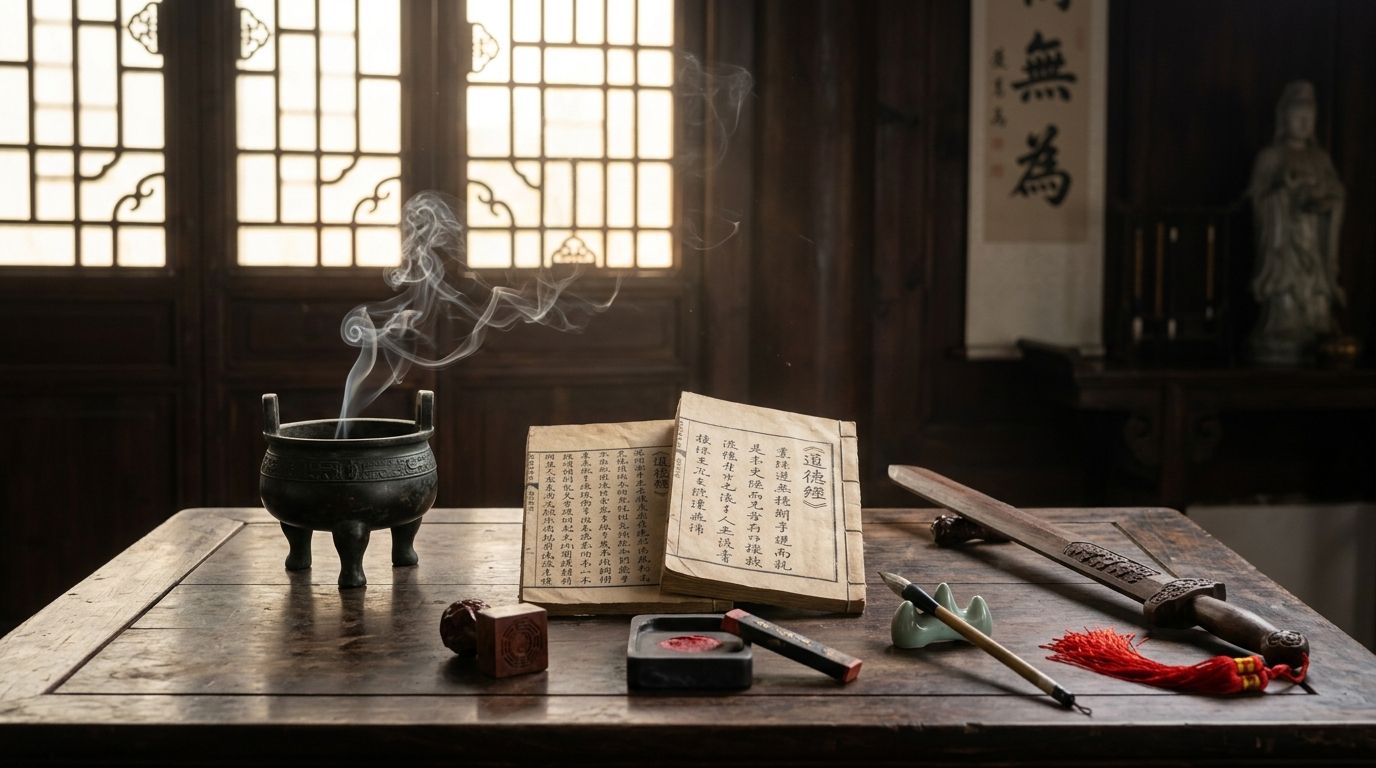
Whether studying Daoism vs Taoism, one cannot truly appreciate the living tradition without examining its material culture. In Taoist cosmology, matter and spirit are not alienated realms; matter is condensed Qi (气), and spirit is rarefied Qi. Consequently, ritual implements (Fa Qi 法器) serve as sacred resonators linking the practitioner's intention with the celestial cosmos.
1. Authenticity Matrix: Traditional Lineage Materials vs. Modern Imitations
To safeguard sacred practitioners from commercial deceptive counterfeits, consult the connoisseurship matrix below:
- Lightning-Struck Jujube Wood (雷击枣木) — Orthodox Lineage Specification: Wild mountain jujube struck naturally by thunderbolts; dense grain; sinking density; subtle roasted honey aroma. · Commercial Counterfeit Warning: Kiln-scorched ordinary wood or timber electrocuted with artificial factory wires. · Spiritual & Energetic Function: Imbued with primordial celestial Yang energy (Tianhuo 天火); supreme for carving lineage seals (Fa Yin 法印).
- Aged Mountain Peach Wood (Taomu 桃木) — Orthodox Lineage Specification: Old-growth mountain peach timber dried naturally for 3–5 years; fine pinkish-tan grain; natural botanical luster. · Commercial Counterfeit Warning: Injection-molded resin or chemically bleached basswood stamped with laser machines. · Spiritual & Energetic Function: Resonates with Spring Solar Yang; crafted into ritual swords (Taomu Jian 桃木剑) to deflect disharmonious Sha Qi (煞气).
- Natural Mineral Cinnabar (Zhusha 朱砂) — Orthodox Lineage Specification: Crystalline mercuric sulfide mined from natural geothermal veins; heavy weight; rich metallic luster. · Commercial Counterfeit Warning: Synthetic red toxic plastic powder mixed with glue and industrial red dye. · Spiritual & Energetic Function: High vibrational Earth-Yang mineral; used to write sacred talismans and dot apertures during Kai Guang.
- Aged Laoshan Sandalwood (老山檀香) — Orthodox Lineage Specification: Wild heartwood aged for decades; smooth creamy balsamic fragrance without pungent acidity. · Commercial Counterfeit Warning: Sawdust soaked in synthetic petrochemical fragrances and toxic chemical binders. · Spiritual & Energetic Function: Dispels turbulent mental noise; clears stagnant domestic Qi; carries sincere prayer to celestial registers.
- Jiangzhen Incense (降真香) — Orthodox Lineage Specification: Ancient wild resinous liana wood; historically documented in the Daozang as summoning genuine immortals. · Commercial Counterfeit Warning: Ordinary pine chips sprayed with artificial musk perfume. · Spiritual & Energetic Function: Supreme incense for solemn temple offerings, harmonizing the Five Elements (Wuxing 五行).
2. The Liturgical Rite of Kai Guang (开光, Opening the Light)
A fundamental tenet in both Daoism and Taoism is that a sacred implement or deity statue is merely an inanimate piece of wood or bronze until consecrated through the ancient lineage liturgy of Kai Guang (开光).
Conducted strictly by an ordained Taoist master (Daoshi 道士) following ritual fasting, the rite encompasses:
- Purification of the Altar Space (Jing Tan 净坛): Reciting the Jingtiandi Shenzhou (净天地神咒, Incantation to Purify Heaven and Earth) while sprinkling consecrated spring water with peach sprigs.
- Invoking Celestial Lineages (Qingshen 请神): Chanting sacred invocations to call upon the presence of the Three Pure Ones (Sanqing 三清) and the Northern Dipper (Beidou 七星).
- Internal Energy Infusion (Zhu Qi 注炁): The master harmonizes breath in the Lower Dantian (Xia Dantian 下丹田), directing refined Yang Qi through the hands and into the implement.
- Consecration of the Sacred Apertures (Dian Yan 点眼): Utilizing a virgin wolf-hair brush dipped in purified cinnabar ink, the master dots the symbolic eyes, ears, mouth, hands, and heart of the implement, awakening its spiritual resonance.
- Internal Organ-Filling (Zhuangzang 装脏): For consecrated statues, the master seals inside the hollow relic chamber five-color silk threads (Five Elements), medicinal botanical roots, sacred miniature scripture scrolls, and mineral gems to endow the vessel with an energetic pulse.
6. Step-by-Step Practical Guide: Daily Altar Etiquette and Cultivation Sequence
For modern practitioners integrating the living wisdom of Daoism vs Taoism into daily life, maintaining a domestic sanctuary altar (Tan 坛) anchors peace, clarity, and centeredness amidst modern chaos.
Follow this classical five-step morning offering protocol (Chenzhao Fenggong 晨朝奉供):
Step 1: Mindful Purification of Body and Mind (Jing Shen Jing Shou 净身净手)
Perform this rite during the quiet dawn hours (ideally between 5:00 AM and 7:00 AM, the Mao Hour 卯时).
- Wash hands and face with clean water, rinsing the mouth to cleanse external and internal speech.
- Gently wipe the altar surface with a dedicated silk or cotton cloth reserved solely for sacred implements.
- Take three slow, deep diaphragmatic breaths through the nose, intentionally releasing yesterday's unfinished tensions and emotional clutter.
Step 2: Offering the Three Pristine Waters (Sanqing Fengshui 三清奉水)
Take three small white porcelain or brass offering cups filled with pure spring water or freshly brewed green tea. Arrange them in a straight horizontal line across the center of the altar table:
- Center Cup: Dedicated to the unmanifest Dao and Yuanshi Tianzun (元始天尊, Heavenly Worthy of the Primordial Beginning).
- Left Cup (Observer's Left): Dedicated to the sacred scriptures and Lingbao Tianzun (灵宝天尊, Heavenly Worthy of the Numinous Treasure).
- Right Cup (Observer's Right): Dedicated to the lineage masters, Laozi, and Daode Tianzun (道德天尊, Heavenly Worthy of the Way and Its Virtue).
Water symbolizes pristine clarity, unforced fluidity, and the mother-like nourishing essence of the Dao.
Step 3: Presenting the Three Sandalwood Incense Sticks (Sanxiang Guige 三香规格)
Ignite three slender sticks of pure, aged Laoshan sandalwood or natural incense. Extinguish any open flame with a swift gentle wave of your hand—never blow upon sacred incense with human breath:
- Hold the three sticks between your palms at eyebrow level, bowing from the waist to show humble reverence.
- Insert the three sticks vertically into the censer from left to right:
- Center Stick: Inserted first, honoring the Dao (Dao Xiang 道香).
- Left Stick: Inserted second, honoring the Scriptures (Jing Xiang 经香).
- Right Stick: Inserted third, honoring the Teachers and Lineage Sages (Shi Xiang 师香).
- Ensure the sticks stand perfectly parallel, symbolizing an upright, unswerving moral conscience.
Step 4: Forming the Sacred Ziwu Hand Mudra (Ziwu Jue 子午诀)
Position your hands together at the solar plexus to form the orthodox Taoist Ziwu Mudra (子午诀):
- Wrap your right thumb gently within the fingers of your left hand.
- Place the tip of your left thumb at the base of your left ring finger (the Zi 子 coordinate, representing North, Water, and Primordial Midnight).
- Rest your right thumb against the tip of your right middle finger (the Wu 午 coordinate, representing South, Fire, and Zenith Midday).
- This sacred mudra locks the body's internal meridian circulation, bridging Fire and Water in alchemical equilibrium (Kan-Li Jiao-Gou 坎离交媾).
Step 5: Seated Breathing & Lower Dantian Cultivation (Jingzuo Zuowang 静坐坐忘)
Transition to a seated meditation cushion before the altar with an erect yet relaxed spine:
- Rest the tip of your tongue softly against the upper roof of your mouth.
- Direct your awareness down to the Lower Dantian (下丹田), situated approximately two inches below the navel.
- Breathe with natural, unforced abdominal expansion on inhalation and gentle contraction on exhalation.
- Practice Zuowang (坐忘, Sitting in Forgetfulness) for 15 to 20 minutes, observing thoughts rise and dissolve without judgment, resting in the quiet presence of the Dao.
7. Frequently Asked Questions (FAQ)
Q1: Is Daoism different from Taoism, or are they the same religion?
Answer: Daoism and Taoism are 100% the same spiritual and philosophical tradition. Both terms represent the exact same Chinese ideogram 道 (Dào), meaning "The Way." The difference is entirely linguistic: "Taoism" was coined using the 19th-century British Wade-Giles romanization system, while "Daoism" uses the contemporary international Hanyu Pinyin system formalized in 1958. Modern academics, sinologists, and international bodies prefer "Daoism" because it accurately reflects standard Mandarin pronunciation, but both words refer to the identical historical tradition.
Q2: Why are there two different spellings (Daoism vs. Taoism)?
Answer: The two spellings exist because Western sinology utilized different methods to transcribe Chinese sounds into the Latin alphabet. In the 1800s, British linguists Thomas Wade and Herbert Giles developed the Wade-Giles system, where unaspirated sounds like the 'd' in door were transcribed as the letter 'T' without an apostrophe. Decades later, China introduced Hanyu Pinyin, which assigned the letter 'D' to that same unaspirated sound for greater phonetic clarity. Thus, "Taoism" (Wade-Giles) and "Daoism" (Pinyin) are simply two transliterations of the exact same sound.
Q3: How do you properly pronounce Daoism and Taoism in Chinese?
Answer: In authentic Mandarin Chinese, the word is pronounced with a soft, unaspirated 'D' sound—rhyming with "cow" or "now"—sounding like "DOW-ism" (or in Chinese, Dào with a falling tone). The widespread Western pronunciation of "Taoism" with a sharp, explosive 'T' (like in tea or town) is a historical mispronunciation caused by English speakers omitting the subtle apostrophe rules of the Wade-Giles system.
Q4: Is Daoism the religion and Taoism the philosophy?
Answer: No. This is one of the most common misconceptions in the West. Some popular books mistakenly suggest that "Taoism" represents pure ancient philosophy (Laozi and Zhuangzi) while "Daoism" represents superstitious temple religion. In reality, both spellings refer to both dimensions. In traditional Chinese scholarship, the philosophical dimension is termed Daojia (道家) and the liturgical, religious dimension is termed Daojiao (道教). Authentic practitioners view Daojia and Daojiao not as rivals, but as the philosophical root and liturgical branches of the same sacred tree.
Authored by the Daoist Cultural Heritage & Sacred Arts Curatorial Guild. All rituals, canonical citations, and connoisseurship guidelines conform to orthodox Daozang liturgical standards.