Daoism Foundations · · 23 min read
Daoism Definition: Core Beliefs, Historical Lineages, Sacred Arts, and Living Spiritual Traditions
Explore the authentic Daoism definition: from cosmic origin and the Three Pure Ones to sacred temple altars, Kai Guang rites, and daily mindfulness.
By Daoismart Editorial
On this page
- Daoism Definition: Core Beliefs, Historical Lineages, Sacred Arts, and Living Spiritual Traditions
- 1. What Is Daoism? Etymological Roots, Philosophical Core, and the Dual Identity
- The Western Dilemma: Untangling Daojia (道家) vs. Daojiao (道教)
- 2. Historical Genesis: From Ancient Shamans to the Daoist Canon
- 1. The Shamanic Substratum and Classical Masters
- 2. The 142 CE Covenant and Institutional Birth
- 3. Medieval Revelations and the Great Canon (Daozang 道藏)
- 3. Structural Comparison: The Four Dimensions of the Daoism Definition
- 4. Cosmic Theology: The Three Pure Ones and the Microcosmic Body
- The Three Pure Ones (Sanqing 三清): Primordial Trinity of Breath
- Tian Ren He Yi (天人合一): The Body as a Living Universe
- Neidan (内丹): The Three Treasures of Internal Alchemy
- 5. Sacred Implements (Fawu 法物), Talismanic Arts, and Connoisseurship
- Peachwood Swords (Taomu Jian 桃木剑)
- Lightning-Struck Jujube Wood (Leiji Zaomu 雷击枣木)
- The Sacred Science of Talismans (Fu Lu 符箓)
- The Canonical Rite of Kai Guang (开光, Opening the Light)
- 6. Practical Step-by-Step Guide: Five-Step Daily Sanctuary Protocol
- Step 1: Spatial Placement & Sacred Taboos (Anwei Dingxiang 安位定向)
- Step 2: Dawn Cleansing of Body & Mind (Jingshen Jingshou 净身净手)
- Step 3: Offering the Three Pure Waters & Sandalwood Incense (Sanxiang Sanquan 三香三泉)
- Step 4: Sealing Microcosmic Qi with the Ziwu Hand Mudra (Ziwu Jue 子午诀)
- Step 5: Diaphragmatic Dantian Breathwork & Scripture Contemplation (Jingzuo Xiuxi 静坐修习)
- 7. Frequently Asked Questions (FAQ)
- Q1: What is the comprehensive Daoism definition in modern religious and academic studies?
- Q2: Is Daoism primarily a philosophy (Daojia) or an organized religion (Daojiao)?
- Q3: Why does Daoism utilize material implements like peachwood swords, wooden seals, and cinnabar talismans?
- Q4: Can an individual practice authentic Daoism without living in a monastery or near a temple?
Daoism Definition: Core Beliefs, Historical Lineages, Sacred Arts, and Living Spiritual Traditions
Key Takeaways (Executive Summary) - Precise Daoism Definition: The Daoism definition designates an indigenous Chinese cosmological, philosophical, and liturgical tradition centered on living in conscious attunement with the Dao (道, the Great Way)—the unnamable, primordial ground of reality and spontaneous life-force of the cosmos. - Philosophy & Religion as One: Far from being an irreconcilable split between intellectual thought (Daojia 道家) and ritual practice (Daojiao 道教), authentic lineage heritage views philosophy as the metaphysical root and liturgical religion as the blossoming canopy of an organic spiritual tree. - Core Theological Principles: The tradition operates through the dynamic balance of Yin-Yang (阴阳), the non-coercive grace of Wu Wei (无为, effortless action), the organic principle of Ziran (自然, self-so spontaneity), and the sacred realization of Tian Ren He Yi (天人合一, unity between cosmos and the human body). - Dual Historic Lineages: Governed by the Three Pure Ones (Sanqing 三清) as the primordial celestial Trinity, modern Daoism thrives through two principal lineages: the liturgical, communal Zhengyi (正一, Orthodox Unity) school and the ascetic, monastic Quanzhen (全真, Complete Perfection) school. - Sacred Implements & Consecration: Authentic practice integrates consecrated ritual implements (Fawu 法物)—such as lightning-struck jujube wood seals (Leiji Zaomu), peachwood swords (Taomu Jian), and cinnabar talismans (Fu Lu)—spiritualized through the canonical Kai Guang (开光, Opening the Light) rite. - Daily Microcosmic Protocol: Practical cultivation centers on the dawn Mao Hour (5:00 AM – 7:00 AM) offering of the Three Pure Waters, natural aged sandalwood incense, the Ziwu Hand Mudra (子午诀), and diaphragmatic Lower Dantian (下丹田) breathwork.
1. What Is Daoism? Etymological Roots, Philosophical Core, and the Dual Identity
To arrive at an authentic Daoism definition, one must look beyond Western theological paradigms and explore China's indigenous understanding of the universe. In the Chinese language, the term is anchored in the foundational ideogram Dao (道), traditionally translated as "the Way," "the Path," or "the Cosmic Principle." The character itself combines two ancient radicals: chuo (辶, meaning movement, walking, or dynamic journey) and shou (首, meaning the head, origin, supreme principle, or conscious leader). Semantically, the Dao signifies the primordial, self-generating cosmic stream—both the metaphysical source from which all existence issues and the rhythmic pattern according to which all things naturally unfold.
Accompanying the Dao is the concept of De (德), commonly rendered as "virtue," "spiritual potency," or "inherent integrity." If the Dao is the infinite, formless ocean of universal intelligence, De is the localized drop of that cosmic ocean dwelling within an individual person, tree, mountain, or river. To cultivate De is to embody the pristine character of the Dao in mortal form.
The Western Dilemma: Untangling Daojia (道家) vs. Daojiao (道教)
For more than a century, modern academia and Western popular culture struggled with the definition of Daoism due to a rigid, Eurocentric dichotomy:
- Daojia (道家 - The School of the Dao): The philosophical literature of the Warring States period (c. 6th–3rd century BCE), principally associated with Laozi (老子) and Zhuangzi (庄子).
- Daojiao (道教 - The Teachings of the Dao): The institutional, ecclesiastical, and liturgical religion established in 142 CE by Celestial Master Zhang Daoling (张道陵), complete with temples, rituals, deities, and ordained clergy.
Early 19th-century colonial translators often celebrated Daojia as a pristine, poetic secular philosophy while dismissing Daojiao as a later, superstitious deviation. To an ordained Taoist master (Daoshi 道士), however, this dichotomy is fundamentally flawed:
- Philosophical Daoism (Daojia) provides the foundational metaphysics—the intellectual compass, cosmology, and ontological blueprint.
- Religious Daoism (Daojiao) provides the practical, somatic, and communal technologies—the liturgical framework, temple sanctuaries, meditative techniques, and sacred implements that bring those metaphysical doctrines into tangible, lived human experience.
Without Daojia, liturgical ceremonies become empty superstition without philosophical grounding. Without Daojiao, the teachings of Laozi remain mere intellectual theories divorced from somatic cultivation and communal preservation. In genuine Eastern practice, the Daoism definition seamlessly unites knowing the Way (Zhi Dao 知道) with embodying the Way (Xing Dao 行道).
2. Historical Genesis: From Ancient Shamans to the Daoist Canon
The historical trajectory of Daoism spans five millennia of Chinese cultural evolution, evolving through distinct epochs of revelation, systematization, and institutional refinement:
1. The Shamanic Substratum and Classical Masters
Long before formal institutional structures emerged, the proto-Daoist worldview was forged by ancient seekers known as Fangshi (方士, Masters of Methods). Operating across sacred peaks like Mount Tai and Mount Hua, they charted stellar constellations, studied the medicinal and energetic properties of wild botanicals, practiced physical breathing exercises (Daoyin 导引), and sought communion with nature spirits.
During the social turbulence of the Spring and Autumn and Warring States periods, the legendary sage Laozi codified these shamanic insights into the succinct, 5,000-character masterwork, the Daodejing (Classic of the Way and Its Virtue). Soon after, Zhuangzi expanded this worldview with profound humor and poetic brilliance, urging humanity to discard artificial social conditioning and awaken to the vast, unbound perspective of the cosmos.
2. The 142 CE Covenant and Institutional Birth
The transformation of Daoism into an organized ecclesiastical religion occurred in 142 CE on Mount Heming (鹤鸣山) in modern Sichuan Province. According to canonical records, Laozi descended in deified form as Taishang Laojun (太上老君, The Grand Supreme Elderly Lord) to impart sacred covenants, liturgical registers, and talismanic arts to Zhang Daoling (张道陵).
Zhang was invested as the first Celestial Master (Tianshi 天师), founding the Way of Orthodox Unity (Zhengyi Dao 正一道). This movement established social clinics, organized communal parishes, distributed moral guidelines, and conducted liturgical rituals to protect communities from sickness and malevolent forces, marking the official inception of organized Daojiao.
3. Medieval Revelations and the Great Canon (Daozang 道藏)
Over subsequent centuries, further sacred revelations expanded the tradition:
- Shangqing (上清, Supreme Purity): Founded on Mount Maoshan during the 4th century by visionary Lady Wei Huacun, emphasizing luminous internal visualizations, astral flight through the Big Dipper, and celestial alchemical meditation.
- Lingbao (灵宝, Numinous Treasure): Emerging in the late 4th century, introducing cosmic communal rituals (Jiao 醮) dedicated to universal salvation, ancestral liberation, and collective planetary harmony.
- The Daozang (道藏): Over imperial dynasties, these revelations were collected into the monumental Taoist Canon. The definitive Ming Dynasty edition of 1445 CE encompasses 5,485 scrolls organized into the "Three Caverns" (Sandong 三洞), housing liturgical manuals, philosophical treatises, internal alchemical diagrams, pharmacology texts, and spatial cosmology.
3. Structural Comparison: The Four Dimensions of the Daoism Definition
To clearly navigate the multifaceted reality of Daoism, the following structured comparison delineates how philosophical theory, liturgical practice, and monastic discipline interact—while debunking common modern misconceptions:
- Historical Inception — Classical Philosophy (Daojia 道家): 6th–4th Century BCE (Warring States Period). · Liturgical Tradition (Zhengyi Dao 正一): 142 CE (Mount Heming, Sichuan Province). · Monastic Tradition (Quanzhen Dao 全真): 12th Century CE (Mount Zhongnan, Shaanxi). · Secular / Western Misconceptions: Regarded as a 1960s counterculture movement or vague New Age mindset.
- Foundational Figures — Classical Philosophy (Daojia 道家): Laozi (老子), Zhuangzi (庄子), Liezi (列子). · Liturgical Tradition (Zhengyi Dao 正一): First Celestial Master Zhang Daoling (张道陵). · Monastic Tradition (Quanzhen Dao 全真): Patriarch Wang Chongyang (王重阳), Seven Immortals. · Secular / Western Misconceptions: Mistaken as founded by Bodhidharma or Confucius.
- Institutional Seat — Classical Philosophy (Daojia 道家): Ancient mountain retreats, imperial archives. · Liturgical Tradition (Zhengyi Dao 正一): Mount Longhu (龙虎山, Dragon Tiger Mountain). · Monastic Tradition (Quanzhen Dao 全真): Beijing White Cloud Temple (白云观, Baiyun Guan). · Secular / Western Misconceptions: Assumed to have no temples, clergy, or formal lineage hierarchy.
- Priesthood & Lifestyle — Classical Philosophy (Daojia 道家): Hermitic scholars, independent philosophers. · Liturgical Tradition (Zhengyi Dao 正一): Huoju Daoshi (火居道士): Clergy marry, raise families, live among the community. · Monastic Tradition (Quanzhen Dao 全真): Chujia Daoshi (出家道士): Celibate monks/nuns, communal monastery living, vegetarian. · Secular / Western Misconceptions: Conflated with wandering martial artists, street fortune-tellers, or magicians.
- Primary Methodology — Classical Philosophy (Daojia 道家): Contemplative reading, philosophical inquiry, Wu Wei. · Liturgical Tradition (Zhengyi Dao 正一): Communal Jiao liturgies, Fu Lu talismans, thunder rites (Leifa). · Monastic Tradition (Quanzhen Dao 全真): Neidan internal alchemy, sitting in stillness (Jingzuo), ethical precepts. · Secular / Western Misconceptions: Believed to consist solely of physical Tai Chi exercises or passive fatalism.
- Sacred Implements (Fawu) — Classical Philosophy (Daojia 道家): Bamboo scrolls, ink stones, simple zithers (Guqin). · Liturgical Tradition (Zhengyi Dao 正一): Lightning-struck jujube seals, peachwood swords, bronze bells, cinnabar. · Monastic Tradition (Quanzhen Dao 全真): Meditation mats, brass incense burners, whisks (Fuchen), prayer beads. · Secular / Western Misconceptions: Trivialized as cheap feng shui souvenirs, superstitious trinkets, or lucky charms.
- Core Ultimate Aim — Classical Philosophy (Daojia 道家): Intellectual equanimity, spontaneous living. · Liturgical Tradition (Zhengyi Dao 正一): Spatial harmony, communal longevity, celestial protection. · Monastic Tradition (Quanzhen Dao 全真): Transmutation of Jing-Qi-Shen into immortal spirit (Xian 仙). · Secular / Western Misconceptions: Misinterpreted as escaping reality or acquiring magical worldly superpowers.
4. Cosmic Theology: The Three Pure Ones and the Microcosmic Body
Unlike Western theological frameworks that position God as an external monarch who creates the universe from nothingness, the Daoism definition centers on an organic, self-generating cosmos. As the Daodejing (Chapter 42) explains:
"The Dao gives birth to One; One gives birth to Two; Two gives birth to Three; and Three gives birth to the ten thousand things." — (道生一,一生二,二生三,三生万物。)
The Three Pure Ones (Sanqing 三清): Primordial Trinity of Breath
At the summit of the Daoist pantheon are the Three Pure Ones (Sanqing 三清). They are not anthropomorphic deities who sit upon golden thrones judging mortals, but the personalized manifestations of primordial cosmic breath (Yuanqi 元炁):
- Yuanshi Tianzun (元始天尊, Celestial Worthy of Primordial Beginning): Residing in the Heaven of Pure Clarity (Qingwei Tian), he embodies Wuji (无极)—the undifferentiated, vast, formless silence of the cosmos prior to the Big Bang.
- Lingbao Tianzun (灵宝天尊, Celestial Worthy of Numinous Treasure): Residing in the Heaven of Grand Mystery (Yuyu Tian), he embodies Taiji (太极)—the emergence of energetic order, sacred geometry, the alternation of Yin and Yang, and cosmic law.
- Daode Tianzun (道德天尊, Celestial Worthy of the Way and Its Virtue): Revered as Taishang Laojun (太上老君). Residing in the Heaven of Great Network (Daluo Tian), he personifies the compassionate descent of the Dao into manifest creation (Wanwu 万物), incarnating on Earth as Laozi to transmit the wisdom of liberation.
Tian Ren He Yi (天人合一): The Body as a Living Universe
A core tenet of the Daoism definition is the profound realization of Tian Ren He Yi (天人合一)—the absolute indivisibility of humanity and the cosmos. Daoism views the human body not as a fallen or profane shell, but as a sacred microcosm (Xiaotiande 小天地, a miniature Heaven and Earth):
- The Five Zang Organs (Wuzang 五脏) directly house cosmic energies and correspond to the Five Elements (Wuxing 五行):
- Liver (Ganzang 肝脏) corresponds to Wood (Mu 木), the East, green vitality, and benevolence.
- Heart (Xinzang 心脏) corresponds to Fire (Huo 火), the South, red luminosity, and propriety.
- Spleen (Pizang 脾脏) corresponds to Earth (Tu 土), the Center, yellow stability, and trust.
- Lungs (Feizang 肺脏) corresponds to Metal (Jin 金), the West, white clarity, and righteousness.
- Kidneys (Shenzang 肾脏) corresponds to Water (Shui 水), the North, black stillness, and deep wisdom.
- The human spine mimics the pillars of heaven; the breath mirrors the wind and atmospheric clouds; the two eyes correspond to the radiant sun and reflective moon.
- Because the human anatomy mirrors the celestial spheres, personal cultivation naturally reverberates across one's entire living environment.
Neidan (内丹): The Three Treasures of Internal Alchemy
Through the science of Neidan (内丹, Internal Alchemy), practitioners systematically reverse the entropy of aging by transmuting the Three Treasures (Sanbao 三宝):
- Jing (精, Generative Essence): The physical, biological vitality anchored in the Kidneys and Lower Dantian.
- Qi (炁, Vital Life Force): The dynamic energetic breath circulating along the twelve primary meridians.
- Shen (神, Spiritual Awareness): The luminous, undying consciousness dwelling in the Upper Dantian (Niwan Gong 泥丸宫).
By gathering Jing, refining it into pure Qi, harmonizing Qi into radiant Shen, and returning Shen into the primordial void of Wuji (Lian Shen Huan Xu 炼神还虚), the adept transcends mortality and realizes conscious immortality (Xian 仙).
5. Sacred Implements (Fawu 法物), Talismanic Arts, and Connoisseurship
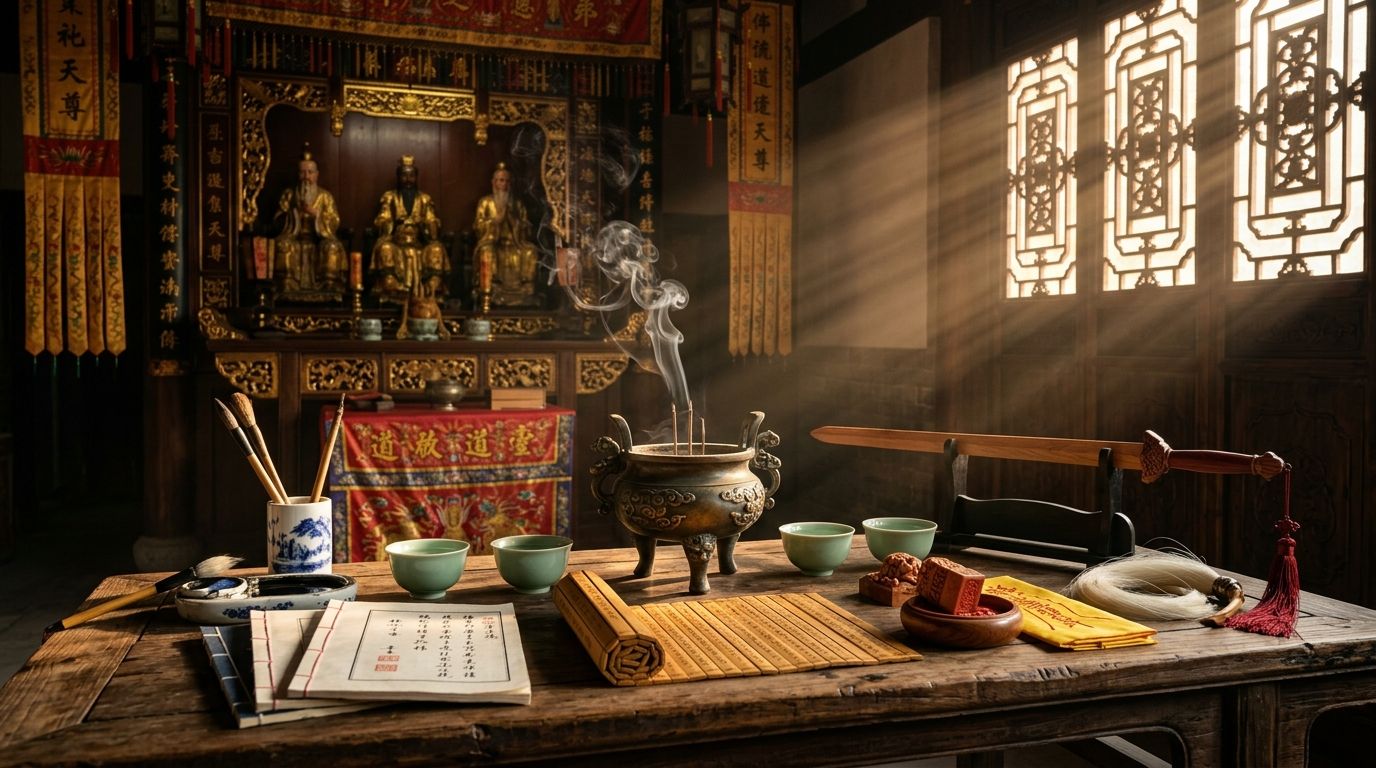
In Daoist living practice, sacred implements (Fawu 法物) are never treated as lifeless ornaments or commercial talismans. They are precision energetic instruments, meticulously consecrated to anchor celestial frequencies, harmonize spatial fields, and dispel stagnant Yin Qi. Authentic Daoist material connoisseurship adheres to centuries of lineage lore, sharply distinguishing between genuine heritage artifacts and modern industrial counterfeits:
Peachwood Swords (Taomu Jian 桃木剑)
In Daoist botanical lore, wild mountain peach wood (Taomu) is revered as the ultimate natural ward against malevolent Yin turbulence. In classical cosmology, the peach tree embodies the concentrated essence of the Five Elements. When seasoned over multiple winters and carved with the Seven Stars of the Northern Dipper (Beidou Qixing 北斗七星), a peachwood sword serves as a steadfast spatial sentinel, cutting through stagnant emotional patterns and shielding the home.
Lightning-Struck Jujube Wood (Leiji Zaomu 雷击枣木)
Hailed within esoteric lineages as the "Emperor of Divine Woods," Leiji Zaomu is created when a wild jujube tree growing on an exposed mountain ridge is struck by celestial lightning. The instantaneous fusion of the thunderstorm's pure celestial Yang Fire (Tianhuo 天火) into the dense grain of the living jujube creates an artifact of extraordinary protective potency. It is prized above all other mediums for carving Celestial Master seals (Tianshi Fayin 天师法印), talismanic tokens, and command boards.
The Sacred Science of Talismans (Fu Lu 符箓)
A Fu Lu (符箓) is not random folk magic; it is a rigorous sonic, spatial, and calligraphic manifestation of celestial authority. An ordained Daoist priest prepares by observing strict fasting, purifying the altar, circulating Qi to the Lower Dantian, and invoking the presiding celestial deities. With undivided focus, the master writes the sacred seal upon imperial yellow silk or mulberry paper using crystalline cinnabar ink while maintaining the Ziwu Mudra (子午诀). The talisman becomes a localized cosmic portal, dissolving obstacles and invoking divine blessings.
The Canonical Rite of Kai Guang (开光, Opening the Light)
Before any sacred statue, mirror, or sword can be enshrined upon an altar, it must undergo the formal liturgical ceremony of Kai Guang (开光) conducted by an ordained priest:
Without this rigorous transmission, an image remains an ordinary artistic sculpture; with authentic Kai Guang, it becomes an active spiritual conduit of peace, clarity, and protection.
6. Practical Step-by-Step Guide: Five-Step Daily Sanctuary Protocol
For international practitioners seeking to align their daily life with the authentic Daoism definition, establishing a respectful, canonical sanctuary space at home provides an anchor of calm in a chaotic world.
Step 1: Spatial Placement & Sacred Taboos (Anwei Dingxiang 安位定向)
The energetic integrity of your altar depends upon its physical foundation:
- Solid Support (Kaoshan 靠山): Position your altar table firmly against a solid, load-bearing interior wall. Avoid placing it beneath open ceiling beams or against hollow partitions.
- Elevation: The altar table must be at least waist-high (traditionally between 38 and 42 inches from the floor), ensuring an attitude of natural reverence when standing before it.
- Directional Facing: Orient the altar facing toward the room's main entrance or eastward toward the rising sun (Chaoyang 朝阳), welcoming the invigorating dawn Yang Qi (Ziqi Donglai 紫气东来).
- Strict Spatial Taboos: Never locate an altar inside a bedroom, on a dining table where meat and alcohol are served, or against a wall shared with a restroom, laundry area, or kitchen stove. Keep all sacred vessels elevated above the floor at all times.
Step 2: Dawn Cleansing of Body & Mind (Jingshen Jingshou 净身净手)
Perform your daily devotion during the auspicious Mao Hour (卯时, 5:00 AM – 7:00 AM), when the day's first Yang Qi emerges across the natural world:
- Wash your hands and face thoroughly with cool, clean water. Rinse your mouth to purify everyday speech before addressing the sacred realm.
- Dust the altar table gently using a soft, clean cloth reserved solely for your sanctuary vessels.
- Silence all electronic devices, take three slow breaths, and stand before the altar in quiet mindfulness.
Step 3: Offering the Three Pure Waters & Sandalwood Incense (Sanxiang Sanquan 三香三泉)
Arrange three celadon or porcelain cups in a straight line across the front of the altar:
- Fill each cup with fresh, pure mountain spring water or filtered water:
- Center Cup: Dedicated to the Dao (道宝) and Yuanshi Tianzun.
- Left Cup (Observer's Left): Dedicated to the Scriptures (经宝) and Lingbao Tianzun.
- Right Cup (Observer's Right): Dedicated to the Lineage Masters (师宝) and Daode Tianzun (Laozi).
Ignite three sticks of natural aged sandalwood or Jiangzhen incense:
- Extinguish open flames with a gentle, swift wave of the right hand. Never blow upon ritual incense with your breath, as human breath is considered mundanely turbid.
- Hold the three sticks with both hands at eye level, bow reverently from the waist, and insert them into your censer one by one:
- Insert the center stick first, affirming: "I take refuge in the unnamable Dao." (Dao Xiang 道香)
- Insert the left stick second, affirming: "I take refuge in the sacred Scriptures." (Jing Xiang 经香)
- Insert the right stick third, affirming: "I take refuge in the Lineage Masters." (Shi Xiang 师香)
Step 4: Sealing Microcosmic Qi with the Ziwu Hand Mudra (Ziwu Jue 子午诀)
Stand with feet shoulder-width apart, knees softly unlocked, and spine comfortably elongated. Bring your hands together at the solar plexus to form the canonical Ziwu Mudra (子午诀):
- Enclose your right thumb inside the curled fingers of your left hand.
- Place the tip of your left thumb against the base of your left ring finger (the Zi 子 position, representing midnight, Water, and receptive Yin).
- Press the tip of your right thumb against the tip of your right middle finger (the Wu 午 position, representing midday, Fire, and radiant Yang).
- This ancient mudra bridges the body's Conception Vessel (Ren Mai 任脉) and Governing Vessel (Du Mai 督脉), locking vital vitality within and preventing the outward dissipation of Qi.
Step 5: Diaphragmatic Dantian Breathwork & Scripture Contemplation (Jingzuo Xiuxi 静坐修习)
Sit comfortably on a meditation cushion before the altar for 15 to 20 minutes of silent contemplation:
- Lightly touch the tip of your tongue to the upper palate just behind the front teeth, bridging the energetic Magpie Bridge (Queqiao 鹊桥).
- Inhale silently and deeply through the nostrils, directing the breath into the Lower Dantian (下丹田)—located roughly two inches below the navel—feeling the abdomen gently expand.
- Exhale slowly and evenly through the nose, releasing tension, anxious thoughts, and selfish attachments.
- Reflect upon Chapter 16 of the Daodejing:
"Attain utmost emptiness; preserve profound stillness. The ten thousand things arise together; in their quiet return, I witness their true nature." — (致虚极,守静笃。万物并作,吾以观复。)
- Conclude by bowing three times toward the altar, gently stepping backward, and carrying the calm equilibrium of the Dao into your daily activities.
7. Frequently Asked Questions (FAQ)
Q1: What is the comprehensive Daoism definition in modern religious and academic studies?
Answer: The most precise Daoism definition recognizes it as China's indigenous, holistic cosmological tradition that unifies classical philosophical metaphysics (Daojia 道家) with an organized, institutionalized liturgical religion (Daojiao 道教). Centered on conscious harmony with the Dao (道)—the nameless, self-generating mother of the universe—Daoism integrates canonical literature (the 5,485 scrolls of the Daozang 道藏), an ordained celestial priesthood, sacred altar rituals, talismanic arts (Fu Lu 符箓), and somatic cultivation (Neidan 内丹 internal alchemy) to nurture longevity, moral equilibrium, and spiritual transcendence.
Q2: Is Daoism primarily a philosophy (Daojia) or an organized religion (Daojiao)?
Answer: Authentic lineage tradition regards philosophy (Daojia) and religion (Daojiao) as the indivisible root and flourishing branches of the same living tree. While 19th-century Western sinologists created an artificial dichotomy by celebrating Laozi and Zhuangzi while dismissing temple rituals, traditional masters maintain that Daojia provides the core metaphysical doctrines (such as Wu Wei and Ziran), while Daojiao provides the practical liturgical liturgies, ethical community covenants, and meditative technologies required to actualize those philosophical ideals within daily human life.
Q3: Why does Daoism utilize material implements like peachwood swords, wooden seals, and cinnabar talismans?
Answer: In orthodox Daoist theology, consecrated sacred objects (Fawu 法物)—including lightning-struck jujube wood seals (Leiji Zaomu), peachwood swords (Taomu Jian), and cinnabar-brushed talismans (Fu Lu)—are not superstitious charms or decorative trinkets. Instead, they function as resonant energetic conduits of pure celestial Yang energy. When consecrated through the orthodox liturgical rite of Kai Guang (开光, Opening the Light), these implements anchor benevolent cosmic frequencies, dissolve stagnant or turbulent Qi, and establish a fortified spiritual sanctuary for meditation and prayer.
Q4: Can an individual practice authentic Daoism without living in a monastery or near a temple?
Answer: Yes. Sincere Daoist self-cultivation begins in ordinary daily life through the principle of Dao Fa Ziran (道法自然), modeling conduct upon natural spontaneity. Anyone can establish a respectful personal sanctuary altar at home following canonical spatial guidelines, offer fresh spring water and natural sandalwood incense during the dawn Mao Hour (5:00 AM – 7:00 AM), practice diaphragmatic Lower Dantian breathing while holding the Ziwu Hand Mudra, and contemplate classical scriptures like the Daodejing and Qingjing Jing. Simplicity, compassion, humility, and mindful presence are the truest expressions of walking the Dao.
Authored by the Daoist Cultural Heritage & Sacred Arts Curatorial Guild. All historical chronicles, canonical citations, and ritual methodologies conform to orthodox Daozang liturgical standards.