Daoism Foundations · · 5 min read
Authentic Taoist Home Altar Setup Guide: Sacred Directions, Offerings, and Daily Etiquette
A definitive guide to establishing an authentic Taoist home altar (Tan 坛). Written by lineage researchers covering sacred Bagua alignment, the Five Offerings (五供), incense etiquette, and consecrated spiritual artifacts.
By Daoismart Editorial
On this page
- Executive Summary & Core Principles
- 1. Sacred Spatial Placement: Bagua Directions and Environmental Feng Shui
- 2. Essential Altar Implements: The Five Sacred Offerings (Wu Gong)
- 3. Consecration (Kai Guang 开光) and Sacred Artifact Selection
- 4. Daily Altar Etiquette: The 3-Step Morning Routine
- 5. Frequently Asked Questions (FAQ)
- Q1: What is the most auspicious direction for a Taoist home altar?
- Q2: What are the essential Five Offerings (Wu Gong) in daily Taoist practice?
- Q3: Can beginners set up a Taoist altar without formal initiation?
Executive Summary & Core Principles
Core Principle: In authentic Taoist tradition, a home altar (Tan 坛 or She 舍) is not merely decorative furniture, but a microcosmic nexus connecting human intention (*Ren*) with the primordial cosmos (*Dao*). Proper establishment requires adhering to the Five Offerings (*Wu Gong* 五供), sacred Bagua spatial orientation, genuine natural materials (solid wood, brass, pure agarwood/sandalwood), and daily mindful etiquette. A consecrated altar anchors peaceful Qi in the home and supports daily meditation (Jingzuo 静坐).
1. Sacred Spatial Placement: Bagua Directions and Environmental Feng Shui
According to classical Taoist geomancy (Kanyu 堪舆) and the Daozang (Taoist Canon), the placement of an altar determines the harmony of spiritual resonance within the dwelling:
- *Facing Direction — Auspicious Placement (Do): Facing South (Yang resonance) or East (Wood/Sunrise energy) · Inauspicious Placement (Don't): Facing West or directly toward dark corridors · Spiritual & energetic Rationale*: South embodies supreme Fire/Yang clarity; East signifies renewal of vital Qi
- *Backing Wall — Auspicious Placement (Do): Solid, load-bearing masonry wall (Kao Shan 靠山) · Inauspicious Placement (Don't): Backing against a window, glass divider, or open air · Spiritual & energetic Rationale*: A solid backing provides energetic stability and divine protection
- *Adjacent Spaces — Auspicious Placement (Do): Quiet study, dedicated meditation hall, or living room perimeter · Inauspicious Placement (Don't): Sharing a wall with a bathroom, toilet, kitchen stove, or master bed · Spiritual & energetic Rationale: Bathrooms generate descending, turbid Qi (Zhuo Qi*); stove fire clashes with sacred stillness
- *Lighting & Air — Auspicious Placement (Do): Natural indirect daylight, gentle ventilation for incense dispersal · Inauspicious Placement (Don't): Dark damp basements or drafty wind-tunnels · Spiritual & energetic Rationale*: Incense smoke must dissipate gently without turbulent dispersion
2. Essential Altar Implements: The Five Sacred Offerings (Wu Gong)
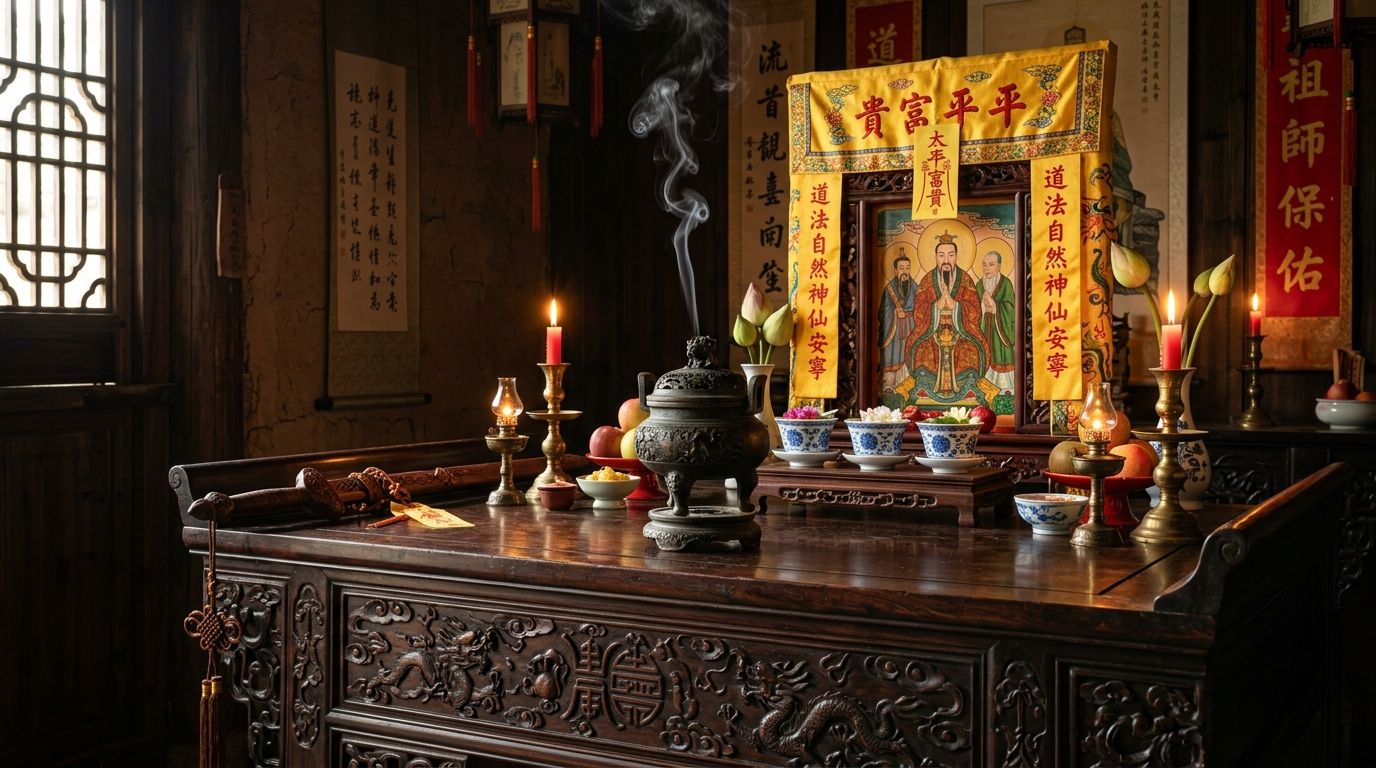
In orthodox Zhengyi and Quanzhen liturgies, the altar represents the balance of the Five Phases (*Wuxing* 五行). Each sacred implement carries specific cosmological symbolism:
- The Censer & Sacred Incense (*Metal / Transformation*): Positioned centrally at the front. Always burn natural, non-chemical incense—such as aged Laoshan sandalwood (Tanxiang) or wild agarwood (Chenxiang). Synthetic perfume incenses disrupt inner cultivation and offend celestial spirits.
- The Sacred Lamps or Candles (*Fire / Illumination*): Flanking the censer on the left and right. Fire symbolizes divine discernment, dispelling ignorance and lighting the path of the Dao.
- The Three Sacred Water Cups (*Water / Purity*): Three small porcelain or brass cups containing pure water or freshly brewed green tea, placed between the statue/tablet and the censer. They embody pristine clarity of mind and unpolluted intention.
- Fresh Flowers (*Wood / Harmony*): Seasonal natural blossoms symbolizing virtue, modesty, and the cyclical beauty of Nature (Ziran 自然).
- Fresh Fruits (*Earth / Karmic Harvest*): Odd-numbered seasonal fruits (3 or 5 pieces) representing gratitude for nature’s bountiful harvest. Avoid pungent fruits such as garlic, onions, or durian.
3. Consecration (Kai Guang 开光) and Sacred Artifact Selection
An authentic Taoist altar often incorporates consecrated artifacts to harmonize space and ward off malevolent energies (Xie Qi 邪气):
- Hand-Carved Peach Wood Sword (*Tao Mu Jian* 桃木剑): Regarded since the Han dynasty as the supreme wood for expelling disharmony. Genuine peach wood bears natural grain, a subtle organic fragrance, and an earthy density. Beware of machine-stamped plastic or glued composite imitations.
- Lightning-Struck Jujube Wood (*Lei Ji Zao Mu* 雷击枣木): Highly prized for celestial talisman seals (Fa Yin 法印) and handheld talismans, having absorbed immense natural Yang energy during celestial lightning strikes.
- Consecrated Talismans (*Fu Lu* 符箓): Written on raw cinnabar (Zhusha 朱砂) and yellow mulberry paper during auspicious planetary hours, energized through ritual mantras and sacred breathwork (Qi).
4. Daily Altar Etiquette: The 3-Step Morning Routine
Cultivating connection with the Dao requires sincerity (Cheng 诚) rather than elaborate theatricality:
- Mindful Purification: Wash hands and rinse the mouth before approaching the altar. Calm the breath, releasing worldly tension.
- Offering Fresh Water: Replace the three water cups with fresh water each morning, symbolizing starting the day with an untainted mind.
- Offering Three Incense Sticks:
- Hold three sticks with both hands at eyebrow level, bowing three times.
- Insert the first stick in the center (Dao Bao 道宝 - Reverence for the Dao);
- Insert the second stick on the left (Jing Bao 经宝 - Reverence for Sacred Scriptures);
- Insert the third stick on the right (Shi Bao 师宝 - Reverence for Lineage Masters).
- Sit in quiet contemplation (Zuowang 坐忘) for 10–15 minutes as the fragrance unfolds.
5. Frequently Asked Questions (FAQ)
Q1: What is the most auspicious direction for a Taoist home altar?
Answer: Traditionally, facing South or East is considered ideal in Taoist cosmology, aligning with Yang energy and the Bagua Qian/Li trigrams. However, the most critical rule is placing the altar against a solid structural wall (representing stability and support), avoiding shared walls with bathrooms or kitchens.
Q2: What are the essential Five Offerings (Wu Gong) in daily Taoist practice?
Answer: The Five Offerings correspond to the Five Elements (Wuxing): Incense (Metal/Qi transformation), Flowers (Wood/Virtue and beauty), Lamps or Candles (Fire/Wisdom and divine illumination), Pure Water or Tea (Water/Clarity and purity), and Fresh Fruit (Earth/Karmic fulfillment and abundance).
Q3: Can beginners set up a Taoist altar without formal initiation?
Answer: Yes. A sincere reverence for the Dao (道) and ethical cultivation are the true foundations. Beginners often begin with an altar dedicated to the Three Pure Ones (Sanqing) or the God of Earth/Ancestors, maintaining daily cleanliness, incense offerings, and quiet contemplation.
Authored by the Daoist Cultural Heritage & Sacred Arts Curatorial Guild. All rituals and symbolic interpretations conform to orthodox Daozang liturgical standards.